


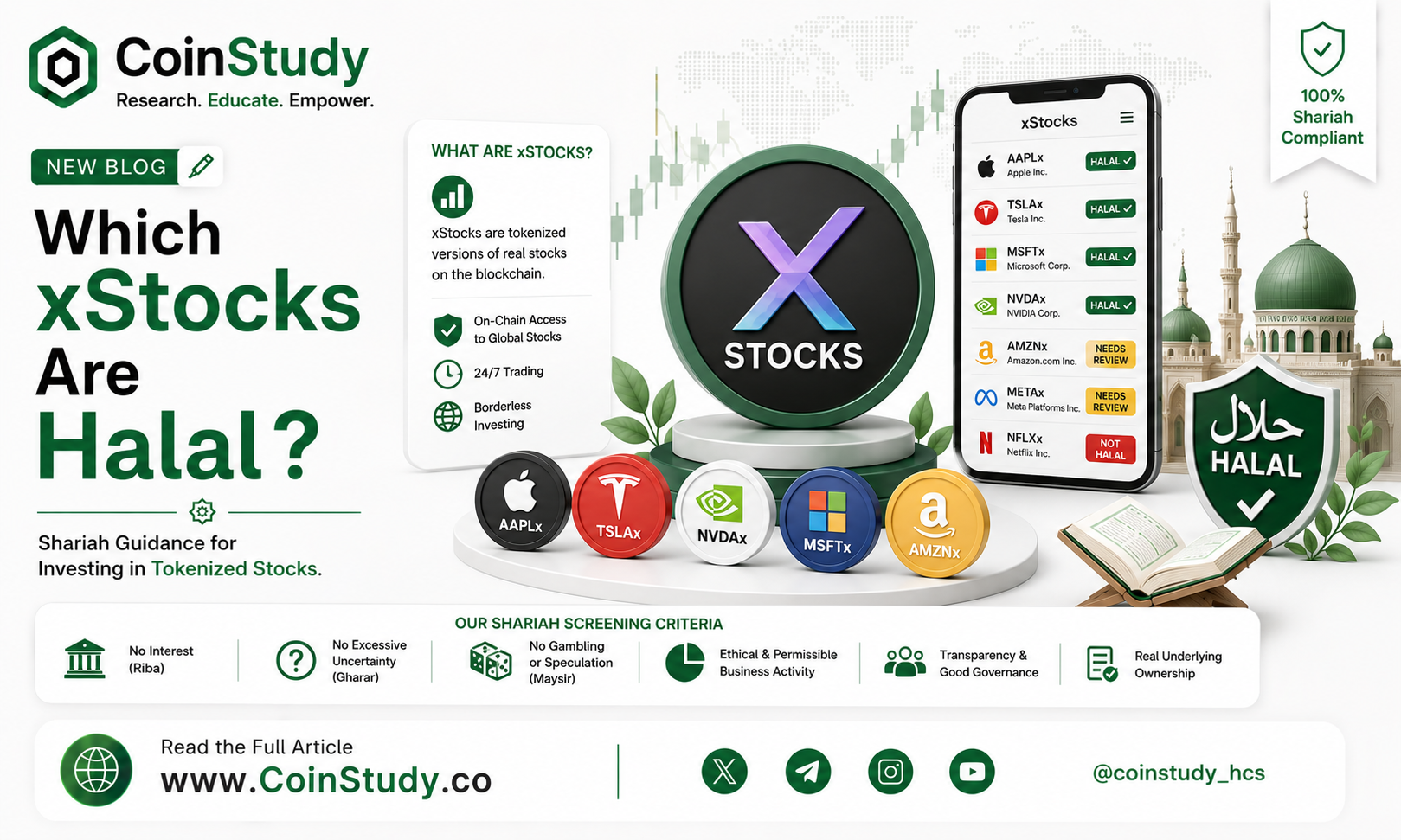
Which xStocks Are Halal? A Complete CoinStudy Guide
Tokenized stocks have gone from a niche experiment to a billion-dollar asset class in less than two years.
By March 2026, the tokenized stock market had surpassed $1 billion in aggregate market capitalization with over 185,000 holders globally. xStocks, the leading tokenized equity framework issued by Backed Finance and now owned by Kraken, accounts for approximately 25% of that market with $25 billion in cumulative trading volume across more than 60 tokenized stocks and ETFs.
For Muslim investors, this growth creates an urgent and practical question that no other halal crypto platform has answered with scholarly authority.
Which xStocks are actually halal? Which are haram? And what specific activities around xStocks are permissible under Islamic finance principles?
CoinStudy has now obtained a direct ruling from our Shariah Board Chairman, Dr. Usman Quddus, who holds a PhD in Islamic Finance under AAOIFI standards, specifically addressing xStocks and tokenized equity activities. This blog presents that ruling in full alongside our complete analytical framework for Muslim investors navigating this genuinely new category.
What Are xStocks?
Before addressing permissibility, it is essential to understand precisely what xStocks are and how they differ from other financial instruments Muslim investors may be familiar with.
xStocks are tokenized tracker certificates issued by Backed Finance under Swiss regulatory framework. Each xStock token is backed 1:1 by the real underlying share or ETF unit, held in regulated custody by licensed third-party custodians. When you hold AAPLx, the tokenized Apple stock, a regulated custodian holds the equivalent Apple share on your behalf.
This structure makes xStocks fundamentally different from synthetic derivatives or perpetual futures that merely track a price without genuine underlying asset backing. An xStock represents a genuine custodial claim on a real share, transferable on blockchain 24 hours a day seven days a week without the restrictions of traditional brokerage infrastructure.
Several features of xStocks are important to understand from an Islamic finance perspective before any ruling can be applied.
First, xStocks do not convey direct voting rights in the underlying company. Token holders have creditor rights rather than direct ownership rights in the legal sense.
Second, dividends from the underlying shares are not distributed directly to token holders. Instead they are automatically reinvested into the token's value, increasing the token's net asset value rather than providing cash distributions.
Third, xStocks are composable with DeFi protocols, meaning they can be used in liquidity pools, as collateral for borrowing, and in various yield-generating strategies depending on which specific protocols the holder chooses to use.
Fourth, xStocks are subject to regulatory restrictions and are not available to users in the United States, United Kingdom, Canada, Australia, and certain other jurisdictions.
CoinStudy Shariah Board Chairman's Complete Ruling
CoinStudy submitted the question of xStocks and tokenized equity activities to our Shariah Board Chairman, Dr. Usman Quddus, with specific scenarios covering buying and holding, liquidity provision, lending, and referral activity.
His complete ruling, translated from Urdu, is as follows.
"Business with xStocks of halal companies is permissible. Liquidity provision is permissible if it is given for the purpose of partnership and trade and it is known that your liquidity will be used in a permissible place. Standard DeFi lending of xStocks is not permissible since taking profit on a loan is Haram in Islamic jurisprudence. However if lending is structured as a genuine Musharakah partnership agreement rather than a simple loan, the profit becomes permissible. Referral commission is not impermissible in itself. Its permissibility depends on the product. If commission is taken on a halal product it is halal, and if taken on a haram product it is haram. Creating fake referrals using fake IDs and fraudulent methods is Haram due to deception."
This ruling provides the foundational framework for everything that follows in this guide.
The Two-Layer Assessment Every Muslim Investor Must Apply
Before applying the chairman's ruling to any specific xStock, Muslim investors must understand that xStocks require a two-layer assessment. Both layers must pass independently. A positive result at one layer does not automatically satisfy the other.
Layer One — Is the xStock Activity Structure Permissible?
This is what the chairman's ruling directly addresses. Buying and holding, liquidity provision, lending, and referral activity each have their own ruling based on the nature of the activity itself.
Layer Two — Is the Underlying Company Permissible?
This is Islamic equity screening applied to the company whose stock is being tokenized. A tokenized stock is still a stock. The blockchain wrapper is neutral. The underlying business is not.
If a company's business activity is Haram, its xStock is Haram regardless of how cleanly the tokenization mechanism works and regardless of what the chairman's ruling says about xStock activity structures. Both layers must pass.
Layer One — Activity Structure Rulings
Buying and Holding xStocks of Halal Companies
Ruling: Halal ✅
The chairman has explicitly ruled that business with xStocks of halal companies is permissible (Mubah).
Buying and holding an xStock of a permissible company in a self-custodial wallet, earning xPoints that may convert to a future airdrop, is permissible activity. The 1:1 custodial backing by real shares held in regulated custody provides the genuine underlying asset basis that distinguishes this from a speculative synthetic derivative.
The absence of voting rights and the reinvestment of dividends into token value rather than cash distributions are real structural differences from direct share ownership. These differences represent genuine scholarly grey area that we have documented in our tokenized stocks blog. However the chairman's direct ruling that xStocks of halal companies are Mubah provides the most authoritative guidance CoinStudy has obtained on this specific question.
Providing Liquidity in Halal Pairs
Ruling: Halal ✅ with conditions
The chairman ruled that liquidity provision is permissible if given for the purpose of partnership and trade and if it is known that the liquidity will be used in a permissible place.
This condition introduces a meaningful and important qualifier. Not all liquidity pools satisfy this condition equally.
A pool pairing AAPLx with SOL involves two permissible assets. Traders using this pool are swapping between a halal company's tokenized equity and a halal-rated cryptocurrency. Your liquidity facilitates this permissible exchange activity. This satisfies the condition.
A pool pairing AAPLx with USDC involves one permissible asset and one asset CoinStudy classifies as Haram due to its Treasury bill-backed reserve structure. When your liquidity facilitates swaps into and out of a Haram-classified stablecoin, the condition that your liquidity goes to a permissible place is not fully satisfied.
A pool involving any Haram company's xStock, such as MicroStrategy, does not satisfy the condition regardless of what the other asset in the pair is.
Muslim investors providing liquidity should therefore verify both assets in any pool before participating. The pool pair determines whether the chairman's permissibility condition is satisfied.
Standard DeFi Lending of xStocks
Ruling: Haram ❌ in standard form
The chairman ruled clearly that standard DeFi lending is not permissible. Taking profit on a loan is Haram in Islamic jurisprudence. This applies to depositing xStocks into lending protocols like Kamino to earn interest-like yield on deposited assets.
The chairman noted one important nuance. If lending is restructured as a genuine Musharakah partnership agreement rather than a simple loan, with genuine profit and loss sharing rather than predetermined interest-like returns, the profit becomes permissible.
In practice, current DeFi lending protocols including Kamino and similar platforms are structured as collateralized loans with predetermined interest rates rather than genuine Musharakah partnership arrangements. Muslim investors should not use xStocks in standard DeFi lending protocols.
Referral Activity
Ruling: Halal ✅ for halal product referrals, Haram ❌ for haram product referrals
The chairman's ruling on referrals is precise and practically important.
Referral commission is not impermissible in itself. It is a form of commission and taking commission is permissible in Islamic jurisprudence. The permissibility depends entirely on the product being referred to.
Referring someone to buy and hold halal company xStocks or to provide liquidity in halal pairs, with clear and complete disclosure of which activities are halal and which are haram, earns commission from a halal activity and is therefore halal.
Referring someone who then uses the haram lending features means your commission becomes tied to a haram product. The chairman's ruling makes clear that commission on a haram product is haram.
The chairman specifically flagged one additional category. Creating fake referrals, using fake IDs, fake email addresses, or other fraudulent methods to generate artificial referral rewards, is Haram due to deception. This is prohibited regardless of whether the underlying product is halal.
CoinStudy's approach on our xStocks airdrop page reflects this ruling precisely. We share our referral link with clear disclosure that lending is Haram and ask users who plan to use lending to not use our referral link. Commission earned from users who follow the halal participation path is therefore commission from a halal product.
Layer Two — Islamic Equity Screening
This is the layer that most resources discussing xStocks completely ignore. Every company whose stock is being tokenized must pass standard Islamic equity screening independently.
The question is not simply whether xStocks as a mechanism is halal. The question is whether the specific company whose xStock you are buying operates a permissible business.
Standard Islamic Equity Screening Criteria
Islamic equity screening as developed by AAOIFI and applied by Islamic finance scholars evaluates companies across several criteria. The primary business activity must be permissible. Companies primarily engaged in conventional banking and interest-based finance, alcohol production and distribution, gambling and betting operations, tobacco, weapons manufacturing, and other prohibited industries fail this screening immediately.
Quantitative ratios are also applied. Total debt divided by total assets should not exceed 33%. Interest income as a proportion of total revenue should remain within defined limits. Accounts receivable as a proportion of total assets should not exceed defined thresholds.
These criteria apply identically to a company's tokenized equity as they apply to its conventional stock. The tokenization does not change the company's business or financial structure.
Companies That Pass Islamic Equity Screening
The following are generally considered permissible under standard Islamic equity screening, though Muslim investors should verify current financial ratios independently since these can change.
The table below reflects approximate debt ratios based on most recent annual filings. The AAOIFI standard requires total debt divided by total assets not to exceed 33%. Verify current ratios independently before investing as these change with every quarterly earnings release.
Apple = 31% ✅ Pass
Nvidia = 21% ✅ Pass
Microsoft = 29% ✅ Pass
Amazon = 28% ✅ Pass
Tesla = 18% ✅ Pass
Alphabet = 8% ✅ Pass
Meta = 7% ✅ Pass
SpaceX = ⚠️ Verify
MicroStrategy = 90%+ ❌ Fail
JPMorgan = N/A ❌ Fail
Goldman Sachs = N/A ❌ Fail
Coinbase = 45% ⚠️ Review
Companies That Fail Islamic Equity Screening
The following categories and specific examples fail Islamic equity screening and their xStocks are Haram regardless of the chairman's ruling on activity structures.
MicroStrategy has a business model built entirely around acquiring Bitcoin using interest-bearing convertible bonds. The company issues debt instruments to fund Bitcoin purchases as its primary business activity. This debt-based model fails Islamic equity screening decisively. MSTRx is Haram.
All conventional banks and financial institutions fail Islamic equity screening because their primary business model is interest-based lending and borrowing. JPMorgan, Goldman Sachs, Bank of America, and similar institutions' xStocks are all Haram.
Alcohol companies including beverage companies whose primary products include alcohol fail the prohibited industry screening.
Gambling companies including casino operators and sports betting platforms fail the prohibited industry screening.
Tobacco companies fail the prohibited industry screening.
Defense contractors whose primary revenue comes from weapons manufacturing require careful individual assessment and many fall outside permissible boundaries.
The SpaceX Warning — A Specific and Documented Risk
Muslim investors considering xStocks of private companies, not just publicly traded stocks, need to understand a specific and documented risk that emerged in June 2026.
During the SpaceX IPO event, Binance, Bybit, Bitget, and MEXC were all forced to cancel tokenized SpaceX offerings and refund over one billion dollars in customer orders because xStocks, their shared intermediary, could not secure enough actual SpaceX shares to back the issued tokens 1:1.
This event exposed a fundamental structural risk that does not exist for publicly traded company xStocks in the same way. Apple shares can be purchased freely in public markets in any quantity. SpaceX shares are privately held and not freely available in public markets. When demand for SPACEx tokens exceeded the available supply of actual SpaceX shares that could be acquired, the 1:1 backing promise could not be fulfilled.
This Gharar risk is specific to private company xStocks and is a meaningful consideration beyond the general tokenized equity grey area that applies to all xStocks. Muslim investors should restrict their xStock participation to publicly traded companies with freely available shares, avoiding private company xStocks where the backing integrity is dependent on the availability of privately held shares that may not be accessible in required quantities.
The Perpetual Futures Warning — A Completely Different Product
This deserves direct and clear emphasis because the xStocks brand is associated with both genuinely backed tokenized equities and with perpetual futures products that bear no structural resemblance to them.
Kraken launched perpetual futures contracts on xStocks in February 2026, offering up to 20x leverage on tokenized equity prices. These perpetual futures contracts have a funding rate mechanism, use leverage, and allow short positions. They are structurally identical to the crypto perpetual futures that CoinStudy classifies as Haram across our entire analysis series.
A perpetual futures contract on Apple's stock price is not the same as holding AAPLx. One is a genuine 1:1 backed custodial claim on a real share. The other is a leveraged derivative with funding rate mechanics that bears no connection to genuine share ownership.
Muslim investors must be completely clear about which product they are using. Spot xStock tokens on the defi.xstocks.fi platform or through self-custodial wallets are the products the chairman's ruling applies to. Perpetual futures on Kraken's derivatives platform are Haram regardless of whether the underlying reference asset is a stock.
Practical Step by Step Guide for Muslim Investors
Based on the chairman's ruling and CoinStudy's complete assessment, here is the most defensible participation path for Muslim investors.
Step One: Verify the company passes Islamic equity screening. Check primary business activity and current debt ratios before buying any xStock. Publicly available financial data allows this verification for any publicly traded company.
Step Two: Acquire the xStock through a permissible method. Buying spot xStocks on Kraken exchange, Bybit, or directly through defi.xstocks.fi using your own self-custodial wallet is the cleanest acquisition path. Avoid any leveraged or margin purchase.
Step Three: Hold in your own self-custodial wallet. This is the most clearly permissible holding method. Your xPoints accumulate automatically through holding.
Step Four: If participating in liquidity provision, verify the pool pair involves two permissible assets. AAPLx paired with SOL satisfies the chairman's condition. AAPLx paired with USDC does not fully satisfy it given USDC's Haram classification.
Step Five: Avoid all DeFi lending protocols. Do not deposit xStocks into Kamino or any other lending protocol regardless of the yield offered.
Step Six: If referring others, use CoinStudy's referral link which is accompanied by full disclosure of halal and haram activities. Do not refer people specifically to lending. Do not create fake referrals.
Important Questions for Muslim Investors
Before participating in any xStock activity, ask yourself honestly.
Have I verified that this specific company's business activity and financial ratios pass standard Islamic equity screening independently? Am I using a spot 1:1 backed xStock token or a perpetual futures derivative that merely tracks the same price? If providing liquidity, have I verified that both assets in the pool are permissible? Am I completely avoiding DeFi lending protocols regardless of the yield offered? Would I be comfortable explaining my specific participation activities to a qualified Islamic scholar?
Final Verdict
xStocks of halal companies are permissible for Muslim investors under the ruling of CoinStudy's Shariah Board Chairman Dr. Usman Quddus, subject to four specific conditions.
The underlying company must independently pass standard Islamic equity screening. The activity must be limited to buying and holding, liquidity provision in halal pairs, or referral activity directed toward halal participation. Standard DeFi lending must be avoided entirely. Perpetual futures products bearing the xStocks name must not be confused with genuine spot tokenized equity tokens.
This ruling represents a significant development for Muslim investors. A genuinely novel financial category, the tokenized equity, has received direct scholarly assessment from a qualified Islamic finance authority, providing clearer guidance than the general scholarly grey area acknowledgment that previously represented the best available position.
For Muslim investors who have always wanted to invest in globally recognised technology companies like Apple, Nvidia, and Microsoft but wanted scholarly guidance on the permissibility of doing so through blockchain infrastructure, that guidance is now available.
Read detail analysis of following coins here:
Are Tokenized Stocks Halal?
xStocks Airdrop Guide
Is Crypto Staking Halal?
Learn Halal Trading Strategies with CoinStudy's Partner
Disclaimer: This article is provided for educational and research purposes only. The scholarly ruling included is provided by CoinStudy's Shariah Board Chairman Dr. Usman Quddus in his capacity as an Islamic finance scholar. This article does not constitute a personal fatwa for any specific individual situation. Muslim investors should independently verify that specific companies pass Islamic equity screening before participating and should consult a qualified Islamic scholar for personal guidance specific to their circumstances.