

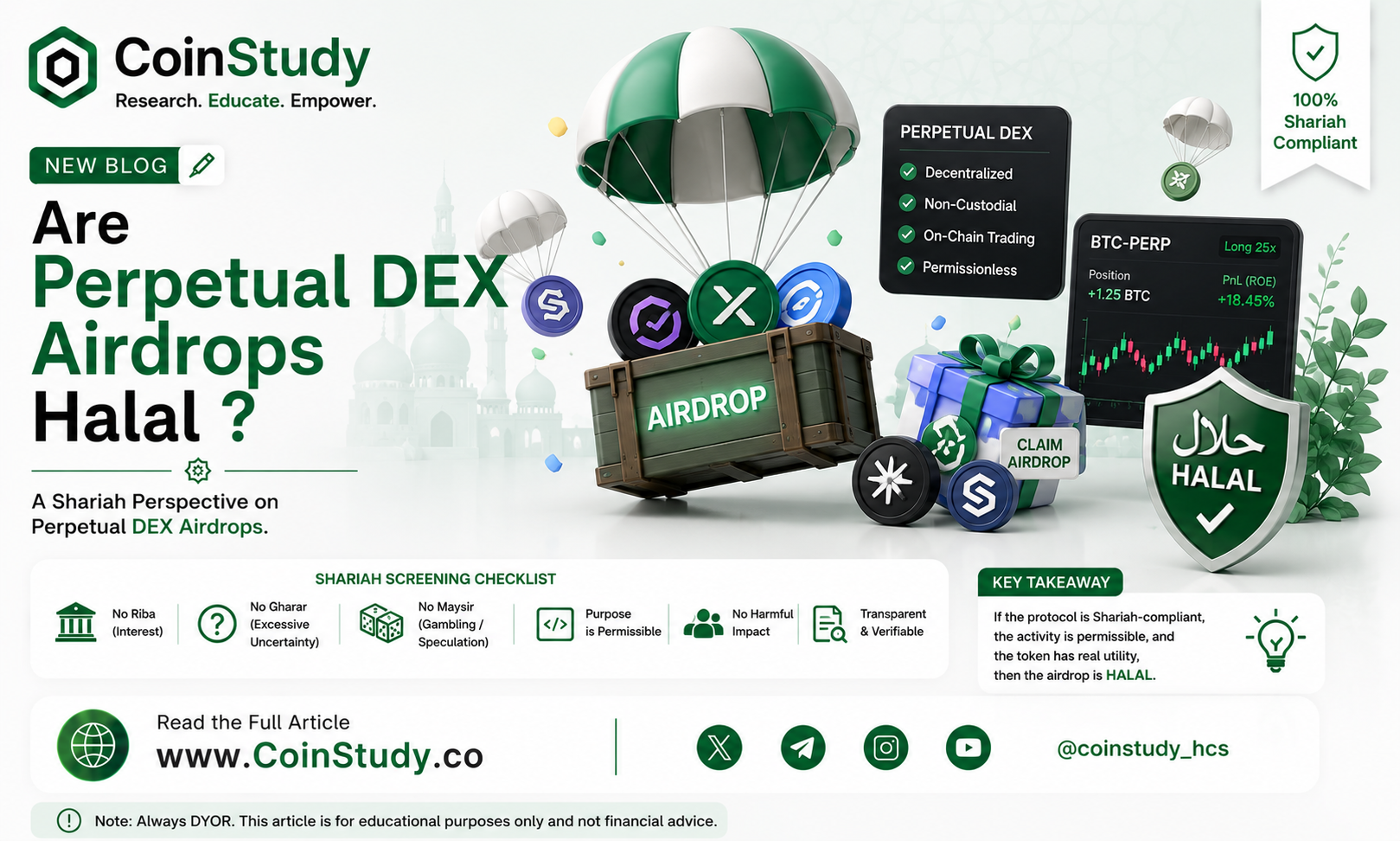
Why Perpetual DEX Airdrops Are Haram for Muslim Investors
Every few months a new perpetual futures exchange launches on a major blockchain with a generous airdrop campaign.
The formula is familiar. Deposit funds early. Trade on the platform. Refer friends. Earn points. Receive a token allocation worth potentially hundreds or thousands of dollars when the exchange officially launches.
The rewards can be genuinely significant. Hyperliquid's HYPE airdrop made early participants wealthy beyond what most crypto activities could have produced. BULK Exchange is promising its pre-depositors similar returns. Every new perpetual DEX that launches follows the same playbook because it works for attracting users.
For Muslim investors, the question is not whether these airdrops are financially attractive. They clearly are. The question is whether the activity required to earn them is permissible under Islamic finance principles.
The answer is no. And understanding precisely why requires examining the structure of perpetual futures itself, the specific activities required by these airdrop campaigns, and how each element maps onto Islamic finance principles.
What Is a Perpetual Futures Exchange?
Before examining the compliance question, it is essential to understand precisely what perpetual futures are and how they differ from other forms of crypto participation.
A perpetual futures contract is a derivative instrument that allows traders to speculate on the price of an asset without owning the asset itself. Unlike a spot trade where you buy and hold actual Bitcoin or Ethereum, a perpetual futures position is a leveraged bet on whether the price of an asset will go up or down.
The defining feature of perpetual futures is the funding rate mechanism. Because perpetual contracts have no expiry date, unlike traditional futures, they use a continuous payment mechanism called the funding rate to keep the contract price aligned with the underlying asset's spot price.
When more traders are long, meaning betting the price will go up, they pay funding to traders who are short. When more traders are short, meaning betting the price will go down, they pay funding to longs. This funding rate payment is continuous, typically charged every eight hours, and functions as a predetermined percentage-based payment between position holders.
Additionally, perpetual futures allow leverage, meaning traders can open positions many times larger than their actual capital. A trader with $1,000 might open a $10,000 or $50,000 position. This amplification means both gains and losses are multiplied significantly beyond the trader's actual invested capital.
Why Perpetual Futures Are Haram — The Complete Analysis
CoinStudy has analyzed perpetual futures across dozens of individual coin assessments and consistently reached the same conclusion. Perpetual futures trading fails multiple Islamic finance red lines simultaneously.
The Funding Rate Is Riba
The funding rate mechanism is the most direct and unambiguous Riba concern in perpetual futures trading.
Riba is the Arabic term for interest and refers to any predetermined financial return on capital that is not connected to genuine productive economic activity. Islamic finance scholars across all major schools of thought have consistently ruled that any financial arrangement where capital generates a predetermined percentage-based return constitutes Riba regardless of what it is called or how it is packaged.
The funding rate in perpetual futures is precisely this structure. Every eight hours, traders on one side of the market pay a predetermined percentage of their position value to traders on the other side. This payment is calculated as a percentage of capital, occurs at regular predetermined intervals, and is entirely disconnected from any productive economic activity. No goods are produced. No services are rendered. Money simply transfers from one group of position holders to another based on a predetermined rate formula.
This is Riba in its most direct and recognizable form, simply denominated in cryptocurrency rather than conventional currency and occurring on a blockchain rather than in a conventional financial system.
Leverage Is Gharar and Maysir
Islamic finance identifies two additional categories of prohibited financial activity that are directly present in perpetual futures trading.
Gharar refers to excessive uncertainty or ambiguity in the terms of a transaction. A leveraged perpetual futures position creates a financial obligation that is completely disconnected from the actual value of the underlying asset the trader is speculating on. A trader who opens a 50x leveraged position can be completely liquidated by a 2% adverse price movement. The relationship between the capital at risk and the potential outcome is so distorted by leverage that the transaction involves excessive contractual uncertainty that Islamic finance specifically prohibits.
Maysir refers to gambling, which is any financial arrangement where one party's gain is directly equivalent to another party's loss with no productive economic value created in the process. Perpetual futures trading is by definition a zero-sum activity between participants. For every long position that profits when price rises, there is an equivalent short position that loses. No economic value is created through this activity. Money simply moves from losing participants to winning participants through price movement speculation.
Islamic finance distinguishes between legitimate commerce, where genuine economic value is created and both parties can benefit, and gambling, where one party's gain necessarily equals another's loss with no productive activity in between. Perpetual futures trading falls decisively into the second category.
The Exchange Token Concern
When a perpetual DEX launches its own native token, that token's value is explicitly connected to the platform's trading volume and fee revenue. The exchange typically uses a portion of trading fees to buy back or distribute rewards to token holders.
This creates a documented and direct financial connection between holding the token and benefiting from Riba-generating and Maysir-based trading activity. Even if a token holder never personally trades perpetual futures, their token's value appreciation and any rewards they receive are funded by the platform's overall trading activity.
CoinStudy has classified Hyperliquid (HYPE), Drift (DRIFT), and other perpetual DEX tokens as Haram specifically because of this direct financial connection between token value and prohibited trading activity.
How Perpetual DEX Airdrop Campaigns Work — The Specific Problem
Understanding why perpetual futures are Haram explains why the native tokens of these exchanges are Haram. But airdrop campaigns create additional compliance concerns that deserve separate and precise examination.
A typical perpetual DEX airdrop campaign involves multiple distinct activities, each with its own compliance profile.
Trading Activity for Points
The most direct form of perpetual DEX airdrop participation involves actually trading perpetual futures contracts on the platform to accumulate points.
This is the clearest and most unambiguous Haram activity. Engaging in perpetual futures trading personally is participating directly in an activity that CoinStudy classifies as Haram on multiple grounds. No amount of framing this as airdrop farming changes what the underlying activity is. Trading perpetual futures for airdrop points is trading perpetual futures.
Pre-Depositing Capital as Margin
This is where perpetual DEX airdrop campaigns create a compliance concern that is less immediately obvious but equally serious.
Many perpetual DEX pre-launch campaigns ask users to deposit funds before the exchange officially opens. BULK Exchange's pre-deposit campaign on early.bulk.trade is a current and prominent example. Users deposit USDC during the pre-launch period, earn AURA points toward the eventual BULK token airdrop, and are told they can withdraw at any time.
On the surface this appears to be a neutral activity. You are depositing USDC. You are not trading perpetual futures. You are not paying or receiving funding rates. You are simply holding funds in a pre-launch deposit contract and receiving airdrop points.
The critical compliance concern lies in what the pre-deposited funds are explicitly designed to become.
BULK's own official documentation states that all contracts on BULK Exchange are margined using USDC and that deposited funds become trading capital at mainnet launch. The Solana Guides resource explicitly states that at mainnet, deposits convert to trading margin.
This means pre-depositing USDC into BULK is not neutral idle holding that happens to earn airdrop points. It is the deliberate seeding of capital into a perpetual futures exchange that will automatically convert that capital into trading margin when the exchange opens.
CoinStudy's Shariah Board Chairman Dr. Mufti Usman Quddus has ruled: "Liquidity provision is permissible if it is given for the purpose of partnership and trade and if it is known that the liquidity will be used in a permissible place."
In the case of BULK pre-deposits, it is explicitly known that the liquidity will be used as perpetual futures trading margin. This is stated in the platform's own documentation. The chairman's permissibility condition is therefore not satisfied.
BulkSOL Staking
BULK Exchange's liquid staking token BulkSOL creates a separate and additional compliance concern.
BulkSOL earns three types of yield: base Solana Proof of Stake staking rewards, MEV tips from block production, and 12.5% of all BULK Exchange trading fees.
The third component is decisive. BULK Exchange's trading fees come from perpetual futures trading activity. A Muslim investor who stakes SOL to receive BulkSOL is holding a token that explicitly earns 12.5% of all revenue from a haram-classified trading platform as a core designed feature.
BULK's own marketing language describes this as the asymmetric edge of BulkSOL: "No other Solana LST shares trading fee revenue." This feature is not incidental. It is explicitly promoted as the primary reason to hold BulkSOL rather than a simple native staking alternative. Earning a direct share of perpetual futures trading revenue as a designed and marketed feature of a staking token is a documented Ecosystem Riba Exposure and Synthetic Interest Products concern.
Referral Programs
Perpetual DEX airdrop campaigns typically include referral programs where existing users earn points or token allocations for bringing new users to the platform.
CoinStudy's Shariah Board Chairman has ruled that referral commission itself is not impermissible. Its permissibility depends entirely on the product being referred to. Commission on a halal product is halal and commission on a haram product is haram.
Referring new users to a perpetual futures exchange, regardless of how the referral is framed or what points system it uses, is earning commission from growing the user base of a haram-classified financial platform. This referral commission is therefore haram.
Social and Community Tasks
Some perpetual DEX airdrop campaigns include social media tasks, Discord participation, and community engagement activities as part of point accumulation.
These sit in the most nuanced position of all the activity types in these campaigns. Creating genuinely educational content about a perpetual DEX's technical infrastructure, while completely avoiding any promotion of the trading activity itself, may be defensible under the majority work principle that CoinStudy's Shariah Board Chairman has articulated.
However in practice, social tasks in perpetual DEX airdrop campaigns are specifically designed to promote the platform, grow its user base, and encourage participation in its trading activities. A social media task that asks participants to share the exchange's features or invite friends to the platform is functionally promoting a haram product regardless of what specific words are used in the post.
Muslim investors should be honest with themselves about the purpose of any social tasks they consider completing for a perpetual DEX airdrop campaign.
The Airdrop Token Itself
Even setting aside the activities required to earn the airdrop, the token received at the end of a perpetual DEX airdrop campaign creates its own compliance concern.
The airdrop token of a perpetual futures exchange derives its value from the exchange's trading volume and fee revenue. Holding the token means your investment appreciates when the exchange processes more perpetual futures trading volume and generates more fee revenue from this activity.
This is the same Ecosystem Riba Exposure and Maysir concern that CoinStudy has applied consistently across all exchange token analyses. The token holder benefits financially from the growth of prohibited trading activity even without personally participating in that trading.
A Muslim investor who receives a perpetual DEX airdrop token and holds it is holding an asset whose value is directly connected to the ongoing growth of a platform generating revenue through Riba-based funding rate mechanisms and Maysir-based speculative zero-sum trading.
The Hyperliquid Example — Why Attractive Returns Do Not Change the Ruling
Hyperliquid's HYPE airdrop is the most prominent recent example of a perpetual DEX airdrop and it is worth addressing directly because of how frequently Muslim investors cite it as a missed opportunity.
Hyperliquid distributed approximately 310 million HYPE tokens to early users of its perpetual futures platform. At peak prices, this distribution was worth billions of dollars in aggregate. Individual users who traded frequently on the platform received allocations worth tens of thousands of dollars in some cases.
The financial magnitude of this return does not change the Islamic finance analysis. The activities required to earn the Hyperliquid airdrop were perpetual futures trading and participation in a platform built around Riba-based funding rate mechanisms and Maysir-based speculative leverage trading.
Islamic finance prohibitions apply regardless of the financial magnitude of the potential return. The Quran's prohibition on Riba does not include a threshold below which it is permissible or above which it becomes more prohibited. It is prohibited because of its nature and structure, not because of its scale.
The attractiveness of Hyperliquid's returns illustrates exactly why understanding these principles clearly matters. Financial pressure, fear of missing out, and the visible wealth generated by such airdrops create real psychological pressure on Muslim investors to rationalize participation. Understanding precisely why the prohibition applies in this case provides the clear framework needed to make an honest decision.
BULK Exchange — A Specific and Current Case Study
BULK Exchange is building what it calls the world's first truly decentralized trading environment for perpetual futures on Solana. It has raised $8 million in seed funding from Robot Ventures, 6th Man Ventures, Wintermute, and other prominent investors. Solana co-founder Anatoly Yakovenko participated as an angel investor.
Its pre-deposit campaign launched June 1, 2026, with users encouraged to deposit USDC to earn AURA points toward the future BULK token airdrop. The campaign has been promoted with projections of 100% or higher APY based on expected token valuations.
CoinStudy analyzed every element of BULK's airdrop campaign and reached the following specific conclusions.
Pre-depositing real USDC is not permissible because the deposited funds explicitly become USDC margin collateral for perpetual futures contracts at mainnet launch as confirmed in BULK's own official documentation.
BulkSOL staking is not permissible because BulkSOL explicitly earns 12.5% of all BULK Exchange trading fees as a designed and marketed feature, creating a direct financial connection between the staking yield and perpetual futures trading revenue.
Referral participation is not permissible because referring others to a perpetual futures exchange constitutes commission on a haram product.
Testnet participation with paper funds from the platform's own faucet involves no real capital commitment and is a different and less directly concerning situation, though it still involves helping improve a haram-classified product's development.
Muslim investors who encounter BULK's campaign should understand that the 100% APY projections and the genuine excitement around this airdrop in the broader crypto community do not change any of the fundamental compliance concerns identified above.
What Muslim Investors Should Look For Instead
Understanding what makes perpetual DEX airdrops impermissible also helps clarify what genuinely permissible airdrop opportunities look like.
CoinStudy's halal airdrop section at coinstudy.co/halal-airdrops maintains a curated list of airdrop opportunities that have passed our HCS screening process. The criteria we use to distinguish permissible from impermissible airdrops include the following considerations.
The underlying platform should perform a genuinely permissible economic function. Infrastructure protocols, payment networks, decentralized storage systems, AI computation marketplaces, and other platforms that create real economic value through productive activity are categorically different from speculative zero-sum trading platforms.
The activities required to earn the airdrop should not involve directly participating in prohibited financial activity. Completing social tasks, running testnet nodes, providing genuine content, and participating in governance of permissible protocols are categorically different from trading leveraged derivatives.
The airdrop token itself should not derive its value primarily from prohibited trading activity. A token whose appreciation depends on the growth of an interest-based lending platform or a perpetual futures exchange creates compliance concerns even for passive holders.
The presence of a confirmed token and explicit airdrop announcement should be verified before significant effort is invested in any campaign. Projects with no confirmed token but whose primary activity is permissible represent speculative time investment rather than compliance risk, while projects with confirmed tokens tied to haram platforms represent direct compliance concerns.
The Honest Self-Examination Every Muslim Investor Needs to Do
The financial returns from perpetual DEX airdrops are real and sometimes very significant. Acknowledging this honestly rather than minimizing it is important because the psychological pressure these returns create is real.
When a friend or social media account shows significant gains from a Hyperliquid airdrop or describes the projected returns from BULK's pre-deposit campaign, the emotional pull toward rationalizing participation is genuine. Islamic finance scholarship has understood this for fourteen centuries, which is precisely why the Quran's prohibition on Riba is stated clearly without qualification rather than being left to individual situational assessment.
Before participating in any airdrop campaign on a perpetual futures exchange, ask yourself the following questions honestly.
If this platform had no airdrop and I was simply being asked to trade perpetual futures, would I participate? If the answer is no, then the airdrop is the only thing making this participation feel acceptable. But the airdrop does not change what the underlying activity is or what platform it benefits.
If I strip away the points and the projected token value, what am I actually doing? Pre-depositing USDC into BULK is positioning capital in a perpetual futures exchange. Staking BulkSOL is earning a share of perpetual futures trading revenue. These descriptions are accurate regardless of whether they are framed as airdrop farming.
Would I be comfortable explaining this activity in detail to a qualified Islamic scholar? If the honest answer involves any omission of what the platform actually is or what the deposited funds actually become, that omission is itself informative about whether the activity is genuinely permissible.
Final Verdict
Perpetual DEX airdrop campaigns are not permissible for Muslim investors regardless of the financial returns they offer, the technical sophistication of the platforms running them, or the prominence of their investors and backers.
The core activities required by these campaigns, including trading perpetual futures contracts, pre-depositing funds that will become trading margin, staking tokens that earn perpetual futures trading revenue, and referring others to haram-classified platforms, each independently fail Islamic finance requirements under the red lines of Riba, Gharar, and Maysir.
The airdrop tokens received at the end of these campaigns represent ownership in platforms whose value is tied to the ongoing growth of prohibited financial activity.
Neither the financial magnitude of the returns nor the technological sophistication of the platforms changes any of these fundamental compliance assessments. The prohibition applies because of the structure of the activity, not its scale or technical implementation.
Muslim investors who encounter perpetual DEX airdrop campaigns, including BULK Exchange's current pre-deposit campaign and future campaigns from similar platforms, should direct their airdrop farming energy toward the genuinely permissible opportunities listed in CoinStudy's halal airdrop section.
The Web3 ecosystem offers hundreds of airdrop opportunities at any given time. The most financially attractive ones in any given moment are not necessarily the most permissible ones. Making the distinction honestly is precisely what CoinStudy exists to help Muslim investors do.
Read detail analysis of following coins here:
Is Perpetual Trading Halal?
Is Hyperliquid Halal?
Halal Airdrop Opportunities
Learn Halal Trading Strategies with CoinStudy's Partner
Halal staking with CoinStudy's Partner
Disclaimer: This article is provided for educational and research purposes only. CoinStudy does not provide personal financial or religious rulings. Please consult a qualified Islamic scholar for individual guidance specific to your circumstances.