

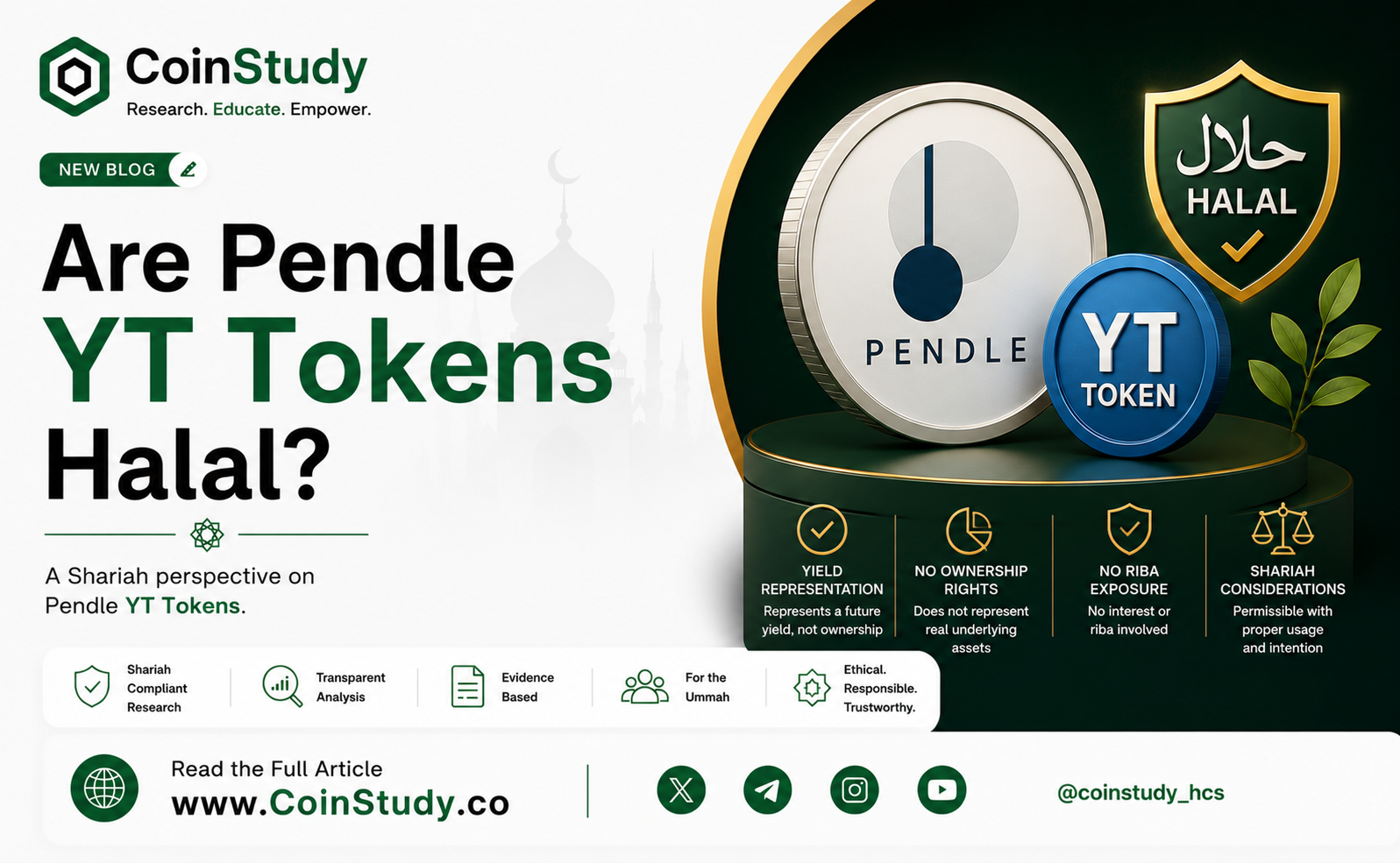
Are Pendle YT Tokens Halal? The xPoints Question Answered Completely
A specific question has been arriving at CoinStudy regularly in recent weeks and it deserves a complete, precise, and honest answer.
The question goes something like this: "I want to earn xPoints for a potential xStocks airdrop. If I buy Yield Tokens on Pendle for a halal company's xStock, like SpaceX or Apple, I am not actually receiving any yield because SpaceX doesn't pay dividends. I am just holding YT tokens to accumulate points. Does the intention to earn points rather than yield make this permissible?"
This is one of the most carefully constructed compliance questions we have received. The person asking it is not trying to find a loophole. They are genuinely trying to understand where the compliance line is and why it falls where it does.
The answer requires understanding three separate layers: what Pendle actually does, what xStocks actually are, and where the line falls between permissible and impermissible regardless of the investor's intention. Every layer is addressed precisely in this blog.
Quick Verdict: Pendle YT Tokens Are Haram ❌
Pendle Yield Tokens are classified as Haram under the CoinStudy Halal Crypto Standard regardless of which underlying asset they represent, regardless of whether that underlying asset belongs to a halal company, and regardless of whether the investor's intention is to collect yield or to earn airdrop points. The YT token is a synthetic interest product in its structure. Buying it is purchasing a Haram instrument. The intention does not change the instrument's nature.
What Pendle Actually Is — Start Here
Pendle Finance is a DeFi protocol that does something genuinely innovative and genuinely problematic from an Islamic finance perspective simultaneously. Its core innovation is splitting yield-bearing assets into two tradable tokens: one representing the principal and one representing the future yield.
When you deposit a yield-bearing asset into Pendle, the protocol splits it into two separate tokens.
The Principal Token represents the right to redeem the original asset value at maturity. The Yield Token represents all yield earned by the asset between now and the maturity date. Medium
Pendle takes a yield-bearing asset like staked Ethereum, Ethena's synthetic dollar USDe, or USDC in Aave and wraps it into a standardized token. It then splits that into a Principal Token that redeems at par at a fixed maturity date and a Yield Token that captures all yield generated by the underlying asset until that maturity date.
The mathematics of this split are precise and documented. If you deposit one SY-stETH worth one ETH before a December 2026 maturity date, you receive one PT-stETH redeemable for one ETH at maturity and one YT-stETH entitling you to all stETH yield generated on one ETH of principal from now until December 2026. The two tokens can be held, sold, or used as collateral independently. Yahoo Finance
Understanding this split is the prerequisite for understanding every compliance question about Pendle YT tokens.
What the Yield Token Actually Represents
The Yield Token is not a share in a company. It is not a claim on productive economic activity in the traditional ownership sense. It is a financial instrument that entitles its holder to a specific economic benefit: all the yield generated by a yield-bearing asset over a defined period.
The Yield Token captures every drop of variable yield until expiry. Coinbureau
Every Pendle pool has a fixed expiry date, typically three, six, nine, or twelve months from launch, after which Principal Tokens redeem one-for-one for the underlying and Yield Tokens become permanently worthless.
This time-bounded structure is critical for the compliance assessment. A YT token has value only because it captures yield from an underlying position until an expiry date. The moment that expiry passes the YT is worth exactly zero. The investor's entire return from holding a YT comes from the yield it captures between purchase and expiry. If no yield accrues, the YT is worthless immediately.
What xStocks Are — The Critical Background
Before assessing Pendle YT tokens on xStocks, understanding what xStocks actually are is essential because the answer is less straightforward than it first appears.
xStocks is a suite of tokenized stocks and exchange-traded funds introduced by Backed Finance. These are not literal stocks on the blockchain. Instead, they are tokenized representations of securities, fully backed 1:1 by the underlying assets. Each xStocks stock token is structured as a tracker certificate that closely tracks the price of the underlying security.
Tokenization provides economic exposure to the underlying asset, but it does not confer direct share ownership or grant holders voting rights.
Dividends are reinvested into token value rather than being distributed directly to token holders.
This structure has specific implications for the compliance question. When you hold an xStock, you do not own shares of the company. You hold a tracker certificate that provides economic exposure to the stock price and has dividends automatically reinvested into the token's value rather than distributed to you.
The SpaceX xStock Dividend Question — Addressed Directly
The specific argument that came to CoinStudy is this: SpaceX does not pay dividends. Therefore a Pendle YT token representing SpaceX xStock yield generates no yield. If no yield accrues to the YT, the YT has no financial income stream. The investor is only holding it for the xPoints leaderboard multiplier. Surely this is permissible?
This argument identifies a real and important fact: SpaceX pays zero dividends. Its current dividend yield is 0.00% as of July 2026. Yahoo Finance
If SpaceX xStocks generate no yield, it follows that a YT representing that yield stream would have no yield to capture. This is technically accurate. But the argument has three specific and decisive problems that make the conclusion wrong.
Problem 1 — xStocks Generate Yield Even When the Underlying Company Pays No Dividends
The yield captured by a Pendle YT on an xStock does not come exclusively from dividends paid by the underlying company. It comes from the entire yield-bearing mechanism that the xStock position generates, which includes several sources that exist regardless of whether the company pays dividends.
Securities lending income is generated when the custodian lends out the underlying securities to short sellers and other borrowers who pay fees for borrowing those shares. This is how most equity-based financial products generate yield even on non-dividend-paying stocks. The custodian or platform earns securities lending fees from the shares held in reserve against the xStock tokens.
The yield source in xStocks is therefore not limited to corporate dividends from the company itself. It can include the financial engineering yield generated by the financial instruments that back the xStock position.
Problem 2 — If Truly Zero Yield, the YT Has No Value and Points Are Obtained Through a Worthless Financial Instrument
If a Pendle YT genuinely has zero expected yield from its underlying xStock position, the YT token would trade at essentially zero price because its entire value comes from the yield stream it captures. A YT that captures zero yield is worth zero regardless of the xPoints multiplier it offers.
In practice, these YT tokens do not trade at zero. They trade at positive prices because the market assigns a positive probability to the underlying position generating some yield. This market pricing reflects the real possibility of yield generation from sources beyond corporate dividends.
A Muslim investor buying a positively-priced YT for zero-yield xPoints farming is either buying a genuinely worthless instrument at a positive price, which is Gharar in itself, or buying an instrument that does have yield generation potential from non-dividend sources, which is the synthetic interest product concern.
Problem 3 — The Instrument Is Haram in Its Structure Regardless of Specific Yield Amount
The most decisive problem with the dividend argument is that it focuses on the quantity of yield while Islamic finance evaluates the nature of the instrument. A YT token is a synthetic interest product in its structural design regardless of whether the specific yield amount is large or zero.
The YT is designed to capture and deliver the yield stream of an underlying position. This is a synthetic interest-bearing instrument in economic substance: capital is deployed, yield accrues from financial mechanisms including potentially interest-adjacent securities lending, and the YT holder receives that accumulated yield. The structural classification as a synthetic interest product does not disappear because one particular underlying asset's company happens to pay no dividends.
The Comprehensive Islamic Finance Analysis
What Pendle YT Tokens Are as Financial Instruments
CoinStudy has classified Pendle as Haram in our analysis series. The classification applies to the PENDLE governance token and to the YT products the platform creates. The YT is the most directly compliance-problematic product Pendle creates.
70% of Pendle's volume is YT speculation, not PT hedging. The product-market fit is leveraged yield gambling, not structured fixed income. MacroTrends
From an Islamic finance perspective this market participant reality confirms the Maysir concern: the dominant use of YT tokens is speculation on yield rates rather than hedging genuine economic exposure. Whether or not any specific YT generates actual yield, the YT market as a whole is a speculative instrument.
The Synthetic Interest Product Assessment
CoinStudy's Synthetic Interest Products red line specifically identifies instruments that automatically generate or represent interest-like returns from capital deployment as prohibited. The Yield Token meets this definition precisely.
When you buy a YT, you are purchasing the right to receive all yield generated by an underlying position for a defined period. The yield comes from mechanisms that include:
Staking rewards from Proof of Stake network participation where an Ethereum-based xStock is involved in ETH staking through the underlying infrastructure.
Securities lending income where the custodian earns fees by lending out underlying shares to borrowers in the traditional financial system. This is a financial intermediation income stream that is Riba-adjacent: the custodian lends assets and earns income from the borrower's use of those assets.
Protocol rewards from any underlying DeFi protocols the position is deployed in.
The YT captures all of these yield streams automatically. The YT holder receives accumulated yield from these sources at expiry or through continuous accrual during the holding period. This is the synthetic interest product structure that Islamic finance prohibits regardless of the instrument's DeFi branding.
Why Intention Does Not Change the Ruling
This is the most important principle for Muslim investors who ask whether holding YT tokens for xPoints rather than yield changes the compliance picture.
Islamic finance evaluates the nature of the financial instrument and the economic relationship it creates between parties, not exclusively the intention of the individual holder. This principle is established and consistent across the scholarly tradition.
The clearest comparable situation is conventional interest-bearing savings. If a Muslim investor deposits money into a savings account to earn the Zakat nisab credit for holding assets rather than to actually spend the interest income, the deposit is still a Riba-generating arrangement regardless of the investor's intention not to benefit from the interest. The prohibited element is the structure of the arrangement, not the investor's personal financial goals within it.
The same principle applies here. A YT token is a synthetic interest product. Buying it to earn xPoints leaderboard multipliers is still buying a synthetic interest product. The airdrop motivation does not change what the instrument is.
CoinStudy established this principle explicitly in our Q&A entry on Pendle YT tokens: purchasing a synthetic interest product is prohibited activity regardless of the farming intention. The activity determines the ruling, not the motivation behind the activity.
The Halal Company Argument — Why It Does Not Apply
A related argument holds that the underlying company being halal, SpaceX is a halal-classified company in our analysis, should make derivative financial products on that company's xStock permissible.
This argument contains a logical error that appears frequently in Islamic finance compliance discussions and is worth addressing directly and clearly.
The halal classification of an underlying asset does not transfer to every financial product built on top of that asset. Bitcoin is classified as 95 out of 100 Halal by CoinStudy. Depositing Bitcoin into Aave to earn lending yield from borrowers is Haram. The Bitcoin's halal classification does not make Aave's lending mechanism permissible. The financial product built on Bitcoin is assessed independently on its own structure.
SpaceX xStock is a permissible holding for Muslim investors under our analysis. The Pendle YT token built on SpaceX xStock is a synthetic interest product assessed independently on its own structure. The SpaceX xStock's permissibility does not transfer to the YT instrument built on it.
This is not a technicality or a loophole closure. It is one of the most fundamental principles of Islamic finance assessment: each financial product creates its own economic relationship between parties and is assessed on that relationship independently.
The xPoints Program — What Is Actually Permissible
The xPoints program on xStocks offers different multipliers for different activities. Simply holding xStocks in a connected wallet earns the base 1x rate. Providing liquidity on supported DEXes earns the highest multiplier of 7x. Lending xStocks on Kamino Finance earns a 5x multiplier. EarnPark
This tiered multiplier structure creates a useful map for Muslim investors who want to maximize permissible xPoints farming.
Holding xStocks directly in your wallet — 1x multiplier — Permissible ✅
Simply holding xStocks of halal-classified companies in your own wallet earns the base 1x xPoints rate. Under our Chairman's ruling that xStocks of halal companies are permissible, this activity is straightforward. You hold a permissible asset and earn leaderboard points from that holding.
Providing liquidity on Raydium, Orca, or Byreal — 7x multiplier — Requires Assessment ⚠️
Liquidity provision for spot trading pairs facilitating genuine xStock trades is closer to permissible service income. However the specific pools, fee structures, and whether the liquidity enables any non-permissible trading activity requires individual assessment per the Chairman's LP ruling. In principle, LP for halal xStock spot trading pairs with permissible mechanics is conditionally permissible.
Lending xStocks on Kamino Finance — 5x multiplier — Haram ❌
Lending xStocks on Kamino Finance means depositing your xStock tokens into Kamino's lending protocol where borrowers pay interest to use your assets. The lending income constitutes Riba. The 5x multiplier does not make this permissible. This is the same principle as any other DeFi lending activity regardless of how valuable the multiplier appears.
Buying Pendle YT tokens — Multiplier varies — Haram ❌
As established throughout this analysis, Pendle YT tokens are synthetic interest products regardless of the underlying xStock asset, regardless of dividend payment status, and regardless of the investor's intention to earn points rather than yield. Do not use this path.
The Comparison That Clarifies Everything — rkuSOL vs YT Tokens
Many Muslim investors are asking this specific question because they see CoinStudy's assessment of rkuSOL as Halal With Concerns and want to understand why a similar argument does not apply to Pendle YT tokens.
The distinction is genuine and important. Understanding it correctly will help Muslim investors evaluate similar situations in the future.
rkuSOL is a Liquid Staking Token. When you hold rkuSOL, you are holding a token that represents a genuine staking position on Solana's network. The yield that accrues to rkuSOL comes from three sources: standard Proof of Stake block rewards for genuine network security service, MEV income from validator operations where Sanctum explicitly excludes toxic MEV practices, and blockspace auction revenue from a novel service-based mechanism. The yield accrues to rkuSOL because it represents a genuine service-providing position, and CoinStudy's Ijarah-adjacent framework assesses genuine network security service compensation as potentially permissible.
Pendle YT tokens are different in a specific and decisive way. The YT is not a position in any service-providing activity. The YT is a separated yield stream from an underlying position, packaged as a standalone tradable financial instrument. The financial engineering that created the YT is the yield stripping operation: taking a yield-bearing asset and removing the yield component into a separate tradable token.
Islamic finance has consistent concern about this type of financial engineering because it creates instruments whose entire value proposition is the anticipated income stream from capital deployment rather than participation in productive economic service. This is the synthetic interest product classification.
Holding rkuSOL means participating in a staking position where rewards come from genuine network service. Holding a Pendle YT means holding a derivative financial instrument whose value comes from capturing a separated yield stream that may include interest-adjacent income from securities lending or other financial intermediation.
The activities are fundamentally different despite both involving yield in some form.
Practical Guidance for Muslim Investors
If you want to participate in xStocks for xPoints without violating Islamic finance principles, here is the complete practical map.
Do this: Buy xStocks of halal-classified companies and hold them in your wallet for the 1x base xPoints rate. This is the cleanest and most unambiguously permissible path. Check our analysis library for which companies are halal-classified.
Consider this carefully: Provide liquidity in spot trading pools for halal xStock pairs on Raydium, Orca, or Byreal after assessing the specific pool mechanics. If the LP only facilitates permissible spot trading of halal assets and the fee structure is service-based rather than interest-based, conditional permissibility applies under the Chairman's LP ruling.
Avoid completely: Lending xStocks on Kamino Finance for the 5x multiplier. This is DeFi lending at interest regardless of the multiplier.
Avoid completely: Buying Pendle YT tokens on any xStock for any multiplier. These are synthetic interest products regardless of the underlying asset's halal status, the company's dividend payment history, and your intention for holding them.
Why This Matters Beyond xPoints
The Pendle YT question illuminates a broader and increasingly important category of DeFi compliance issues that Muslim investors will encounter more frequently as DeFi infrastructure matures.
Yield stripping and securitization of yield streams, which is what Pendle does, is becoming more common across DeFi as the space develops more sophisticated financial instruments. Understanding the Islamic finance principle that applies here, specifically that separating a yield stream into a standalone tradable financial instrument creates a synthetic interest product regardless of the underlying asset's nature, will help Muslim investors navigate the many similar instruments that will appear in coming years.
The principle is: assess the financial instrument on its own structure, not on the halal status of what it is built on. A permissible asset put through a prohibited financial engineering process creates a prohibited instrument. The permissibility of the underlying asset does not transfer through the financial engineering layer.
Final Verdict
Pendle YT tokens are Haram for Muslim investors under the CoinStudy Halal Crypto Standard.
The Synthetic Interest Products red line is triggered by the YT's structural design as a separated yield stream from a yield-bearing position, packaged as a standalone tradable financial instrument whose entire value comes from capturing accumulated yield. This classification applies regardless of which underlying asset the YT represents, regardless of whether the underlying company pays dividends, and regardless of whether the investor's intention is to collect yield income or to accumulate xPoints leaderboard points for a potential future airdrop.
For xPoints farming specifically: the 1x base rate from holding xStocks of halal companies directly in your wallet is permissible. The 5x rate from lending on Kamino is Haram. The points multiplier from Pendle YT positions is obtained through a Haram instrument and is therefore Haram regardless of its value.
The airdrop points do not transform the nature of the instrument you must buy to earn them. The instrument remains what it is regardless of your motivation for holding it.
Read detail analysis and concepts of following coins here:
Is Pendle Halal?
Which xStocks Are Halal?
Is Crypto Lending Halal?
Is Liquidity Provision Halal?
Disclaimer: This analysis is provided for educational and research purposes only based on guidance from CoinStudy's HCS Shariah Board members. CoinStudy does not issue personal fatwas or financial advice. Please consult a qualified Islamic scholar for individual guidance.