

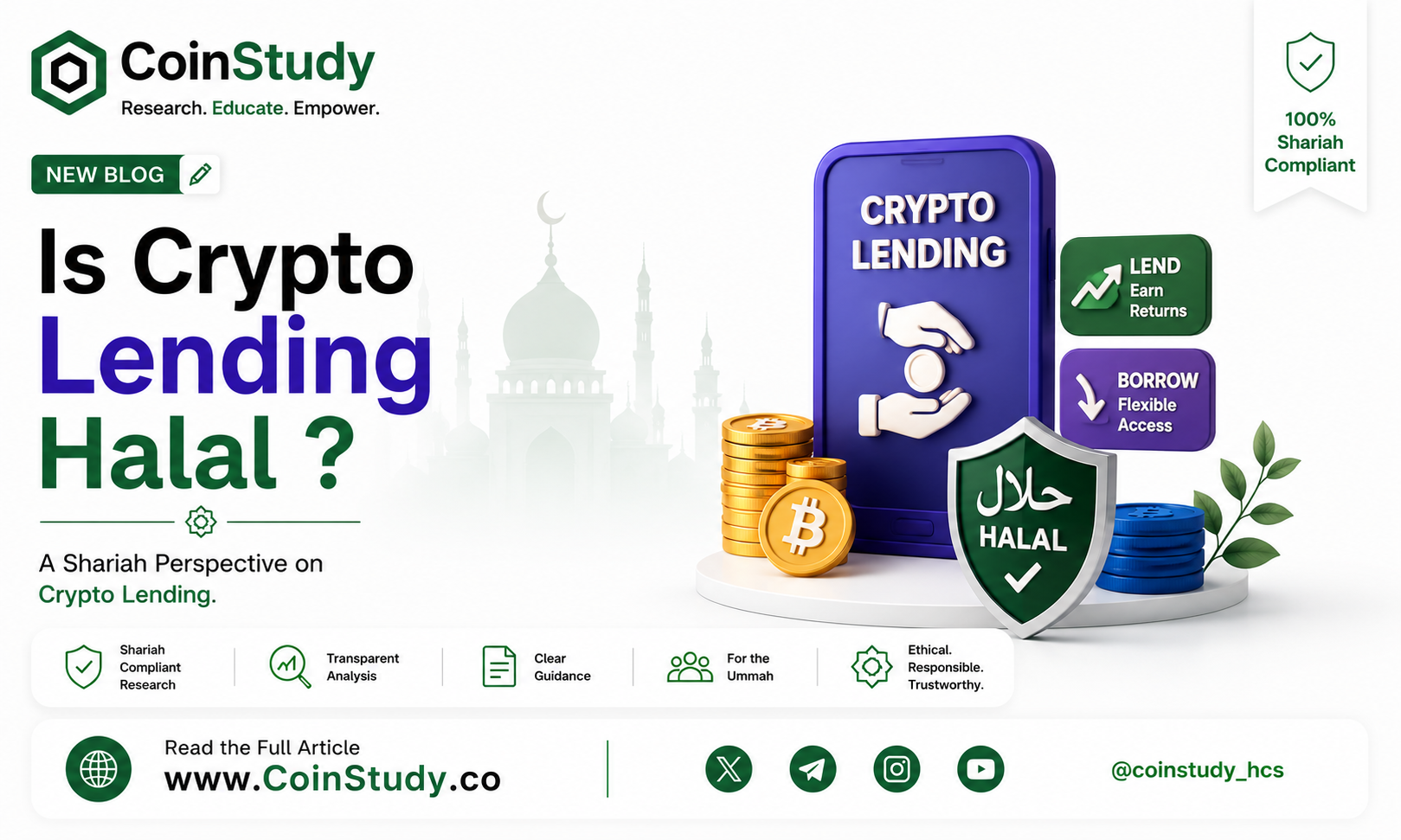
Is Crypto Lending Halal or Haram? A Complete Islamic Finance Guide
Passive income is one of the most powerful concepts in personal finance.
Put your money to work. Let it grow while you sleep. Earn returns without active effort. These ideas have driven billions of dollars into crypto lending platforms, where users deposit their crypto assets and receive ongoing yield in return.
For Muslim investors, the appeal of passive income is understandable. But the appeal of an activity and its permissibility under Islamic finance are two entirely separate questions. And when you examine crypto lending precisely, the Islamic finance assessment becomes one of the clearest and most unambiguous rulings in the entire crypto space.
Crypto lending is built around the single financial relationship that Islamic finance prohibits most clearly and most explicitly: lending capital in exchange for a predetermined return.
We examined crypto lending comprehensively through CoinStudy's Halal Crypto Standard (HCS) framework and consulted our Shariah Board Chairman Dr. Mufti Usman Quddus, PhD in Islamic Studies and Finance under AAOIFI standards. Here is the complete picture.
Quick Verdict: Crypto Lending Is Haram ❌
Crypto lending fails the CoinStudy HCS Sharia red-line screening. The Ecosystem Riba Exposure and Guaranteed Interest red lines are triggered directly and unambiguously by the core mechanism of every crypto lending product. No further scoring is required.
This is not a nuanced grey area. It is one of the clearest compliance assessments in our entire analysis series.
What Is Crypto Lending?
Crypto lending is a financial service where depositors supply cryptocurrency assets to a platform or protocol, which then lends those assets to borrowers. In exchange for supplying their assets, depositors earn ongoing yield. Borrowers receive temporary access to assets they do not own, in exchange for paying ongoing fees and providing collateral.
The activity exists in two primary forms.
Centralized crypto lending platforms like Nexo, BlockFi, and Celsius operated as companies that accepted crypto deposits, paid yield to depositors, and lent those assets to institutional borrowers at higher rates. The platforms captured the spread between what they paid depositors and what they charged borrowers as profit.
Decentralized lending protocols like Aave, Compound, JustLend, Kamino, and Morpho operate through smart contracts rather than through centralized companies. Depositors supply assets to liquidity pools and receive continuously accruing yield tokens representing their deposits plus accumulated interest. Borrowers take over-collateralized loans from these pools and pay algorithmically determined interest rates.
The technical implementation differs between centralized and decentralized forms. The economic relationship is identical. Lender provides capital. Borrower uses capital. Borrower pays ongoing fee proportional to capital amount and time elapsed. Lender receives that fee as yield.
How Crypto Lending Works — The Mechanics That Matter for Islamic Finance
Understanding the precise mechanics is essential because the Islamic finance assessment follows from the mechanics, not from the labels.
When a user deposits USDC into Aave, they immediately receive aUSDC tokens. These tokens automatically increase in quantity over time, with new aUSDC tokens continuously minted to represent the accumulated interest income from borrowers. A depositor who supplies 1,000 USDC will find their aUSDC balance growing to 1,020, 1,040, and 1,060 over time without taking any additional action. The yield accrues automatically and continuously.
The interest rate in DeFi lending is determined algorithmically based on utilization, which is the proportion of the total pool that is currently borrowed. When more of the pool is borrowed, the protocol raises interest rates automatically, incentivizing more deposits and discouraging more borrowing. When less is borrowed, rates fall.
Borrowers must over-collateralize their loans, typically providing 130% to 200% of the loan value as collateral. If the collateral value falls below a liquidation threshold, the smart contract automatically sells the collateral and repays the loan, protecting depositors from default.
From the depositor's perspective, the relationship is simple. They provide capital. Time passes. They receive more capital than they provided as a predetermined proportional return on the original amount. This is the financial relationship Islamic finance has prohibited for over 1,400 years.
Why Crypto Lending Is So Popular
Before the Islamic finance assessment, it is worth acknowledging why crypto lending has attracted so many users including Muslim investors.
The returns can be genuinely significant, ranging from 4% to 20% or higher on various assets depending on market conditions. The process requires no active management once assets are deposited. Major DeFi lending protocols have operated for years with substantial security audits. The smart contract execution is transparent and publicly verifiable.
For Muslim investors watching non-Muslim peers earn substantial passive income through these platforms, the psychological pressure to rationalize participation is real. CoinStudy acknowledges this honestly. The financial attractiveness of crypto lending is genuine. The compliance problem is equally genuine.
The Islamic Finance Analysis — Why Crypto Lending Is Haram
Riba — The Central and Decisive Concern
This is not a peripheral concern or an edge case. It is the foundational prohibition of Islamic finance applied to a mechanism that perfectly replicates the prohibited structure.
Riba is the Arabic term for interest and refers to any predetermined financial return on capital that is not connected to genuine productive economic risk-sharing. Islamic finance scholars across all four major schools of thought, Hanafi, Maliki, Shafi'i, and Hanbali, are unanimous in prohibiting Riba. The Quranic prohibition is stated directly and without qualification.
The definition of Riba has three core characteristics. Capital is provided to another party. A predetermined proportional return is expected in addition to the return of the original capital. The passage of time is the mechanism generating the additional return rather than genuine productive economic participation.
Crypto lending exhibits all three characteristics simultaneously.
You deposit 1,000 USDC. You lend this capital to the lending pool which in turn lends it to borrowers. You receive a return proportional to the 1,000 USDC you deposited and the time it has been deposited. The return is calculated as a percentage of the deposited capital over time. You do not take entrepreneurial risk in any productive business. You do not share in the genuine losses if borrowers cannot repay. You receive a predetermined yield on your capital as a function of time.
This is Riba. Not in a technical edge-case sense. In the most direct and unambiguous sense possible. The mechanism of crypto lending is the mechanism that Riba prohibits, implemented through a smart contract rather than a conventional bank.
CoinStudy's Shariah Board Chairman Dr. Mufti Usman Quddus has confirmed this directly: "Taking profit on a loan is Haram in Islamic jurisprudence."
Gharar — Secondary but Real
Crypto lending does introduce genuine Gharar concerns beyond the primary Riba failure. Smart contract risk means depositors face uncertainty about whether the code will behave exactly as intended under all conditions. Platform insolvency risk in centralized lending means depositor funds could be lost if the platform fails, as happened with Celsius in 2022. Oracle manipulation risk in DeFi lending means liquidation triggers could be exploited, potentially resulting in unfair liquidations.
These Gharar concerns are real and add to the compliance concerns surrounding crypto lending. However they are secondary. The Riba failure is decisive on its own. Even a perfectly secure crypto lending platform with zero smart contract risk would still fail the Islamic finance assessment because of the fundamental interest-based economic relationship at its core.
Maysir — A Contextual Concern
Crypto lending is not itself a gambling mechanism in the direct sense that perpetual futures trading is. The depositor is not betting on a price prediction. However the broader ecosystem of crypto lending can encourage Maysir-adjacent behavior, particularly when high-yield lending attracts speculative capital deployment in volatile market conditions or when complex yield farming strategies use lending positions as components in leveraged speculative strategies.
Maysir is not the primary compliance failure here. Riba is. But the Maysir concern is real in the broader ecosystem context.
Types of Crypto Lending — All Forms Assessed
Centralized Lending Platforms
Centralized platforms like Nexo operate as companies that accept crypto deposits, promise yield returns, and lend to borrowers at higher rates. The company earns the spread.
Islamic finance assessment: Haram ❌
The yield paid to depositors is interest income from the platform's lending activity. The structure is identical to a conventional savings account or money market fund. The fact that the underlying assets are cryptocurrencies rather than fiat currency does not change the economic relationship. A savings account denominated in Bitcoin that pays 8% annual interest is still a savings account paying interest.
DeFi Lending Protocols
Protocols like Aave, Compound, JustLend, and Morpho operate through smart contracts where algorithmically determined interest rates govern deposits and borrowing.
Islamic finance assessment: Haram ❌
The smart contract implementation does not change the economic substance. Depositors supply capital. Borrowers pay interest. Interest distributes to depositors. The algorithm managing the rates does not transform interest into something else. Decentralization does not transform the prohibited financial relationship. The chairman's ruling applies directly: taking profit on a loan is Haram regardless of whether the loan is managed by a bank or an Ethereum smart contract.
Collateralized Loans Where You Are the Borrower
Some Muslim investors ask about the permissibility of taking crypto loans rather than giving them, specifically collateralized loans where they receive USDC against their BTC or ETH collateral.
Islamic finance assessment: Haram ❌
Borrowing at interest is the same prohibited relationship viewed from the other side. Riba applies to both parties in an interest-based loan arrangement. The Islamic prohibition covers both the giving and receiving of interest. A Muslim who takes a collateralized crypto loan at 8% interest is engaging in the same prohibited financial arrangement as one who provides the capital earning that 8%.
Yield Accounts and Earn Products
Exchange yield products like Binance Earn and similar products at Crypto.com, OKX, and Coinbase where users deposit assets and receive advertised APY returns.
Islamic finance assessment: Haram ❌
The relabeling of interest income as yield, APY, or earn returns does not change the underlying financial relationship. A predetermined percentage return on deposited capital over time is interest regardless of what it is called. CoinStudy has consistently identified advertised APY products across exchange platforms as Guaranteed Interest violations in our exchange token analysis series, classifying BNB, CRO, OKB, and other exchange tokens as Haram partly because these earn products form a core part of their ecosystems.
Flash Loans
Flash loans are a unique DeFi-specific mechanism where users borrow large amounts without collateral on the condition that the loan is repaid within the same transaction block. They are used primarily for arbitrage, liquidations, and complex DeFi strategies.
Islamic finance assessment: Haram ❌
Flash loans charge fees that function as interest on the borrowed amount. The fact that the loan is repaid within a single blockchain transaction does not eliminate the interest-like fee structure. Additionally flash loans are primarily used to execute complex arbitrage and liquidation strategies in DeFi, activities that themselves raise independent Maysir and Gharar concerns.
Peer-to-Peer Crypto Lending
Some platforms facilitate direct lending between individuals rather than through institutional pools.
Islamic finance assessment: Haram ❌
The identity of the counterparty does not change the financial relationship. A peer-to-peer loan at interest is still a loan at interest. Islamic finance does not permit individual-to-individual interest transactions any more than institutional ones. The prohibition applies to the financial structure, not to the identity or scale of the parties involved.
Common Rationalizations and Why They Fail
Muslim investors sometimes encounter arguments attempting to justify crypto lending as permissible. These arguments deserve honest engagement and honest rebuttal.
The Risk Argument
Some argue that because crypto lending involves risk, including smart contract risk, platform risk, and asset price volatility, it is closer to profit-sharing than to interest.
This argument fails. The presence of risk does not transform interest into profit-sharing. A conventional bank deposit carries risk. The bank could fail. Interest payments could be suspended. These risks do not make bank interest permissible under Islamic finance. What distinguishes permissible profit-sharing from prohibited interest is not the presence of risk but the structure of the financial relationship. Genuine profit-sharing involves shared ownership of productive activity with variable returns tied to actual business performance. Crypto lending involves a loan with a predetermined proportional return regardless of what the borrowed capital is used for and regardless of whether it generates genuine productive value.
The Technology Argument
Some argue that smart contracts are different from conventional banking contracts and therefore represent a new financial instrument that Islamic scholars have not yet addressed.
This argument fails. Islamic finance evaluates economic substance, not technological implementation. The economic substance of lending 1,000 USDC to a smart contract and receiving 1,080 USDC in return after one year is identical to the economic substance of depositing $1,000 in a conventional bank account at 8% annual interest. The smart contract is the mechanism. The financial relationship is the same.
The Labeling Argument
Some argue that because the return is called yield, APY, liquidity rewards, or protocol revenue sharing rather than interest, it is a different type of income.
This argument fails. Islamic finance evaluates the economic reality of financial arrangements, not the labels applied to them. The Prophet Muhammad, peace be upon him, warned against transactions that change the form of Riba while maintaining its substance. Calling interest yield does not change what it is.
The Mudarabah Argument
Some argue that lending protocols where depositors and borrowers share in the protocol's overall activity resemble Mudarabah, the Islamic profit-sharing arrangement.
This argument fails for a precise and important reason. In genuine Mudarabah, the capital provider's return varies with the actual productive performance of the business using the capital. If the business loses money, the capital provider loses their principal. In crypto lending, the depositor's yield accrues continuously regardless of whether the borrower's activities generate genuine productive value, and the depositor is protected from loss through over-collateralization that forces borrower liquidation rather than sharing in genuine business losses.
CoinStudy HCS Screening Results
Layer 1 — Sharia Red Line Screening
Ecosystem Riba Exposure — ❌ Failed. Every form of crypto lending is directly built around lending capital in exchange for predetermined proportional returns. This is the definition of the financial relationship Riba prohibits.
Guaranteed Interest — ❌ Failed. Crypto lending platforms explicitly advertise and deliver predetermined percentage returns on deposited capital including fixed APY rates on centralized platforms and algorithmically determined but continuously accruing yield rates on DeFi protocols.
Gambling and Betting — ✅ Passed. Crypto lending is not itself a gambling mechanism, though the broader ecosystem can encourage speculative behavior.
Haram Industry — ✅ Passed.
Synthetic Interest Products — ✅ Passed in the direct sense, though yield tokens like aUSDC that continuously appreciate to represent accumulated interest could be considered synthetic interest instruments. The primary failures of Ecosystem Riba Exposure and Guaranteed Interest are already decisive.
Two red lines failed. Under the CoinStudy HCS framework, any single red-line failure results in an automatic Haram classification. Two failures makes this result definitive and unambiguous.
Overall Result: Haram — Red Line Violations
What Muslim Investors Should Do Instead
CoinStudy does not simply identify what is prohibited. We aim to help Muslim investors find genuinely permissible alternatives that serve similar practical needs.
For liquidity needs: If you need access to capital and hold crypto assets, the permissible approach is to sell the assets you hold rather than to borrow against them at interest. If you need to maintain your crypto position while accessing liquidity, this is a genuine practical challenge that does not have a straightforward Islamic finance solution in current DeFi. Consult a qualified Islamic finance scholar for guidance specific to your situation.
For passive income: Proof of Stake staking on permissible networks, where rewards come from genuine network security participation rather than from lending capital to borrowers, represents a more defensible alternative that many Islamic finance scholars view as closer to permissible under Ijarah principles. CoinStudy's halal staking guide at coinstudy.co/halal-staking covers specific staking opportunities we have assessed as permissible.
For yield on stable value: This is the most difficult need to address within current permissible boundaries. CoinStudy has consistently classified all major dollar-pegged stablecoin yield products as Haram. Physical commodity-backed tokens like PAX Gold and Tether Gold, classified as Halal at 86 and 81 out of 100 respectively, provide stable value without the interest-based reserve structures of dollar-pegged stablecoins, though they carry gold price volatility rather than dollar stability.
For genuine profit-sharing structures: As the Islamic fintech space matures, genuinely Mudarabah-compliant structures where returns vary with actual productive business performance rather than being predetermined on deposited capital are being developed by platforms like HalalFi. CoinStudy will analyze these as they become available and mature enough to assess comprehensively.
The Chairman's Direct Ruling
CoinStudy's Shariah Board Chairman Dr. Mufti Usman Quddus, PhD in Islamic Studies and Finance, AAOIFI standards, has confirmed directly regarding lending and interest: "Taking profit on a loan is Haram in Islamic jurisprudence."
This ruling applies to crypto lending in all its forms. The blockchain implementation does not change the underlying financial relationship that the chairman's ruling addresses.
The chairman has also noted one important nuance regarding lending structures: "If lending is structured as a genuine Musharakah partnership agreement rather than a simple loan, with genuine profit and loss sharing rather than predetermined interest-like returns, the profit becomes permissible." However in practice, no current major DeFi lending protocol is structured as genuine Musharakah. The existence of this theoretical permissible path does not make current lending protocols permissible, since they universally operate as interest-bearing loan mechanisms rather than genuine profit-and-loss sharing partnerships.
Important Questions for Muslim Investors
Before considering any crypto lending activity, ask yourself honestly.
Am I depositing capital and receiving a return that is proportional to the amount deposited and the time elapsed, regardless of what happens with the borrowed capital? Does this return accrue automatically and continuously without any action on my part? Is the return predetermined, advertised as a specific APY or yield rate, before I deposit? Would I recognize this financial relationship as interest if it were implemented by a conventional bank rather than a smart contract? Would I be comfortable explaining this arrangement to a qualified Islamic scholar and asking them directly whether it constitutes Riba?
Final Verdict
Crypto lending is classified as Haram / Non-Compliant under the CoinStudy Halal Crypto Standard, across all forms including centralized platforms, DeFi protocols, collateralized loans, exchange earn products, peer-to-peer lending, and flash loans.
The compliance failure is not about the technology, the label applied to the returns, or the specific assets involved. It is about the fundamental financial relationship that every form of crypto lending creates. Capital is provided. A predetermined proportional return is generated as a function of time. This is Riba regardless of implementation.
Muslim investors deserve to understand this clearly and honestly rather than encountering rationalized justifications that change the labels without changing the substance. Crypto lending can be financially attractive. That attractiveness does not change what it is.
For Muslim investors seeking passive income from crypto assets, permissible alternatives exist. They involve participating in genuine productive economic activity through Proof of Stake validation and network security rather than lending capital to earn interest.
Read detail analysis of following coins here:
Is DeFi Halal?
Halal Staking Guide
Is Indirect Riba Exposure Haram?
Learn Halal Trading Strategies with CoinStudy Partner
Halal Staking with Sharia Compliant Validator & CoinStudy Partner
Disclaimer: This article is provided for educational and research purposes only and does not constitute a formal fatwa. The scholarly ruling included reflects the position of CoinStudy's Shariah Board Chairman Dr. Mufti Usman Quddus. Muslim investors should consult a qualified Islamic scholar for personal guidance specific to their situation and the specific platforms they are considering.