


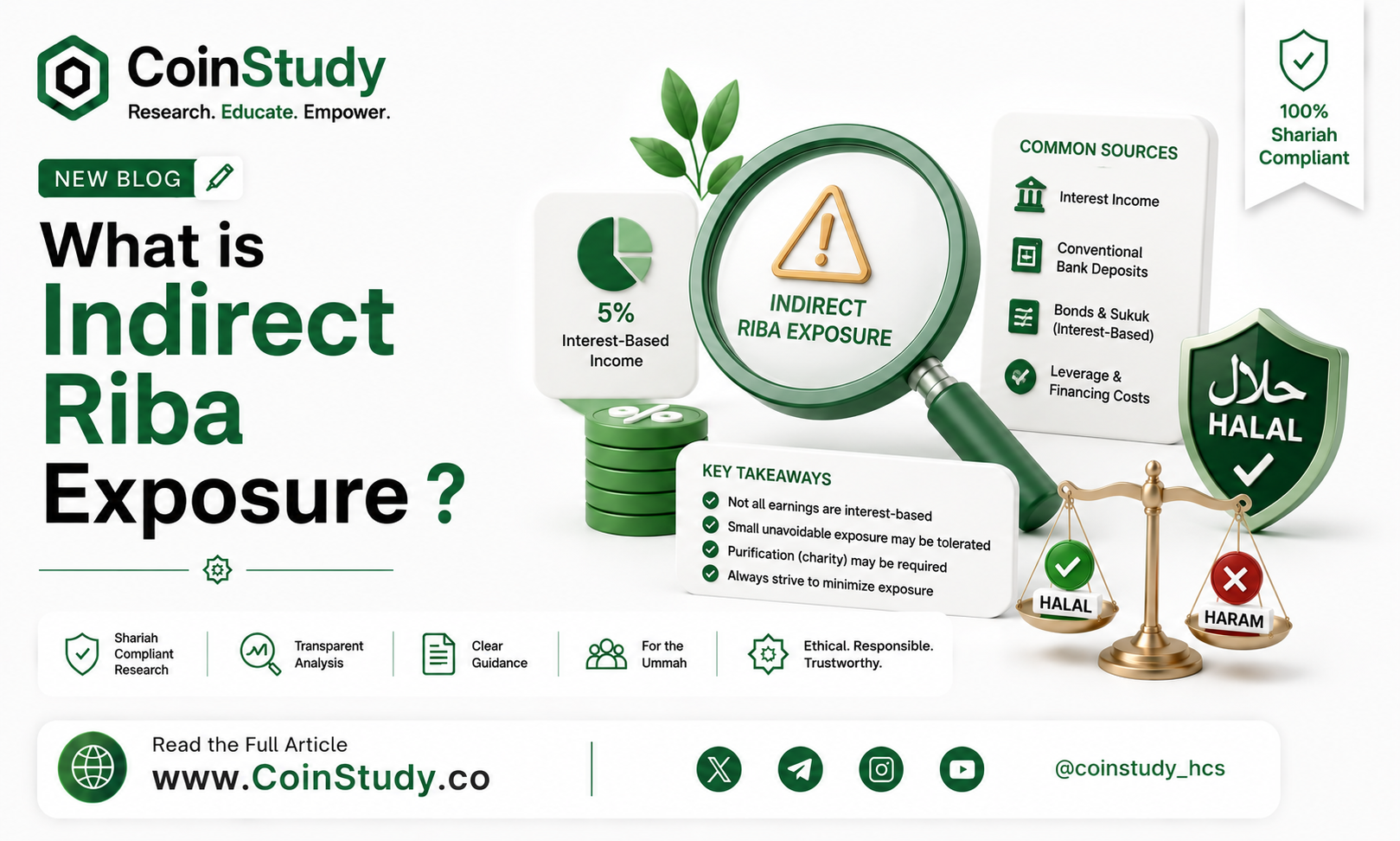
Is Indirect Riba Exposure Haram?
Every few weeks a thoughtful Muslim investor asks CoinStudy a version of the same question.
I understand that Binance offers interest-based products. But when I hold BNB, I am not earning interest directly. I am not depositing in their earn program. I am not using their lending products. My return comes from price appreciation, not from Riba income. Why does that make BNB haram?
This is not a naive question. It is a sophisticated and honest fiqh inquiry that deserves a thorough and direct answer. And the answer has implications far beyond BNB. It applies to every exchange token, every DeFi governance token, and every crypto asset whose value is primarily driven by prohibited financial activity.
The Question Being Asked
The specific challenge raised to CoinStudy's analysis can be summarized precisely.
With conventional bank shares, you own part of the business and your return comes directly from what the bank earns. The connection between prohibited revenue and shareholder return is more direct.
But with a token like BNB, if the price goes up because more people use Binance, is that the same as owning the revenue itself? Price appreciation and direct profit participation do not seem exactly the same.
This is a genuine and important distinction worth taking seriously. Let us examine it honestly.
The Distinction Is Real But Does Not Change the Ruling
The person raising this challenge is correct about one thing. Price appreciation and direct dividend income are structurally different.
When you hold BNB and its price rises, you are not receiving a direct payment from Binance's interest income. You are experiencing an increase in the market value of your token. The mechanism is different from receiving a dividend check funded by Riba earnings.
But Islamic finance scholarship does not require direct payment of prohibited income to establish a compliance failure. The question it asks is different and more fundamental.
The question Islamic finance asks is this. What is the primary source of economic value that causes this asset to appreciate?
If the primary driver of an asset's price appreciation is the growth of prohibited financial activity, then the holder of that asset benefits economically from that prohibited activity through price appreciation. The form of the benefit, whether direct dividend or indirect appreciation, does not change the economic reality of what is driving the value.
The AAOIFI Standard — The Authoritative Reference
The Accounting and Auditing Organization for Islamic Financial Institutions, known as AAOIFI, is the primary international standard-setting body for Islamic finance. Their equity screening standards are used by Islamic banks, investment funds, and Shariah boards globally.
AAOIFI's equity screening methodology establishes a specific and important principle. A company whose primary revenue comes from prohibited activities makes its shares non-compliant regardless of how shareholders receive their return.
AAOIFI does not distinguish between companies that pay dividends funded by Riba and companies whose share price appreciates because of Riba revenue. The compliance failure attaches to the economic relationship between the asset's value and the prohibited activity, not to the specific mechanism through which value reaches the shareholder.
This principle makes intuitive sense when examined carefully. Consider two scenarios.
Scenario A: A conventional bank pays its shareholders a quarterly dividend funded directly by interest income earned from its loan portfolio.
Scenario B: A conventional bank reinvests all profits rather than paying dividends. Its share price rises as the market recognizes its growing interest income and expanding loan portfolio.
Under a narrow reading focused only on the direct receipt of Riba income, only the shareholder in Scenario A would face a compliance concern. The shareholder in Scenario B never directly receives interest income. Their return comes from price appreciation.
Islamic finance scholarship correctly rejects this narrow reading. The shareholder in Scenario B benefits economically from the bank's Riba-generating activity just as clearly as the shareholder in Scenario A. The form of the economic benefit is different. The economic substance is the same. Both shareholders hold assets whose value is primarily driven by prohibited activity.
The BNB Analysis — Applying the Standard
With this principle established, the BNB analysis becomes straightforward.
BNB is the native utility token of the Binance ecosystem. Binance generates enormous revenue from lending products where users deposit capital and pay interest charges on loans, earn programs with advertised APY rates where users deposit assets and receive guaranteed percentage returns funded by interest income, perpetual futures markets where traders pay leverage financing fees and funding rates between position holders, and margin trading where traders pay ongoing interest on borrowed capital.
These are not peripheral features of Binance. They are its primary revenue drivers. The earn programs and lending products in particular represent some of the highest-margin financial products on the platform.
BNB's price appreciation is directly connected to this revenue in a documented and structural way. Binance uses a portion of its quarterly profits to buy back and burn BNB tokens. The more revenue Binance generates from its products including its Riba-generating products, the more BNB is burned, the lower the supply, and the higher the price of remaining BNB.
This is not an indirect or speculative connection. It is an explicit, documented, contractual mechanism that directly links BNB's price to Binance's total revenue including its prohibited revenue streams.
When you hold BNB and its price rises because Binance's earn programs attracted more deposits and generated more interest income, you are benefiting economically from that Riba-generating activity. Not through a direct dividend. Through price appreciation driven by supply reduction funded by prohibited revenue.
Under AAOIFI's equity screening standard and under the broader Islamic finance principle that evaluates the primary driver of economic value, this creates a compliance failure.
The Most Direct Test
AAOIFI and mainstream Islamic finance scholarship apply a specific question to any equity or crypto token that is worth every Muslim investor knowing.
If you removed all the prohibited revenue sources from this entity, would the token or share still have the same value?
For a conventional bank, if you removed all lending and interest-based products, the bank would cease to exist in any meaningful form. Its value would collapse to near zero.
For BNB, if you removed Binance's lending products, earn programs, and perpetual futures markets, Binance would still have a spot trading platform. But it would lose the majority of its revenue. The buyback and burn mechanism would be funded by a fraction of its current income. The scarcity pressure on BNB would collapse. BNB's price would fall dramatically.
The dependency between BNB's value and Binance's prohibited revenue is not incidental. It is structural. Removing the prohibited revenue does not leave you with a slightly less valuable BNB. It leaves you with a fundamentally different and far less valuable asset.
That dependency is the compliance failure.
Why This Matters Beyond BNB
This principle applies consistently across every exchange token CoinStudy has analyzed.
LEO derives its value from Bitfinex's explicit peer-to-peer lending market where users earn interest income on lent assets. Remove the lending products and LEO's buy-and-burn mechanism loses its primary funding source.
CRO derives its value from Crypto.com's earn programs and lending services. Remove the earn products and the revenue supporting CRO's ecosystem collapses.
OKB derives its value from OKX's savings products with guaranteed returns and one of the largest perpetual futures platforms in the industry. Remove the prohibited products and OKB loses most of its value driver.
The same analysis applies to BGB, KCS, GateToken, and HTX. Eight exchange tokens. Eight parallel analyses. Eight identical conclusions reached by applying the same consistent principle.
This is not coincidence. It is the inevitable result of applying a consistent Islamic finance framework to a category of tokens that share the same fundamental business model.
The Objection Addressed Directly
Some investors will still feel that price appreciation is meaningfully different from direct profit participation and that the distinction should matter for the ruling.
This position has a logical internal consistency. But it leads to conclusions that Islamic finance cannot accept.
If price appreciation from Riba-generating activity were permissible, then a Muslim investor could hold shares in any conventional bank, any interest-charging lender, and any company whose primary business is prohibited, as long as they received their benefit through price appreciation rather than dividends. The compliance requirement would be trivially easy to engineer around by simply choosing companies that do not pay dividends.
Islamic finance does not accept this outcome because it recognizes that economic benefit from prohibited activity is prohibited regardless of the form that benefit takes. The principle is not about the mechanism of payment. It is about the source of economic value.
Riba earned by a company makes its equity non-compliant because the equity's value is derived from that Riba. Whether the equity holder receives that value as a dividend today or as price appreciation tomorrow does not change the source of the value.
The Scholarly Consensus
This position is not unique to CoinStudy. It reflects mainstream Islamic finance scholarship on equity screening.
AAOIFI's standards apply it to conventional equities. The Islamic Financial Services Board applies similar principles in their guidance. Major Islamic banks use this framework when screening equity portfolios for their customers.
CoinStudy applies the same principle to crypto tokens because the economic logic is identical. A token whose value is primarily driven by prohibited financial activity is non-compliant regardless of whether holders receive their return through direct income distributions or through price appreciation.
The application is new because the asset class is new. The principle is well-established.
What This Means for Muslim Investors
Understanding this principle has practical implications for how Muslim investors evaluate any crypto asset.
Before investing in any token, ask yourself honestly whether the entity behind this token could maintain its current value without its prohibited revenue sources. If the answer is no, the token's value is primarily derived from prohibited activity and the compliance failure exists regardless of whether your personal return comes through price appreciation rather than direct income.
This test protects Muslim investors from a form of compliance failure that would be completely invisible without understanding the underlying principle. Exchange tokens look like utility tokens that provide fee discounts. Their marketing never mentions that their value is structurally dependent on interest-bearing lending products and perpetual futures markets. Without applying this principle systematically, Muslim investors have no way of identifying the compliance failure from the surface presentation of the token.
CoinStudy's methodology applies this test systematically to every token we analyze. It is why eight consecutive exchange tokens have received Haram classifications. Not because CoinStudy is searching for reasons to classify things as haram. Because the honest application of this principle to the business models of major exchanges consistently produces the same outcome.
Final Verdict
Price appreciation from the growth of prohibited financial activity is not permissible under Islamic finance principles even when the investor does not directly receive interest income.
The AAOIFI standard and mainstream Islamic finance scholarship evaluate compliance based on the primary source of economic value driving an asset's price. When that primary source is Riba-generating activity, the compliance failure exists regardless of the mechanism through which value reaches the investor.
For Muslim investors who hold exchange tokens, the question to ask is not whether you personally use the prohibited products on that exchange. The question is whether the exchange token's value would survive the removal of those prohibited products. For every major exchange token CoinStudy has analyzed, the honest answer is no.
That is the compliance failure. And that is why the ruling is the same whether your return comes through dividends or through price appreciation.
Read the detail analysis of following coins here:
Is BNB Halal?
Why Are Exchange Tokens Haram?
What Is Ecosystem Riba Exposure?
Disclaimer: This article is provided for educational and research purposes only. CoinStudy does not provide personal financial or religious rulings. Investors should consult qualified Islamic scholars for individual guidance.