

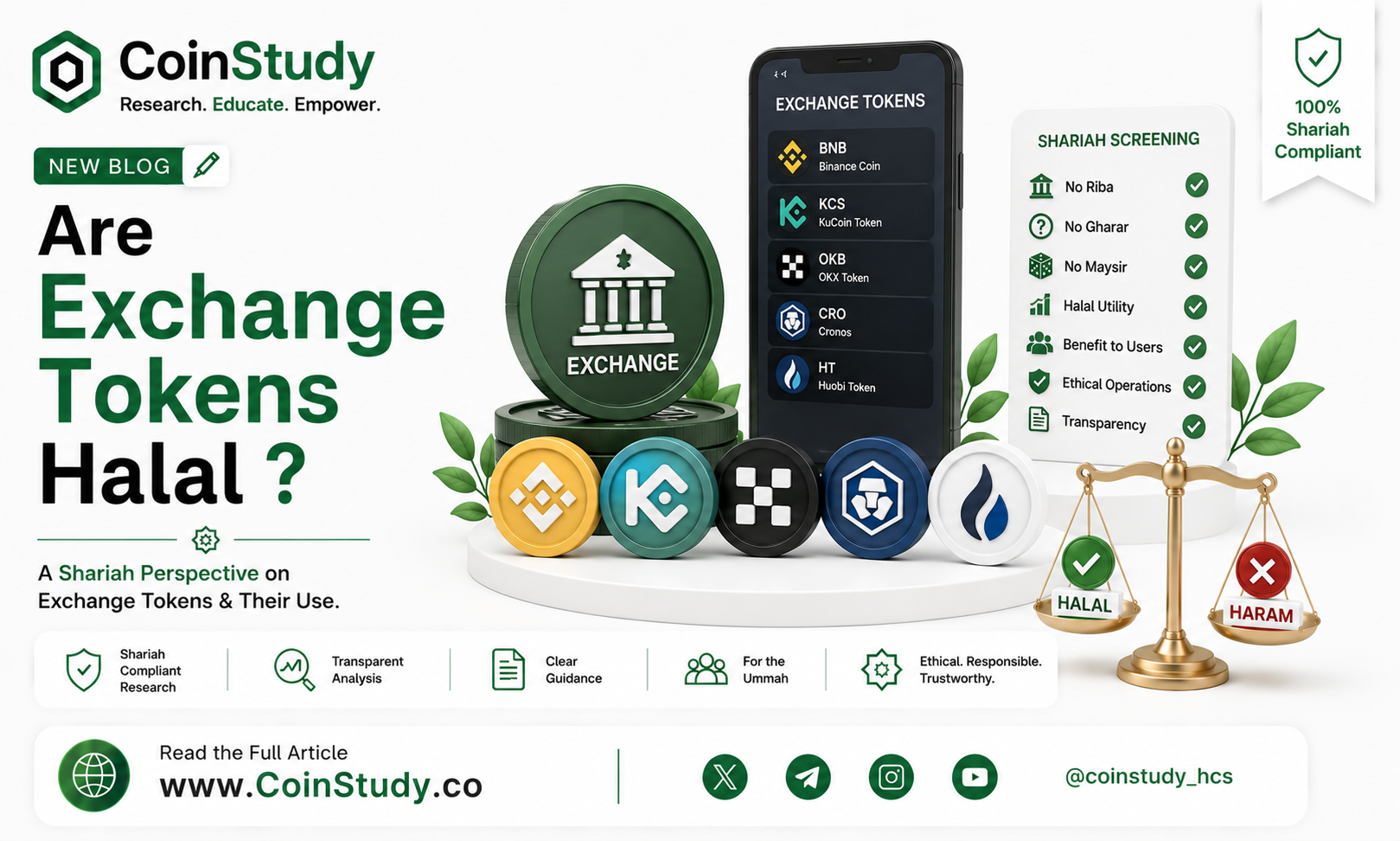
Why Are Exchange Tokens Haram?
If you have spent any time researching halal crypto investments, you have probably noticed a pattern on CoinStudy.
BNB — Haram.
LEO — Haram.
CRO — Haram.
OKB — Haram.
BGB — Haram.
KCS — Haram.
GateToken — Haram.
HTX — Haram.
Eight consecutive exchange tokens. Eight consecutive Haram classifications. Not one exception.
Muslim investors often ask whether this is a coincidence or whether CoinStudy is being too strict. The honest answer is neither. It is the inevitable result of applying a consistent Islamic finance methodology to a category of tokens that share the same fundamental business model.
This blog explains exactly why exchange tokens are haram, what they all have in common, and what Muslim investors should understand before considering any exchange-native token.
What Is an Exchange Token?
An exchange token is the native cryptocurrency issued by a centralized cryptocurrency exchange. Every major exchange has one.
Binance issues BNB. Bitfinex issues LEO. Crypto dot com issues CRO. OKX issues OKB. Bitget issues BGB. KuCoin issues KCS. Gate dot io issues GateToken. HTX issues HTX token.
These tokens serve similar purposes across every platform. They give holders trading fee discounts on the exchange. They enable participation in token launches and initial exchange offerings. They provide governance rights over certain protocol decisions. They grant access to various platform privileges and enhanced features.
On the surface this sounds like straightforward utility. Holding the token saves you money on fees. That is a simple and seemingly permissible value proposition.
The compliance problem is not the token's direct utility. It is the ecosystem the token powers and benefits from.
The Core Problem — Ecosystem Riba Exposure
Understanding why exchange tokens are haram requires understanding one principle that CoinStudy applies consistently across all its analyses.
A token cannot be economically separated from the ecosystem whose growth drives its value.
Every major centralized cryptocurrency exchange generates significant revenue from the same categories of products. Interest-bearing earn programs where users deposit assets and receive ongoing percentage returns. Lending products where users borrow capital and pay financing fees. Perpetual futures markets where traders pay leverage financing fees and funding rates. Margin trading platforms where traders pay interest on borrowed capital.
These are the products that make major exchanges profitable. When these products grow, exchange revenue grows. When exchange revenue grows, the exchange's native token becomes more valuable.
BNB's value grows when Binance's lending products attract more deposits. KCS's value grows when KuCoin's earn programs generate more fee income. OKB's value grows when OKX's perpetual futures markets process more volume. The economic connection between each exchange token and the prohibited financial activities of its exchange is structural and documented.
This is precisely what CoinStudy's Ecosystem Riba Exposure red line identifies. A token that derives its value from an ecosystem that generates revenue primarily through Riba-based products inherits the compliance concerns of that ecosystem.
What Every Major Exchange Actually Does
Let us be specific about what these exchanges offer because the compliance concern is not theoretical.
Every major exchange in our analysis series offers some combination of the following products.
Earn programs where users deposit USDT, BTC, ETH, or other assets and receive advertised APY returns on their deposits. These are interest-bearing deposit products regardless of what the exchange calls them. The user deposits capital. They receive ongoing guaranteed percentage returns. The returns come from the exchange lending those deposits to borrowers who pay financing fees.
Lending and borrowing products where users can borrow assets against collateral and pay ongoing financing fees for the duration of the loan. These financing fees are interest on borrowed capital regardless of the terminology used.
Perpetual futures markets where traders open leveraged positions and pay funding rates between long and short position holders and financing fees on borrowed leverage capital. Perpetual futures involve multiple interest-like financial mechanisms simultaneously.
Margin trading where traders borrow capital from the exchange to open larger positions than their own funds would allow, paying interest on the borrowed amount for the duration of the position.
These are not fringe products on major exchanges. They are central revenue generators. The earn programs, lending products, and derivatives markets collectively generate a substantial portion of major exchange revenue. The native exchange token benefits when all of these grow.
Why the Token Cannot Be Separated From the Ecosystem
The most common defense of exchange tokens from Muslim investors is this. The token itself is just a discount token. I use it to save on fees. I am not using the lending or futures products. Why should I be penalized for what other users do on the platform?
This argument misunderstands how exchange tokens work economically.
When you hold BNB, your investment appreciates when Binance grows. Binance grows when all its revenue-generating products grow, including the lending programs, earn products, and perpetual futures markets. Your BNB appreciates partly because of the Riba-generating activity of millions of other Binance users who use those products.
You do not need to personally use the haram products for your investment to benefit from them. The economic connection is built into the token's value proposition. A token that is more valuable when a Riba-generating ecosystem grows is a token with Ecosystem Riba Exposure under CoinStudy's methodology.
Islamic finance has a well-established principle that benefits derived from prohibited activity carry the compliance concern of that activity. Holding an exchange token and benefiting from its appreciation, which is driven partly by the growth of haram financial products on that exchange, creates a compliance concern regardless of your personal usage.
The Governance Argument — Why It Does Not Help
Some exchange tokens have introduced governance mechanisms that allow token holders to vote on protocol decisions. HTX DAO is one example. The token holders can participate in decentralized governance over some ecosystem parameters.
This governance sophistication does not change the compliance outcome.
Governance rights over an ecosystem that includes Riba-based products do not make those products permissible. A DAO vote about how to structure an interest-bearing lending product is still governance over a Riba-based financial product. The decentralized decision-making process does not transform the nature of what is being decided.
Evaluating a token's compliance based on how it is governed rather than what it governs would allow almost any haram financial product to achieve a halal classification simply by adding a governance layer. CoinStudy's methodology correctly evaluates the financial activities being governed, not the governance mechanism itself.
The Eight Consecutive Haram Classifications — The Pattern
CoinStudy has analyzed eight major exchange-native tokens. Every single one received a Haram classification.
BNB powers Binance, which offers lending products, earn programs with advertised APY, and perpetual futures markets. Haram.
LEO powers the Bitfinex ecosystem, which includes lending products and professional trading infrastructure connected to interest-based financial products. Haram.
CRO powers Crypto dot com, which offers earn programs, lending services, and a derivatives trading platform. Haram.
OKB powers OKX, which offers savings products with guaranteed returns, lending programs, and one of the largest perpetual futures platforms in the industry. Haram.
BGB powers Bitget, which offers earn products, lending, and copy trading connected to leveraged positions. Haram.
KCS powers KuCoin, which offers lending, earn programs, and futures trading with leverage financing fees. Haram.
GateToken powers Gate dot io, which offers lending products, earn programs, and derivatives trading. Haram.
HTX powers the HTX exchange ecosystem, which includes lending programs, yield-generating earn products, and perpetual futures markets. Haram.
Eight different exchanges. Eight different governance structures. Eight different branding strategies. The same business model. The same compliance outcome.
What Would Make an Exchange Token Halal?
This is the more constructive question and it deserves an honest answer.
An exchange token could potentially pass CoinStudy's screening if the exchange it powers offered only genuinely permissible services. Spot trading of halal-rated cryptocurrencies with no lending products, no earn programs with guaranteed returns, no perpetual futures, and no margin trading would be the foundation of a permissible exchange.
No major centralized exchange currently operates this model. The revenue model of major exchanges depends on the interest-based and derivatives products that create the compliance failures. A spot-only exchange would generate significantly less revenue than competitors who offer the full suite of financial products.
This creates an honest challenge. The most financially competitive exchange model is structurally incompatible with Islamic finance principles. Until an exchange is built that is deliberately designed to serve Muslim investors with exclusively permissible financial products, exchange tokens will continue to fail CoinStudy's screening.
What Muslim Investors Should Do Instead
The halal alternative to exchange tokens is straightforward. Invest in blockchain infrastructure projects with clean and permissible economic models rather than in the tokens of platforms that generate revenue from prohibited financial activities.
Bitcoin scores 95 out of 100 as Halal. It is pure payment infrastructure with no Ecosystem Riba Exposure.
Ethereum scores 88 out of 100 as Halal. Smart contract infrastructure whose core protocol has no interest-based mechanisms.
Cardano scores 90 out of 100 as Halal. Proof of Stake blockchain with research-driven governance and clean token economics.
Cosmos scores 89 out of 100 as Halal. Interoperability infrastructure with permissible validator-based staking rewards.
Akash Network scores 88 out of 100 as Halal. Decentralized cloud computing marketplace with service-based economics.
These projects provide genuine blockchain infrastructure value without the Ecosystem Riba Exposure that makes exchange tokens haram. They are investments in productive technology rather than in platforms built substantially around prohibited financial products.
The Simple Test for Any Exchange Token
Before investing in any exchange-native token, ask yourself these questions honestly.
Does the exchange this token powers offer lending products or earn programs with advertised APY rates on deposited capital? Are perpetual futures and margin trading with leverage financing fees significant parts of how the exchange generates revenue? Does the token's value grow when these interest-based and derivatives products attract more users and generate more volume? Would the token be worth less if the exchange stopped offering all its lending and derivatives products tomorrow?
For every exchange token CoinStudy has analyzed, the honest answers to these questions consistently point toward the same compliance conclusion. The business model is the problem. And the business model is consistent across every major exchange.
Final Verdict
Exchange tokens are haram under CoinStudy's Halal Crypto Standard because the major exchanges that issue them generate substantial revenue from interest-bearing lending products, earn programs with guaranteed returns, and derivatives markets with leverage financing fees.
The native token of an exchange benefits economically when all the exchange's products grow. When the Riba-generating products grow, the token grows. That structural economic connection between the token's value and the prohibited financial activities of its ecosystem triggers the Ecosystem Riba Exposure red line under our methodology.
This is not methodological rigidity. It is the consistent application of a principled Islamic finance framework to a category of tokens that share the same fundamental business model. Eight exchange tokens have demonstrated that the compliance determination follows the business model, not the branding, governance structure, or individual token features.
For Muslim investors, the guidance is clear. Exchange tokens represent investments in platforms built substantially around prohibited financial products. Permissible alternatives with clean economic models exist in abundance across the halal-rated analyses on CoinStudy. The choice of where to invest is a reflection of the values you bring to every financial decision.
Read detail analysis of following coins here:
Is BNB Halal?
Is HTX Halal?
Learn how CoinStudy scores every coin
Disclaimer: This article is provided for educational and research purposes only. CoinStudy does not provide personal financial or religious rulings. Investors should consult qualified Islamic scholars for individual guidance.