


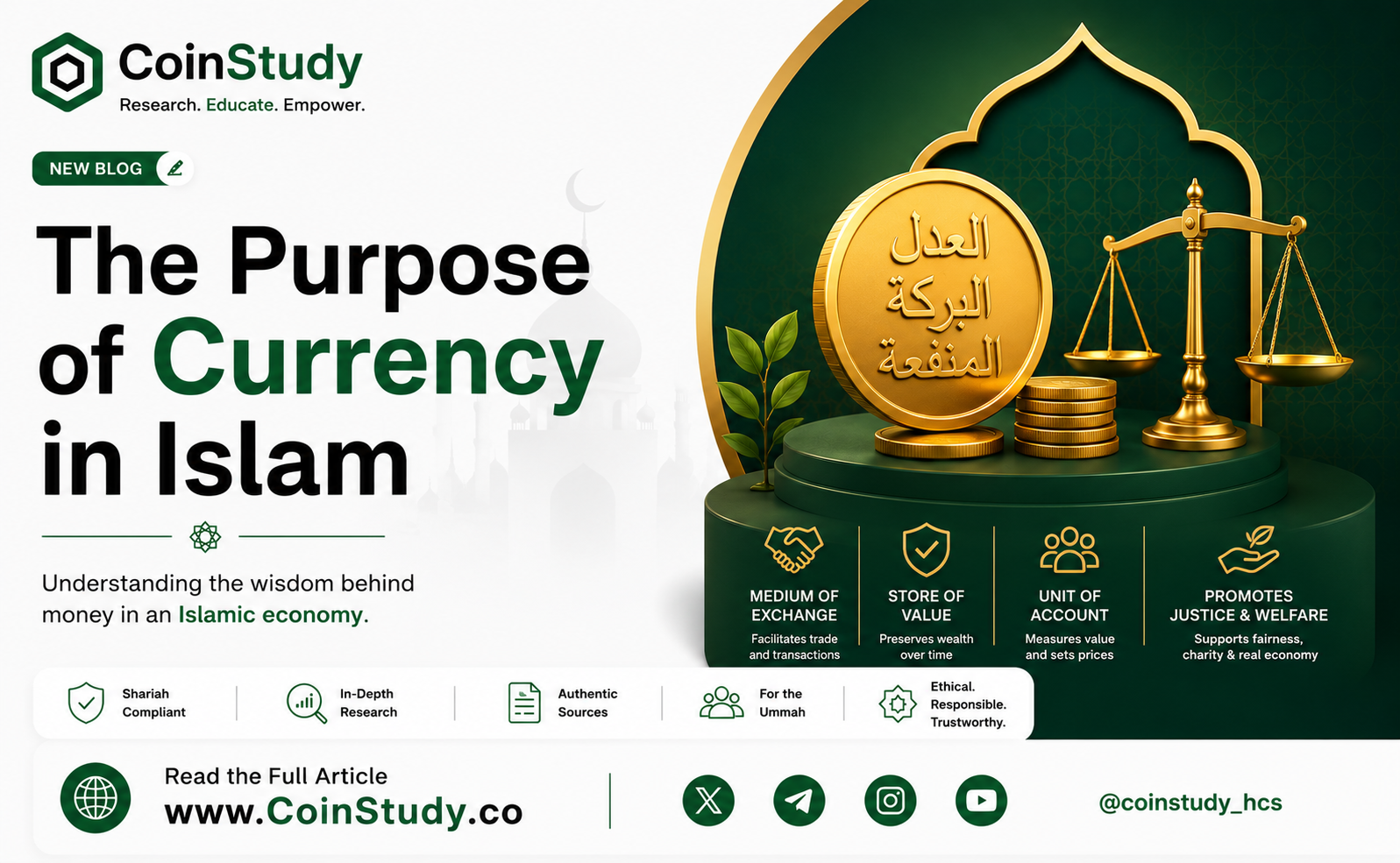
The Purpose of Currency in Islam and Where Digital Currency Stands
Money is one of the most discussed subjects in Islamic jurisprudence and one of the least understood in the context of cryptocurrency.
When Muslim investors ask whether Bitcoin is halal or whether USDT is permissible, they are asking a question that Islamic scholars have been answering in different forms for centuries. The specific asset changes. The underlying question does not. What makes a medium of exchange permissible? What conditions turn it impermissible? And how does Islamic jurisprudence apply principles developed over fourteen centuries to a financial technology that did not exist until 2009?
CoinStudy's Shariah Board Chairman Dr. Usman Quddus, PhD in Islamic Studies and Finance, has provided a foundational scholarly essay addressing these questions directly. This blog presents his complete framework for understanding currency, decentralization, and digital assets through the lens of Islamic jurisprudence.
This is not a ruling on a specific coin. It is the scholarly foundation that underlies every ruling on every coin.
Currency Serves Human Need
The starting point of Dr. Quddus's framework is not a financial definition of currency but a human one.
Human need is the foundational justification for currency's existence. Whatever serves genuine human need generates benefit. Whatever produces harm moves in the direction of prohibition. The ethical and jurisprudential boundaries of any financial instrument are determined by whether it serves the needs it was created for or whether it drifts from those needs into harm.
This framing is important because it establishes Islamic jurisprudence's fundamental approach to financial instruments. The question is never simply whether a specific mechanism exists in a hadith or a Quranic verse. The question is whether the instrument serves genuine human need and produces benefit or whether it produces harm. Islamic scholars reason from established principles to new situations by asking what the instrument actually does and who it actually serves.
For currency specifically, the purpose is straightforward. Human society requires exchange to survive and grow. People need to trade what they produce for what they need. Currency is the mechanism that makes this exchange efficient, replacing the cumbersome limitations of barter with a universally accepted medium that can be stored, transferred, and used across time and geography.
This function, facilitating productive exchange for genuine human needs, is what gives currency its moral legitimacy in Islamic jurisprudence. Currency justified by this function is permissible. Currency that drifts from this function into harmful speculation, zero-sum extraction, or deceptive uncertainty moves toward prohibition.
How Currency Evolved and What Gives It Authority
Dr. Quddus traces the historical evolution of currency to establish an important principle about what makes a medium of exchange legitimate.
From the barter of goods for goods in ancient trade to metals, then to paper, then to plastic cards, and now to digital numbers, the medium of exchange has continuously evolved in response to the practical needs of human economic life. Each transition happened because the previous form of currency could not fully serve the needs of expanding and increasingly complex human commerce.
Throughout this evolution, one element remained constant. Every form of currency that achieved genuine legitimacy did so under the authority of a state or governing institution. The metal coins of the Islamic caliphate bore the seal of authority. Paper currency derives its value from the guarantee of national governments and central banks. Plastic and digital banking infrastructure operates within tightly regulated state-supervised frameworks.
This state authority serves a specific and essential function in Islamic jurisprudence's evaluation of currency. It creates accountability. It creates a claim structure. If you are harmed in a transaction involving state-backed currency, you have recourse. There is an authority you can appeal to. There is a system that guarantees the currency's value within defined limits. The state backing of currency is not merely a political fact. It is a moral and jurisprudential feature that makes the currency trustworthy for use in legitimate commerce.
Decentralization and the Gharar Question
This is where Dr. Quddus's framework addresses cryptocurrency directly and where his analysis becomes most important for Muslim investors.
Cryptocurrency has taken the medium of exchange and done something unprecedented in monetary history. It has made it decentralized. There is no state authority that controls Bitcoin. There is no government that guarantees Ethereum's value. There is no central institution that a harmed party can appeal to if something goes wrong.
Dr. Quddus identifies this decentralization as creating what Islamic jurisprudence calls Gharar, which is the uncertainty or risk arising from insufficient information, insufficient guarantee, or insufficient accountability in a financial transaction. Because no state authority controls or backs digital currency, there is no claim available in the event of harm. If a person loses their cryptocurrency to a hack, a failed protocol, or a market collapse, there is no authority they can turn to for recourse the way a bank depositor can turn to deposit insurance or a currency holder can rely on a central bank.
This Gharar from decentralization is a genuine and honest concern that Dr. Quddus identifies without dismissing cryptocurrency entirely. He is not saying decentralization makes cryptocurrency Haram by definition. He is identifying a specific jurisprudential concern that must be factored into any honest Islamic evaluation of digital assets.
The Gharar concern is one of the reasons CoinStudy's HCS methodology includes Gharar as one of the seven weighted scoring principles in Layer 2 analysis. Every coin we analyze is assessed for the uncertainty it introduces to investors, including uncertainty arising from the absence of state-backed guarantee structures. This scholarly grounding in Dr. Quddus's framework is why the Gharar dimension appears in every CoinStudy score.
The Islamic Jurisprudence Framework for Currency Evaluation
Dr. Quddus establishes a clear framework for when currency moves from permissible to prohibited. This framework does not depend on the specific technology of the currency. It depends on what the currency does and what it produces.
Currency remains in the permissible zone when it serves its foundational purpose of facilitating genuine productive exchange for legitimate human needs. The medium can be metal, paper, plastic, or digital code. As long as it serves genuine transactional purposes between parties engaged in legitimate commerce, the medium itself is morally neutral.
Currency moves toward prohibition through three specific pathways that Dr. Quddus identifies from classical Islamic jurisprudence.
The first pathway is Riba. When currency generates one-sided benefit at the expense of the counterparty through interest, the exchange stops being mutual and productive and becomes exploitative. One party gains from the other's loss not through genuine commercial skill or service but through the mechanism of time applied to capital. This is the most fundamental and explicitly prohibited financial structure in Islamic jurisprudence.
The second pathway is Gharar. When the currency's authenticity becomes doubtful, when what is received may suddenly cease to be currency, or when the benefit expected from it becomes uncertain in a way that neither party can assess or control, this uncertainty pushes the instrument toward prohibition. Dr. Quddus applies this specifically to digital currencies where the absence of state authority creates legitimate questions about long-term value preservation and accountability in the event of harm.
The third pathway is Maysir. When currency is used not for genuine productive exchange but as a vehicle for gambling, where the primary purpose is speculative profit from price movements rather than genuine commercial activity, the currency use moves into the prohibited category regardless of the currency's own neutral nature. Dr. Quddus specifically notes that some digital currencies are created for the express purpose of enabling gambling activity, which pushes them firmly into the prohibited category.
These three pathways, Riba, Gharar, and Maysir, are precisely the three primary compliance dimensions that CoinStudy's HCS red-line screening and Layer 2 scoring are designed to assess in every coin analysis. Dr. Quddus's scholarly framework is the direct jurisprudential foundation for CoinStudy's methodology.
The Digital Age Demands Scholarly Engagement
The final and arguably most important section of Dr. Quddus's essay addresses what Islamic scholarship must do in response to the digital revolution.
The digital age has created what amounts to a digital revolution in human civilization. Investment, education, asset protection, and the basic mechanisms of economic life have become digitized. This transformation is not peripheral or temporary. It is foundational and ongoing.
Dr. Quddus identifies a specific need arising from this transformation. Digital currencies need to move toward centralization in a way that makes the uncertainty within them more transparent. Their use should be made more beneficial for the genuine societal needs they can serve. This is a scholarly prescription for the development of digital finance rather than a rejection of it.
The most significant point in this section is one that Muslim scholars and Islamic institutions should take seriously as a challenge and a responsibility. Dr. Quddus warns that if Islamic scholarship responds to the digital revolution by ignoring the genuine human needs it serves, by focusing only on prohibitions without understanding the purposes behind those prohibitions, and by taking positions that delay the Muslim community's access to the shared rights and benefits of the digital age, then religious scholarship will make itself irrelevant in the digital era.
This is a remarkably forward-looking position from a PhD Islamic finance scholar trained under AAOIFI standards. It reflects the highest tradition of Islamic jurisprudence which has always engaged seriously with new commercial realities rather than simply refusing to acknowledge them. The scholars who formulated the classical principles of Islamic commercial law were engaging with the most complex financial instruments of their time. The scholars of the digital age must do the same.
For CoinStudy, this is the deepest scholarly justification for why this platform exists. The Muslim community deserves rigorous, honest, and scholarly engagement with digital finance rather than blanket prohibition or uncritical acceptance. Dr. Quddus's framework provides the jurisprudential compass that makes that engagement possible.
What This Means for Muslim Investors Today
Dr. Quddus's framework translates into practical guidance that aligns directly with CoinStudy's HCS methodology.
A cryptocurrency that facilitates genuine productive exchange without Riba, without prohibited Gharar, and without Maysir serves legitimate human needs and is permissible. Bitcoin at 95 out of 100, Ethereum at 88 out of 100, Solana at 87 out of 100, and dozens of other coins in our Halal analysis library reflect this assessment.
A cryptocurrency whose primary mechanism generates interest-like returns for depositors, distributes guaranteed percentage yields, or creates synthetic interest instruments fails the Riba pathway. Aave, Compound, Morpho, Maple Finance, and every DeFi lending protocol in our Haram library reflect this assessment.
A cryptocurrency created specifically for gambling, speculative wagering, or zero-sum financial extraction fails the Maysir pathway. Pump.fun, Hyperliquid, and perpetual futures platforms in our Haram library reflect this assessment.
A cryptocurrency whose fundamental uncertainty goes beyond normal commercial risk into the kind of contractual ambiguity that harms participants without recourse accumulates Gharar in a way that requires caution or avoidance. The Gharar scoring across every analysis in our library reflects this assessment.
Dr. Quddus's framework does not make these assessments easy. It makes them principled. The question is always what the instrument actually does, who it actually serves, and whether the benefit or harm it produces aligns with or contradicts the purposes that Islamic jurisprudence has always used to evaluate commercial activity.
Chairman's Statement
The following is the direct statement of CoinStudy's Shariah Board Chairman Dr. Usman Quddus, PhD in Islamic Studies and Finance, on the purposes of currency and digital currency in Islamic jurisprudence.
"Human need will either produce benefit or harm for human beings. Both benefit and harm are divided into necessity and need, which clarifies the ethical and jurisprudential scope of currency.
Whether a metal or paper becomes currency, its exchange being a secure and stable medium depends on state authority.
In human society, survival and growth require exchange to the degree necessary to sustain the business of life and promote its development. Just as the exchange of goods for goods in the past was one factor of this survival and growth, which under economic necessity demanded an alternative whose journey has come from metal through paper and plastic to numbering.
But all these activities remained under state and governmental institutions, which made this need secure.
Decentralization. In current circumstances, currency has taken a new form under the purpose of need. It has made commercial profit and the mode of transition decentralized, meaning the authority aspect of currency has been made non-state. There is no authority that has complete control over digital currency. In this context this currency is creating factors of insecurity which in Islamic ethics is described as Gharar: that due to the absence of any state authority no claim of any kind can be made in the event of harm.
Islamic jurisprudential context. In Islamic law, economics is viewed in connection with sociology. The outcome is divided through jurisprudential reasoning into ethical and unethical, meaning the currency's essence is connected with other factors and elements, its benefit and harm are brought under discussion, and a jurisprudential ruling is stated: from which aspect will the justification of permissibility remain for the use of currency and at what point will the application of prohibition be applied to it.
If the purpose of currency moves from attracting benefit into the circle of harm, its situation moves toward prohibition. Like Riba which is interest, meaning one-sided benefit and the other party's loss. Like Gharar, meaning the currency's authenticity becomes doubtful such that after acquisition it suddenly ceases to be currency or uncertainty arises in the benefit to be obtained from it. This situation will also lead toward prohibition. If currency becomes involved in factors other than its fundamental purpose, such as some digital currencies being created specifically for gambling which is Maysir, this aspect will also lead toward prohibition.
The digital age and digital currency. This era has almost created a digital revolution and has made survival and growth conditional on digital progress. Investment, education and learning, and the need to protect wealth have become digital.
The role and stature of this growth requires that digital currencies be centralized so that uncertainty can be made transparent and their use can be made more beneficial for societal needs.
If in this revolution, positions are taken without understanding human needs, ignoring the purposes behind the causes of permissibility and prohibition, and these positions become a cause of delay in the shared rights and benefits of the human community, then the religious role will make its time irrelevant in the digital age."
Read detail analysis of following coins here:
Is DeFi Halal?
Is Solana Halal?
Are Meme Coins Halal?
Is Crypto Lending Halal?
Top 10 Halal Cryptocurrencies 2026
Learn Halal Trading Course with CoinStudy Partner
Check your Airdrop Eligibility with CoinStudy Partner
Halal Staking with Sharia Compliant Validator & CoinStudy Partner