


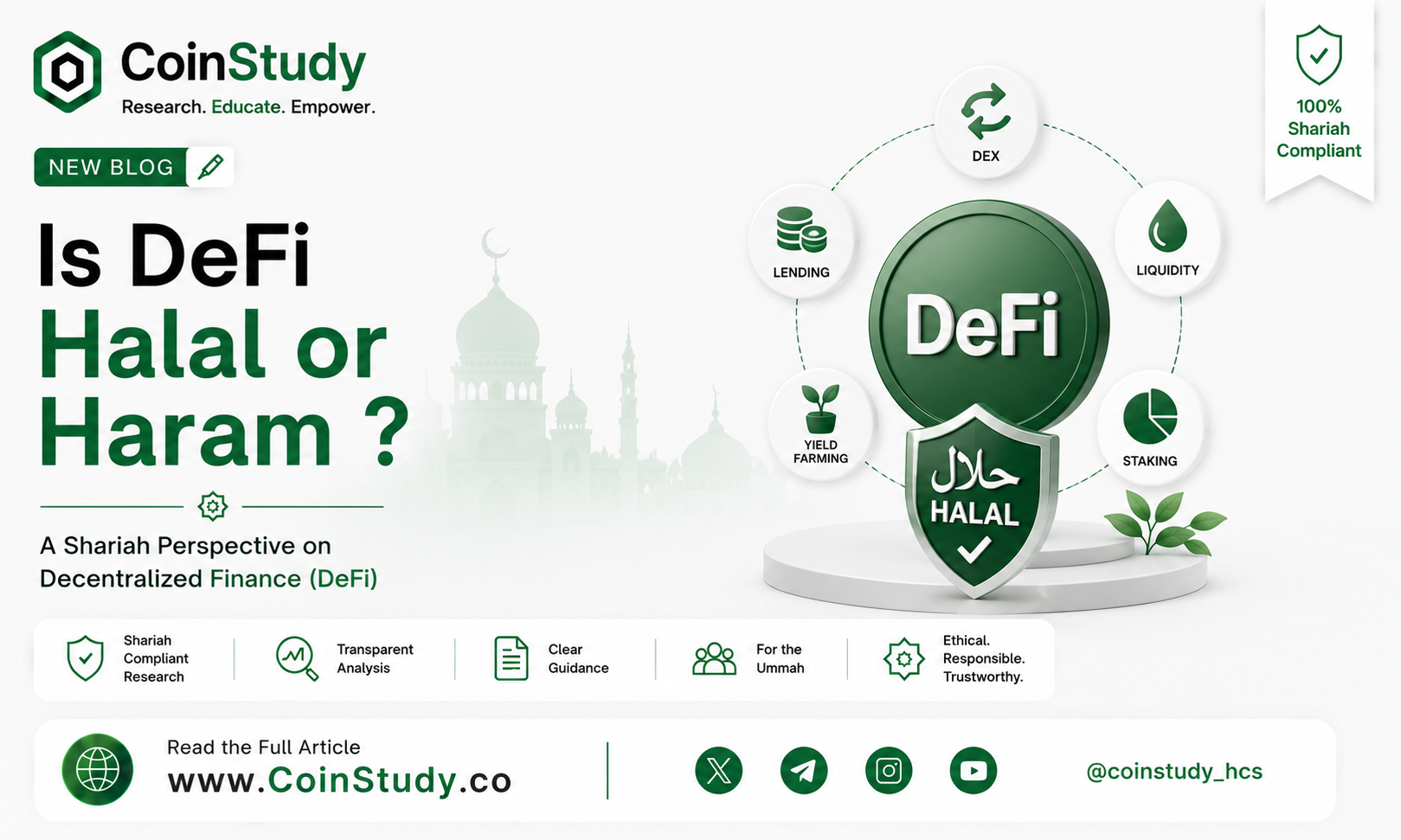
Is DeFi Halal or Haram? A Complete Islamic Finance Guide
Decentralized Finance has rewritten the rules of money.
In less than a decade, a collection of software protocols running on public blockchains has constructed an alternative financial system that lends, borrows, trades, insures, and invests without banks, brokers, or government oversight. By 2026, DeFi protocols collectively manage hundreds of billions of dollars in user assets. Interest rates are set by algorithms. Loans are issued instantly. Trading happens 24 hours a day, seven days a week, across borders, without identity verification or permission from any institution.
For Muslim investors watching this revolution unfold, the fundamental question has never been more urgent: is DeFi halal?
The honest answer is more nuanced than either enthusiastic DeFi proponents or cautious traditional scholars typically acknowledge. DeFi is not one thing. It is a category containing hundreds of distinct protocols with fundamentally different financial structures. Some of those structures raise serious and direct Islamic finance concerns. Others are surprisingly defensible. And many fall into genuine scholarly grey area where the honest answer is that qualified Islamic finance scholars are still working through the implications.
CoinStudy has now analyzed over 300 individual DeFi protocols, tokens, and financial products through our Halal Crypto Standard (HCS) methodology. This guide presents the complete picture of what we have learned.
Quick Verdict: DeFi Depends Entirely on the Specific Protocol
DeFi cannot receive one universal ruling.
It is a category, not a product.
The compliance question must be asked
about each specific protocol individually.
Lending and borrowing protocols with
interest-like return structures:
Haram ❌
Perpetual futures and leveraged
trading protocols:
Haram ❌
Yield tokenization of interest-bearing
instruments:
Haram ❌
Algorithmic stablecoins with stability
fees on debt positions:
Haram ❌
Basic DEX trading infrastructure
(fee-based spot swaps):
Halal With Concerns ⚠️
Liquidity provision in permissible
asset pairs:
Halal With Concerns ⚠️
(subject to chairman's LP test)
Decentralized commodity tokenization
(gold, metals):
Potentially Halal ✅
(subject to individual assessment)
Native Proof of Stake staking:
Grey area ⚠️
(subject to scholarly debate)
What Is DeFi?
Decentralized Finance refers to financial applications built on public blockchains that operate without traditional centralized intermediaries. Instead of a bank deciding whether to approve your loan, a smart contract does. Instead of a stock exchange matching your trade, an automated market maker does. Instead of a central bank managing interest rates, an algorithm does.
The infrastructure enabling DeFi has three foundational components.
Smart contracts are self-executing programs deployed on public blockchains that automatically enforce the terms of a financial agreement without requiring trust between parties or reliance on a central institution. A smart contract governing a lending pool will automatically liquidate a borrower's collateral if it falls below the required ratio, without any human intervention required.
Liquidity pools are pools of two or more tokens locked in a smart contract that enable trading and other financial activities without traditional order books. When you swap one token for another on a DEX, you are trading against a liquidity pool rather than against another human buyer or seller.
Governance tokens are tokens that give holders voting rights over the parameters of a DeFi protocol, including fee structures, risk thresholds, supported assets, and development direction. Holding a governance token in a DeFi protocol is similar in structure to holding a share in the company that owns the protocol, except that governance typically happens on-chain through token-weighted voting rather than through corporate shareholder meetings.
How Each Major DeFi Category Actually Works
Before any Islamic finance assessment is possible, Muslim investors need a precise understanding of what each DeFi category actually does mechanically. The compliance analysis follows from the mechanics, not from the labels.
Lending and Borrowing Protocols
Lending protocols like Aave and Compound operate through liquidity pools where depositors supply assets and borrowers take out loans.
When a depositor supplies USDC to Aave, they receive aUSDC tokens representing their deposit plus accruing interest. The interest rate is determined algorithmically based on the utilization rate of the pool, meaning how much of the supplied capital is currently borrowed. Higher utilization means higher interest rates, both for borrowers paying and for depositors receiving.
Borrowers must over-collateralize their loans, typically supplying 150% or more of the loan value as collateral. If the collateral value falls below a liquidation threshold, the smart contract automatically sells the collateral to repay the loan plus a liquidation penalty.
The financial relationship is structurally straightforward. Depositors lend capital to the pool. Borrowers pay interest to the pool. The interest revenue distributes proportionally to depositors. A fee accrues to the protocol's treasury. The entire mechanism is an algorithmically managed interest-based lending and borrowing system.
Decentralized Exchanges
DEXs like Uniswap, Curve, and Raydium enable token trading without traditional order books through an automated market maker model.
In the most common implementation, two assets are held in a liquidity pool in a ratio that maintains a constant product formula. When a trader swaps token A for token B, they increase the pool's supply of token A and decrease its supply of token B, changing the ratio and thus the price. A small fee, typically ranging from 0.01% to 1% depending on the pool, is charged on each swap and distributed proportionally to liquidity providers.
The liquidity provider's economic position is meaningfully different from a depositor's position in a lending protocol. An LP deposits a pair of tokens, earns fees when those tokens are traded, and faces impermanent loss risk when the ratio of the two tokens changes significantly. The return is not predetermined or guaranteed. It depends on trading volume and price movements. The LP can lose money in real terms relative to simply holding the two tokens separately.
Yield Farming
Yield farming refers to strategies where users move capital between different DeFi protocols, positions, or liquidity pools to optimize their total return from multiple simultaneous reward streams including trading fees, governance token incentives, and protocol liquidity mining programs.
The activity can range from relatively straightforward, such as providing liquidity to a DEX pool and staking the LP tokens to earn additional governance token rewards, to highly complex automated vault strategies that compound rewards across dozens of protocols and positions simultaneously.
Perpetual Futures Protocols
Perpetual DEXs like Hyperliquid, dYdX, and the late BULK Exchange operate markets for perpetual futures contracts, which are derivative instruments allowing traders to take leveraged long or short positions on asset prices without owning the underlying assets.
The defining mechanism is the funding rate, a recurring payment between long and short position holders that keeps the perpetual contract price anchored to the spot price. When the perpetual price is above spot, longs pay shorts. When the perpetual price is below spot, shorts pay longs. This payment occurs continuously, typically charged every eight hours.
Yield Tokenization
Protocols like Pendle Finance split yield-bearing assets into Principal Tokens representing the asset's face value at maturity and Yield Tokens representing the right to receive all future yield generated by the underlying asset until maturity.
This creates a marketplace for fixed yield exposure, which is buying PT at a discount and holding to maturity for a predetermined return, and for yield speculation, which is buying YT to gain leveraged exposure to future yield rates.
The Islamic Finance Framework Applied to DeFi
CoinStudy evaluates DeFi protocols through our Halal Crypto Standard (HCS) methodology, which applies three foundational Islamic finance principles to the specific mechanics of each protocol.
Riba — The Most Critical Principle
Riba is the Arabic term for interest and refers to any predetermined financial return on capital that is not connected to genuine productive economic activity or risk-sharing.
Islamic finance scholars across all major schools of thought agree that Riba is one of the most clearly and explicitly prohibited activities in the Quran. The Quranic prohibition is stated without qualification: "Allah has permitted trade and has forbidden Riba." The severity of the prohibition is emphasized through multiple Quranic verses and numerous Hadith.
The application of Riba to DeFi requires precision because the label used by a protocol does not determine whether its mechanism constitutes Riba. A protocol that calls its returns "yield" or "APY" or "staking rewards" rather than "interest" is not making a compliance argument. What matters is the economic structure of the financial relationship.
The clearest indicator of Riba in a DeFi mechanism is the combination of: capital deposited, a predetermined or formulaic percentage return calculated on that capital, and the passage of time as the mechanism generating the return. When these three elements are present, the economic relationship resembles interest regardless of what it is called.
By this standard, the following DeFi mechanisms directly trigger Riba concerns.
Lending protocol deposit returns where aUSDC continuously appreciates against USDC at an algorithmically determined rate constitute a predetermined percentage return on deposited capital derived from lending that capital to borrowers. The fact that the rate fluctuates based on utilization does not make it variable in the same sense that stock dividends or profit-sharing arrangements are variable. The rate is determined by a formula applied to the capital deposited, not by the underlying productive performance of a business.
Stability fees charged by collateralized debt protocols like Sky Protocol where borrowers pay ongoing percentage fees on their debt positions constitute interest on loans regardless of whether the protocol calls them stability fees rather than interest rates.
Yield tokenization Principal Tokens that purchase at a discount and redeem at face value providing a fixed predetermined return on invested capital constitute one of the clearest interest-resembling structures in DeFi, explicitly described by Pendle's own marketing as "you know your return the moment you buy, no variability, no monitoring required."
Gharar — Excessive Uncertainty
Gharar refers to transactions involving excessive uncertainty, ambiguity, or information asymmetry between parties in a way that could lead to unjust outcomes.
Islamic finance does not prohibit all uncertainty. Commercial activity inherently involves uncertainty about future outcomes. What Gharar prohibits is the kind of uncertainty that makes the essential terms of a transaction indeterminate, that conceals material information from one party in a way that enables exploitation, or that involves contractual uncertainty so severe that the transaction becomes more like gambling than legitimate commerce.
DeFi introduces multiple genuine Gharar concerns.
Smart contract risk is the most direct form of DeFi-specific Gharar. When you deposit assets into a DeFi protocol, you are relying on the smart contract code to behave exactly as intended under all possible conditions. The history of DeFi includes numerous exploits where smart contract bugs allowed attackers to drain deposited user funds. For Muslim investors, the Gharar concern is not that smart contracts are inherently impermissible. It is that the inability to verify smart contract correctness through ordinary financial due diligence introduces uncertainty about whether the financial terms of the arrangement will actually be honored.
Liquidation risk in collateralized DeFi positions introduces Gharar through the possibility that market volatility during a liquidation event may not execute at the expected price, resulting in outcomes for both the borrower and the liquidator that were not determinable at the time of entering the position.
Oracle dependency is a specific form of Gharar that affects DeFi protocols using external price feeds to manage collateral ratios, trigger liquidations, and settle settlements. When the price feed can be manipulated or can malfunction, the financial outcomes of the protocol become dependent on factors outside the stated contract terms.
Maysir — Speculation and Gambling
Maysir refers to gambling, which is any financial arrangement where one party's gain is directly equivalent to another party's loss with no productive economic value created in the process.
The distinction between legitimate commercial uncertainty and Maysir is the presence or absence of genuine productive activity. A merchant who buys goods hoping to sell at a higher price is taking commercial risk, but productive economic activity, which is the movement of goods and the service of facilitating commerce, is occurring. A gambler who bets on a coin flip creates no productive value. Money simply transfers from the loser to the winner based on a random outcome.
DeFi activities that most clearly raise Maysir concerns are perpetual futures trading where leveraged positions are opened and closed based on price predictions with no ownership of underlying assets and no genuine economic production occurring. The funding rate mechanism that transfers money between long and short position holders regardless of any productive activity is among the most direct expressions of Maysir-resembling financial structure in DeFi.
Yield farming strategies specifically designed to extract maximum returns from a protocol before its governance token inflates away in value, sometimes called mercenary liquidity, involve a zero-sum competitive dynamic where early participants extract value at the expense of later ones through timing rather than productive contribution.
CoinStudy's Complete DeFi Assessment Framework
Layer 1 — Sharia Red Line Screening
Every DeFi protocol CoinStudy analyzes passes through five red-line checks. A single failure results in an automatic Haram classification with no further scoring.
Ecosystem Riba Exposure asks whether the protocol generates, distributes, or fundamentally depends on interest-like income as its core economic mechanism. This check fails for lending protocols, collateralized debt systems, and yield tokenization of interest-bearing instruments.
Gambling and Betting asks whether the protocol's core mechanism is structured as a zero-sum game where one participant's gain directly equals another's loss with no productive economic activity. This check fails for perpetual futures DEXs and prediction market platforms.
Haram Industry asks whether the protocol is fundamentally serving or enabling industries that are categorically prohibited in Islamic jurisprudence.
Guaranteed Interest asks whether the protocol provides predetermined percentage returns on deposited capital that constitute guaranteed interest income regardless of economic performance. This check fails for Principal Token yield tokenization products and explicit fixed-rate savings products.
Synthetic Interest Products asks whether the protocol creates financial instruments whose economic effect is to provide interest-like income through a derivative or synthetic structure that avoids the direct label of interest while replicating its economic characteristics. This check fails for Yield Tokens in yield tokenization protocols and for liquid staking tokens that auto-compound yield from interest-bearing DeFi mechanisms.
Layer 2 — HCS Scoring for Protocols Passing Layer 1
DeFi protocols that pass all five Layer 1 red lines proceed to Layer 2 scoring across CoinStudy's seven-principle framework covering Financial Exposure Risk, Gharar, Maysir, Underlying Business Activity, Utility and Real Use, Tokenomics Fairness, and Transparency and Governance.
Detailed Analysis by DeFi Category
Category One: Lending and Borrowing Protocols — Haram ❌
This is the clearest and most unambiguous category in DeFi Islamic finance assessment.
Protocols in this category include Aave, Compound, Sky Protocol's former Maker lending system, JustLend on TRON, Kamino on Solana, and all similar money market protocols where depositors earn percentage-based returns and borrowers pay percentage-based fees on outstanding debt balances.
CoinStudy has analyzed dozens of protocols in this category and every single one has received a Haram classification. The mechanism is consistent across all of them. Depositor supplies capital. Protocol lends that capital to borrowers. Borrowers pay interest. Interest distributes to depositors minus a protocol fee. This is a straightforward interest-based lending arrangement regardless of which blockchain it is deployed on, which governance structure oversees it, or which label is applied to the interest payments.
CoinStudy's Shariah Board Chairman Dr. Mufti Usman Quddus has confirmed this ruling directly: "Taking profit on a loan is Haram in Islamic jurisprudence."
The DeFi lending category provides no alternative path to permissibility for Muslim investors. The mechanism is the definition of the prohibited activity.
Category Two: Perpetual Futures DEXs — Haram ❌
Perpetual futures trading platforms represent the second most clearly prohibited DeFi category.
Protocols in this category include Hyperliquid, dYdX, GMX, Drift, BULK Exchange, and all similar platforms enabling leveraged derivative trading on asset prices without ownership of the underlying assets.
These protocols fail multiple Layer 1 red lines simultaneously. The funding rate mechanism constitutes a predetermined percentage transfer of capital between position holders, which resembles guaranteed interest income from one perspective. The zero-sum structure of leveraged derivative trading where aggregate gains exactly equal aggregate losses net of fees constitutes Maysir in its most direct form. The protocol's revenue, which funds governance token buybacks and treasury accumulation, derives entirely from the volume of prohibited speculative trading activity.
CoinStudy has covered this category extensively in our dedicated blog on why perpetual DEX airdrops are Haram and in analyses of Hyperliquid, BULK Exchange, Drift, and Aster.
Category Three: Algorithmic Stablecoin Systems — Haram ❌
Protocols that create synthetic dollar-pegged assets through collateralized debt mechanisms with stability fees constitute the third clearly prohibited DeFi category.
The clearest examples are Sky Protocol (formerly MakerDAO), which creates USDS through collateralized debt positions with ongoing stability fees and distributes those fees to Sky Savings Rate depositors, and Ethena Finance, which creates USDe through delta-neutral perpetual futures positions and distributes perpetual futures funding rate income to sUSDe holders.
Both mechanisms fail multiple red lines. The stability fee on debt positions constitutes interest on a loan. The savings rate product distributes that interest income to depositors. The Ethena mechanism derives income from perpetual futures activity, which is itself prohibited.
Category Four: Yield Tokenization Protocols — Haram ❌
Protocols that split yield-bearing assets into fixed-yield and variable-yield components, most prominently Pendle Finance, constitute a fourth category that fails red lines across multiple dimensions.
The Principal Token mechanism explicitly provides fixed predetermined returns. The Yield Token mechanism creates synthetic derivative instruments providing exposure to interest income from underlying assets that are themselves Haram-classified in the majority of Pendle's largest pools including Ethena USDe and Sky Protocol stUSDS.
Pendle was explicitly built to bring the global interest rate derivative market into DeFi. That mission statement is itself a description of what Islamic finance prohibits.
Category Five: Basic DEX Trading Infrastructure — Halal With Concerns ⚠️
This is where the DeFi analysis becomes significantly more nuanced and where honest acknowledgment of genuine scholarly grey area is required.
Basic decentralized exchanges that facilitate spot token swaps through automated market maker mechanisms, the clearest examples being Uniswap on Ethereum, Raydium on Solana, and similar fee-based trading infrastructure, pass the Layer 1 red line screening under CoinStudy's methodology.
The core mechanism of a basic DEX does not constitute Riba. The trading fee is a service charge for facilitating a swap between two assets, not a percentage return on deposited capital over time. The relationship is more analogous to a brokerage commission than to interest income.
However the Halal With Concerns classification reflects several genuine and honest concerns that Muslim investors should understand.
The assets being traded matter enormously. A DEX that primarily facilitates trading between assets CoinStudy classifies as Haram, including stablecoins backed by Treasury bills, perpetual futures tokens, and lending protocol tokens, is providing infrastructure that primarily serves Haram financial activity, even if the DEX mechanism itself is not inherently prohibited.
The post-UNIfication fee capture mechanism for Uniswap specifically, where a portion of trading fees now accrues to UNI governance token holders, introduces a connection between holding the governance token and benefiting from the volume of all trading activity including trading of Haram-classified assets. This is why CoinStudy classifies UNI at 58 out of 100 Doubtful rather than fully Halal.
Category Six: Liquidity Provision — Conditional ⚠️
Liquidity provision in DEX pools sits in genuine scholarly grey area and CoinStudy's Shariah Board Chairman has provided a direct ruling on the conditions for permissibility.
The chairman's ruling: "Liquidity provision is permissible if given for the purpose of partnership and trade AND if it is known the liquidity will be used in a permissible place."
This ruling establishes two independent conditions that must both be satisfied. The intention behind the liquidity provision must be genuine partnership in legitimate commercial activity rather than capital deployed for percentage return. And the specific pool must consist of assets that are themselves permissible, deployed in trading activity that serves legitimate commercial purposes.
A pool pairing a halal-rated crypto asset against SOL or another halal-rated asset, facilitating genuine trading activity between those assets, satisfies both conditions more defensibly than a pool involving Haram-classified stablecoins on one side.
A pool pairing any asset against USDT or USDC, which CoinStudy classifies as Haram due to their interest-bearing reserve structures, does not satisfy the second condition because the liquidity is being used in a place involving Haram-classified assets.
The chairman's ruling also explicitly excludes Meteora's Dynamic AMM and Dynamic Vault products because they automatically deploy deposited assets into external lending protocols for interest income, which is explicit confirmation that the chairman's LP condition is not satisfied for those products regardless of the token pair.
Category Seven: Liquid Staking — Highly Variable ⚠️
Liquid staking protocols occupy a broad spectrum from potentially permissible to clearly Haram, depending on three critical factors.
The first factor is the underlying staking mechanism. Native Proof of Stake staking, where rewards come from genuine block production and transaction fee processing, sits in scholarly grey area with a defensible permissibility argument under Ijarah principles. Many Islamic finance scholars view this as compensation for genuine network security service rather than interest on deposited capital.
The second factor is the MEV revenue composition. Many liquid staking protocols, most prominently Jito on Solana, auto-compound MEV revenue from the Jito Block Engine into the liquid staking token's appreciation rate. CoinStudy classified JitoSOL as Haram specifically because Jito's Block Engine processes all MEV bundle types without distinguishing between permissible arbitrage and prohibited extractive strategies including front-running and sandwich attacks. JitoSOL holders receive ongoing yield from this undifferentiated pool of MEV activity.
By contrast, Raiku's rkuSOL was reclassified from Haram to Doubtful following a valid community challenge that demonstrated Sanctum, Raiku's validator infrastructure, explicitly avoids toxic MEV strategies. This distinction between undifferentiated MEV and stated-permissible-arbitrage-only MEV is the methodology CoinStudy applies to all liquid staking protocols.
The third factor is DeFi composability marketing. When a liquid staking protocol explicitly promotes deploying the liquid staking token in DeFi lending markets as a core value proposition, as opposed to merely acknowledging that users could choose to do so independently, the protocol's own design intent crosses from neutral infrastructure into direct facilitation of interest-bearing activity.
Category Eight: Decentralized Identity and Non-Financial Infrastructure — Generally Halal ✅
DeFi encompasses more than financial products. Decentralized identity systems, blockchain-based credential verification, decentralized storage protocols, and other non-financial infrastructure applications built using DeFi's smart contract technology are not inherently connected to the financial concerns that make lending, trading, and yield products problematic.
Muslim investors evaluating exposure to these categories should assess them on the specific utility they provide and the financial structure of the associated tokens rather than assuming that all blockchain-based financial applications share the same compliance profile.
The DeFi Composability Problem — A Critical Methodology Note
One of the most important principles in CoinStudy's DeFi methodology was established and clarified through a genuine community challenge regarding Raiku's rkuSOL.
The challenge demonstrated that CoinStudy's earlier reasoning had incorrectly treated DeFi composability, meaning the fact that a token can be used in DeFi lending markets, as a standalone Haram trigger for that token. This reasoning was inconsistent with how CoinStudy treats native layer one tokens that can also be deposited into DeFi lending markets by their holders.
The correct methodology principle, which CoinStudy now applies consistently: DeFi composability of a token is not itself a compliance failure. The compliance question is whether the TOKEN'S OWN MECHANISM generates yield through prohibited channels, not whether users could choose to deploy the token in prohibited DeFi applications of their own volition.
SOL is composable with Kamino lending markets on Solana. CoinStudy rates SOL at 87 out of 100 Halal. SOL is not responsible for what users choose to do with it in DeFi lending.
This principle has direct implications for how Muslim investors should think about DeFi participation. The presence of permissible infrastructure, whether a Layer 1 blockchain or a DEX, in an ecosystem that also contains impermissible DeFi applications does not make the permissible infrastructure impermissible. But individual investment decisions about specific DeFi tokens and positions must assess whether the specific mechanism in question generates prohibited income.
The LP Permissibility Test — Applying the Chairman's Ruling
CoinStudy's Shariah Board Chairman Dr. Mufti Usman Quddus has ruled directly on liquidity provision permissibility: "Liquidity provision is permissible if given for the purpose of partnership and trade AND if it is known the liquidity will be used in a permissible place."
This ruling provides Muslim investors with a practical two-question test for any specific LP opportunity.
Question One: Is this liquidity being provided for genuine partnership in commercial trade, or primarily as capital deployed for a percentage return divorced from any underlying commercial purpose? If the primary motivation is earning a predetermined return percentage rather than facilitating genuine commerce between two parties, the first condition is not satisfied.
Question Two: Will this specific liquidity be used in a permissible place? The second condition requires that both assets in the pool are permissible and that the trading activity facilitated by the pool serves legitimate commercial purposes rather than primarily enabling trading of Haram-classified instruments.
Applying this test consistently across DeFi opportunities:
A USDC/ETH pool fails the second condition because USDC is Haram-classified due to its interest-bearing reserve structure.
A WBTC/ETH pool may satisfy both conditions if both assets are permissible, though the specific compliance of each wrapped asset requires individual verification.
A SOL/JitoSOL pool fails the second condition because JitoSOL is Haram-classified due to its undifferentiated MEV revenue structure.
A pool involving only halal-rated assets from CoinStudy's analysis series, trading in genuine spot exchange activity, represents the most defensible LP participation available in current DeFi.
What the Scholars Say — An Honest Landscape of Islamic Finance Opinion
Muslim investors deserve an honest overview of where Islamic finance scholarship stands on DeFi, rather than a presentation of only the most permissive views or only the most restrictive ones.
On DeFi lending, there is broad consensus among Islamic finance scholars that interest-based lending and borrowing, whether in conventional banking or in DeFi smart contracts, is Riba and therefore prohibited. The labeling difference between "interest" and "APY" or "stability fee" does not change the scholarly consensus on the underlying financial relationship.
On DEX trading and liquidity provision, scholarly opinion is genuinely divided. Some scholars view AMM-based trading fees as a legitimate service charge analogous to brokerage commissions. Others raise concerns about the nature of LP positions as capital deployed for a percentage return regardless of underlying commercial performance. The genuine existence of this debate is why CoinStudy classifies basic DEX activity as Halal With Concerns rather than Halal or Haram.
On Proof of Stake staking, CoinStudy's own Shariah Board Chairman has confirmed the broader category as generally permissible under Ijarah principles while acknowledging that specific staking mechanisms, particularly those involving MEV revenue of uncertain permissibility or DeFi composability marketing, require individual assessment.
On perpetual futures trading, the scholarly consensus is more clearly negative. The combination of speculative zero-sum mechanics, leverage creating obligations exceeding owned assets, and the funding rate transfer mechanism resembling predetermined interest payments between position holders aligns with what the majority of Islamic finance scholars identify as prohibited.
On algorithmic stablecoins, the stability fee mechanism on debt positions has been identified by CoinStudy's chairman as straightforwardly impermissible: "Lending is essentially a loan and taking profit on a loan is Haram in Islamic jurisprudence."
A Practical Guide for Muslim DeFi Participants
Based on CoinStudy's complete analysis framework, here is practical guidance organized by the actions most Muslim investors are likely to considering.
Holding DeFi governance tokens: The governance token of any DeFi protocol derives its value from the protocol's overall ecosystem activity. If that ecosystem primarily generates revenue from prohibited activities including interest-based lending or perpetual futures trading, the governance token financially benefits from the growth of those activities even if the holder never personally participates in them. Muslim investors should evaluate governance tokens through CoinStudy's individual coin analyses rather than assuming any governance token is permissible because the holder personally avoids specific prohibited activities.
Providing liquidity to DEX pools: Apply the chairman's LP permissibility test directly. Both assets in any pool you consider must be permissible. The trading activity facilitated by the pool should serve legitimate commercial purposes. Pools involving Haram-classified stablecoins, lending protocol tokens, or perpetual futures tokens on either side do not satisfy the second condition.
Participating in yield farming: Evaluate each specific yield source independently. Protocol revenue from trading fees in permissible pools may be defensible. Protocol revenue from lending interest or perpetual futures trading is not. Governance token incentives should be evaluated based on the token's own compliance profile. Complex multi-protocol yield strategies that route capital through multiple DeFi protocols without ability to verify each step's compliance should be avoided on Gharar grounds.
Using stablecoins in DeFi: CoinStudy has classified all major fiat-backed stablecoins including USDT, USDC, DAI, and PYUSD as Haram due to their interest-bearing reserve structures. Using these stablecoins as the primary medium within DeFi applications introduces compliance concerns even where the DeFi mechanism itself might otherwise be defensible.
Participating in DeFi airdrops: Evaluate the underlying protocol through CoinStudy's airdrop methodology. If the protocol is Haram-classified, participating in its ecosystem specifically to earn an airdrop involves the same compliance questions as directly using the protocol. If the protocol is Halal With Concerns, the airdrop participation should be evaluated based on what specific activities are required to qualify for the rewards.
The Technological Innovation Argument — Does Innovation Override Compliance?
Muslim investors sometimes encounter the argument that DeFi's technological innovation, its decentralization, transparency, and trustless execution, represents a genuinely different kind of financial system that should be evaluated differently from conventional finance.
This argument deserves respectful engagement and honest rejection on its merits.
Islamic finance evaluates economic activity, financial relationships, and the distribution of risk and reward between parties. It does not evaluate the technology used to implement those relationships as a primary compliance criterion.
A loan that charges interest is Riba whether it is denominated in cash, gold, cryptocurrency, or any other asset. A perpetual futures contract that transfers money between position holders based on price predictions is Maysir whether it is executed on a centralized exchange or a decentralized protocol. A savings account that provides predetermined percentage returns on deposited capital by lending that capital to borrowers constitutes the same economic relationship whether it is managed by a bank or an Ethereum smart contract.
Blockchain technology is a distribution and execution mechanism. It changes how financial agreements are recorded and enforced. It does not change the economic nature of the agreements themselves. The Quran's prohibition on Riba is based on the economic injustice of predetermined returns on capital regardless of productive performance, not on the specific technology used to implement that return.
Decentralization specifically does not change the compliance analysis. A prohibited financial structure implemented by 10,000 distributed nodes worldwide is still a prohibited financial structure. The absence of a central authority does not transform interest into something else. It only removes the ability to complain to that authority when things go wrong.
An Honest Note on What We Do Not Yet Know
Islamic finance scholarship on DeFi is genuinely at an early stage. Some of the most important questions are ones where honest scholars disagree, where the existing frameworks developed for conventional financial instruments do not map perfectly onto novel DeFi mechanisms, and where more research and scholarly engagement is needed.
The question of how to evaluate AMM impermanent loss from an Islamic finance perspective, specifically whether the structural disadvantage faced by LPs relative to passive holders constitutes an impermissible uncertainty, is one where CoinStudy acknowledges genuine scholarly debate rather than claiming a settled answer.
The question of how to evaluate native Proof of Stake staking rewards in cases where the validator's MEV revenue composition is partially unknown is one where CoinStudy's methodology has evolved through community challenges and continues to develop.
The question of what constitutes a genuinely permissible DeFi financial product that captures the genuine utility benefits of programmable finance without replicating the interest-based economic relationships of conventional finance remains one of the most important open questions in Islamic fintech. CoinStudy believes genuine solutions exist and will analyze them as they emerge.
Important Questions for Muslim DeFi Participants
Before participating in any DeFi activity, ask yourself honestly.
Have I read CoinStudy's individual analysis of this specific protocol rather than assuming all DeFi activities in a category share the same compliance profile? Does this protocol's core mechanism generate revenue from depositing capital for a percentage return, lending to borrowers who pay interest, or trading derivative positions that transfer money between participants based on price predictions? Have I applied the chairman's LP permissibility test specifically: am I providing liquidity for genuine partnership and trade, and do I know that my liquidity will go to a permissible place? Am I evaluating the governance token of this protocol based on what the protocol does, not just on what I personally do with the token? Have I consulted a qualified Islamic finance scholar who is familiar with blockchain mechanics for any specific participation decision I am uncertain about?
Final Verdict
DeFi cannot be classified as Halal or Haram as a whole. It is a technology category containing hundreds of distinct financial protocols with fundamentally different economic structures and very different compliance profiles.
Lending and borrowing protocols are Haram due to their interest-based lending mechanisms, consistently and unambiguously.
Perpetual futures DEXs are Haram due to their zero-sum leveraged speculative trading mechanics and funding rate mechanisms.
Algorithmic stablecoin systems with stability fees on debt positions are Haram due to interest-like charges on borrowed capital.
Yield tokenization of interest-bearing instruments is Haram due to explicit fixed-return PT structures and synthetic interest derivative YT structures.
Basic DEX trading infrastructure for spot swaps is Halal With Concerns, with the specific assets traded and the governance token structure requiring individual assessment.
Liquidity provision is conditionally permissible, subject to the chairman's two-condition test requiring genuine trade purpose and liquidity deployed in a permissible place.
Native Proof of Stake staking is a scholarly grey area with a defensible permissibility argument, subject to individual protocol assessment of MEV revenue composition.
Real-world asset tokenization of physical commodities is potentially permissible, subject to genuine physical backing verification and individual assessment of each specific product structure.
For Muslim investors engaging with DeFi, the fundamental principle is that DeFi is a mechanism, not a ruling. The ruling belongs to the specific economic relationship created by each specific protocol. Understanding that relationship precisely, rather than accepting category-level generalizations, is the only honest basis for an Islamic finance assessment of any specific DeFi participation decision.
Read detail analysis of following coins here:
Is Aave Halal?
Is Liquid Staking Halal?
Why Perpetual DEX Airdrops Are Haram
Learn Halal Trading Strategies with CoinStudy Partner
Halal Staking with Sharia Compliant Validator & CoinStudy Partner
Disclaimer: This article is provided for educational and research purposes only and does not constitute a formal fatwa or personal religious ruling. This analysis is based on guidance from CoinStudy's HCS Shariah Board members. CoinStudy does not issue personal fatwas or financial advice. Muslim investors should consult a qualified Islamic scholar familiar with both Islamic jurisprudence and blockchain technology mechanics for personal guidance specific to their situation.