


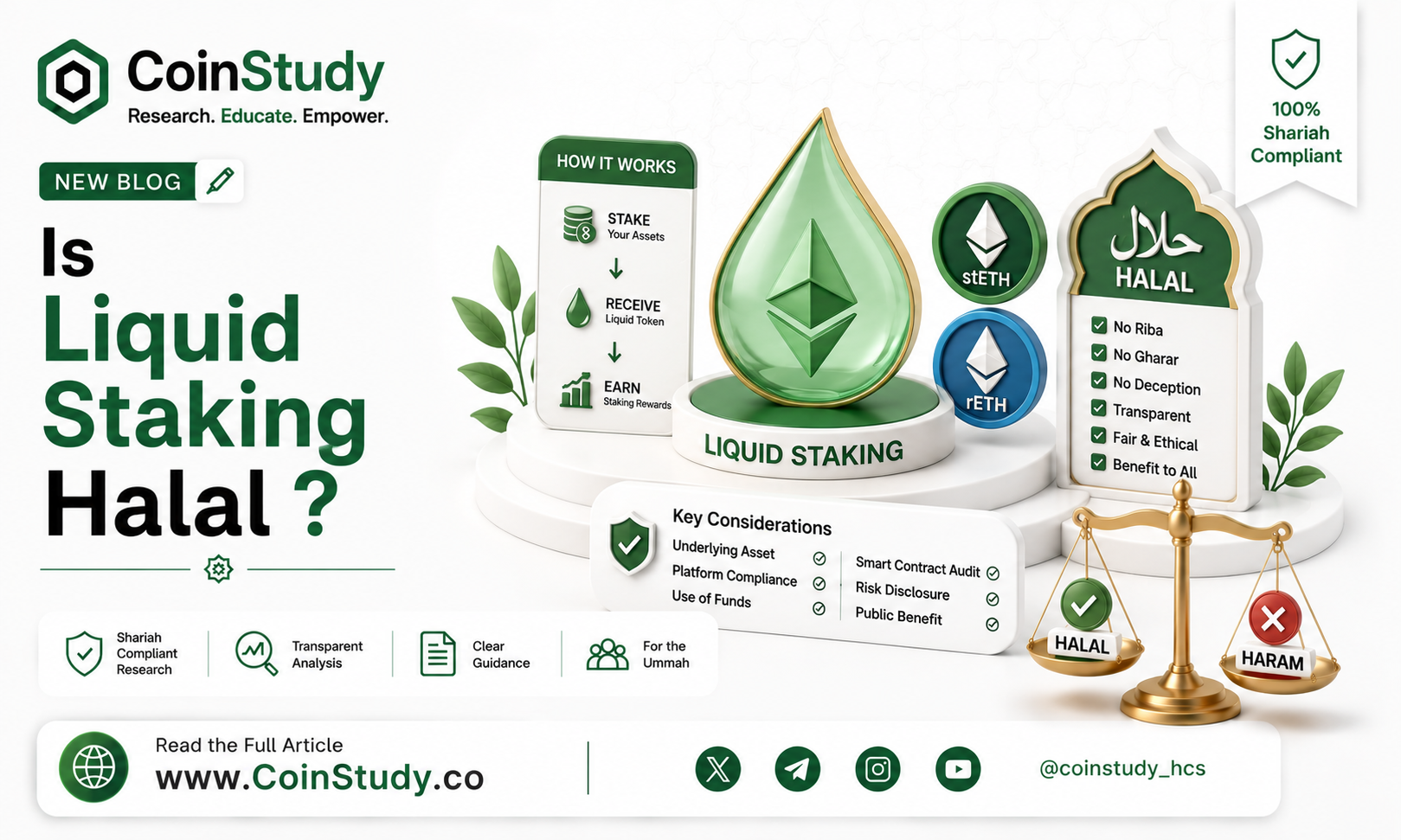
Is Liquid Staking Halal in Islam?
The crypto industry has a liquidity problem.
When you stake your tokens on a Proof of Stake blockchain, your assets are locked. You cannot sell them, trade them, or use them elsewhere while they are staked. On most networks, the unbonding period ranges from several days to several weeks. For investors who believe in the long-term utility of a network and want to support its security, this lockup creates a genuine practical constraint.
Liquid staking was invented to solve this exact problem. And over the past three years it has grown from a niche innovation into one of the largest sectors in the entire crypto ecosystem, with protocols like Lido Finance securing tens of billions of dollars in staked assets.
For Muslim investors the question is urgent and practical. Is liquid staking halal? Is it different from regular staking? Does it matter which protocol you use? And why do some liquid staking tokens receive Haram classifications from CoinStudy while others receive Halal or Doubtful classifications under the same methodology?
We examined liquid staking comprehensively through CoinStudy's Halal Crypto Standard (HCS) framework. Here is the complete picture.
Quick Verdict: Liquid Staking Is Not a Single Answer ⚠️
Liquid staking cannot be given one universal classification because it is not one thing. It is a category of financial product whose compliance depends entirely on the specific design choices made by each individual protocol.
Under the CoinStudy Halal Crypto Standard:
Base liquid staking that simply maintains liquidity while earning Proof of Stake rewards, without adding DeFi yield composability as a core marketed feature, sits in a genuinely grey area closer to permissible than prohibited.
Liquid staking products that explicitly auto-compound yield from mixed or prohibited revenue sources, actively market DeFi lending and yield farming deployment as a core value proposition, or layer additional yield mechanisms on top of base staking rewards are more clearly problematic and may trigger Layer 1 red-line violations.
The difference between a Halal With Concerns classification and a Haram classification for a liquid staking product is not arbitrary. It reflects genuine and meaningful structural differences between specific protocols that Muslim investors deserve to understand clearly.
What Is Liquid Staking?
Before the Islamic finance analysis, it is important to understand precisely what liquid staking is and how it works mechanically.
In standard Proof of Stake staking, a user deposits tokens with a validator or staking pool, the tokens are locked for a defined unbonding period, and the user earns variable rewards from block production and transaction fee activity. The staked tokens cannot be moved or used during the lockup period.
Liquid staking modifies this arrangement by introducing a third token into the equation. When a user deposits their tokens into a liquid staking protocol, they receive a liquid staking token in return. This liquid staking token represents their claim on the staked position and accumulates the associated rewards over time. Because the liquid staking token is itself freely transferable and tradeable, the user effectively maintains economic access to their staked position even while the underlying tokens remain locked in the staking contract.
To make this concrete: a user deposits one ETH into a liquid staking protocol and receives one stETH in return. As Ethereum staking rewards accumulate, the value of stETH relative to ETH either increases directly or is reflected through a rebasing mechanism. The user can then trade, sell, or deploy their stETH in other applications without needing to wait for an unbonding period, because the liquid token itself is freely transferable even while the underlying ETH remains staked.
This innovation genuinely solves a real problem and has achieved real adoption. It is one of the most technically legitimate innovations in the Proof of Stake ecosystem.
How Liquid Staking Tokens Work — Three Different Mechanisms
Not all liquid staking tokens use the same mechanism and the specific mechanism used has meaningful implications for the Islamic finance assessment.
Rebasing Tokens
Some liquid staking protocols, most famously Lido's stETH, use a rebasing mechanism where the quantity of tokens in your wallet automatically increases as staking rewards accumulate. If you hold 100 stETH and the staking reward rate is 5%, your wallet will gradually show 105 stETH by the end of a year as rewards are automatically added to your balance.
Exchange Rate Appreciation Tokens
Other protocols, including Rocket Pool's rETH, use an appreciating exchange rate model where the quantity of tokens in your wallet stays constant but each token becomes worth more over time relative to the underlying asset. You hold the same 100 rETH throughout the year but each rETH is now redeemable for more ETH than when you received it.
Auto-Compounding Tokens
A third design, used by protocols like Jito on Solana, combines staking rewards with additional revenue sources and automatically compounds them into the token's appreciation rate. This design is the most technically complex and raises the most significant Islamic finance concerns because the additional revenue sources may include MEV, DeFi protocol fees, or other income streams of uncertain permissibility.
Understanding which mechanism a specific protocol uses is the starting point for any meaningful Islamic finance assessment of a liquid staking product.
The Critical Islamic Finance Question
The question that determines compliance for any liquid staking product is not simply whether it is called "liquid staking." The question is what the token's own mechanism does and where the yield comes from.
CoinStudy's methodology, refined through community challenges including the landmark Raiku methodology correction, establishes this principle clearly.
The compliance question is whether the token's OWN MECHANISM generates yield through prohibited channels, not whether users COULD choose to deploy the token in prohibited DeFi applications.
A liquid staking token that simply maintains liquidity while earning variable Proof of Stake block production rewards is structurally similar to native staking, with the addition of a liquidity wrapper. The compliance picture depends on the same questions that apply to native staking: do the rewards come from genuine network security participation, are they variable rather than guaranteed, and are there any MEV or other revenue components of uncertain permissibility mixed in?
A liquid staking token that auto-compounds yield from sources beyond base Proof of Stake rewards, or whose core marketed value proposition is deployment in DeFi lending and yield farming as a way to earn additional returns, introduces separate and more serious compliance concerns that may trigger red-line violations.
Islamic Finance Principles Applied to Liquid Staking
Riba — The Central Question
Riba is the core concern across all staking and liquid staking analysis. The key distinction is between variable rewards from genuine productive participation in a network and guaranteed predetermined returns from a lending-like arrangement.
Base Proof of Stake staking rewards are variable. They depend on network conditions, total stake, transaction volumes, and other factors that fluctuate over time. This variability is one reason many Islamic finance scholars consider native Proof of Stake staking more defensible than lending-based yield products, where the return is predetermined and guaranteed regardless of productive activity.
The Riba concern for liquid staking specifically arises when additional yield layers are introduced on top of base staking rewards. When a liquid staking protocol generates additional income from MEV capture, lending protocols, yield farming, or other DeFi mechanisms, and automatically compounds this income into the liquid staking token's value, the combined yield starts to resemble a yield-bearing financial instrument rather than simple variable service compensation.
Gharar — Layers of Uncertainty
Liquid staking introduces genuine Gharar concerns that native staking does not have to the same degree.
With native staking, the relationship is relatively clear. You delegate tokens to a validator. That validator produces blocks and earns fees. A proportion flows back to you as a reward. The mechanism is transparent and auditable on-chain.
With liquid staking, several additional layers of uncertainty are introduced. The liquid staking token's value depends on the protocol's ability to maintain its peg to the underlying asset. Smart contract risk exists at the protocol level. If the protocol is hacked, exploited, or encounters a technical failure, the liquid staking token may lose its value even though the underlying staked tokens are performing normally. The relationship between the liquid token's market price and its redemption value may diverge during market stress, as was observed with stETH during periods of market volatility.
These are real sources of uncertainty that are honestly reflected in CoinStudy's Gharar scoring for liquid staking protocols. They do not necessarily render liquid staking prohibited, since all commercial activities involve uncertainty, but they are meaningfully elevated compared to native staking.
Maysir — Speculation in Liquid Staking Markets
Liquid staking tokens, unlike locked staked positions, are freely tradeable on secondary markets. This creates the possibility that a liquid staking token is traded primarily for speculative purposes rather than used for its functional purpose of representing a staked position.
This is a legitimate Maysir consideration in the sense that a token primarily used for speculation rather than its underlying productive function raises concerns about whether the holder's relationship with the asset is genuinely investment-oriented or primarily speculative in character.
However it is important to be precise here. The existence of a secondary market for a liquid staking token does not by itself create a Maysir violation, any more than the existence of secondary markets for stock shares makes stock ownership impermissible. The question is whether the token's core purpose and the holder's own intention are oriented toward the underlying productive activity, which is network security participation, or toward zero-sum speculative activity divorced from genuine economic value creation.
The DeFi Composability Principle — A Critical Distinction
This is perhaps the most important section of this blog for Muslim investors who have read CoinStudy's individual protocol analyses and want to understand how our methodology is applied consistently.
CoinStudy's methodology explicitly states that DeFi composability of a token is NOT a standalone Haram trigger. The compliance question is whether the token's OWN MECHANISM generates yield through prohibited channels, not whether users COULD independently deploy the token in prohibited DeFi applications.
This principle has real consequences for how liquid staking is evaluated.
SOL, Ethereum's ETH, Cardano's ADA, and many other tokens CoinStudy classifies as Halal can all be deposited into DeFi lending protocols by their owners. CoinStudy does not classify these tokens as Haram because of this possibility. The token is not responsible for what its holder chooses to do with it.
The same logic applies to liquid staking tokens. A liquid staking token that represents a staked position and earns variable Proof of Stake rewards is not made Haram by the mere fact that some holders choose to deposit it in Aave or Compound. The holder who makes that deposit has introduced a separate compliance question for themselves through their own choice. The token itself has not failed a red line.
What DOES matter is when the liquid staking protocol itself makes DeFi lending and yield farming deployment a core marketed value proposition, actively promotes using the liquid token in lending and yield protocols as a primary way to earn additional returns, or auto-compounds yield from these mechanisms at the protocol level without user choice. In these cases, the prohibited mechanism is not the user's choice but the protocol's own design.
This distinction was clarified through CoinStudy's analysis of Jito's JitoSOL, where the Haram classification was maintained not because JitoSOL is composable with DeFi lending, but because Jito's own platform explicitly markets DeFi lending and yield farming deployment as a core feature and because JitoSOL auto-compounds yield from undifferentiated MEV revenue sources of uncertain permissibility at the protocol level.
Real Protocol Examples — How CoinStudy Has Applied This Framework
The best way to illustrate the compliance distinction is through the actual protocols CoinStudy has analyzed.
Jito (JitoSOL) — Haram
Jito's JitoSOL fails three Layer 1 red lines under CoinStudy's methodology. The decisive factors are that JitoSOL's auto-compounding mechanism draws from Jito's Block Engine MEV revenue, which is processed without distinguishing between permissible arbitrage and prohibited extractive strategies including front-running and sandwich attacks. JitoSOL holders receive yield from this undifferentiated revenue pool with no visibility or mechanism to separate permissible from prohibited income. This is a direct token mechanism concern, not a DeFi composability concern.
Raiku (rkuSOL) — Doubtful
Raiku's rkuSOL was initially assessed more critically but was revised to Doubtful following a valid community challenge. The key distinction from Jito is that Raiku uses Sanctum, which explicitly does not participate in toxic MEV or sandwiching. This means rkuSOL's MEV revenue component comes from stated permissible arbitrage rather than an undifferentiated pool including prohibited activity. The remaining concern is Raiku's own marketing language explicitly framing rkuSOL as a way to "speculate on demand in excess of the native staking rate," which raises Gharar and Maysir concerns specific to their marketing positioning rather than a structural mechanism failure.
EtherFi (eETH/weETH) — Haram
EtherFi's liquid restaking tokens fail red lines not because of DeFi composability but because EtherFi's Liquid product is an automated vault that explicitly deploys user assets into DeFi protocols to find yield opportunities on behalf of users at the protocol level. This is not user choice. The protocol itself automatically deploys capital into interest-bearing DeFi mechanisms as a core product feature. This is a direct mechanism concern.
These three examples illustrate how the same category of liquid staking can receive three different classifications based on precise differences in protocol design and marketing positioning, all applied through consistent methodology.
The Three-Tier Liquid Staking Assessment Framework
Based on CoinStudy's methodology and the analyses completed across multiple protocols, liquid staking can be evaluated through a three-tier framework that Muslim investors can apply to any specific protocol.
Tier One — Base Liquid Staking (Closest to Permissible)
Characteristics: The protocol issues a liquid token representing staked assets. Rewards come from base Proof of Stake block production and transaction fees. The MEV component is either absent or explicitly limited to stated permissible arbitrage activity. The protocol does not actively market DeFi lending and yield farming as a core value proposition. The token is transferable but its marketed purpose remains representing a staked position rather than serving as yield-farming collateral.
Compliance assessment: Halal With Concerns, reflecting the genuine grey area around Proof of Stake staking rewards generally, with Gharar concerns from the liquid token structure and smart contract risks. Not Haram absent additional red-line-triggering features.
Tier Two — Mixed or Ambiguous Liquid Staking (Doubtful)
Characteristics: The protocol earns rewards from both base staking and additional sources like MEV, with some information available about the nature of those additional sources but with incomplete transparency or some concerning marketing language. The DeFi composability is acknowledged but not actively marketed as the primary value proposition.
Compliance assessment: Doubtful. Reflects genuine uncertainty about whether the protocol's revenue sources and marketing positioning cross into red-line territory. Muslim investors should seek personal scholarly guidance before participating.
Tier Three — DeFi-Composable Auto-Compounding Liquid Staking (Likely Haram)
Characteristics: The protocol auto-compounds yield from mixed revenue sources at the protocol level including MEV of unknown composition. The protocol actively markets DeFi lending, yield farming, and liquidity provision as core features of holding the liquid token. The token's value proposition explicitly includes speculative yield-maximization beyond base network security participation.
Compliance assessment: Likely Haram, with specific red-line failures determined by the precise mechanism details. Triggers Ecosystem Riba Exposure when deployed in lending, Guaranteed Interest when returns are auto-compounded from predetermined yield sources, and Synthetic Interest Products when the combined structure functions as a yield-bearing instrument beyond genuine Proof of Stake participation.
What Native Staking vs Liquid Staking Means for Compliance
It is worth directly comparing native staking and liquid staking because the contrast helps clarify what is genuinely concerning and what is not.
In native staking, a user deposits tokens directly with a validator. The relationship is direct. Rewards are variable and come from block production. There is no liquid derivative token. There is no secondary market for the staked position. There is no DeFi composability. The compliance concerns, while real, are limited to the nature of the reward mechanism itself and any MEV components captured by the validator.
In liquid staking, all of the above complexity remains, and a derivative token layer is added on top. This derivative token can be traded, used as collateral, or deployed in yield-generating protocols. The protocol has made design choices about what revenue sources feed into the token's value and whether DeFi deployment is marketed as a core feature. Each of these design choices has compliance implications.
The net result is that liquid staking is not inherently more permissible or less permissible than native staking. It is more complex, with more design variables that affect the compliance picture, and more opportunities for specific design choices to introduce red-line violations that would not exist in simple native staking.
Restaking — An Additional Layer Worth Understanding
Some of the most advanced liquid staking products in 2026, particularly in the Ethereum ecosystem, involve restaking through protocols like EigenLayer. Restaking involves using already-staked assets to provide security to additional protocols, earning additional rewards for this additional security service.
Restaking is a genuinely novel structure that existing Islamic finance scholarship has not comprehensively addressed. CoinStudy's current position is that restaking sits in genuinely grey area territory.
The permissibility argument rests on the claim that restaking is providing additional genuine security services to additional protocols and earning variable compensation for those services, which is an extension of the Ijarah-adjacent service framework that makes native staking defensible.
The concern rests on the observation that the additional rewards from restaking create layered yield on top of existing staking yield, increasing the overall return profile in ways that may make the combined instrument more closely resemble a yield-bearing financial product than simple service compensation, and that the protocols secured by restaking may themselves include haram-classified applications.
CoinStudy will continue monitoring restaking scholarship as this area develops. Muslim investors currently using or considering restaking protocols should seek personal scholarly guidance given the genuine novelty of this structure.
CoinStudy's Position on Liquid Staking
Based on the comprehensive analysis above, CoinStudy's position on liquid staking can be stated clearly.
Liquid staking is a category, not a product. The compliance assessment must be applied to each specific protocol individually, examining the precise revenue sources feeding into the liquid token's yield, the specific marketing positioning around DeFi composability, and the degree to which the protocol's own mechanism differs from simple variable Proof of Stake reward accumulation.
Base liquid staking that represents staked Proof of Stake positions with variable rewards from block production, without auto-compounding from mixed revenue sources and without actively marketing DeFi lending as a core value proposition, sits in Halal With Concerns territory consistent with how CoinStudy treats native Proof of Stake staking generally.
Liquid staking products whose own mechanisms draw yield from prohibited or undifferentiated revenue sources, or that explicitly market DeFi lending and yield farming deployment as primary features, may trigger Layer 1 red-line violations and receive Haram classifications.
The classification of any specific protocol requires individual analysis and is not determined by whether it is called "liquid staking" but by what it actually does at the mechanism level.
Important Questions for Muslim Investors
Before participating in any liquid staking protocol, ask yourself honestly.
What are the specific revenue sources feeding into this liquid staking token's yield? Does the protocol use MEV revenue, and if so, does it distinguish between permissible arbitrage and prohibited extractive strategies? Does the protocol actively market deploying this token in DeFi lending and yield farming as a core feature, or is DeFi composability an incidental possibility? Does the protocol auto-compound yield at the protocol level from sources beyond base Proof of Stake rewards? Have I checked CoinStudy's individual analysis of this specific protocol rather than assuming all liquid staking has the same compliance profile? Would I be comfortable explaining this specific protocol's revenue mechanism to a qualified Islamic scholar?
Final Verdict
Liquid staking as a category is classified as Doubtful under the CoinStudy Halal Crypto Standard, reflecting the genuine grey area that exists when Proof of Stake staking is combined with a liquid derivative token layer.
This is not a blanket Haram ruling on all liquid staking, nor is it a clean Halal classification. It is an honest reflection of a category that contains a wide range of protocols with meaningfully different compliance profiles, from those that closely approximate native staking with added liquidity to those that layer multiple prohibited yield mechanisms on top of base staking rewards.
Muslim investors seeking permissible crypto participation should evaluate each liquid staking protocol individually using the three-tier framework described in this analysis, check CoinStudy's published individual analyses where available, and consult a qualified Islamic scholar for personal guidance on any specific protocol they are considering, particularly for the more complex restaking products where scholarly consensus has not yet developed.
The most defensible path for Muslim investors remains native Proof of Stake staking through validators with clearly defined and permissible reward structures, without the derivative token complexity that liquid staking introduces. Where liquid staking is being considered for its genuine liquidity benefits, the tier-one protocols that most closely approximate native staking without added DeFi yield layers represent the most defensible option pending more comprehensive scholarly guidance on this genuinely evolving area.
Read detail analysis of following coins here:
Is Jito Halal?
Is Crypto Staking Halal?
Is EtherFi Halal?
Learn Halal Trading Strategies with CoinStudy's Partner
Disclaimer: This article is provided for educational and research purposes only and does not constitute a formal fatwa. This analysis is based on guidance from CoinStudy's HCS Shariah Board members. CoinStudy does not issue personal fatwas or financial advice. Please consult a qualified Islamic scholar for individual guidance specific to your staking approach and the specific protocol you are considering.