

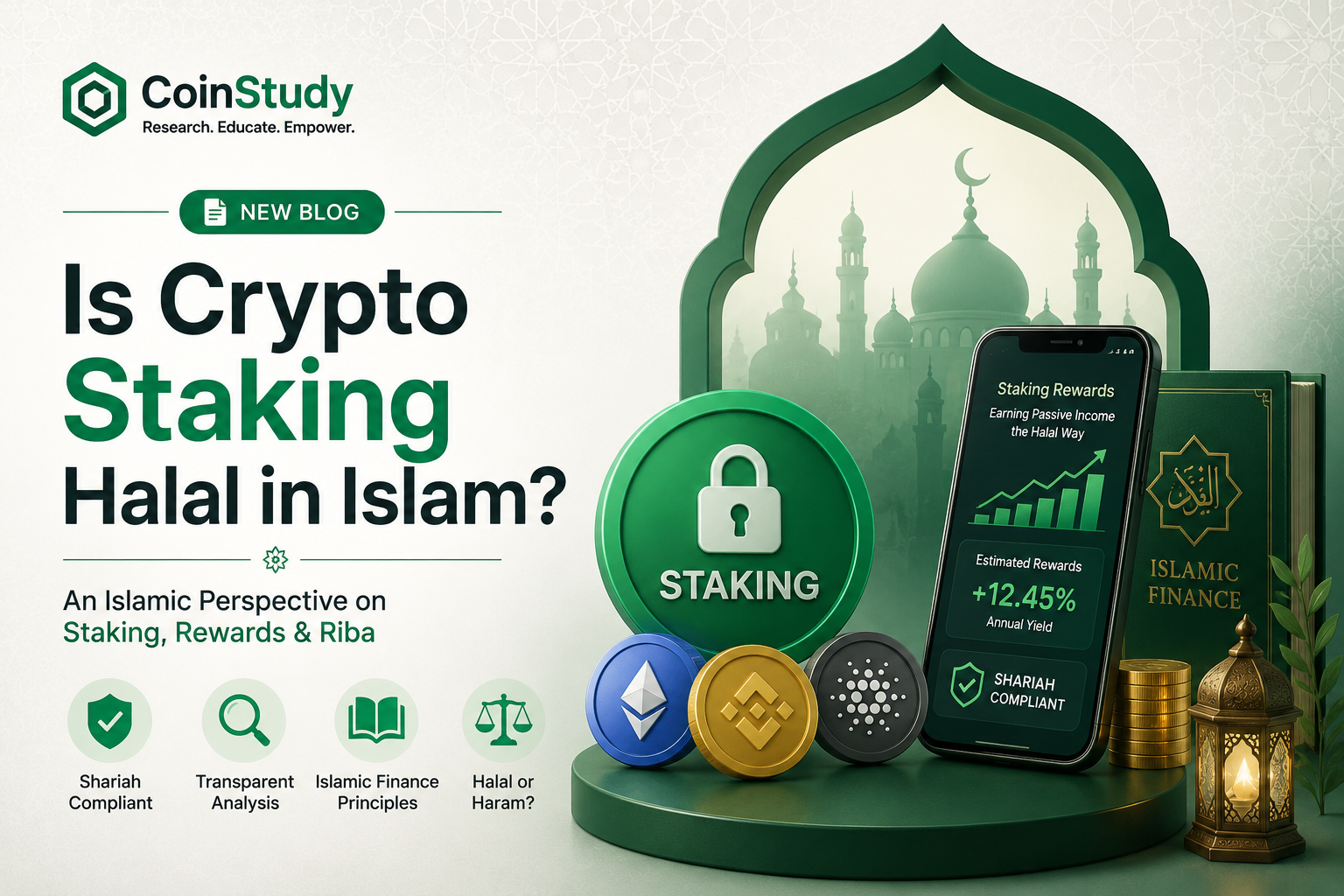
Is Crypto Staking Halal in Islam? A Complete Islamic Analysis
Every Muslim who holds crypto eventually asks the same question.
You are sitting on tokens. The network is offering you rewards just for locking them up. Your friend is earning 8% annually on his Cardano. Another person in your Telegram group is making passive income on his Cosmos. It looks easy, it looks passive, and it looks profitable.
But is it halal?
This is one of the most genuinely nuanced questions in Islamic crypto finance because staking is not one thing. It is several different things packaged under the same name. And the Islamic ruling on each type is completely different.
CoinStudy's Shariah Board has reviewed this question thoroughly. Here is the complete and honest answer.
Quick Verdict: Crypto Staking Depends Entirely on the Structure ⚠️
Crypto staking is not automatically halal and not automatically haram. The ruling depends on the specific mechanism being used.
Native Proof of Stake staking on legitimate networks is generally permissible, ranging from Halal to Halal with Concerns depending on the specific network.
Lending based staking where platforms borrow your tokens and pay you fixed returns is generally Haram due to Riba concerns.
Liquid staking with derivative tokens requires individual analysis on a case by case basis.
Understanding why requires understanding what each type of staking actually is.
What Is Crypto Staking?
Crypto staking is the process of locking up cryptocurrency tokens in a blockchain network to support its operations. In return, participants earn staking rewards, typically paid in the same cryptocurrency.
Staking is most commonly associated with Proof of Stake consensus mechanisms, which are used by networks like Cardano, Cosmos, Solana, Ethereum, and many others. It is the primary alternative to Proof of Work mining as a method of securing a blockchain network.
The fundamental purpose of staking is to give validators a financial stake in behaving honestly. If a validator tries to cheat the network, their staked tokens can be destroyed through a process called slashing. This financial risk incentivizes honest participation and makes the network secure.
How Staking Actually Works
Understanding the mechanics is essential for the Islamic finance analysis.
When you stake tokens on a Proof of Stake network, you are either running a validator node yourself or delegating your tokens to a validator who runs the node on your behalf. Validators are responsible for confirming transactions, producing new blocks, and maintaining network security.
In return for this genuine service to the network, validators receive two types of rewards. The first is newly minted tokens that the network creates as an incentive for validation. The second is a share of the transaction fees paid by users of the network.
These rewards are then distributed proportionally among everyone who delegated tokens to that validator. The more tokens you delegate, the larger your share of the validator's rewards.
The key point for Islamic finance purposes is this. You are being rewarded for contributing to genuine productive economic activity, which is network security and transaction validation. You are not lending money and receiving interest in return.
The Critical Islamic Finance Question
The entire halal or haram determination for staking comes down to one question.
Are staking rewards equivalent to interest on lent capital, or are they compensation for genuine productive participation in a network?
If your tokens are being lent to someone who pays you a guaranteed percentage return, that is Riba.
If your tokens are being used to secure a network and your rewards come from that genuine network participation, that is a different economic relationship entirely.
This distinction is not just semantic. It is the foundation of the entire ruling.
Islamic Finance Analysis
Riba — The Central Question
Traditional interest involves lending capital to a borrower who pays a predetermined percentage return regardless of whether any productive activity generates that return. The lender's capital does the work of earning simply by being lent. The return is guaranteed and predetermined.
Native Proof of Stake staking is structurally different in important ways. Your tokens are not being lent to anyone. They are being locked in the network's consensus mechanism to provide security. The rewards you receive come from network activity, specifically newly minted tokens and transaction fees, not from a borrower paying you interest.
The rewards are not guaranteed in the way interest is guaranteed. They vary based on network activity, total staked supply, validator performance, and other factors. A network that processes more transactions generates more fees that flow to stakers. A network with fewer transactions generates fewer rewards.
This variable, activity based reward structure is meaningfully different from a fixed interest rate on deposited capital. Most Islamic finance scholars who have analyzed Proof of Stake staking have found this distinction sufficient to permit native staking on legitimate networks.
However, not all staking is native Proof of Stake staking. And this is where the analysis becomes critical.
Gharar — Uncertainty in Staking
Native staking involves some uncertainty that is generally considered acceptable rather than prohibited.
Reward amounts vary based on network conditions. Lock up periods mean you cannot access your tokens freely during staking. Slashing risk exists if a validator behaves dishonestly. The value of the underlying token fluctuates with market conditions.
None of these uncertainties are of the type that Islamic finance prohibits. They are the normal uncertainties of participating in a productive economic activity. The lock up period is clearly disclosed. The reward mechanism is transparent. The slashing conditions are defined in the protocol.
The Gharar concern becomes more serious in complex staking products where the reward mechanism is unclear, the underlying assets are opaque, or the terms are difficult to understand. Simple native staking on established networks with clear documentation generally passes the Gharar test.
Maysir — Speculation in Staking
Staking itself is not gambling. You are not betting on an outcome. You are participating in network security and receiving compensation for that participation.
However, if staking is approached with a purely speculative mindset, focused entirely on token price appreciation rather than the underlying utility, the Maysir concern can apply to the broader investment behavior even if not to the staking mechanism itself.
Long term staking tied to genuine belief in a network's utility is meaningfully different from short term staking on highly volatile meme tokens with no utility, done purely to chase high APR percentages that are unsustainably inflated.
CoinStudy HCS Analysis of Staking Types
Type 1 — Native Proof of Stake Staking
Examples: Cardano (ADA), Cosmos (ATOM), Polkadot (DOT), Algorand (ALGO)
How it works: You delegate tokens to a validator. The validator participates in consensus. You earn a share of block rewards and transaction fees.
Layer 1 Screening: Passed. No interest based lending mechanism. Rewards come from genuine network participation.
Layer 2 Assessment: Generally Halal or Halal with Concerns depending on the specific network's overall HCS score. A network that passes CoinStudy's HCS screening as Halal can generally be staked in a permissible manner.
Verdict: Generally Permissible
The key conditions are that the underlying network itself is halal rated, the staking mechanism is native and transparent, and no guaranteed fixed return is being offered.
Type 2 — Lending Based Staking
Examples: Centralized exchange earn products, lending platforms offering fixed APY on staked tokens, yield products like sUSDf or USD0++
How it works: You deposit tokens with a platform. The platform lends or deploys your tokens in various ways. You receive a fixed or advertised percentage return.
Layer 1 Screening: Failed. This is lending capital for a guaranteed return, which is structurally identical to interest bearing deposits regardless of what the platform calls it.
Verdict: Generally Haram
When a platform advertises a specific APY on your deposited tokens, that is an interest bearing deposit product. Calling it staking does not change the financial relationship. The sin of the Riba belongs to the platform, but Muslim investors should not participate in products whose entire value comes from interest based income distribution.
Type 3 — Liquid Staking
Examples: Lido's stETH on Ethereum, similar derivative staking tokens on other networks
How it works: You stake tokens and receive a liquid derivative token representing your staked position. This derivative token can be traded, used in DeFi, or held while you continue earning staking rewards.
Assessment: Liquid staking sits in more complex territory. The underlying staking mechanism may be legitimate Proof of Stake participation. But the derivative token adds layers of complexity that require individual analysis.
The concern is that liquid staking tokens are often used in DeFi lending protocols to generate additional yield on top of staking rewards. This layering of yield on yield, where some of the additional yield may come from interest based mechanisms, creates indirect Riba exposure.
Additionally, some liquid staking protocols have governance or fee structures that introduce additional compliance questions.
Verdict: Requires Individual Analysis
Each liquid staking product should be assessed on its specific mechanism before a Muslim investor participates. Using a liquid staking token in DeFi lending protocols adds further complications that would likely fail Layer 1 screening.
Type 4 — Exchange Staking Programs
Examples: Binance Earn, OKX staking, other centralized exchange staking products
Assessment: Most centralized exchange staking programs fall into the lending based category. When you stake on Binance, you are depositing tokens with Binance. Binance deploys those tokens as it sees fit and pays you a return. This is functionally an interest bearing deposit with Binance, not genuine Proof of Stake participation.
Additionally, exchange native tokens like BNB that are staked benefit from exchange ecosystems that include derivatives markets and lending programs, creating broader compliance concerns beyond the staking mechanism itself.
Verdict: Generally Haram for most centralized exchange staking products
The Practical Guide for Muslim Stakers
Before staking any cryptocurrency, ask yourself these questions honestly.
Is the network I want to stake on rated as Halal by CoinStudy? If the underlying network fails HCS screening, staking it adds complexity to an already non-compliant investment.
Is this native Proof of Stake staking or am I depositing tokens with a platform that promises me a return? The difference is fundamental. Native staking means you are participating in consensus. Platform staking usually means you are lending.
Is there a guaranteed APY being advertised? If a platform promises you 8% annually regardless of network conditions, that guarantee is a red flag. Genuine Proof of Stake rewards vary with network activity.
Am I using the staking token in any DeFi lending protocol to generate additional yield? If yes, that additional yield layer requires its own compliance assessment.
Would I be comfortable explaining this staking arrangement to a qualified Islamic scholar? If the explanation feels complicated or requires creative framing to sound permissible, that discomfort is worth taking seriously.
Specific Coin Staking Guidance
CoinStudy has analyzed many networks that offer staking. Here is a quick reference based on our existing HCS analyses.
Cardano staking: Cardano scored 90/100 as Halal. Native ADA staking through non-custodial wallets, delegating to a stake pool, is generally permissible. No lock up period required on Cardano, which reduces the Gharar concern further.
Cosmos staking: Cosmos scored 89/100 as Halal. Native ATOM staking with a 21 day unbonding period is generally permissible.
Algorand staking: Algorand scored 89/100 as Halal. Native participation rewards through wallet based staking are generally permissible.
Ethereum staking: Ethereum scored 88/100 as Halal. Native ETH staking through running a validator or delegating through non-lending based platforms is generally permissible. Using liquid staking tokens in DeFi lending is not.
Solana staking: Solana scored 87/100 as Halal. Native SOL staking by delegating to validators is generally permissible.
In all cases, using centralized exchange staking products for these networks rather than native staking changes the compliance picture significantly.
What Makes Staking Permissible — The Summary Principles
Summarizing the scholarly position reflected in CoinStudy's Shariah Board guidance, native Proof of Stake staking is generally permissible when these conditions are met.
The underlying network is itself halal, meaning it passes CoinStudy's HCS Layer 1 screening. The staking mechanism is native Proof of Stake participation, not lending based yield. The rewards are variable and linked to genuine network activity, not guaranteed fixed returns. The staking is done through non-custodial means where you retain control of your assets, or through clearly transparent delegation to validators. The staked tokens are not further deployed in DeFi lending or yield generating protocols that create additional Riba exposure.
When these conditions are not met, the permissibility disappears regardless of what the product is called.
Final Verdict
Crypto staking is not inherently halal and not inherently haram. The ruling depends entirely on the structure.
Native Proof of Stake staking on halal rated networks, done through transparent delegation mechanisms with variable rewards, is generally permissible under Islamic finance principles. The rewards represent compensation for genuine productive participation in network security, not interest on lent capital.
Lending based staking, exchange earn products, and fixed APY yield programs are generally haram because their economic structure is functionally identical to interest bearing deposits regardless of the terminology used.
Liquid staking and other complex derivative staking products require individual analysis before a Muslim investor participates.
The Muslim investor who wants to stake responsibly should start by verifying the halal status of the underlying network through CoinStudy's HCS analyses, then confirm they are using native staking mechanisms rather than platform based lending programs, and finally consult a qualified Islamic scholar for personal guidance on their specific situation.
Read detail analysis of coins here:
Is Cardano Halal?
Is Cosmos Halal?
Is Ethereum Halal?
Why lending platforms are haram?
Disclaimer: This article is provided for educational and research purposes only. CoinStudy does not provide personal financial or religious rulings. Investors should consult qualified Islamic scholars for individual guidance.