

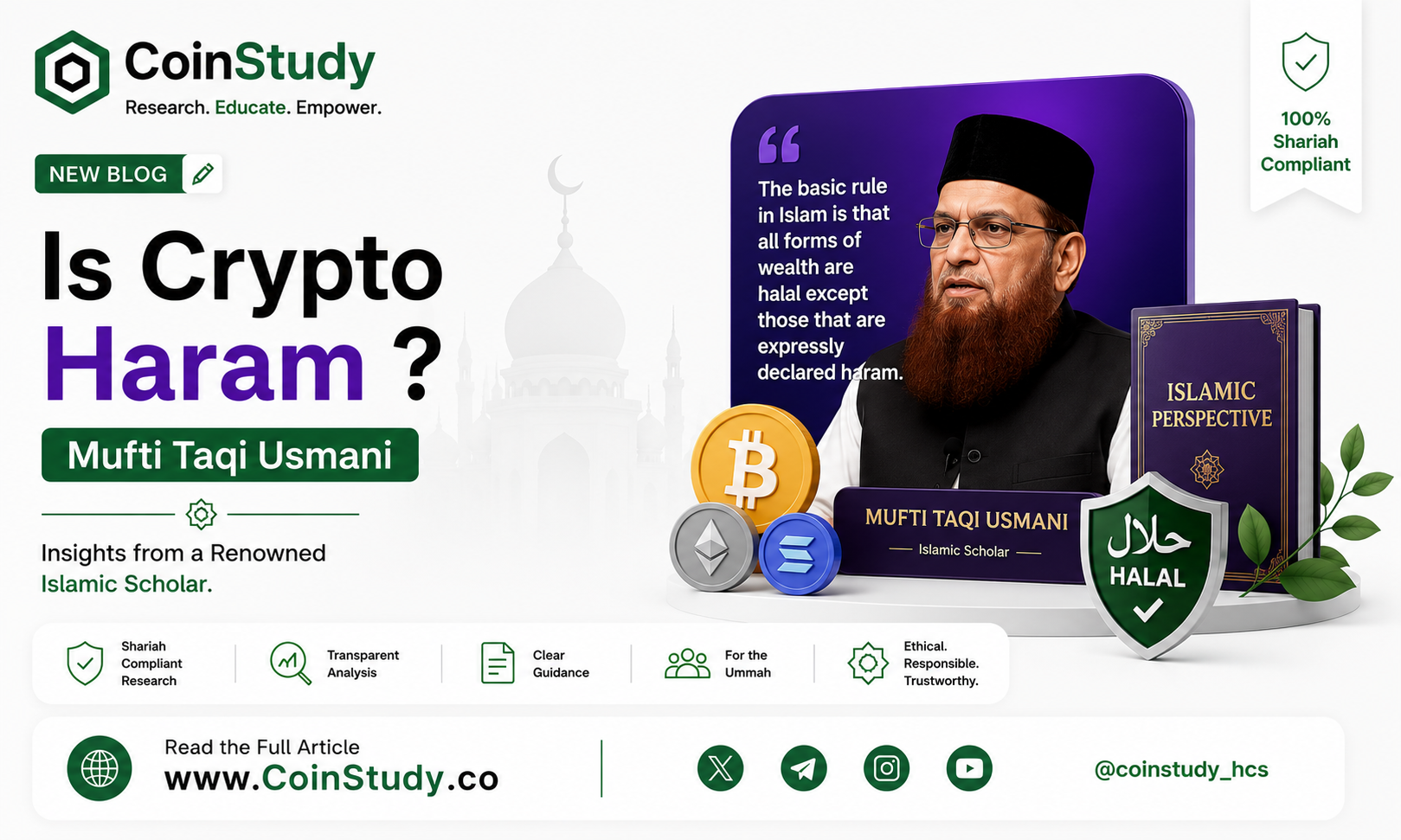
Is Crypto Haram? Pakistan's Grand Mufti Said Yes. Here Is What CoinStudy's Shariah Board Chairman Said.
Few religious rulings have shaken the Muslim crypto community as much as the fatwa attributed to Mufti Taqi Usmani.
Mufti Taqi Usmani is one of the most respected Islamic finance scholars alive today. His contributions to Islamic banking, the development of sukuk, and the formalization of Islamic finance principles have shaped the global Islamic financial industry for decades. When a scholar of his stature speaks on a financial matter, Muslim investors listen.
The ruling that crypto is impermissible created genuine confusion, genuine concern, and genuine disruption for millions of Muslim investors who had been engaging with cryptocurrency based on earlier scholarly assessments that permitted it conditionally.
Many stopped. Many hesitated. Many asked: if a scholar of this caliber says no, what do the scholars who say yes actually have to say?
CoinStudy submitted this exact question to our Shariah Board Chairman, Dr. Usman Quddus, PhD in Islamic Studies and Finance under AAOIFI standards. His response is one of the most important scholarly statements CoinStudy has received since our founding.
This blog presents that response in full, with its scholarly foundations and its practical implications for Muslim investors.
What the Grand Mufti's Ruling Actually Said
Before engaging with the response, it is important to understand precisely what Mufti Taqi Usmani's position is and what it is based on.
Mufti Taqi Usmani's concern about cryptocurrency centers on several classical Islamic jurisprudence arguments. The first is that cryptocurrency is not backed by any real asset or government authority, making its value purely speculative. The second is that the extreme price volatility creates excessive Gharar that renders transactions impermissible. The third, drawing particularly on classical Hanafi jurisprudence, is that something must be physical and tangible to qualify as mal, which is the Islamic concept of legitimate wealth or property, and that cryptocurrency, being purely digital, does not meet this criterion.
These concerns are serious. They come from a scholar who has spent decades thinking carefully about Islamic finance. CoinStudy's Shariah Board Chairman engages with them seriously, methodically, and with full scholarly grounding rather than dismissing them.
CoinStudy Shariah Board Chairman's Complete Response
Dr. Usman Quddus reviewed the question of cryptocurrency's status as mal under Islamic jurisprudence and provided the following comprehensive scholarly response.
The Classical Definition of Mal — What the Four Schools Actually Say
The first and most foundational question is whether cryptocurrency can be considered mal under Islamic jurisprudence. The answer to this question determines whether crypto can be bought, sold, owned, and transacted in Islam, because the rulings of commerce apply to mal.
The Hanafi school holds that for something to be considered mal it must be physical and tangible and capable of being stored or possessed. This is why classical Hanafi jurists considered manafi, meaning benefits such as the right to live in a house, to be ownership rather than wealth in itself. Under a strict classical Hanafi interpretation, purely digital assets that have no physical existence could face a classification challenge.
However the majority of jurists across the Maliki, Shafi'i, and Hanbali schools take a broader view. Imam Shafi'i stated: "Mal is everything that has financial value, people exchange it, and if someone destroys it, compensation becomes obligatory." Under this definition, anything with genuine economic value that people transact and that would require compensation if destroyed or taken unlawfully qualifies as mal. This definition makes no requirement for physical tangibility.
The established fiqhi summary for something to qualify as Mal-e-Mutaqawwam, which is wealth whose protection and value is recognized in Shariah, requires two conditions. The first is Tamawwul, meaning people generally consider it valuable and conduct transactions in it. The second is Taqwim, meaning Shariah has declared its use permissible, which is why alcohol and pork are not mal for Muslims even though they have market value among others.
The Modern Application of Mal — How Fiqhi Thought Has Evolved
With changes in economics and technology, the concept of mal has expanded in contemporary Islamic jurisprudence. This is not innovation for its own sake. It is the application of established fiqhi principles to new realities, a process that has always been part of Islamic legal methodology.
In earlier times, mal was limited to gold, silver, and commodities exchanged through barter. Today government-issued paper notes, coins, and digital balances in bank accounts are completely recognized as mal by virtually all Islamic finance scholars and institutions, because they have genuine purchasing power and perform the functions of money. No serious contemporary scholar argues that digital balances in conventional bank accounts are not mal simply because they are not physically tangible.
This evolution did not require abandoning classical principles. It required applying them honestly to new realities. The Tamawwul condition is met because people universally value and transact in currency. The Taqwim condition is met because the transaction of currency itself is permissible.
Modern fiqhi institutions have extended this same reasoning to intellectual property rights including copyrights, trademarks, patents, and goodwill. These are entirely non-physical assets that nonetheless have recognized economic value and are treated as mal by contemporary Islamic finance scholars and institutions. A software program that required significant investment to create and has market value is mal. A brand name with established market recognition is mal. These developments represent the honest application of established Islamic jurisprudence to the modern world.
Digital assets that have genuine economic value, that people transact in, and whose use is permissible under Shariah satisfy the conditions for mal under contemporary fiqhi reasoning, particularly from the majority Maliki, Shafi'i, and Hanbali positions and from the application of those positions by leading contemporary Islamic finance scholars.
Contemporary Scholarly Authority — Who Has Ruled on This
Dr. Usman Quddus cited three categories of contemporary scholarly authority that support the conditional permissibility of cryptocurrency as mal.
The first is Dr. Ali Muhyiddin Al-Qaradaghi, who serves as President of the International Union of Muslim Scholars and is one of the most prominent Islamic finance scholars in the contemporary world. Dr. Al-Qaradaghi's position, elaborated in his work on the economic dimensions of digital currencies, is that if a specific cryptocurrency does not have severe Gharar or fundamental ignorance in its structure, and people accept it as a means of transacting value, then it qualifies as mal and its buying and selling is principally permissible. His reference work is Al-Majalat al-Iqtisadiyya lil-Umlat al-Raqmiyya.
The second is Professor Dr. Ali Ahmad Al-Salus, who serves as Professor of Economic Fiqh at Qatar University and is one of the most authoritative voices on contemporary Islamic financial transactions. His position, elaborated in his work Al-Muamalat al-Maliyya al-Muasira fil-Fiqh al-Islami, is that if a digital currency is not merely an empty concept but has genuine utility and real-world function, and society accepts it as a form of mal, then the rulings of mal apply to it.
The third is the Shariah Advisory Council of the Securities Commission Malaysia, which is one of the most rigorous and institutionally credible Islamic finance regulatory bodies in the world. In its 2020 official resolution, the council declared that digital tokens and cryptocurrencies are in the ruling of Mal-e-Mutaqawwam and that Muslim investors can trade and invest in them. This is not a private opinion but an official institutional resolution from a nationally recognized Shariah authority.
The Chairman's Conclusion
In the modern era, the questions received by CoinStudy have been addressed by Dr. Usman Quddus and his team in agreement with these contemporary scholars, within a scholarly tradition that permits cryptocurrency conditionally with proper screening and methodology.
The chairman's position is that cryptocurrency that meets the conditions of mal under contemporary fiqhi reasoning, has genuine utility, is accepted by people as a means of transacting value, and is free from severe Gharar and prohibited uses, is principally permissible as a form of digital asset under Islamic jurisprudence.
This is not a blanket permissibility of all crypto. It is a principled and methodologically grounded position that requires individual assessment of each specific cryptocurrency, which is precisely what CoinStudy's Halal Crypto Standard exists to provide.
The Scholarly Disagreement — Understanding Why Two Respected Scholars Reach Different Conclusions
The most important thing Muslim investors need to understand is that the disagreement between Mufti Taqi Usmani's position and the position of scholars like Dr. Al-Qaradaghi, Dr. Al-Salus, the Malaysian Shariah Advisory Council, and CoinStudy's chairman is a genuine scholarly disagreement, not a case where one side is clearly right and the other clearly wrong.
Scholarly disagreements in Islamic jurisprudence are not failures of the system. They are features of a living intellectual tradition that has always engaged with new realities through principled reasoning. The four major schools of Islamic jurisprudence themselves represent centuries of legitimate scholarly disagreement on countless questions, from the definition of mal to the permissibility of specific commercial transactions.
The disagreement about cryptocurrency centers on two genuinely contested questions.
The first is which definition of mal applies to digital assets. Scholars who follow a stricter classical Hanafi interpretation of physical tangibility requirement reach different conclusions from scholars who apply the majority Shafi'i, Maliki, and Hanbali definition based on economic value and social acceptance. Both positions are grounded in genuine scholarly tradition.
The second is how to assess the level of Gharar in cryptocurrency markets. Scholars who view crypto's price volatility as constituting excessive impermissible Gharar reach different conclusions from scholars who view this volatility as the kind of commercial risk that has always existed in legitimate markets.
CoinStudy's chairman has chosen to align with the majority fiqhi tradition on the definition of mal and with the assessment that appropriate cryptocurrency selected through careful screening does not necessarily involve excessive Gharar of the kind that makes transactions impermissible.
What This Means Practically for Muslim Investors
The scholarly response to the Grand Mufti's fatwa does not mean that all cryptocurrency is halal. It means that the question requires more precise analysis than a blanket ruling in either direction.
CoinStudy's Shariah Board Chairman's position, supported by the contemporary scholarly tradition cited above, is that the question is not whether crypto as a category is halal or haram. The question is whether each specific cryptocurrency meets the conditions required for permissible mal under Islamic jurisprudence.
A cryptocurrency that has genuine utility, serves a real economic function, has been accepted by people as a form of value, and is free from severe Gharar and prohibited applications can qualify as permissible mal under contemporary fiqhi reasoning supported by major global Islamic finance authorities.
A cryptocurrency that is purely speculative with no genuine utility, that facilitates prohibited financial activities, or that involves such severe Gharar that the fundamental terms of the transaction are indeterminate, requires a different assessment.
This is precisely why CoinStudy applies a systematic two-layer screening process to each cryptocurrency individually rather than issuing blanket category rulings. The Halal Crypto Standard exists because the honest answer to the question of whether crypto is halal requires the kind of detailed analysis that a blanket fatwa cannot provide.
Bitcoin, which CoinStudy classifies at 95 out of 100 Halal, has over fifteen years of operational history, is accepted globally as a form of digital value by individuals, institutions, and governments, and has genuine utility as a store of value and medium of exchange. Its classification as mal under contemporary fiqhi reasoning aligned with the majority scholarly tradition is well-supported.
A meme coin with no utility, no genuine backing, and market activity driven entirely by social media speculation sits in a completely different category from an analytical perspective, regardless of whether both are technically called cryptocurrencies.
The blanket fatwa treats these two assets as the same thing. CoinStudy's methodology, aligned with the contemporary scholarly tradition our chairman cited, does not.
Respecting the Grand Mufti While Engaging With the Evidence
CoinStudy and our Shariah Board Chairman hold Mufti Taqi Usmani in the highest respect. His contributions to Islamic finance are without peer in the modern era. His concerns about cryptocurrency speculation, Gharar, and the potential for harm to ordinary investors are legitimate and worth taking seriously.
The chairman's response does not argue that the Grand Mufti is wrong to be concerned. It argues that the appropriate response to those concerns is careful individual assessment through established fiqhi methodology, not a blanket prohibition that makes no distinction between Bitcoin and a meme coin, between genuine blockchain infrastructure and a pump-and-dump scheme.
Scholarly disagreement at this level, between respected qualified scholars applying established principles to genuinely new realities, is a sign of a living intellectual tradition engaging seriously with the world. Muslim investors deserve to know that this disagreement exists, what the arguments on each side are, and where the weight of contemporary scholarly opinion sits.
The weight of contemporary scholarly opinion, as represented by Dr. Al-Qaradaghi at the International Union of Muslim Scholars, Dr. Al-Salus at Qatar University, the Malaysian Securities Commission Shariah Advisory Council, and CoinStudy's own Shariah Board Chairman, is that cryptocurrency can qualify as mal and can be transacted permissibly when assessed through proper fiqhi methodology.
The CoinStudy Approach — Why Individual Assessment Matters
This scholarly context is why CoinStudy has always insisted on individual analysis of each cryptocurrency rather than category-level rulings.
When the chairman says that cryptocurrency can be permissible as mal under contemporary fiqhi reasoning, he is not saying that all cryptocurrency is permissible. He is saying that the question must be answered for each specific asset through proper methodology.
CoinStudy's Halal Crypto Standard applies this methodology systematically. Layer 1 screens each asset against five Sharia red lines covering interest exposure, gambling and betting, prohibited industries, guaranteed interest products, and synthetic interest instruments. Assets that fail any red line receive an automatic Haram classification regardless of their technical characteristics.
Assets that pass Layer 1 proceed to Layer 2 scoring across seven principles covering financial exposure risk, Gharar, Maysir, underlying business activity, utility and real use, tokenomics fairness, and transparency and governance. The resulting score places each asset in one of four classifications from Halal at 80 to 100 through Halal With Concerns, Doubtful, and Haram.
This systematic methodology applied to individual assets, grounded in established fiqhi principles and aligned with the majority of contemporary Islamic finance scholarship, is how CoinStudy serves the Muslim investor community's genuine need for reliable Islamic finance guidance on cryptocurrency.
Final Verdict
The question of whether cryptocurrency is halal is not settled by a single fatwa in either direction. It is answered through careful application of established Islamic jurisprudence principles to each specific asset, a process that CoinStudy's Shariah Board Chairman has confirmed is aligned with the contemporary scholarly tradition represented by some of the most authoritative Islamic finance institutions and scholars in the world.
Muslim investors who have been uncertain since the Grand Mufti's ruling deserve to know that their uncertainty is appropriate given the genuine scholarly disagreement on this question, that respected and credentialed Islamic finance scholars and institutions have taken a different position, and that the most intellectually honest approach is individual assessment through proper fiqhi methodology rather than blanket acceptance or rejection of an entire asset class.
CoinStudy's commitment is to provide exactly that individual assessment, grounded in proper scholarship, reviewed by a qualified Shariah Board, and presented with the honesty and precision that Muslim investors deserve.
Shariah Board Chairman's Opinion
CoinStudy's Shariah Board Chairman Dr. Usman Quddus, PhD in Islamic Studies and Finance under AAOIFI standards, reviewed the question of cryptocurrency's status as mal under Islamic jurisprudence in response to concerns raised by the Grand Mufti's blanket prohibition fatwa and provided the following scholarly position.
The majority of contemporary Islamic finance scholars, fiqhi institutions, and researchers including Dr. Ali Muhyiddin Al-Qaradaghi of the International Union of Muslim Scholars, Professor Dr. Ali Ahmad Al-Salus of Qatar University, and the Shariah Advisory Council of the Securities Commission Malaysia have recognized cryptocurrency as a form of digital asset that can qualify as Mal-e-Mutaqawwam under contemporary fiqhi reasoning, particularly from the majority Maliki, Shafi'i, and Hanbali positions on the definition of mal.
In the modern era, questions received by CoinStudy have been addressed by Dr. Usman Quddus and his team in agreement with these contemporary scholars, within a scholarly tradition that permits cryptocurrency conditionally. The permissibility is conditional on individual assessment of each specific cryptocurrency through established fiqhi methodology, not a blanket permission for all digital assets. CoinStudy's Halal Crypto Standard provides this individual assessment methodology.
Disclaimer: This article is provided for educational and research purposes only. The scholarly position presented reflects the views of CoinStudy's Shariah Board Chairman Dr. Usman Quddus and the contemporary scholars cited. This does not constitute a personal fatwa for any specific individual. Muslim investors should consult a qualified Islamic scholar for personal guidance specific to their situation.