


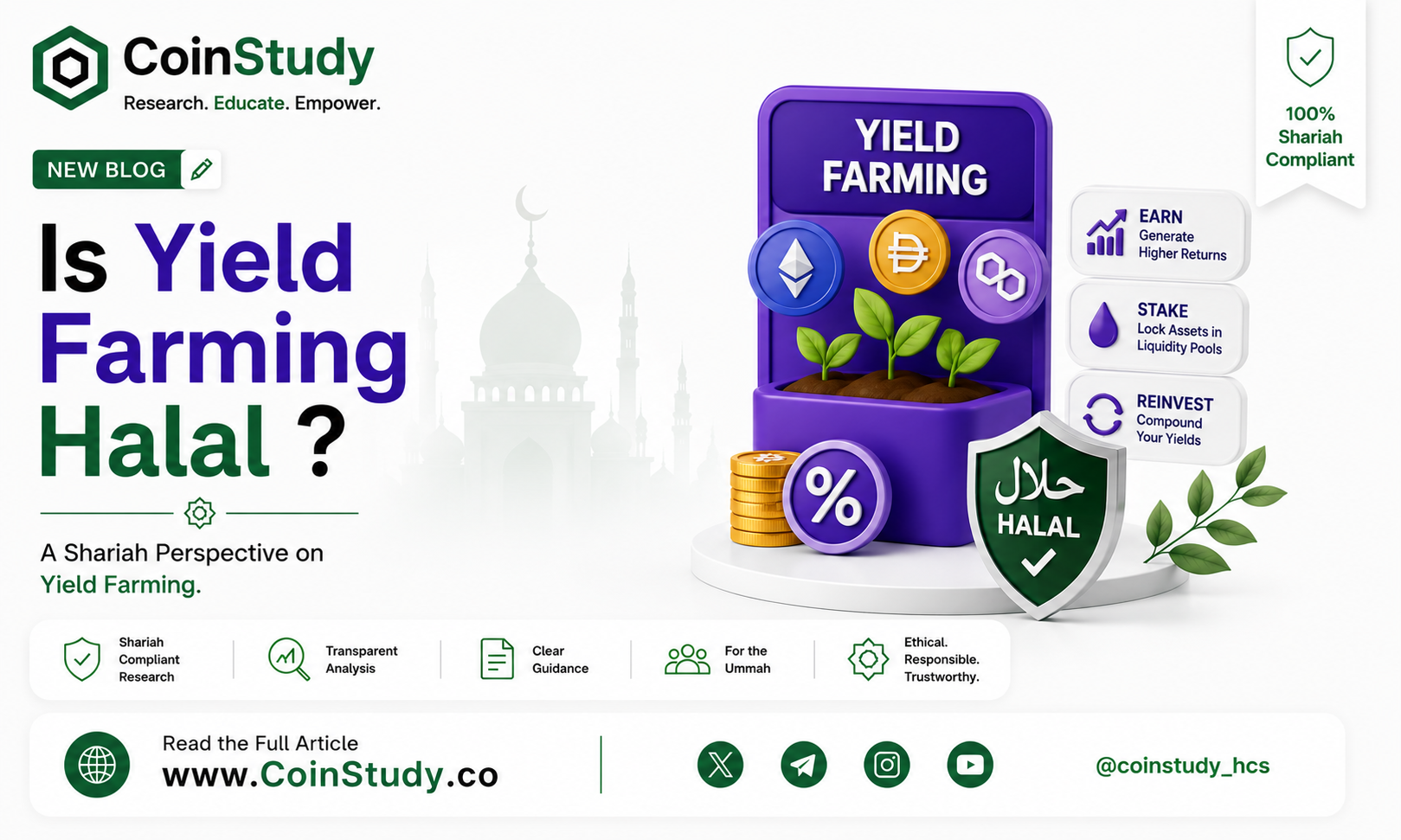
Is Yield Farming Halal in Islam? A Complete Islamic Finance Guide
DeFi promised to turn every crypto holder into a yield-generating machine.
At the peak of the 2021 DeFi summer, yield farming protocols were advertising returns of hundreds and sometimes thousands of percent annually. Users were moving capital between protocols daily, stacking rewards from multiple sources simultaneously, compounding governance tokens into more positions, and chasing the highest available APY across an ever-expanding universe of DeFi applications.
The financial engineering was genuinely innovative. The returns were genuinely extraordinary, at least temporarily. And the complexity was genuinely unprecedented.
For Muslim investors watching this unfold, the question was urgent: is any of this halal?
The honest answer requires dismantling yield farming into its component parts because yield farming is not one activity. It is a category of strategies that can include fee-based liquidity provision, governance token incentives, lending interest compounding, automated vault strategies, and leveraged yield loops, each with fundamentally different compliance profiles under Islamic finance principles.
CoinStudy has analyzed hundreds of yield farming protocols and strategies through our Halal Crypto Standard (HCS) methodology. This guide presents the complete picture.
Quick Verdict: Yield Farming Is Mostly Doubtful to Haram
Yield farming as commonly practiced in DeFi cannot receive a single universal ruling. The compliance outcome depends entirely on which yield sources the specific strategy involves.
Fee-based liquidity provision in permissible asset pairs, earning only trading fees from genuine market-making activity, is Halal With Concerns under the chairman's LP ruling, subject to both assets being permissible and the liquidity going to a permissible place.
Lending-based yield farming where assets are deposited into lending protocols to earn interest income is Haram, directly and without exception.
Governance token farming where the primary motivation is earning and immediately selling newly minted governance tokens of protocols generating revenue from prohibited activity is Haram through the economic dependence connection.
Automated vault strategies that compound multiple yield sources including lending interest are Haram because the prohibited income source is embedded in the strategy regardless of what other components are permissible.
Leveraged yield farming where borrowed capital is deployed to amplify yields is Haram because it adds interest-bearing debt obligations to whatever other compliance concerns exist in the underlying strategy.
The most honest summary: the majority of yield farming as actually practiced in DeFi fails Islamic finance red-line screening, primarily through Riba exposure from lending mechanisms and secondarily through excessive Gharar and Maysir in speculative farming strategies.
What Is Yield Farming?
Yield farming refers to the practice of deploying cryptocurrency assets across various DeFi protocols to generate returns from multiple simultaneous sources including trading fees, governance token emissions, lending interest, and liquidity mining incentives.
The term emerged during the DeFi summer of 2020 when Compound Finance began distributing COMP governance tokens to users of its lending protocol. The distribution of governance tokens as rewards for using DeFi protocols created a new category of financial strategy where the governance token reward could sometimes generate returns that exceeded the underlying yield from the protocol itself.
The basic concept is deploying capital where it can generate the highest possible return, continuously moving assets to optimize yield, and compounding rewards back into positions to accelerate growth. At its most sophisticated, yield farming involves automated vault strategies that execute complex multi-protocol strategies without manual intervention.
How Yield Farming Works — The Complete Mechanics
Understanding precisely how yield farming generates returns is essential because the Islamic finance assessment follows directly from the source of those returns.
Single-Protocol Yield Farming
The simplest form of yield farming involves depositing assets into a single protocol and earning whatever returns that protocol offers. A user deposits USDC into Aave and earns both the base lending interest rate and additional AAVE governance token rewards. Both yield sources come from the same protocol interaction.
Multi-Protocol Yield Farming
More complex strategies involve deploying assets across multiple protocols simultaneously to capture returns from each. A user might deposit ETH into a liquid staking protocol to earn staking rewards, take the liquid staking token they receive and deposit it into a DEX liquidity pool to earn trading fees, then stake the LP tokens they receive in the DEX's incentive program to earn governance token rewards. Each step adds a layer of complexity and often a layer of additional yield source.
Automated Vault Strategies
Protocols like Yearn Finance, Beefy Finance, and similar yield optimizers pool user deposits and execute complex strategies automatically. Users deposit a single asset and receive a vault token representing their share. The vault smart contracts automatically harvest rewards, sell them for more of the deposited asset, and compound the position. Users earn the vault's net yield rate without needing to manage the underlying strategies themselves.
Leveraged Yield Farming
Some farmers use borrowed capital to amplify their positions. A user might deposit $1,000 of ETH as collateral, borrow $800 in USDC, deploy that USDC into a yield farming position, earn yield on $1,800 of effective exposure while paying interest on the $800 borrowed, and capture the spread if the yield exceeds the borrowing cost.
Mercenary Liquidity Farming
A specific and particularly problematic subset of yield farming involves depositing capital into protocols specifically to earn governance token rewards, then immediately selling those governance tokens for stable value, and repeating the process. This strategy extracts value from protocol treasuries through token emissions without any genuine long-term commitment to the protocol's success.
The Islamic Finance Analysis — Yield Source by Yield Source
The compliance assessment of yield farming must follow each specific yield source rather than evaluating yield farming as a single undifferentiated category.
Yield Source One: Trading Fees from Liquidity Provision
This is the most defensible yield source in all of DeFi and the only one that passes the red-line screening without significant concern.
When a liquidity provider deposits assets into an AMM pool and earns a share of the trading fees generated by swaps through that pool, the economic relationship is service compensation for genuine market-making activity. The return varies with actual trading volume. It is not a predetermined percentage of deposited capital over time. The LP bears genuine commercial risk through impermanent loss.
CoinStudy's Shariah Board Chairman Dr. Mufti Usman Quddus has ruled directly: "Liquidity provision is permissible if given for the purpose of partnership and trade AND if it is known that the liquidity will be used in a permissible place."
This ruling provides the framework for evaluating fee-based LP yield specifically. When both assets in the pool are permissible, the trading activity facilitated serves legitimate commercial purposes, and the liquidity provider's intent is genuine market participation rather than predetermined yield extraction, the trading fee income is the most defensible yield source in DeFi.
What this means practically: earning trading fees from providing liquidity to an ETH/SOL pool, where both assets are Halal-rated, can satisfy the chairman's two conditions. Earning trading fees from providing liquidity to a USDC/ETH pool, where USDC is Haram-classified, fails the second condition because the liquidity is not being used in a permissible place.
Yield Source Two: Lending Interest Income
This is the clearest and most unambiguous Haram yield source in DeFi, and it appears in a large proportion of yield farming strategies either directly or indirectly.
When any component of a yield farming strategy generates returns from lending capital to borrowers who pay interest, that yield source is Riba. It does not matter whether the lending is direct, such as depositing USDC into Aave, or indirect, such as using an automated vault that deploys assets into Aave as one step in a multi-protocol strategy.
CoinStudy's Shariah Board Chairman has confirmed: "Taking profit on a loan is Haram in Islamic jurisprudence."
Lending-based yield appears in more yield farming strategies than most Muslim investors realize. Automated vaults frequently include lending protocol deposits as steps in their optimization strategies. Protocols like Meteora's Dynamic Vault explicitly deploy deposited assets into external lending protocols to earn "lending interest" and "lending yields," their own words. Many high-yield farming opportunities that appear to come from liquidity provision actually include lending components embedded in the strategy.
Muslim investors evaluating any yield farming opportunity should specifically identify whether any lending interest component exists in the strategy before participating.
Yield Source Three: Governance Token Emissions
Many DeFi protocols distribute newly minted governance tokens as additional rewards to users who provide liquidity, deposit assets, or engage with the protocol. This token distribution, called liquidity mining, was the innovation that transformed DeFi from a niche experiment into a multi-billion dollar ecosystem during DeFi summer 2020.
The Islamic finance assessment of governance token rewards is more nuanced than lending interest because governance tokens are not themselves interest income. They are a form of equity-like compensation for contributing to a protocol's growth.
However three important considerations affect the compliance assessment of governance token farming.
First, if the governance token is itself Haram-classified due to its connection to prohibited ecosystem revenue, receiving it as a reward from participating in that ecosystem extends the compliance concern to the farming activity. Farming AAVE tokens by depositing into Aave's lending pools means you are both earning lending interest directly and receiving tokens connected to an interest-based lending protocol.
Second, if the farming strategy involves immediately selling governance tokens with no genuine interest in the protocol's governance, the activity is closer to extracting value from protocol treasuries through token emissions than genuine participation in protocol development. This mercenary capital behavior creates Maysir concerns when governance tokens are speculative assets being farmed and sold purely for profit rather than held for genuine governance participation.
Third, governance token emissions are funded by token inflation which dilutes existing token holders. The returns you receive come at the expense of other token holders through dilution. This creates a zero-sum dynamic where the farmer's gain is offset by the loss of value in every other token holder's position.
Yield Source Four: Protocol Revenue Sharing
Some protocols distribute a portion of their genuine operating revenue, such as protocol fees from actual economic activity, to token stakers or liquidity providers rather than distributing newly minted tokens.
This yield source requires individual assessment of what the protocol's actual revenue comes from. If the protocol earns revenue from permissible services such as bridge fees, swap fees, or data services, and distributes that revenue to token holders proportionally, this is closer to genuine profit-sharing than interest income.
If the protocol earns revenue from lending interest, perpetual futures trading, or other prohibited financial activities, and distributes that revenue to token holders, the distribution carries the same compliance concerns as the revenue source.
CoinStudy's exchange token analysis framework identifies this as the ecosystem dependence concern. Revenue sharing from protocols generating income from Haram sources inherits those compliance concerns regardless of how the distribution mechanism is structured.
Yield Source Five: Staking Rewards
Some yield strategies include native Proof of Stake staking rewards as a component. CoinStudy addresses this in our dedicated staking analyses. In summary, native PoS staking rewards come from genuine network security service provision and are viewed as more defensible under Ijarah principles by many Islamic finance scholars, though scholarly debate continues.
When staking rewards are combined with lending interest, speculative token emissions, and other yield sources in an automated strategy, the permissible staking component does not redeem the prohibited components. The strategy must be evaluated on all its yield sources collectively.
Types of Yield Farming — Complete Assessment
Type One: Pure Fee-Based Liquidity Farming
The user provides liquidity to an AMM pool containing only Halal-rated assets, earns only trading fees, and does not receive additional governance token rewards. No lending, no token emissions, no automated rebalancing.
Assessment: Halal With Concerns ⚠️
This is the only form of yield farming that can pass red-line screening. The concerns are smart contract risk, impermanent loss complexity, and the need to verify each specific pool's asset permissibility. This strategy is rare in practice because most yield farming strategies add governance token rewards on top of fees.
Type Two: LP Farming with Governance Token Rewards
The user provides liquidity to a DEX pool and receives both trading fees and governance token rewards distributed by the protocol as liquidity mining incentives.
Assessment: Conditional ⚠️ to More Concerning ❌
The trading fee component may satisfy the chairman's LP conditions if the underlying assets are permissible. The governance token component requires assessment of whether the governance token itself is permissible. Many DEX governance tokens fail CoinStudy's analysis because their value is connected to ecosystem revenue that includes prohibited financial products.
Type Three: Lending Protocol Farming
The user deposits assets into a lending protocol like Aave or Compound to earn both lending interest income and governance token distributions.
Assessment: Haram ❌
Both yield sources are problematic. The lending interest is direct Riba. The governance tokens represent ownership in a protocol whose core revenue is interest income. This category fails immediately at Layer 1.
Type Four: Automated Vault Strategies
The user deposits a single asset into a yield optimizer vault that automatically executes a complex multi-protocol strategy. The vault may include liquidity provision, lending, leveraged positions, and governance token harvesting as components in its strategy.
Assessment: Haram ❌ in most implementations
The automated nature of vault strategies means the user has no visibility into or control over which yield sources the vault is using at any given moment. If any component of the vault strategy involves lending interest, and most yield optimizer vaults do, the entire strategy carries the compliance failure of that component. Muslim investors cannot separate the lending component from the fee component when both are bundled into a single vault position.
CoinStudy's analysis of EtherFi's Liquid product identified this concern precisely. EtherFi's automated vault deploys user assets across DeFi protocols to find yield opportunities. The protocol itself makes the deployment decisions rather than the user. This is the protocol's own mechanism generating prohibited income rather than a user's personal choice, which triggers the Ecosystem Riba Exposure red line.
Type Five: Leveraged Yield Farming
The user borrows capital to amplify their yield farming position, deploying both owned and borrowed capital to increase effective exposure.
Assessment: Haram ❌
Leveraged yield farming compounds multiple compliance failures. The borrowing itself involves paying interest on the borrowed capital. The yield farming strategy likely involves lending protocols paying interest. The leverage mechanism introduces extreme Gharar through liquidation risk. And the overall structure is speculative financial engineering disconnected from genuine productive economic activity.
Type Six: Algorithmic Stablecoin Yield Farming
Strategies that farm yield from algorithmic stablecoin protocols including Sky Protocol, Ethena, and similar platforms, earning from stability fees, savings rates, or perpetual futures funding rate mechanisms.
Assessment: Haram ❌
The underlying protocols generating the yield are themselves Haram-classified by CoinStudy. Sky Protocol's savings rate distributes interest from collateralized debt stability fees. Ethena's yield derives from perpetual futures funding rates. Farming yield from these protocols means earning from the same prohibited mechanisms that make the protocols themselves Haram.
Type Seven: Cross-Protocol Yield Loops
The user creates circular strategies where borrowed capital is repeatedly deployed across protocols to capture multiple yield sources simultaneously, creating a leveraged loop that amplifies both returns and risk.
Assessment: Haram ❌
Cross-protocol yield loops combine leveraged borrowing at interest with multiple DeFi yield sources of varying compliance. The complexity makes it impossible for ordinary investors to verify the compliance of every step, which itself creates excessive Gharar. The interest costs of the borrowing mechanism are directly Riba. This is among the most clearly impermissible categories of yield farming from an Islamic finance perspective.
The Mercenary Liquidity Problem — A Specific Islamic Finance Concern
This deserves specific attention because it represents a yield farming behavior that is distinctly problematic under Islamic finance principles and is rarely addressed in general DeFi discussions.
Mercenary liquidity farming refers to the practice of depositing capital into DeFi protocols specifically to earn governance token rewards with the intention of immediately selling those tokens for stable value upon receipt. The farmer has no genuine commitment to the protocol's long-term success or governance. The strategy is purely extractive.
The governance token rewards in this strategy are funded by token inflation that dilutes every existing token holder. The farmer's gain comes directly at the expense of long-term holders whose token value decreases through dilution. This is a zero-sum transfer of value from committed community members to mercenary capital rather than genuine economic value creation.
Islamic finance places significant emphasis on honest dealing and avoidance of deception in commercial transactions. Participating in a protocol's governance token distribution while having no genuine intention of contributing to its governance or long-term development, and while knowing that your participation will dilute existing community members through token inflation, raises genuine questions about the permissibility of the intent even where the technical mechanism might otherwise pass scrutiny.
This concern applies particularly to farming strategies that treat governance tokens purely as a yield extraction mechanism rather than as genuine participation in protocol governance.
The Automated Vault Transparency Problem
This is one of the most important practical concerns for Muslim investors interested in yield farming but committed to Islamic finance compliance.
Automated vault strategies are attractive precisely because they remove the complexity of managing multi-protocol positions manually. But that automation also removes the user's visibility into and control over which specific yield sources the vault is using.
Consider what a typical yield optimizer vault might do with deposited USDC. It might deposit a portion into Aave to earn lending interest. It might provide liquidity to a USDC/ETH pool to earn trading fees. It might stake LP tokens in a liquidity mining program to earn governance token rewards. It might continuously harvest and compound these rewards. And it might rebalance between these positions to optimize yields.
The Muslim investor who deposits into this vault cannot easily determine what proportion of their total yield comes from lending interest versus trading fees versus governance token emissions. They cannot withdraw from the lending component while maintaining the LP component. They cannot avoid the stablecoin LP pairs. The strategy is bundled into a single position.
For Muslim investors who want to ensure all components of their yield are from permissible sources, this transparency limitation is a fundamental obstacle. CoinStudy recommends that Muslim investors avoid automated vault strategies unless the vault's complete strategy is publicly documented and verifiable as containing only permissible yield sources in every step.
Common Rationalizations and Why They Fail
The Complexity Argument
Some argue that yield farming's complexity makes it a new financial instrument that existing Islamic finance scholarship has not addressed.
This argument fails. Islamic finance evaluates economic substance, not complexity. Complex financial engineering that generates income from lending to borrowers who pay interest is still lending at interest regardless of how many additional steps and protocols are interposed between the original capital deposit and the eventual interest income.
The Decentralization Argument
Some argue that because yield farming protocols are decentralized and governed by code rather than humans, the interest-like returns they generate are different from conventional interest.
This argument fails for the same reasons it fails in our crypto lending analysis. The algorithm governing the lending pool does not transform the economic relationship of lending for predetermined percentage returns. The decentralization of the mechanism does not change what the mechanism does financially.
The Inflation Argument
Some argue that governance token rewards are not interest because they come from token inflation rather than from interest payments by borrowers.
This argument partially addresses the Riba concern but introduces separate Maysir and Gharar concerns. Governance tokens distributed through inflation represent a claim on future protocol value that decreases as more tokens are minted. The farming strategy is speculative on whether the governance token can be sold for more than the dilution it represents. This is closer to speculation than genuine investment in productive economic activity.
The Variable Returns Argument
Some argue that because yield farming returns are variable and not guaranteed, they are different from fixed interest.
This argument has some merit when applied specifically to pure fee-based LP returns, which are genuinely variable and not predetermined. However it does not apply to lending protocol returns, which while technically variable in rate, are functionally interest on deposited capital regardless of the rate fluctuation. And it does not address the fundamental question of whether the activity generating the return is permissible productive economic activity or prohibited interest-like income.
CoinStudy HCS Screening Results
Layer 1 — Sharia Red Line Screening
For lending-based yield farming and automated vault strategies including lending components:
Ecosystem Riba Exposure — ❌ Failed. Interest income from lending capital to borrowers is embedded in the strategy either directly or through automated multi-protocol deployment.
Guaranteed Interest — ❌ Failed. Lending protocols provide ongoing percentage returns on deposited capital functioning as guaranteed interest income.
Synthetic Interest Products — ❌ Failed. Many yield farming instruments including yield-bearing vault tokens and receipt tokens from lending protocols function as synthetic interest-bearing instruments.
For pure fee-based LP farming in permissible asset pairs:
Ecosystem Riba Exposure — ✅ Passed where no lending component exists.
Guaranteed Interest — ✅ Passed. Trading fee returns are variable and not predetermined.
Gambling and Betting — ✅ Passed.
Haram Industry — ✅ Passed where underlying assets are permissible.
Synthetic Interest Products — ✅ Passed for pure LP positions.
Overall Layer 1 Result: Haram ❌ for most yield farming strategies. Conditional pass ⚠️ for pure fee-based LP in permissible pairs only.
Practical Guidance for Muslim Investors
Before participating in any yield farming strategy, apply the following assessment systematically.
Identify every yield source in the strategy. List explicitly what generates each component of the total return. If any component comes from lending interest, the strategy fails immediately regardless of other components.
Verify the assets involved. Every asset in every pool and every protocol in a multi-step strategy must be individually permissible. Haram-classified stablecoins, lending protocol tokens, and perpetual futures tokens all fail the second condition of the chairman's LP ruling.
Assess the strategy's transparency. If you cannot identify every yield source and verify its compliance independently, the Gharar from that opacity is itself a concern. Automated vaults that do not publicly disclose every step of their strategy should be avoided.
Evaluate the intent. Are you providing genuine market-making services with the expectation of earning service compensation from real trading activity, or primarily seeking to extract maximum yield from multiple DeFi protocols through complex financial engineering? The first is closer to permissible productive economic participation. The second is closer to the kind of financial engineering that Islamic finance approaches with caution.
Consult a qualified scholar for any strategy you remain uncertain about. The complexity of DeFi yield strategies means that general principles alone may not be sufficient to assess specific edge cases. A qualified Islamic finance scholar familiar with blockchain mechanics can provide guidance specific to your situation.
What Muslim Investors Can Do Instead
CoinStudy does not simply identify prohibitions. We aim to help Muslim investors find genuinely permissible alternatives.
For passive returns from crypto holdings: Native Proof of Stake staking through permissible validators is the most defensible alternative. CoinStudy's halal staking guide at coinstudy.co/halal-staking covers specific staking opportunities we have assessed as permissible, including Cosmos, Cardano, Polkadot, and other networks through reputable validators.
For genuine market participation: Pure fee-based liquidity provision in permissible asset pairs, following the chairman's two-condition test, represents the most permissible form of active DeFi participation for Muslim investors who understand the risks.
For stable value: Physical commodity-backed tokens including PAX Gold at 86 out of 100 Halal and Tether Gold at 81 out of 100 Halal provide more defensible stable value without the interest-bearing reserve structures of dollar-pegged stablecoins, though they carry commodity price exposure.
For genuine halal DeFi yield: The Islamic fintech space is developing genuinely Musharakah-compliant structures where returns vary with actual productive business performance. CoinStudy will analyze these as they mature and become available for comprehensive assessment.
The Shariah Board Chairman's Ruling on Yield Farming Components
CoinStudy's Shariah Board Chairman Dr. Mufti Usman Quddus has provided rulings on the key components that appear in yield farming strategies.
On lending: "Taking profit on a loan is Haram in Islamic jurisprudence."
On liquidity provision: "Liquidity provision is permissible if given for the purpose of partnership and trade AND if it is known that the liquidity will be used in a permissible place."
On Musharakah-structured alternatives: "If lending is structured as a genuine Musharakah partnership agreement rather than a simple loan, with genuine profit and loss sharing rather than predetermined interest-like returns, the profit becomes permissible."
These rulings collectively confirm that the majority of yield farming as currently practiced in DeFi is impermissible, while pure fee-based liquidity provision in permissible pairs under the specified conditions represents the only defensible component of yield farming under Islamic finance principles.
Important Questions for Muslim Investors
Before participating in any yield farming strategy, ask yourself honestly.
Can I identify every yield source in this strategy and has every source been independently verified as permissible? Does any component of the strategy involve lending capital to borrowers who pay interest, whether directly or through an automated vault? Are all assets in every pool and every protocol in the strategy independently permissible, including all stablecoins? Am I participating to provide genuine market-making services or primarily to extract maximum yield through complex financial engineering? If this strategy were simplified to its basic financial relationships without the DeFi terminology, would I recognize any of those relationships as interest-based lending? Would I be comfortable explaining every step of this strategy to a qualified Islamic scholar?
Final Verdict
Yield farming as commonly practiced in DeFi is classified as Doubtful to Haram under the CoinStudy Halal Crypto Standard, with the specific ruling depending entirely on which yield sources a particular strategy involves.
Lending-based yield farming is Haram due to direct Riba through interest income on deposited capital. This represents the majority of high-yield farming opportunities in DeFi.
Automated vault strategies that include lending components are Haram because the prohibited income source is embedded in the automated strategy regardless of user intent.
Leveraged yield farming is Haram through multiple simultaneous failures including interest on borrowed capital, excessive Gharar, and Maysir from speculative leverage mechanics.
Governance token farming from prohibited protocols is Haram through economic dependence on prohibited revenue sources.
Pure fee-based liquidity provision in permissible asset pairs is Halal With Concerns, representing the only genuinely defensible form of yield generation from DeFi activity, subject to satisfying both conditions of the chairman's LP ruling.
For Muslim investors, the practical guidance is clear. The majority of yield farming opportunities in DeFi involve prohibited yield sources and should be avoided. The exception, pure fee-based LP in permissible pairs, requires careful individual verification of every asset and mechanism involved. And even this most defensible form carries genuine commercial risks from impermanent loss and smart contract vulnerability that honest assessment requires acknowledging.
The high returns advertised by yield farming protocols are real in some cases and temporary in many others. Neither the financial attractiveness nor the temporal nature of the returns changes what they are or whether they come from permissible sources.
Read detail analysis of following coins here:
Is EtherFi Halal?
Is Liquidity Providing Halal?
Is Crypto Lending Halal?
Learn Halal Trading Strategies with CoinStudy Partner
Halal Staking with Sharia Compliant Validator & CoinStudy Partner
Disclaimer: This article is provided for educational and research purposes only and does not constitute a formal fatwa. The scholarly rulings referenced reflect the direct rulings of CoinStudy's Shariah Board Chairman Dr. Mufti Usman Quddus, PhD in Islamic Studies and Finance, AAOIFI standards. Muslim investors should consult a qualified Islamic scholar for personal guidance specific to their situation and the specific protocols they are considering.