

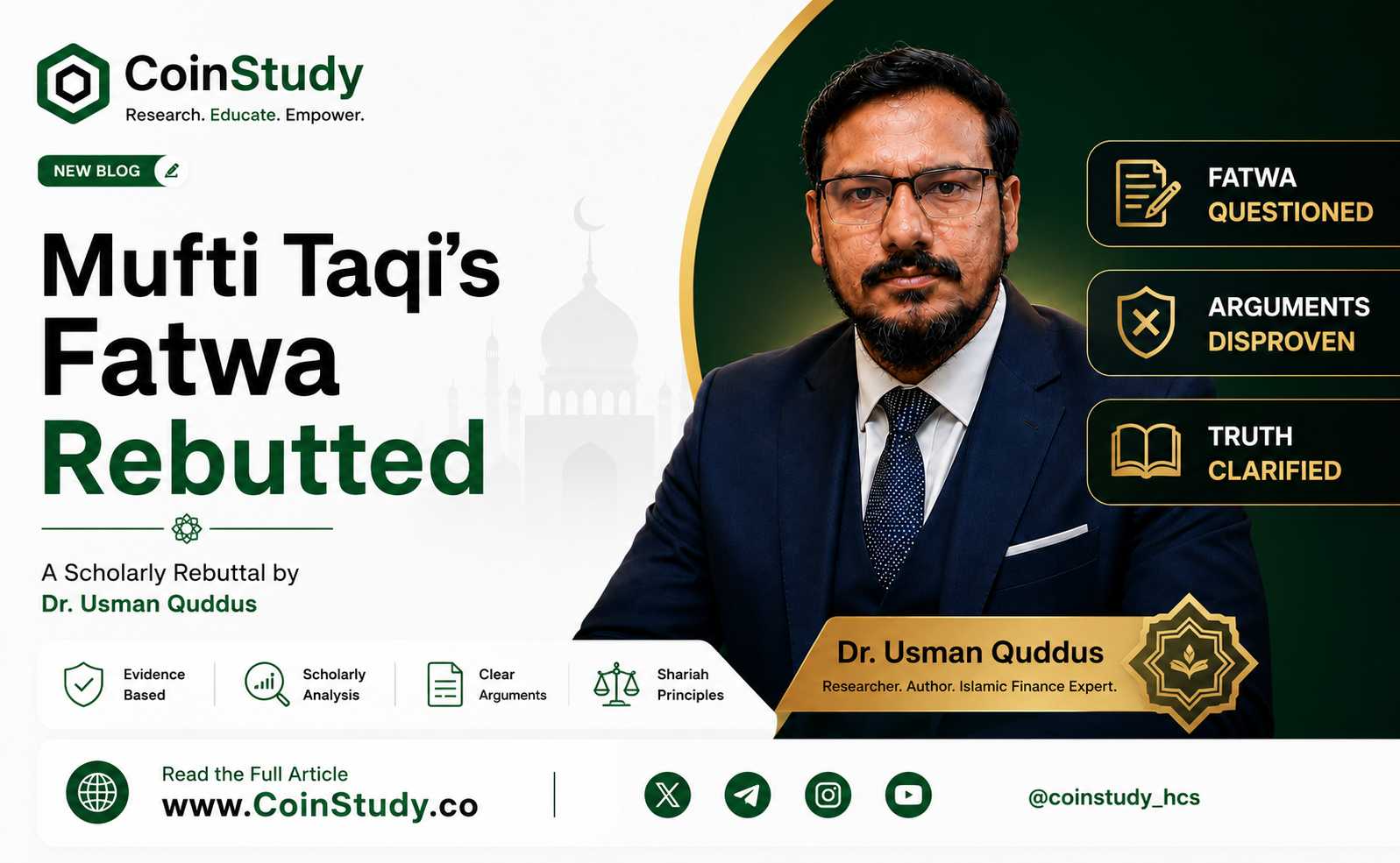
Mufti Taqi's Fatwa Rebutted
Mufti Taqi Usmani is one of the most respected Islamic finance scholars alive today.
His contributions to Islamic banking, the formalization of sukuk, and the practical development of Sharia-compliant financial products have shaped the global Islamic finance industry for decades. When he speaks on a financial matter, Muslim investors listen. And they should.
His ruling that cryptocurrency is impermissible created genuine disruption across the Muslim crypto community. Millions of investors paused. Regulators in Pakistan cited it. The conversation about crypto in Islamic finance shifted significantly in the direction of prohibition.
CoinStudy published our first response to this ruling, presenting the position of Dr. Ali Al-Qaradaghi at the International Union of Muslim Scholars, Professor Dr. Ali Al-Salus at Qatar University, and the Shariah Advisory Council of the Securities Commission Malaysia, all of whom have taken the position that cryptocurrency can qualify as permissible mal under contemporary fiqhi reasoning.
Our Shariah Board Chairman, Dr. Usman Quddus, PhD in Islamic Studies and Finance, has now gone further. He has provided a formal scholarly analysis of Mufti Taqi Usmani's specific argument and concluded something that goes beyond simply citing alternative scholarly opinions.
His conclusion is that the argument on which the Grand Mufti's fatwa is based is logically weak within Mufti Taqi Usmani's own system of thought.
This is a fundamentally different and more significant critique than simply saying other scholars disagree. It is an internal analysis of the argument's logical consistency using the Grand Mufti's own principles. And it deserves to be presented completely and honestly to Muslim investors who are trying to understand this question clearly.
The Foundation of the Grand Mufti's Fatwa
Before presenting the chairman's rebuttal, it is essential to understand precisely what argument Mufti Taqi Usmani made.
The Grand Mufti's fatwa did not rule cryptocurrency impermissible because of Gharar or excessive speculation, though those concerns have been raised elsewhere. The specific foundation of his ruling as presented was that cryptocurrency is not mal at all.
Mal is the Arabic term for wealth or property in Islamic jurisprudence. The concept is foundational because the rulings of commerce, ownership, exchange, and transaction all apply to mal. If something is not mal, it cannot be legitimately bought, sold, owned, or transacted under Islamic law.
The Grand Mufti's specific argument was that cryptocurrency is not mal because it consists of fictional digital numbers recorded in ledgers rather than any real thing. The implication is that something non-physical, non-material, and existing only as digital ledger entries cannot qualify as the kind of real property that Islamic jurisprudence recognizes as mal.
This is the argument that Dr. Usman Quddus has examined and found to be internally inconsistent.
The Chairman's Formal Rebuttal — Complete and Precise
Dr. Usman Quddus's response begins with a careful and important observation. Before entering into the broad scholarly debate about the different definitions of mal across the four major schools of Islamic jurisprudence, he focuses specifically on whether the Grand Mufti's particular argument holds together within the Grand Mufti's own thinking.
The chairman's core observation is this: the characteristic that Mufti Taqi Usmani uses to exclude cryptocurrency from mal, namely that it consists of digital ledger entries rather than real things, applies equally to fiat currencies like the rupee and the dollar as they exist in modern banking systems. And the Grand Mufti accepts fiat currencies as mal.
This is not a trivial observation. It identifies a specific logical inconsistency at the heart of the argument.
The Fiat Currency Problem — The Most Powerful Argument
Consider carefully what fiat currency actually is in the modern world.
When you have ten thousand rupees in your bank account, what exactly do you have? You have a number recorded in a computer system. A digital entry in a ledger maintained by your bank. You cannot touch those rupees. You cannot hold them in your hand. They exist as data, as numerical representations in a financial system.
This is precisely the description that the Grand Mufti uses to argue that cryptocurrency is not mal. Cryptocurrency consists of entries in a distributed ledger, fictional digital numbers recorded in accounts.
The question the chairman asks is: what is the relevant difference between the digital rupee in your bank account and the Bitcoin in your crypto wallet from the perspective of whether each one qualifies as mal?
Both are non-physical. Both are digital representations. Both are recorded in ledgers. Both have no tangible material existence beyond their representation in a data system.
The Grand Mufti himself accepts that fiat currencies held in bank accounts are mal. He is on record as permitting salam contracts in currencies, which presupposes that currencies qualify as mal. He does not argue that the rupee in your bank account is not real property because it is merely a digital ledger entry.
If the characteristic of being a digital ledger entry makes cryptocurrency not mal, then the same characteristic should apply equally to fiat currency in the banking system. But since the Grand Mufti does not draw that conclusion for fiat currency, his argument requires explaining what the relevant difference is between the two cases. The chairman's position is that no such relevant difference has been adequately identified.
Carbon Credits — A Telling Additional Example
Dr. Usman Quddus extends this observation to carbon credits, which are one of the most prominent examples of modern non-material financial rights.
Carbon credits are transferable entitlements in electronic registries that give their holder the right to emit or offset a specific quantity of carbon dioxide. They have no physical existence whatsoever. They are entries in registries, permissions recorded in databases, rights that exist entirely as information rather than as physical objects.
Yet carbon credits are traded in global markets, have genuine economic value, and represent a form of property that the modern financial world treats as an asset. Their value derives from genuine human benefits and harms related to environmental outcomes.
If the criterion for something not being mal is that it is non-physical and exists only as entries in electronic systems, then carbon credits would also fail to qualify as mal. But Islamic finance scholars including those who hold conservative positions have not generally argued that carbon credits are not property simply because they are non-material digital entitlements.
The chairman's argument is that cryptocurrency, when it has genuine utility and function, has at minimum the same logical standing as carbon credits from the perspective of mal classification. Excluding one while accepting the other requires a principled distinction that the digital ledger entry argument does not provide.
The Three Arguments the Grand Mufti Would Need to Make
Dr. Usman Quddus identifies precisely what the Grand Mufti would need to establish to make the argument that cryptocurrency is not mal logically coherent. He presents three possible paths, each of which faces serious difficulties.
The First Path: Physical Tangibility as a Requirement
The first path is to argue that being mal requires having genuine physical existence as a tangible object, and that cryptocurrency fails this test because it is purely digital and non-physical.
This position faces immediate difficulties. If physical tangibility is required for mal, then numerous categories of rights and properties that Islamic jurisprudence widely accepts would also fail the test. Software licenses, intellectual property rights, copyrights, trademarks, brand goodwill, and the abstract rights that Islamic banks trade in would all lack mal status on this definition.
Digital gaming assets present a particularly illuminating contemporary case. Virtual land, weapons, skins, and powers in digital games are bought and sold with real money. They have no physical existence. Yet ownership, markets, prices, and exclusive possession all apply to them. If merely being digital and non-physical disqualifies something from being mal, the implications extend far beyond cryptocurrency into domains where Islamic finance scholars have generally recognized financial rights.
The chairman makes a deeper philosophical observation as well. Even in classical Islamic philosophy, non-physical things called arad, which translates roughly as accidents or properties, are recognized as real existents even though they do not exist independently but subsist in physical substances. The reduction of reality to only the physically tangible has always been philosophically contested. The value of abstract rights, including most rights that constitute the modern financial system, ultimately connects to human benefit and harm, which are themselves of a non-physical character.
The Second Path: Requiring Liability Against an Institution
The second possible path is to argue that for something to be mal it must represent a claim against some person or institution, a liability that someone owes, and that cryptocurrency fails this test because no central institution is responsible for it.
This path also encounters a fundamental difficulty. Land, gold, silver, agricultural commodities, and most classical assets recognized as mal are not claims against anyone. They are independent assets that simply exist and can be owned. The requirement of institutional liability as a condition for mal status would exclude these foundational categories of real property.
If someone understands cryptocurrency as an independent digital asset rather than as a claim against an institution, the same logical framework that allows gold and land to be mal without being institutional liabilities would allow cryptocurrency the same standing. The chairman's point is that the institutional liability requirement, if applied consistently, would create far more problems for classical fiqh than it solves.
The Third Path: Denying Genuine Human Utility
The third path is arguably the strongest and the chairman engages with it most carefully. The argument would be that cryptocurrency has no genuine human utility, that its entire apparent value rests on pure speculation and the expectation of finding a greater fool to sell to, and that therefore it lacks the real benefit to humans that would justify treating it as property.
This is a more nuanced argument than the previous two and the chairman acknowledges its potential force. But he identifies a critical condition that must be met for this argument to succeed: it must be demonstrated that cryptocurrency has no genuine, stable, and considerable human benefit associated with it.
If cryptocurrency provides real human benefits including the ability to transfer value across borders instantly without intermediaries, resistance to censorship by governments or corporations, settlement between parties who do not share a banking system, and decentralized ownership that cannot be arbitrarily confiscated, then denying its mal status purely because it is digital becomes logically very difficult. These are genuine human utilities in the same category as the utilities that justify treating other non-physical rights as property.
The chairman acknowledges that someone might argue these utilities are not sufficiently significant or reliable. But this creates a different kind of question: are these utilities recognized by rational people as a basis for genuine financial rights? If the answer is yes, which the global adoption of cryptocurrency suggests, then excluding cryptocurrency from mal status on utility grounds requires a much more specific and developed argument than simply calling it fictional numbers.
The Critical Distinction — Between Mal and Its Rulings
This is the most intellectually precise point in the chairman's rebuttal and it is worth presenting with great care because it is where the argument cuts most sharply.
Dr. Usman Quddus distinguishes between two entirely different questions that the Grand Mufti's fatwa appears to collapse together.
The first question is whether cryptocurrency is mal at all, whether it qualifies as a form of property that can in principle be owned, transacted, and subject to the normal rulings of commerce in Islamic law.
The second question is whether specific dealings with cryptocurrency are permissible or impermissible given the characteristics of current cryptocurrency markets, including volatility, speculative behavior, potential for harm, and regulatory considerations.
These are not the same question and they do not have the same answer.
Even if a scholar concludes that cryptocurrency dealings are currently impermissible due to excessive Gharar, wild price fluctuations, harm to ordinary investors, or conflict with government regulations, these conclusions are about the rulings that apply to mal and how its trade should be conducted. They do not establish that cryptocurrency is not mal in the first place.
The parallel is precise. Alcohol is mal in Islamic jurisprudence, in the sense that it has recognized financial value, destroying someone's alcohol creates a financial liability, and it can be bought and sold between non-Muslims. But its sale and consumption by Muslims is impermissible because of what it is and what it does. The impermissibility of the dealing does not mean it is not mal.
Similarly, the chairman argues, even if one accepts all of the Grand Mufti's concerns about volatility, speculation, and investor harm, the correct conclusion from those concerns is "dealings with cryptocurrency are impermissible" not "cryptocurrency is not mal." These are categorically different conclusions with different logical requirements.
The Grand Mufti appears to have moved directly from "there are serious problems with crypto dealings" to "therefore crypto is not mal" without establishing the logical bridge between those two conclusions within his own framework. The chairman's rebuttal identifies this logical gap precisely.
What This Means for Muslim Investors
The chairman's rebuttal is important for Muslim investors to understand for a specific and practical reason.
If the Grand Mufti's argument that cryptocurrency is not mal were correct, it would create unusual and problematic implications. It would mean that if someone steals your Bitcoin, they owe you nothing, because you had no mal to steal. It would mean that profits from crypto trading could not be subject to zakat, because you own no mal to calculate zakat on. It would mean that any harm caused by cryptocurrency fraud creates no financial liability under Islamic law.
None of these implications follow from the scholarly tradition. And the Grand Mufti himself would almost certainly not accept these implications either. But if cryptocurrency is truly not mal as the fatwa's specific argument requires, these implications would logically follow.
The chairman's point is that the distinction between "cryptocurrency is not mal" and "dealings with cryptocurrency are impermissible under current conditions" matters enormously both theoretically and practically. The Grand Mufti's fatwa appears to assert the stronger claim without fully establishing its logical requirements within his own system of thought.
Respecting the Grand Mufti While Engaging the Argument
CoinStudy and Dr. Usman Quddus hold Mufti Taqi Usmani in genuine and deep respect. His contributions to Islamic finance, his decades of scholarship, and his commitment to protecting ordinary Muslims from financial harm are all real and worthy of acknowledgment.
The chairman's rebuttal is not an attack on Mufti Taqi Usmani's scholarship. It is an engagement with a specific argument within the tradition of Islamic scholarly discourse where ideas are examined, tested, and debated through reason and textual evidence. This is how Islamic jurisprudence has always developed.
Disagreeing with a specific argument while deeply respecting the scholar who made it is not only possible but is the correct mode of engagement in the Islamic scholarly tradition. The chairman's analysis is offered in that spirit and Muslim investors should receive it in the same spirit.
The Complete Picture — Both Blogs Together
CoinStudy has now published two scholarly responses to the Grand Mufti's fatwa and Muslim investors should read both to understand the complete picture.
The first response presented the majority position of contemporary Islamic finance scholarship. Dr. Al-Qaradaghi, Dr. Al-Salus, and the Malaysian Securities Commission Shariah Advisory Council all support conditional permissibility of cryptocurrency through individual assessment. This response showed that the Grand Mufti's position does not represent scholarly consensus.
This second response goes further. It presents Dr. Usman Quddus's formal analysis of why the specific argument on which the Grand Mufti's fatwa is based appears logically weak within the Grand Mufti's own system of thought. This shows not just that other scholars disagree but that the specific reasoning deployed in the fatwa faces serious internal difficulties.
Together these responses represent the most complete and rigorous scholarly engagement with the Grand Mufti's crypto fatwa published by any halal crypto research platform.
What CoinStudy Stands For
CoinStudy exists precisely because these distinctions matter.
A blanket ruling that all cryptocurrency is haram because it is not mal does not distinguish between Bitcoin with fifteen years of operational history and genuine utility as a store of value and a meme coin with no utility and purely speculative market activity. A framework that allows for individual assessment of each specific cryptocurrency based on its actual characteristics, financial structure, and genuine utility serves Muslim investors far better than a categorical ruling that cannot make this distinction.
Our Shariah Board Chairman's formal rebuttal of the specific argument in the Grand Mufti's fatwa, grounded in classical fiqhi reasoning and engaging honestly with the internal logic of the argument rather than dismissing it, is the kind of rigorous scholarly engagement that Muslim investors deserve from a platform committed to honest halal crypto research.
Final Verdict
The Grand Mufti's concern about cryptocurrency speculation, investor harm, and excessive Gharar in current markets are legitimate concerns that deserve serious engagement. CoinStudy and our Shariah Board take them seriously and they are reflected in our individual coin analyses.
But the specific argument that cryptocurrency is not mal because it consists of digital ledger entries faces serious logical difficulties within Mufti Taqi Usmani's own system of thought. Fiat currencies in modern banking are also digital ledger entries and the Grand Mufti accepts them as mal. Carbon credits and other modern non-material financial rights are also non-physical digital entitlements and Islamic finance has not generally excluded them from the category of property.
The correct scholarly response to genuine concerns about crypto market volatility, speculation, and investor harm is to conclude that specific crypto dealings under specific conditions may be impermissible. It is not to conclude that the entire asset class does not qualify as property at all. These are categorically different conclusions with different logical requirements and different practical implications.
Dr. Usman Quddus's formal rebuttal, offered with respect for the Grand Mufti and within the tradition of Islamic scholarly discourse, identifies this logical gap precisely and honestly. Muslim investors deserve to know it exists.
Read detail analysis of following coins here:
Is Bitcoin Halal?
Is Solana Halal?
Grand Mufti Said Haram. Our Chairman Disagrees.
Learn Halal Trading Strategies with CoinStudy's Partner
Halal Staking with Sharia Compliant Validator & CoinStudy Partner
Disclaimer: This article is provided for educational and research purposes only. The scholarly analysis presented reflects the formal position of CoinStudy's Shariah Board Chairman Dr. Usman Quddus, PhD in Islamic Studies and Finance. This does not constitute a personal fatwa for any individual. Muslim investors should consult a qualified Islamic scholar for personal guidance.