

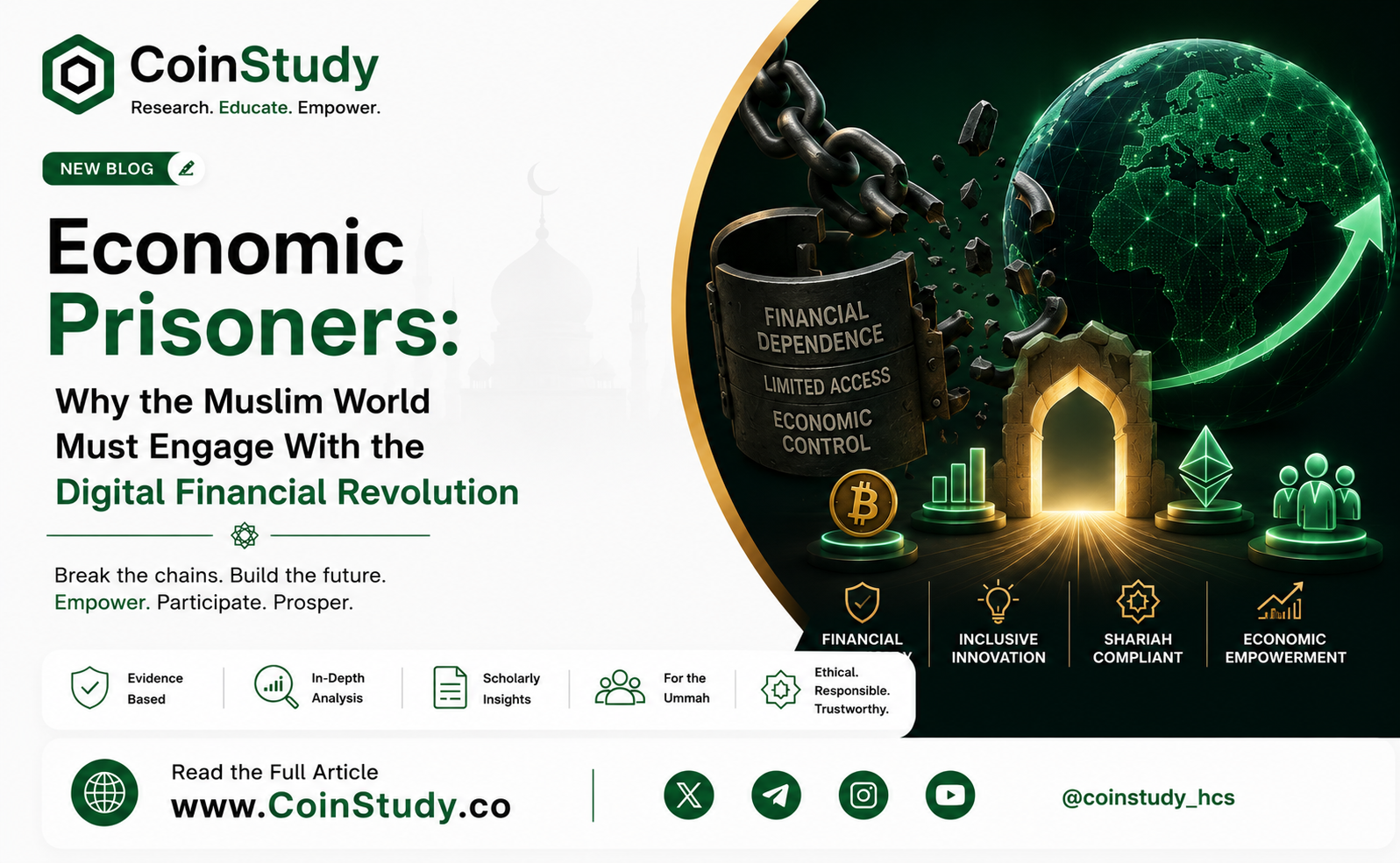
Economic Prisoners: Why the Muslim World Must Engage With the Digital Financial Revolution
There is a question that Muslim economists, Islamic finance scholars, and Muslim investors rarely ask directly but that underlies every debate about cryptocurrency, tokenization, and digital assets.
Who controls the financial system? And what does that control mean for Muslim nations, Muslim communities, and Muslim investors who want to participate in global commerce on their own terms?
CoinStudy's Shariah Board Chairman Dr. Usman Quddus, PhD in Islamic Studies and Finance, has written a scholarly essay that answers this question with remarkable directness. His essay does not begin with a ruling on a specific financial instrument. It begins with a political and civilizational observation: that whether we are talking about politics or nationalism, both are prisoners of economic power. Those who hold capitalist control over capital and trade hold the real authority.
This is not a fringe position. It is a straightforward reading of modern political economy that economists across the ideological spectrum have reached independently. And it has profound implications for how Muslim communities should approach the digital financial revolution.
The Prisoner of Capital
Dr. Quddus opens with a fundamental observation about power in the modern world.
Politics and nationalism are both prisoners of economic power. The real government belongs to those who hold capitalist control over capital and trade. The political rise and national advancement of any nation lies in the free movement of its resources and capital.
This framework explains patterns that would otherwise seem puzzling. Why do wealthy nations maintain their global influence even when their populations hold minority views on international affairs? Why do international institutions consistently reflect the interests of capital-holding powers? Why does political independence without economic independence so rarely translate into genuine national sovereignty?
The answer is that economic control is the foundational form of control. Political systems, legal frameworks, and international institutions all tend over time to reflect the interests of those who hold the capital that makes economic activity possible.
Dr. Quddus applies this framework directly to the Muslim world. The Muslim world has lost its sovereignty in its economic dynamics. The capitalist system dominates it as well. The fall of the Muslim caliphate in history and the decline of socialism and other systems are all contained within this same point. The economic system has become the servant of the hands that carry the banner of capitalism.
This is a sobering assessment. But it is also the necessary starting point for understanding why the digital financial revolution matters so profoundly for Muslim communities globally.
The Fall of Muslim Economic Sovereignty
Understanding this section of Dr. Quddus's essay requires engaging honestly with a historical reality that Muslim scholars and communities sometimes avoid discussing directly.
The Muslim world's economic marginalization is not primarily a theological problem. It is not primarily a cultural problem. It is fundamentally an economic problem. Muslim-majority nations produce significant natural resources, have large and growing populations, and possess deep intellectual and cultural traditions. Yet the mechanisms of global finance, the structures of international trade, the institutions of capital allocation, and the systems of monetary policy all operate primarily in accordance with frameworks developed outside the Muslim world and reflecting interests that are not always aligned with Muslim communities.
Dr. Quddus connects this to the broader pattern of history. The fall of the caliphate was not only a political event. It was an economic event. The decline of Muslim commercial supremacy, which once dominated trade routes from West Africa to Southeast Asia, preceded the political collapse of Muslim governance and contributed to it. Economic systems become the servant of those who control capital, and Muslim communities gradually lost that control.
The capitalist system that now dominates global finance generates its returns through interest, speculation, and financial engineering that Islamic jurisprudence identifies as prohibited. Muslim communities participate in this system not because they endorse it but because there is no alternative infrastructure available to them at scale. This is the economic prison Dr. Quddus describes.
The Digital Age Has Changed Everything
Here is where Dr. Quddus's essay shifts from historical diagnosis to present opportunity, and this shift is the most important part of his argument for Muslim investors and policymakers.
The digital age has brought a revolution in which economic dynamics are moving from centralized to decentralized rather than becoming more centralized. The coin and tokenized system will change the capitalist order alongside centralization.
This is a genuinely significant claim. For the entirety of modern economic history, increasing scale has meant increasing centralization. Larger banks. Larger corporations. More concentrated capital. More powerful financial institutions. The trend of modernity seemed to point inexorably toward economic power becoming more concentrated in fewer hands.
Blockchain technology and the tokenized economy represent a genuine structural break from this trend. When financial value can be issued, transferred, and stored without requiring a central bank, a major financial institution, or a state intermediary, the economic dynamics of power change in ways that have no historical precedent.
Dr. Quddus identifies a universal law that governs how new systems spread: when a human community recognizes convenience and benefit in something, that system becomes their laboratory for experimentation. The coin and tokenized system is spreading in the world so rapidly that no hand, firm, industry, country, or state will remain untouched by it.
This is already empirically verifiable. Every major financial institution in the world is now engaged with blockchain and digital assets in some form. Central banks are developing digital currencies. Major corporations are issuing tokenized assets. Nations are establishing legal frameworks for cryptocurrency. The question for Muslim communities is not whether this revolution will reach them. It already has. The question is whether they will engage with it actively or passively, on their own terms or on terms set by others.
The Muslim Approach
This section of Dr. Quddus's essay is arguably the most important for CoinStudy's audience because it translates civilizational analysis into practical guidance for Muslim communities.
The Muslim world cannot keep itself distant from the prevailing system and order. In this situation there should be a platform of mutual meeting and discussion among economic experts. Muslim countries should make an effort toward dominance over the coming economic order while keeping their own concerns in view. Otherwise economic imprisonment will not allow any other system to be free.
The word dominance here is significant and should be understood in its proper context. Dr. Quddus is not calling for political control or coercive power over global financial systems. He is calling for active intellectual, institutional, and practical engagement with the emerging digital economic order from a position of Islamic values and Muslim community interests rather than passive acceptance of frameworks designed without Muslim input.
The path he identifies has two dimensions. First, Muslim economic experts need platforms for genuine scholarly and practical discussion about digital finance. The Islamic finance field has produced sophisticated frameworks for evaluating financial instruments but these frameworks need to engage directly and rigorously with blockchain technology, tokenization, decentralized finance, and digital assets rather than maintaining a cautious distance from them. Second, Muslim nations and communities need to engage with the coming economic order actively enough to shape it rather than simply being shaped by it. Muslim-majority nations represent more than 1.8 billion people and significant natural resources and economic activity. Their collective voice in shaping the standards, regulations, and practices of the digital financial revolution could be substantial if organized and active.
The warning at the end of this section is sharp. Otherwise economic imprisonment will not allow any other system to be free. If the Muslim world remains passive while the digital financial revolution reshapes the global economic order, the new system will simply replicate the power dynamics of the old one with different technology. The same interests that hold economic power today will use digital infrastructure to consolidate that power further.
The Law of Rise
Dr. Quddus concludes his essay with what he calls a universal law of advancement.
There is one law of rise: truth and practical activity. Whichever nation or community brought truthfulness into its purpose and cause, and remained practically active in its organization and arrangement, became sovereign in its own order.
This principle is both simple and demanding. Truthfulness means engaging honestly with reality as it is rather than as we wish it to be. For Muslim communities engaging with digital finance, this means honest assessment of which digital financial instruments are genuinely permissible and which are prohibited, without either reflexive rejection of all digital finance or uncritical acceptance of everything labeled as Islamic.
CoinStudy's entire methodology is built on this principle. The HCS framework does not give blanket permission or blanket prohibition. It assesses each instrument honestly against established Islamic jurisprudence principles. It acknowledges scholarly disagreement where it exists. It distinguishes between an instrument's structural features and an individual's specific use of that instrument. It publishes the chairman's direct rulings openly rather than hiding scholarly reasoning behind institutional opacity.
Practical activity means that honest assessment must be followed by organized action. A Muslim investor who understands which cryptocurrencies are halal but has no platform to access them, no community of fellow investors to learn from, and no scholarly guidance to consult is not better off than one who simply avoids digital finance entirely. The knowledge must be organized into accessible, practical, community-building infrastructure.
This is what CoinStudy is building. The platform is not merely a research database. It is an attempt at the kind of practical organization that Dr. Quddus describes as the second requirement for genuine sovereignty, bringing truthfulness and practical activity together in service of the Muslim community's engagement with the digital financial revolution.
What This Means for Muslim Investors Today
Dr. Quddus's essay has direct and practical implications for Muslim investors navigating the cryptocurrency space in 2026.
The digital financial revolution is not optional. It is already reshaping how wealth is created, stored, and transferred globally. Muslim investors who disengage entirely cede that territory to frameworks and institutions that are not designed with Islamic values in mind. This is the economic imprisonment Dr. Quddus describes.
Engagement must be principled. The fact that the digital financial revolution creates opportunities does not mean every opportunity within it is permissible. Riba-based DeFi lending, zero-sum perpetual futures trading, and meme coin speculation are not permissible simply because they happen on a blockchain. The same jurisprudential principles apply to new instruments as to old ones.
Scholarly guidance is not optional. Muslim investors who navigate digital finance without qualified scholarly guidance, relying only on community forums, influencer opinions, or their own judgment, are not engaged in principled participation. They are simply following the crowd with extra steps. CoinStudy's partnership with Dr. Quddus's scholarly expertise exists to make that guidance accessible and specific.
Collective organization matters. The Muslim community's influence over the digital financial revolution will be proportional to its collective organization, its investment in developing Islamic digital finance infrastructure, and its willingness to advocate for regulatory frameworks that accommodate Islamic finance principles. Individual investors making individually halal choices are a beginning. Muslim-majority nations engaging collectively with global digital finance governance is the fuller realization of the approach Dr. Quddus calls for.
Chairman's Statement
The following is the direct statement of CoinStudy's Shariah Board Chairman Dr. Usman Quddus, PhD in Islamic Studies and Finance, on economic sovereignty and the Muslim world's engagement with the digital financial revolution.
"Whether it is politics or nationalism, both are prisoners of economic power. Those who hold capitalist control over capital and trade, the real government belongs to them. The political and national rise of any nation lies in the free movement of its resources and capital.
The Muslim world has lost its sovereignty in its economic dynamics. The capitalist system dominates it as well. The fall of the Muslim caliphate in history and the decline of socialism and other systems are all contained within this same point. The economic system has become the servant of the hands that carry the banner of capitalism.
The digital age has brought such a revolution in which economic dynamics are becoming decentralized rather than centralized. The coin and tokenized system will change the capitalist order alongside centralization.
There is one law prevalent in the world that is the same for everyone, which is called convenience. When the human community recognizes convenience and benefit in something, that system becomes their laboratory. The coin and tokenized system is spreading in the world so rapidly that no hand, firm, industry, country, or state will remain untouched by it.
The Muslim world cannot keep itself distant from the prevailing system and order. In this situation there should be a platform of mutual meeting and discussion among economic experts. Muslim countries should make an effort toward dominance over the coming economic order while keeping their own concerns in view. Otherwise economic imprisonment will not allow any other system to be free.
There is one law of rise: truth and practical activity. Whichever nation or community brought truthfulness into its purpose and cause, and remained practically active in its organization and arrangement, became sovereign in its own order."
Read detail analysis of following coins here:
Is DeFi Halal?
Is Solana Halal?
Are Meme Coins Halal?
Is Robinhood Chain Halal?
Learn Halal Trading Course with CoinStudy Partner
Check your Airdrop Eligibility with CoinStudy Partner
Halal Staking with Sharia Compliant Validator & CoinStudy Partner