

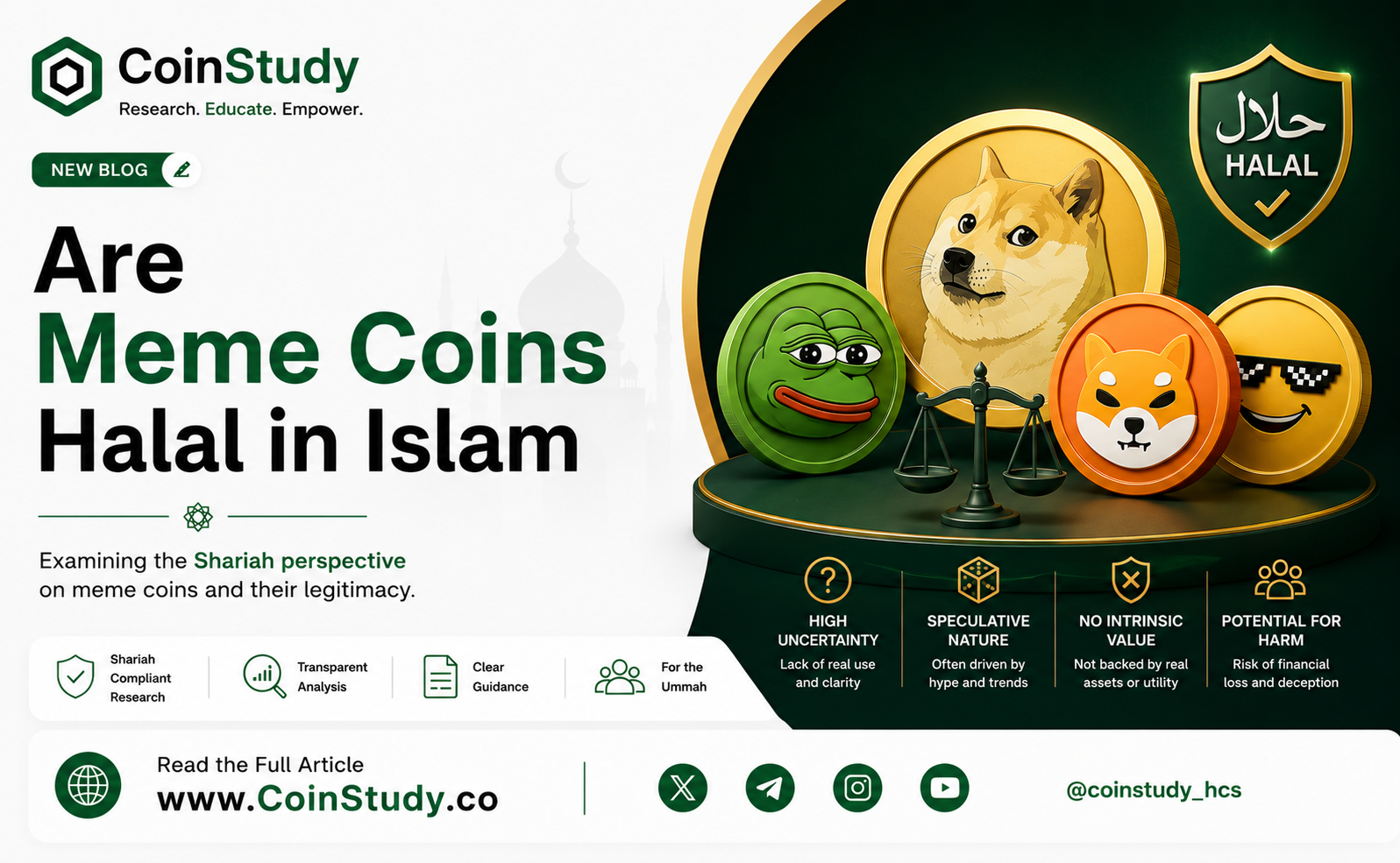
Are Meme Coins Halal or Haram? A Complete Islamic Finance Analysis 2026
Every crypto bull market produces the same story. Someone turns $500 into $500,000 on a meme coin. Screenshots circulate across Telegram groups, Twitter threads, and WhatsApp messages. The story goes viral across Muslim investing communities. Questions flood our inbox at CoinStudy. People want to know if this is permissible. If they have missed something halal. If Islamic finance allows participation in what everyone around them seems to be profiting from.
The honest answer requires understanding three things simultaneously: what meme coins actually are at a structural level, what Islamic finance principles say about those specific characteristics, and what the documented evidence about meme coin market outcomes shows about who actually profits and who actually loses.
In September 2026 the meme coin market sits at approximately $31.2 billion in total capitalization across roughly 6,270 tracked tokens, down significantly from the November 2024 peak of approximately $150 billion according to Coinmarketcap and CoinGecko research. Dogecoin dominates at approximately $12.59 to $15.2 billion according to available September 2026 research. PEPE sits at approximately $1.4 to $1.9 billion. Pump.fun's own PUMP token has a market cap of approximately $1.65 to $2.13 billion. The market is active and highly visible.
And the documented structural concerns that apply to the majority of tokens in this category remain significant. Understanding those concerns with precision rather than with generality is the prerequisite for honest Islamic finance engagement with this topic.
Quick Verdict: Most Meme Coins Analyzed by CoinStudy Score Doubtful or Approach Haram ⚠️
Most meme coins analyzed by CoinStudy fail to achieve Halal classification under the CoinStudy Halal Crypto Standard. The concerns are multiple, specific, and operate at different levels of the analytical framework: extreme Gharar at the asset level from value drivers rooted in social media hype rather than identifiable economic fundamentals, unfair tokenomics from insider-concentrated supply structures, minimal or nonexistent genuine utility, and documented ecosystem-level market abuse patterns at the user behavior level.
These concerns are analytically distinct from one another and each is assessed through its correct analytical pathway under CoinStudy's four-level HCS framework.
Our Shariah Board Chairman Dr. Usman Quddus, PhD in Islamic Studies & Finance, confirmed the analytical framework directly in his ruling on Dogecoin, establishing that when speculative uncertainty becomes permanent and genuine demand never develops, avoidance becomes necessary.
The Four-Level Framework Applied to Meme Coins
Before the substantive analysis CoinStudy establishes a structural principle that must govern the entire assessment.
CoinStudy applies a four-level analytical framework to every crypto assessment. Level 1 covers the intrinsic asset and protocol characteristics. Level 2 covers native economic mechanisms including pricing structures, token issuance, and native incentives. Level 3 covers external products including derivatives, margin, and lending built on the asset. Level 4 covers user activity and misuse including market manipulation, fraudulent schemes, and abusive promotional conduct.
A Level 4 abusive use pattern does not automatically become a Level 1 prohibition applicable to every holder of the underlying token. CoinStudy's HCS analysis assesses intrinsic asset characteristics at Levels 1 and 2 separately from ecosystem abuse patterns at Level 4.
This distinction matters enormously for the meme coin analysis. Three separate analytical questions must be kept distinct throughout this analysis.
The first is whether the token protocol itself contains a wagering, chance-based, or inherently zero-sum mechanism at Levels 1 and 2. The second is whether participants are conducting coordinated pump-and-dump schemes at Level 4. The third is whether people are simply buying expecting the price to rise, which is ordinary market behavior that CoinStudy explicitly excludes from the Maysir dimension. Conflating these three questions produces analytical errors. Keeping them distinct produces honest and defensible conclusions.
What Meme Coins Actually Are: The Structural Reality
Meme coins are cryptocurrencies created around internet culture, viral trends, online communities, and social media momentum rather than genuine technological innovation, utility, or productive economic purpose.
Their value is driven primarily by community hype, influencer promotion, viral content spread, and speculative trading cycles. Most were created without genuine technical purpose. Many were launched anonymously. Most have no whitepaper, no development roadmap, no service being provided to any user who genuinely needs it, and no measurable economic activity they enable.
The price of a meme coin rises when enough people believe it will rise and buy it. It declines when the buying stops and early holders sell. There is often no fundamental reason for either movement. No revenue is being generated. No adoption metric is improving. No technology is being deployed for genuine use.
This structural description applies to the majority of meme coin price cycles. It is not a characterization of every token using the meme label. CoinStudy's individual HCS analyses of specific tokens including Dogecoin, Shiba Inu, PEPE, and Bonk demonstrate that meaningful distinctions exist within this category, as documented in the compliance spectrum section below.
The 2026 Evidence: What the Data Actually Shows
The Islamic finance assessment of meme coins is strengthened in 2026 because comprehensive documented evidence is available.
Binance Research analysis finds approximately 97% of meme coins die or lose meaningful trading volume with an average lifespan near one year. Chainalysis research tracked over $2.8 billion in rug-pull losses across the meme coin category in 2025 alone. Pump.fun's graduation rate, meaning the proportion of tokens that reach a decentralized exchange listing before dying, fell to 0.26% by mid-2026 based on platform data analysis from available research.
Better Markets research documenting meme coin market manipulations found that 62.9% of tokens subjected to profit extraction operations had previously undergone wash trading or liquidity pool inflation, revealing how initial price manipulations often serve as preliminary stages in broader exploitation strategies. Among meme coins delisted by established aggregators, Better Markets research found 86.67% of those subjected to profit extraction had previously been artificially inflated.
Solidus Labs research documented a 98.6% scam rate across tokens listed on Pump.fun specifically. According to Pump.fun data analysis from available research, users collectively lost approximately $4 to $5.5 billion while the platform earned $935.6 million in fees. Chainalysis analysis found 74,037 tokens launched in 2024 were suspected of being linked to pump-and-dump schemes, equaling approximately 3.59% of all tokens launched that year.
These documented outcomes represent real wealth transfers. They are evidence of Level 4 user behavior patterns operating at enormous scale. CoinStudy treats them as evidence of ecosystem-level risk and as context for the Gharar and tokenomics assessments at Levels 1 and 2, not as automatic proof that every token in the category is intrinsically Haram through a Maysir mechanism.
In September 2026 the market remains actively traded. According to available research, PEPE extended approximately 13% weekly gains as of September 20, 2026. Dogecoin futures open interest reached approximately $1.31 billion. Pump.fun's PUMP token posted 16.3% gains in a single day during September according to CoinGabbar research. Active trading and genuine value creation are separate analytical questions.
The SEC Regulatory Position: What It Does and Does Not Mean
The SEC Division of Corporation Finance stated in February 2025 that transactions involving meme coins matching the characteristics described in its statement generally do not involve securities under the federal securities laws. The statement also notes that it does not establish the status of every individual meme coin and that fraudulent conduct may remain subject to other laws. This is a staff statement from the Division of Corporation Finance rather than a Commission rule or binding legal determination.
The SEC's statement means that meme coins matching those characteristics fall outside the specific regulatory jurisdiction of US securities law. It does not mean they are safe investments or that their market dynamics are fair or transparent. Fraudulent conduct including pump-and-dump schemes may remain subject to other laws as the statement itself acknowledges.
The SEC's regulatory classification is about jurisdiction and legal oversight. Islamic finance's assessment is about the economic structure and its compliance with Shariah principles. These are separate questions requiring separate analysis.
The Chairman's Ruling: Applied to Meme Coins
Our Shariah Board Chairman Dr. Usman Quddus, PhD in Islamic Studies & Finance, provided a direct ruling in the context of Dogecoin that establishes the complete analytical framework for evaluating meme coins.
His ruling states: Most coins in the crypto market are used not as a genuine medium of exchange but primarily for their fame and temporary price fluctuations with the purpose of gaining profit. From this aspect, uncertainty is created in these coins which produces a resemblance to Maysir, generating a ruling of caution. If this uncertainty becomes permanent, avoidance will become necessary. The compliance status depends on supply matching genuine demand.
This ruling provides a conditional two-path framework rather than a categorical determination. If a meme coin develops genuine adoption as a medium of exchange where supply meets real transactional demand, the Maysir resemblance diminishes and the compliance concern reduces. If speculative use remains the dominant driver permanently and genuine utility never materializes at meaningful scale, avoidance becomes necessary.
Applying this framework requires honest assessment of which path each specific token is on rather than applying a blanket category ruling to all tokens using the meme label.
Islamic Finance Analysis: The Three Core Principles
Riba: Not the Primary Concern at the Protocol Level
Most meme coin tokens at Level 1 do not involve interest-based lending or borrowing mechanisms in their protocol design. A basic DOGE or PEPE token held in a wallet does not generate or require interest payments at the protocol level.
Riba concerns enter the meme coin analysis through Level 3 external products and Level 4 user behavior. When a Muslim investor uses leverage products involving interest-bearing borrowing to trade meme coins, the borrowing mechanism creates a Riba concern that is separate from the asset-level assessment. When meme coins are deposited into DeFi lending protocols for yield, the lending income raises its own separate compliance concerns at Level 3.
The meme coin token itself typically passes the Riba red-line check at the Level 1 protocol assessment. The significant compliance concerns arise elsewhere in the analysis.
Gharar: Elevated and Structural for Most Meme Tokens
Gharar refers to excessive uncertainty about the fundamental nature, value, and economic purpose of what is being transacted. Islamic finance does not prohibit all uncertainty. It addresses situations where the value of an asset has no stable economic foundation and the transaction depends entirely on factors that cannot be meaningfully analyzed.
Under CoinStudy's HCS framework, most meme coin valuations present a degree of uncertainty about their economic purpose and value foundation that materially increases the Gharar assessment. Their prices are driven primarily by promotional activity and sentiment rather than identifiable fundamentals like adoption, revenue, or genuine technology deployment.
A coin's value can fall as quickly as it rose, often with no economic explanation for either movement. According to available research, PEPE trades approximately 84% below its all-time high in September 2026 and Dogecoin trades approximately 87% below its all-time high. These documented peak-to-current declines illustrate the distance between prices reached during promotional periods and the subsequent market assessment in the absence of that promotional intensity.
When an asset's value foundation cannot be analyzed through any identifiable economic metric, under CoinStudy's HCS Gharar framework this represents a significant compliance concern. This is framed as CoinStudy's application of its Gharar assessment framework rather than as a universal jurisprudential determination that applies identically across all scholarly traditions.
Maysir: The Most Precisely Important Analysis
This is the dimension that requires the most analytical precision in the meme coin context because the four-level distinction matters critically here.
At the Level 1 protocol assessment, most meme coin tokens do not contain an intrinsic wagering or chance-based zero-sum mechanism in their protocol design. A meme token is not a betting contract. Holding PEPE does not place a formal wager against another participant. The token itself lacks the classical Qimar structure that defines Maysir in the most direct sense.
The Maysir-relevant concerns arise at Level 2 and through the ecosystem evidence at Level 4. At Level 2, certain native pricing mechanisms including bonding curve structures create specific analytical concerns. A bonding curve is a pricing mechanism that automatically raises token prices as more participants buy. Early buyers benefit when later buyers purchase. This creates structural information asymmetry and tokenomics fairness concerns that are most naturally assessed in the Gharar and Tokenomics Fairness dimensions. It does not automatically create Maysir without establishing an actual chance-based or zero-sum contractual mechanism.
The Level 4 ecosystem evidence is where the most significant documented wealth-transfer concerns are identified. In pump-and-dump cycles documented at scale across the meme coin category, early sellers can realize gains by selling into later buying demand, transferring economic value from later participants to earlier holders without corresponding productive activity. This is Level 4 user behavior and coordinated market abuse rather than an intrinsic mechanism of the token protocol itself. CoinStudy treats documented pump-and-dump conduct as Haram at the activity level through the specific analytical pathway of deceptive commercial conduct and exploitation of information asymmetry, which is separately prohibited in Islamic commercial ethics.
The Chairman's ruling describes a Maysir resemblance from speculative uncertainty rather than intrinsic Maysir from a direct wagering mechanism. This distinction is important and CoinStudy maintains it throughout this analysis. The compliance concern is real and significant. The analytical pathway that establishes it must be precise.
The Pump-and-Dump Mechanism: Level 4 Analysis
The pump-and-dump sequence operates with documented consistency across Level 4 user behavior in the meme coin ecosystem.
First, insiders and early buyers accumulate a token at very low prices before any promotion begins. Second, coordinated promotion across social media, Telegram groups, and influencer channels creates buying pressure from retail participants who see the price rising and feel urgency. Third, early holders sell their accumulated positions into the buying pressure created by the promotional activity. Fourth, retail buyers who purchased during the promotional phase are left holding tokens that decline sharply once selling pressure from early holders exceeds new buying pressure.
According to Better Markets research, 86.67% of meme coins delisted by established aggregators that were subjected to profit extraction had previously been artificially inflated, revealing a coordinated pattern across the ecosystem.
This conduct is Haram at the Level 4 activity level for the participants who organize and execute it. The Islamic prohibition on deception, on exploiting information asymmetry, and on harming others for personal gain applies with full force to any Muslim who knowingly participates in or promotes tokens as part of a coordinated extraction scheme.
From Islamic ethics, this conduct conflicts directly with the Islamic emphasis on honest commerce, protection of others from harm, and the prohibition on earning wealth through deception. The Level 4 activity-level Haram classification for this conduct does not require establishing a Level 1 intrinsic Maysir mechanism in the token itself. It rests on the specific nature of the conduct.
A Muslim investor who holds a meme token without participating in any coordinated scheme is assessed at the Level 1 and Level 2 asset and mechanism level, which produces the Gharar, utility, and tokenomics concerns documented above, rather than automatically inheriting the Level 4 activity-level prohibition.
The Official Trump Token: A Distribution Structure Case Study
The Official Trump meme coin launched in January 2026 provides a documented case study in supply concentration risk at the tokenomics level.
According to available research, approximately 80% of the total supply was controlled by entities affiliated with the Trump organization at launch. This insider supply concentration means that any price appreciation during the promotional launch period primarily benefited entities holding positions established before public trading began. Retail investors who purchased during the promotional period acquired tokens at prices that reflected the promotional momentum with the concentrated insider supply creating structural downside risk as those holdings were gradually distributed.
This supply concentration structure illustrates the Chairman's framework at the asset analysis level: promotional activity drove temporary price appreciation without supply meeting genuine demand from users who needed the token for a productive purpose. CoinStudy's analysis of Official Trump at 52 out of 100 Doubtful reflects the combination of insider supply concentration, absence of genuine utility development, and the speculative uncertainty that the Chairman's framework identifies as requiring caution.
According to available research, Official Trump remains in the top 5 to top 10 meme coins by market capitalization in September 2026, demonstrating that celebrity and political branding creates sustained trading activity. Trading activity is not itself evidence of genuine demand satisfying the Chairman's compliance condition.
The September 2026 Meme Coin Landscape
The September 2026 market provides current data that Muslim investors need for honest assessment.
According to CoinDCX and CoinGecko research, the total meme coin market capitalization in September 2026 is approximately $31.2 billion across roughly 6,270 tracked tokens. This represents a decline of approximately 79% from the November 2024 peak of approximately $150 billion documented by Coinspeaker research. The peak-to-current decline of nearly 79% across the category as a whole illustrates the Gharar concern about the distance between peak promotional prices and sustained market assessments.
According to multiple September 2026 research sources, Dogecoin trades near $0.08 to $0.097 with a market cap of approximately $12.59 to $15.2 billion, remaining the dominant meme coin by a significant margin. PEPE trades near $0.0000033 to $0.0000041 with a market cap of approximately $1.4 to $1.9 billion according to available September 2026 research. According to Koinpark research, PEPE sits approximately 84% below its all-time high and Dogecoin sits approximately 87% below its all-time high.
Pump.fun's PUMP token trades at approximately $0.003 to $0.005 with a market cap of $1.65 to $2.13 billion according to CoinDCX and CoinGabbar research. Bonk trades at market caps ranging from approximately $227 million to $1.71 billion across different research sources reflecting its significant intraday volatility.
The Compliance Spectrum: What Differentiates Better from Worse
CoinStudy's individual analyses of major meme coins reveal a spectrum worth understanding because it demonstrates what specific factors actually differentiate compliance profiles rather than treating all meme tokens as identical.
Dogecoin scores 67 out of 100 Halal With Concerns, the highest score CoinStudy has assigned in the meme coin category. Over twelve years of continuous operation without collapse. Genuine merchant acceptance through AEON Pay and Alchemy Pay. SEC digital commodity classification in March 2026. These are specific asset-level and Level 2 characteristics that reduce Gharar concerns and establish genuine utility foundation that most meme coins do not have. CoinStudy's analysis finds that speculative trading remains a significant feature of Dogecoin's market activity, while its merchant and payment utility provides a genuine use case that differentiates it meaningfully from tokens with no utility development whatsoever. The Chairman's conditional ruling applies here with full force: if speculative uncertainty becomes permanent and genuine transactional demand does not develop at meaningful scale, avoidance becomes necessary.
Shiba Inu approaches the Doubtful zone. Shibarium and ShibaSwap represent genuine Level 2 ecosystem development attempts. But documented adoption has not achieved meaningful scale and speculative dynamics dominate market activity.
PEPE sits in the Doubtful to Haram-approaching range. No utility development documented. Extreme Gharar from value entirely derived from meme identity and promotional cycles. The 84% decline from all-time high illustrates the Gharar concern precisely.
Bonk scores in the Doubtful range. The community airdrop with no venture capital allocation represents genuinely more equitable initial distribution than most meme tokens, which reduces the insider supply concentration concern at the tokenomics level. Speculative dynamics and minimal genuine economic function still dominate.
Official Trump sits at 52 out of 100 Doubtful with significant insider supply concentration at the tokenomics level and no genuine utility development pathway.
The pattern across CoinStudy's analyzed meme coins is consistent: scores correlate with whether genuine utility has developed beyond meme identity, whether the project has survived long enough to demonstrate sustained genuine existence, and whether the supply was distributed equitably at launch.
Zakat on Meme Coin Holdings
Muslim investors who hold meme coins above the Nisab threshold for a full lunar year and who follow the scholarly position that cryptocurrency is a zakatable asset should consult a qualified Islamic scholar about the appropriate treatment for their specific holdings. The general Zakat rate applied by many contemporary scholars to zakatable assets is 2.5% of market value at the Zakat calculation date. The precise treatment can differ depending on the scholar's framework, the classification of the asset, and the specific holding structure. This is presented as guidance toward the relevant scholarly consultation rather than as a definitive ruling.
The Honest Self-Assessment Every Muslim Investor Needs
Before considering any meme coin, answer this question honestly.
Why am I buying this?
If the answer is genuine belief that this specific token provides real economic value that justifies its price based on identifiable utility development and genuine demand, that is investment thinking that warrants careful individual research including CoinStudy's HCS analysis of that specific token.
If the answer is that the price has been going up and you do not want to miss out, recognize that urgency as the promotional cycle working as designed.
If the answer is that an influencer promoted it and it might pump, understand that the influencer likely holds a position established before the promotion began and that promoting a token you hold to attract buyers who fund your exit raises specific Islamic ethics concerns about deception and exploitation of information asymmetry.
Your reason for buying matters for assessing your own conduct and your personal accountability before Allah. It does not by itself change the underlying asset's HCS classification, which is determined by the asset's intrinsic characteristics and mechanisms at Levels 1 and 2 of CoinStudy's analytical framework.
The Chairman's framework is the most honest guide. Ask yourself: is this token developing genuine demand where supply meets real transactional need? Or is the uncertainty about its purpose becoming permanent? Binance Research's documented 97% death rate across the meme coin category suggests the answer for the vast majority of specific tokens is the latter.
What Is Permissible and What Is Haram
Permissible activities:
Holding Dogecoin as a spot asset for potential genuine payment use, with full application of the Chairman's conditional caution that avoidance becomes necessary if speculative uncertainty becomes permanent = Halal With Concerns ✅ at 67 out of 100. Individual HCS analysis applies.
Holding meme tokens that pass individual CoinStudy HCS screening at 60 or above after full four-level assessment = Requires individual HCS assessment ⚠️. Category membership does not determine individual compliance.
Conditional and requiring individual assessment:
Holding established meme tokens with documented genuine utility development, equitable distribution, and multi-year operational history = Requires individual HCS assessment ⚠️. Compliance depends on specific token characteristics assessed at Levels 1 and 2.
Haram based on specific conduct or mechanism:
Organizing, coordinating, or knowingly participating in pump-and-dump schemes, rug pulls, or fraudulent token promotions = Haram ❌ based on the specific prohibited conduct of deception, exploitation of information asymmetry, and transfer of harm to uninformed participants. This is a Level 4 activity classification based on the conduct itself.
Knowingly promoting a meme token you hold to attract buyers whose purchases fund your exit without disclosing your position = Haram ❌ based on the Islamic prohibition on deception in commerce and exploitation of information asymmetry.
Using leverage products involving interest-bearing borrowing to trade meme coins = Haram ❌ based on the Riba mechanism in the borrowing structure, compounding the existing asset-level concerns.
Perpetual futures or leveraged derivative products involving interest-bearing borrowing, funding rate mechanisms, or derivative structures that CoinStudy classifies as prohibited, applied to any underlying asset including meme tokens = Haram ❌ based on the specific prohibited mechanisms in those products.
Depositing meme coins into DeFi lending protocols for interest income = Haram ❌ based on the Riba mechanism in the lending structure.
Accounts earning interest income on uninvested cash balances = Haram ❌ regardless of what is being traded.
Final Verdict
Most meme coins analyzed by CoinStudy score Doubtful or approach the Haram boundary under the Halal Crypto Standard. The compliance concerns are multiple and specific: elevated Gharar from value foundations rooted in promotional hype rather than identifiable economic fundamentals, unfair tokenomics from insider-concentrated supply structures, minimal or nonexistent genuine utility, and documented Level 4 ecosystem abuse patterns that transfer economic value from later participants to earlier holders in pump-and-dump cycles.
These concerns are assessed through their correct analytical pathways under the four-level framework. The Level 4 pump-and-dump conduct is Haram for those who organize and execute it based on the specific Islamic prohibitions on deception and exploitation. The Level 1 and Level 2 asset-level concerns including Gharar and tokenomics unfairness produce the Doubtful to Haram-approaching scores for most tokens through their own separate analytical pathways.
The exceptional cases with Dogecoin as the clearest example have operational history, developing genuine utility through merchant integrations, and regulatory classification that separate them from pure meme tokens. Even these score in Halal With Concerns territory rather than clean Halal ratings and carry the Chairman's conditional caution in full.
For Muslim investors, the Chairman's framework applies with precision: compliance depends on supply matching genuine demand. The documented 97% death rate per Binance Research, the $2.8 billion in rug-pull losses per Chainalysis research, the 84% to 87% all-time-high drawdowns in major meme tokens per available research, and the systematic documented patterns of Level 4 abuse all confirm that the overwhelming majority of specific meme tokens are not developing genuine demand at meaningful scale. The crypto market contains genuinely Halal options with clear utility and transparent economic value. CoinStudy's HCS library identifies them specifically.
Read detail analysis and concepts here:
Is Dogecoin Halal?
Is Pump fun Halal?
Is Shiba Inu Halal?
Is Official Trump Halal?
Is Crypto Trading Halal?
Understanding Maysir in Crypto
Understanding Gharar in Crypto
Real Risks of Haram Crypto Projects
Disclaimer: This analysis is provided for educational and research purposes only and incorporates our Shariah Board Chairman Dr. Usman Quddus, PhD in Islamic Studies & Finance's direct ruling on meme coin speculation frameworks. CoinStudy's compliance conclusions apply to the specific analytical pathways documented throughout this blog and individual tokens require separate HCS assessment. A category-level analysis does not constitute an individual HCS ruling on any specific token not named. CoinStudy does not issue personal fatwas or financial advice. Please consult a qualified Islamic scholar for individual guidance.