


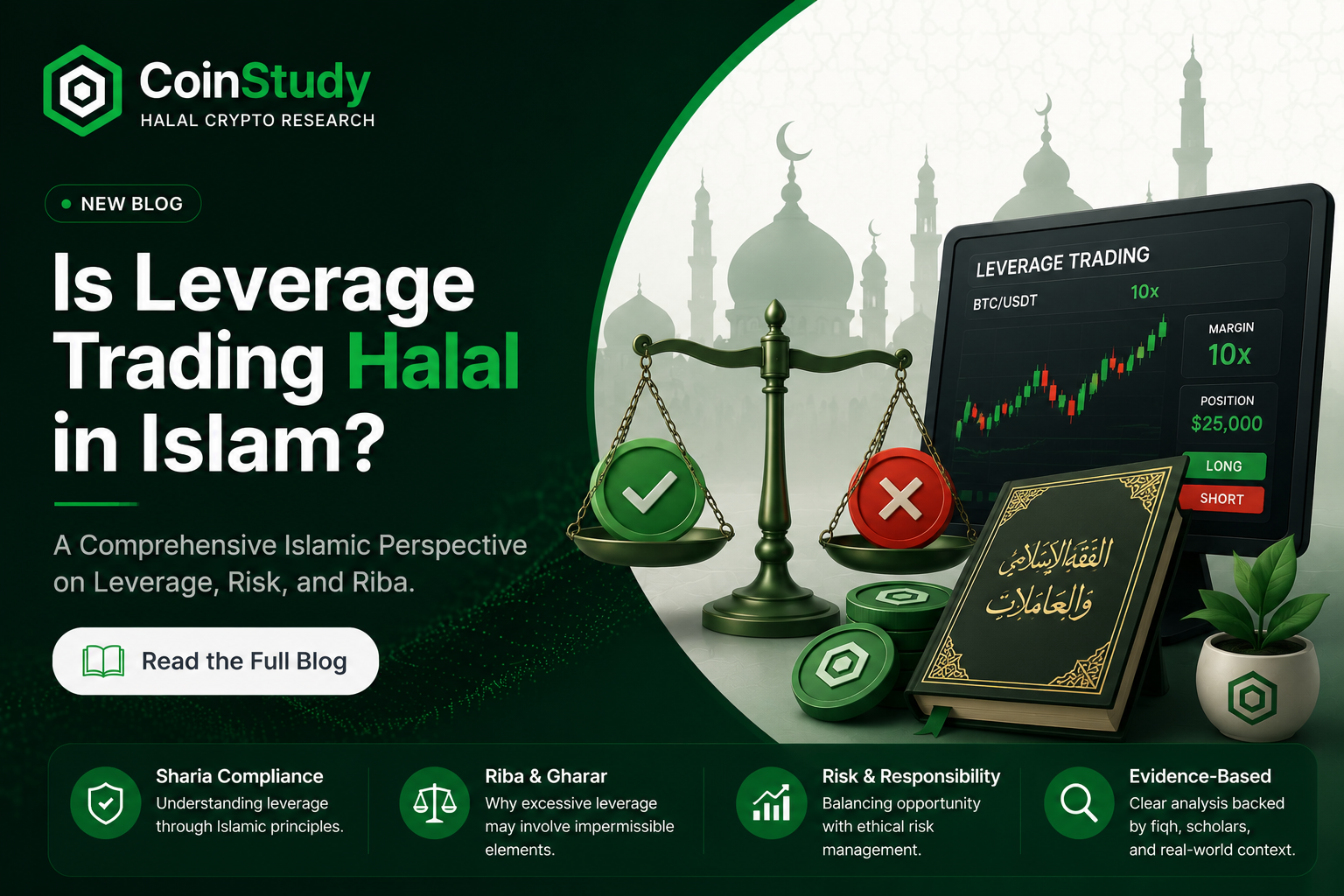
Is Leverage Trading Halal? Why Higher Leverage Makes It Worse
Most conversations about leverage trading focus on the profits.
10x returns. 50x positions. Turning $500 into $50,000. The numbers are designed to be exciting and they work. Millions of traders globally use leverage every day, many of them from Muslim-majority countries, many of them without ever stopping to ask what leverage actually is from an Islamic finance perspective.
Here is what leverage actually is. You borrow money. You pay for borrowing it. You take on catastrophic loss potential. And the higher the leverage, the more pronounced each of these problems becomes.
This isn't just generally haram territory. The Islamic finance concerns around leverage trading get measurably worse as leverage ratios increase and understanding why helps Muslim investors make genuinely informed decisions about what they're being offered by crypto exchanges.
Quick Verdict: Leverage Trading Is Generally Haram ❌
Leverage trading fails Islamic finance screening at the most basic level. The borrowed capital that makes it possible carries interest charges that constitute Riba. The liquidation mechanism creates extreme Gharar. The forced short-term speculation creates Maysir. And critically, the higher the leverage ratio, the more severe each of these problems becomes.
What Leverage Actually Is — Stripping Away the Marketing
Before the Islamic finance analysis, it's worth being clear about what leverage trading actually involves because exchanges do an excellent job of making it sound like a feature rather than a financial mechanism with serious implications.
Leverage is borrowing. When an exchange offers you 10x leverage, they are lending you nine times your deposit. When they offer 50x leverage, they are lending you forty-nine times your deposit. The capital controlling your position is almost entirely borrowed capital, not your own.
That borrowed capital costs money. Every hour, every day the position is open, you pay financing fees on the amount you've borrowed. These fees are small percentages but on large leveraged positions held over time, they accumulate significantly.
And that borrowed capital can be called back. If the market moves against your position enough that your collateral can no longer cover the potential losses, the exchange liquidates your position automatically. You lose your collateral. The lender is protected. You bear the loss.
Strip away the trading terminology and leverage trading is this. Borrow money at interest, use it to speculate on price movements, and risk losing everything if you're wrong.
The Leverage Ratio Problem — Why Higher Is Always Worse
This is the specific contribution this analysis makes beyond the general margin and futures trading discussions. It explains exactly how increasing leverage ratios intensify each Islamic finance concern.
2x Leverage — The Minimum Problem
Even at 2x leverage, which is the lowest commonly available ratio, the Riba concern is present. You're borrowing an amount equal to your deposit. You're paying financing fees on that borrowed amount. The interest-based borrowing relationship exists regardless of how small the ratio is.
The Gharar is more manageable at 2x. The market would need to move 50% against you to trigger liquidation, which is possible but not imminent in most conditions. The Maysir concern depends on your trading behavior more than the leverage ratio.
10x Leverage — Serious Across All Dimensions
At 10x leverage, you're borrowing nine times your deposit. Financing fees are nine times larger relative to your own capital. A 10% adverse price movement triggers liquidation. In crypto markets where 10% daily moves are common, this means your position can be wiped out by normal market volatility entirely unrelated to your long-term thesis.
The Gharar is now serious. The gap between your liquidation level and normal price volatility is narrow. You can be right about where an asset will be in three months and still lose everything because of where it was in three days.
50x to 100x Leverage — Near Pure Gambling
At 50x leverage, a 2% adverse price movement liquidates your position. At 100x, a 1% movement does. In crypto markets that routinely move 2 to 5% in an hour, these positions are not investments. They're short-duration bets on price movements measured in minutes.
The Gharar at these ratios is extreme. The uncertainty is no longer about whether your long-term thesis is correct. It's about whether the market will move 1% in the wrong direction in the next fifteen minutes. That's not investment uncertainty. It's gambling uncertainty.
The Maysir at these ratios is equally clear. No trader using 100x leverage is making considered long-term value judgments. They're predicting micro-movements in highly volatile markets. Money is won and lost based on price movements too small and too fast to be analyzed by any genuine fundamental framework.
Islamic Finance Analysis
Riba — Present at Every Leverage Ratio
The borrowed capital that enables leveraged trading carries financing fees. At 2x you borrow the same amount as your deposit and pay fees on that. At 100x you borrow ninety-nine times your deposit and pay fees on all of it.
The Riba concern is present at every leverage ratio. It scales with the leverage. Higher leverage means more borrowed capital means more interest paid. But even the minimum leverage creates the Riba relationship that Islamic finance prohibits.
No exchange can offer genuinely interest-free leveraged trading because the capital being lent has a cost to the lender, and that cost is passed to the borrower in some form. Exchanges that rename the fee don't remove the interest relationship. They rename it.
Gharar — Directly Proportional to Leverage
The liquidation mechanism creates Gharar, which is excessive uncertainty, whose severity increases directly with leverage ratio.
At 2x, liquidation requires 50% adverse movement. Possible but not imminent. At 5x, liquidation requires 20% adverse movement. Normal crypto volatility range. At 10x, liquidation requires 10% adverse movement. Common daily range. At 50x, liquidation requires 2% adverse movement. Routine hourly range. At 100x, liquidation requires 1% adverse movement. Minute by minute noise.
As leverage increases, the relationship between genuine market analysis and trading outcomes breaks down completely. At 100x, the outcome of your trade has almost no relationship to whether your fundamental assessment of the asset is correct. It depends entirely on short-term price noise.
This is extreme Gharar, not because the future is uncertain, but because the financial structure makes your position impossible to manage through any rational analysis.
Maysir — Amplified by Every Additional Multiple
The speculative gambling-like dynamic of leveraged trading intensifies with every increase in the leverage ratio.
Low leverage still allows some connection between fundamental value analysis and trading outcomes. A 2x leveraged long position in Bitcoin can survive normal volatility while waiting for a long-term thesis to play out. High leverage eliminates this connection entirely. At 100x, you're not investing in Bitcoin's long-term value. You're betting on where the price will be in the next few minutes.
The zero-sum competitive dynamic that characterizes gambling is fully present in leveraged crypto trading. When a highly leveraged long trader profits from a rapid price spike, highly leveraged short traders lose, liquidated by the same movement. No economic value is created. Money redistributes between speculators based on short-term price predictions.
CoinStudy HCS Screening
Layer 1 — Sharia Red Line Screening
Result: Failed
Leverage trading fails Layer 1 screening on the Riba red line. The borrowed capital that defines leveraged trading carries interest-based financing fees. This single failure is sufficient for automatic Haram classification.
The Gharar and Maysir concerns compound the failure at every leverage ratio and become increasingly severe as the leverage ratio increases.
The Exchange Terminology Problem
Crypto exchanges have developed extensive vocabulary for describing leverage trading in ways that obscure the underlying financial relationships.
"Funding rate" is interest on borrowed capital in perpetual contracts. "Financing fee" is interest on borrowed capital in margin systems. "Overnight rate" is interest charged for holding borrowed positions overnight. "Borrowing cost" is the most transparent term and still means interest. "Trading fee" sometimes includes embedded interest costs.
Islamic finance evaluates financial relationships, not financial terminology. An exchange that charges you a percentage of your borrowed capital over time for having borrowed it is charging you interest. What they call that charge doesn't change what it is.
Muslim investors should look past the terminology and ask the fundamental question. Am I paying a time-based percentage charge for using borrowed capital? If yes, that's Riba regardless of what it's called.
A Note on "Low Leverage"
Some Muslim traders rationalize low leverage, meaning 2x or 3x, as being meaningfully different from the extreme leverage ratios that are most obviously haram.
The Islamic finance concern about Riba doesn't have a leverage ratio threshold below which borrowing with interest becomes permissible. Borrowing any amount of capital and paying financing fees on it creates the Riba relationship, at 1.5x just as much as at 100x.
The severity of the Gharar and Maysir concerns does vary with the leverage ratio as analyzed above. But the foundational Riba concern is present at every leverage ratio greater than 1x.
Halal Alternatives
Muslim investors seeking genuine crypto market exposure without leverage have straightforward permissible alternatives.
Direct spot ownership means buying actual cryptocurrencies, owning them in your wallet, and holding them based on genuine conviction in their long-term value. No borrowed capital. No financing fees. No liquidation risk. Your downside is limited to what you've invested. Your upside is unlimited.
Gradual position building means rather than using leverage to gain large immediate exposure, building positions gradually over time through regular purchases. This reduces timing risk without requiring any borrowed capital.
Portfolio diversification across halal-rated projects means spreading genuine ownership across multiple halal-rated cryptocurrencies, which provides exposure to the broader crypto market without concentration risk and without any of the leverage-related compliance concerns.
Final Verdict
Leverage trading is generally considered haram under Islamic finance principles and the higher the leverage ratio, the more comprehensively haram it becomes.
The Riba from financing fees on borrowed capital is present at every leverage ratio. The Gharar from liquidation risk becomes increasingly extreme as leverage increases, reaching near-gambling levels of uncertainty at high ratios. The Maysir from speculative zero-sum dynamics intensifies with every additional multiple of leverage.
For Muslim investors, leverage trading isn't a grey area that requires complex scholarly analysis. The borrowed capital with financing fees is Riba. The liquidation mechanism is extreme Gharar. The forced speculation is Maysir. These aren't incidental features of leverage trading. They're what leverage trading is.
The crypto market offers genuine permissible opportunities through spot investing in halal-rated projects. Those opportunities don't require leverage to be meaningful. They require patience, research, and the discipline to participate in permissible ways.
Read detail analysis of following coins here:
Is Margin Trading Halal?
Is Crypto Futures Trading Halal?
Is Perpetual Trading Halal?
Disclaimer: This article is provided for educational and research purposes only. CoinStudy does not provide personal financial or religious rulings. Investors should consult qualified Islamic scholars for individual guidance.