


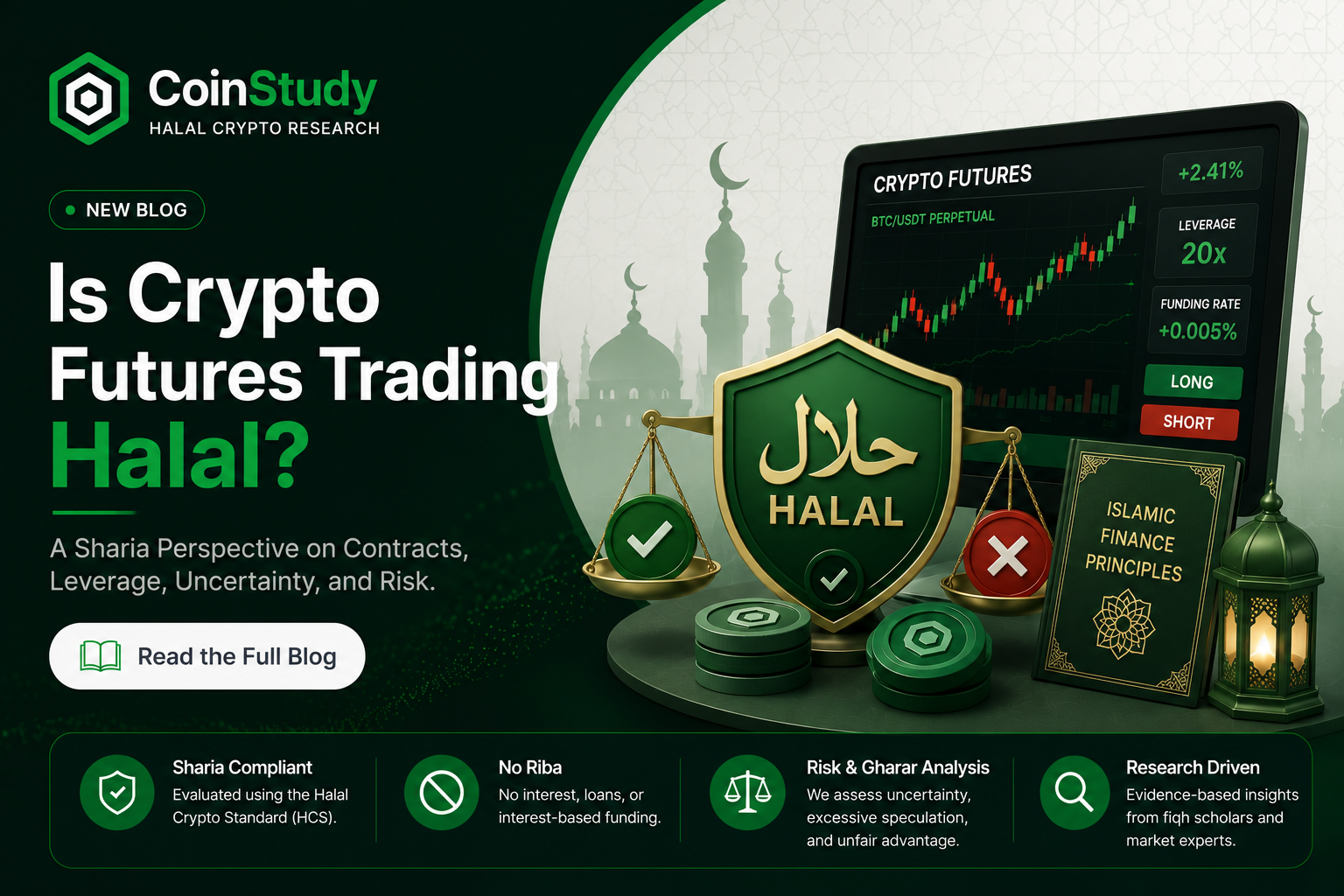
Is Crypto Futures Trading Halal? An Islamic Analysis
Walk into any major crypto exchange today and futures trading is front and center.
Massive leverage. Perpetual contracts. The ability to profit whether markets go up or down. Liquidation leaderboards turned into entertainment. Billions of dollars in daily trading volume. The marketing around crypto futures makes it look like the most exciting thing in finance.
For Muslim investors, excitement is not a compliance criterion. What matters is whether the financial structure is permissible and when you examine how crypto futures actually work, the Islamic finance analysis is one of the clearest in the entire crypto space.
Quick Verdict: Crypto Futures Trading Is Generally Haram ❌
Crypto futures trading fails Islamic finance screening due to its derivative contract structure, absence of genuine asset ownership, interest-based financing mechanisms, and speculative gambling-like dynamics. The concerns are not incidental. They are built into how futures products fundamentally work.
What Is Crypto Futures Trading?
Crypto futures trading is derivative trading, which means trading contracts whose value is linked to the future price of a cryptocurrency rather than trading the actual cryptocurrency itself.
When you open a Bitcoin futures position, you don't buy any Bitcoin. You enter a contract that will pay you based on the difference between your entry price and the exit price when you close the position. If Bitcoin's price moves in your predicted direction, you profit. If it moves against you, you lose, sometimes catastrophically if you're using leverage.
In most crypto futures products, no actual cryptocurrency ever changes hands. Settlement happens in cash or stablecoins. The entire transaction is financial engineering, which is a contract whose value tracks an asset without any genuine ownership of that asset taking place.
How Crypto Futures Actually Work — The Mechanics That Matter
Understanding why futures trading raises Islamic finance concerns requires understanding how it actually works in practice.
Leverage is the most prominent feature. Most crypto futures platforms offer leverage of 10x, 20x, 50x, or even 100x. This means a trader can control a $100,000 position with just $1,000 of their own capital, borrowing the remaining $99,000 from the exchange. That borrowing comes with financing fees, which are interest charges calculated against the borrowed amount. The higher the leverage and the longer the position is held, the more interest accumulates.
Perpetual contracts, the most popular type of crypto futures, have no expiration date. They use a funding rate mechanism where traders on the long side pay traders on the short side or vice versa depending on market conditions. These funding rates are effectively ongoing interest-like payments that flow between position holders based on market dynamics.
Short selling allows traders to profit from falling prices by opening positions that gain value as the asset price declines. This involves borrowing assets to sell them, which is another interest-bearing mechanism, with the intent to buy them back cheaper later.
Liquidation occurs when a position's losses reach the trader's margin balance. The exchange automatically closes the position, the trader loses all their deposited collateral, and the losses are absorbed. The leverage that made large gains possible makes complete capital loss equally possible.
Islamic Finance Analysis
Riba — The First and Most Direct Failure
Crypto futures trading involves interest-based financial mechanisms at its core in multiple ways.
The leverage that defines futures trading requires borrowing capital. That borrowed capital carries financing fees, which are percentage-based charges on the borrowed amount that accumulate over the holding period. These financing fees are structurally identical to interest regardless of what they're called by the exchange.
Perpetual futures contracts add funding rates, which are periodic payments between long and short position holders that function as ongoing interest-like obligations flowing between market participants.
Both mechanisms, leverage financing fees and perpetual funding rates, constitute Riba under Islamic finance principles. The fact that they occur on a crypto exchange rather than in a conventional bank doesn't change the financial relationship being created.
Gharar — Extreme and Structural
Islamic finance prohibits financial arrangements with excessive fundamental uncertainty, particularly where that uncertainty is the defining feature of the transaction rather than an incidental risk.
Crypto futures trading is built entirely around uncertain future prices. The outcome of every futures trade depends entirely on where prices move during the holding period, which is something that is genuinely unknowable at the time of entry. Leverage amplifies this uncertainty dramatically. Small adverse price movements can wipe out entire positions that would otherwise survive.
The liquidation mechanism creates a specific form of extreme Gharar. A trader can have a fundamentally correct long-term view about an asset's value, open a leveraged futures position, and be liquidated by short-term market volatility before the price moves in their predicted direction, losing their entire position even though they were ultimately right.
This isn't normal business uncertainty. It's a financial structure specifically engineered to create dramatic outcomes from uncertain price movements. That level of uncertainty, created deliberately by the product design, is precisely what the Gharar prohibition addresses.
Maysir — Pervasive Throughout
The speculative dynamics of crypto futures trading closely resemble gambling-like financial behavior at multiple levels.
In spot investing, your profit or loss comes from genuine changes in the value of an asset you own, driven by the underlying business's performance, adoption, or utility. In futures trading, your profit comes from correctly predicting short-term price movements before your position is closed, primarily influenced by market sentiment, news events, and the behavior of other traders rather than fundamental value.
The zero-sum nature of futures markets intensifies the Maysir concern. When a leveraged long trader profits from a price rise, leveraged short traders lose and vice versa. Money moves between speculators based on price movement predictions. No economic value is created. No productive activity is performed. The total gains and losses across all futures traders net to zero, minus the exchange's fees, over any given period.
This is a defining characteristic of gambling-like financial systems. Futures trading redistributes money between participants based on prediction accuracy about uncertain events, with no connection to genuine economic value creation.
CoinStudy HCS Screening
Layer 1 — Sharia Red Line Screening
Result: Failed
Crypto futures trading fails Layer 1 screening for multiple distinct reasons.
The leverage financing mechanisms constitute Riba. The derivative contract structure creates genuine Gharar through its fundamental dependence on uncertain price movements amplified by leverage. The speculative zero-sum dynamics constitute Maysir. The absence of genuine asset ownership removes the foundation that makes spot trading permissible.
Under the CoinStudy HCS methodology, multiple red-line violations result in automatic Haram classification. No further scoring is required.
"But I Use Futures to Hedge" — Addressing the Hedging Argument
Some Muslim investors use futures contracts to hedge existing crypto positions, attempting to limit downside risk on assets they genuinely own by opening offsetting short positions.
The hedging argument has some intuitive appeal. Conventional finance widely accepts hedging as a legitimate risk management tool. But Islamic finance scholars have identified specific concerns with derivatives-based hedging that apply in this context.
The instrument used for hedging, which is the futures contract, retains all the compliance concerns regardless of the motivation for using it. A short futures position opened for hedging purposes still involves borrowed assets, financing fees, and leverage. The purpose doesn't change the structure.
Additionally, the practical reality of crypto futures hedging is that most retail traders who claim to hedge are actually speculating, using hedging as a mental framework to justify derivatives exposure. Genuine institutional hedging is different from what most retail traders describe as hedging.
Muslim investors seeking to manage downside risk on crypto positions should consult a qualified Islamic scholar for specific guidance on whether any hedging strategies are compatible with their personal compliance requirements.
The Popularity Argument — Why It Doesn't Help
Crypto futures trading is extraordinarily popular. The volumes are massive. The marketing is sophisticated. Major exchanges make it their primary product. Influencers and trading educators promote futures strategies constantly.
Islamic finance has never determined permissibility based on popularity. Riba was prohibited by Allah even when it was the dominant financing mechanism of pre-Islamic Arabia. The widespread adoption of a financial practice doesn't make it permissible.
The popularity of crypto futures trading among the general population, and even among some Muslim traders who haven't investigated the Islamic finance implications, doesn't change what futures contracts are structurally or whether they're compatible with Islamic principles.
Halal Alternatives for Muslim Investors Seeking Crypto Exposure
If you want exposure to cryptocurrency markets in a permissible way, there are genuine alternatives that don't involve futures or derivatives.
Spot investing in halal-rated cryptocurrencies is the most straightforward. Buy actual Bitcoin, Ethereum, Cardano, or any other halal-rated project. Own it directly. Hold it long-term based on genuine conviction in its utility and value.
Long-term portfolio building through gradual accumulation of positions in projects with genuine utility and strong HCS scores. This approach emphasizes genuine ownership and patient value investing rather than short-term price speculation.
Network participation in permissible forms, where some blockchain networks allow users to contribute to network security and receive rewards for that genuine productive contribution.
None of these alternatives offer the dramatic leverage-amplified gains that futures trading promises. They also don't offer the complete capital wipeouts that leverage-amplified losses create. For Muslim investors, that trade-off is the right one.
Final Verdict
Crypto futures trading is generally considered haram under Islamic finance principles.
The derivative contract structure, the absence of genuine asset ownership, the interest-based financing fees embedded in leverage mechanisms, the extreme Gharar from leverage-amplified uncertain price exposure, and the zero-sum speculative dynamics that resemble gambling-like behavior are not peripheral features of futures trading. They are how futures products fundamentally work.
Muslim investors seeking crypto market exposure have genuinely permissible alternatives through spot investing, direct asset ownership, and long-term participation in halal-rated blockchain projects. These alternatives don't offer futures-level leverage, but they also don't carry futures-level compliance concerns or futures-level catastrophic loss risk.
The discipline to pursue permissible returns rather than prohibited ones, even when prohibited products promise higher short-term gains, is a fundamental expression of Islamic economic ethics.
Read detail analysis of following coins here:
Is Crypto Trading Halal?
Is Perpetual Trading Halal?
Is Margin Trading Halal?
Disclaimer: This article is provided for educational and research purposes only. CoinStudy does not provide personal financial or religious rulings. Investors should consult qualified Islamic scholars for individual guidance.