


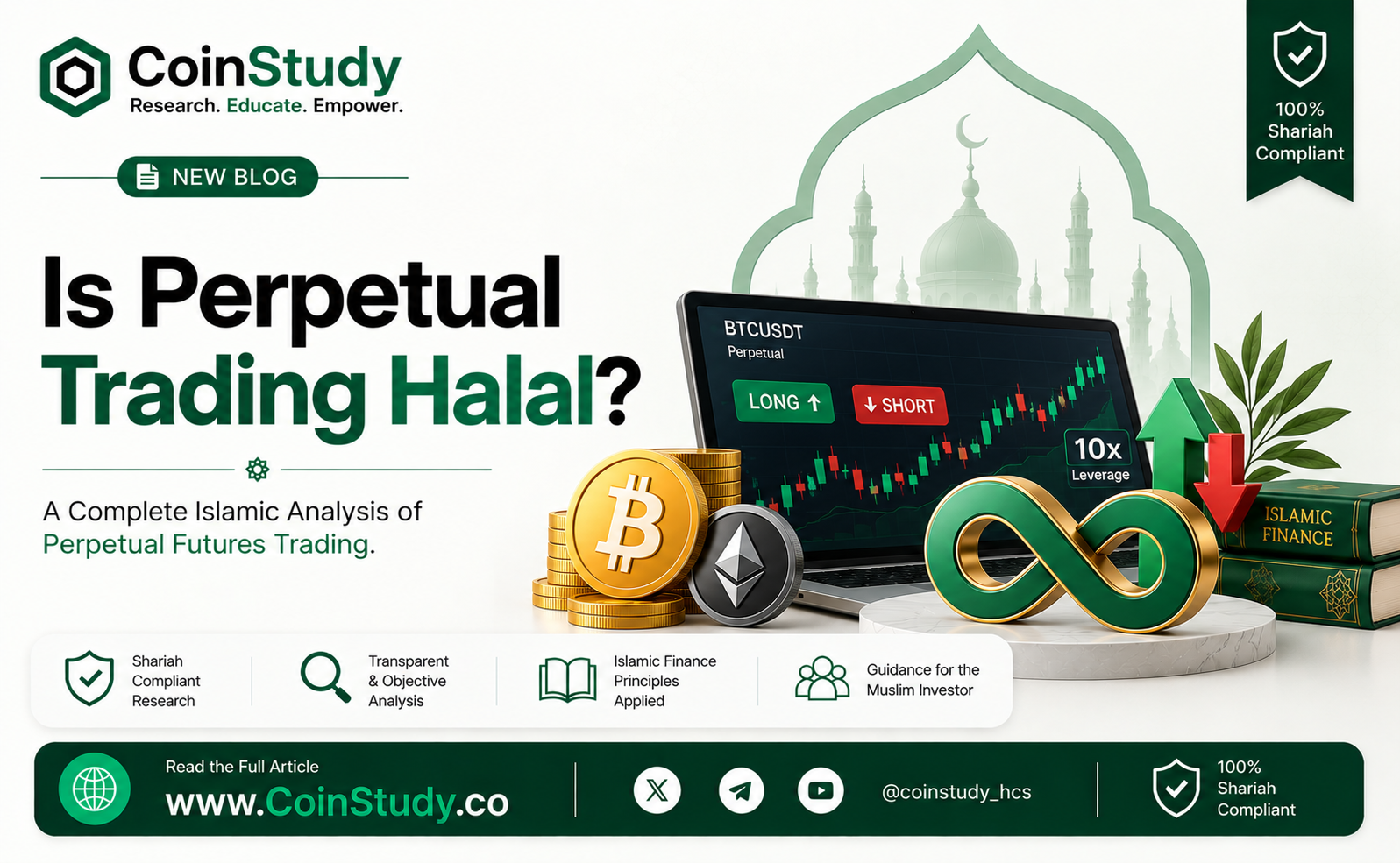
Is Perpetual Trading Halal or Haram? The Funding Rate Problem Explained
Every crypto trader has heard of perpetual contracts. Most have never stopped to understand what actually makes perpetuals different from other derivatives and why that difference matters specifically for Islamic finance.
The answer is the funding rate. Once you understand what the funding rate actually is, who pays it, who receives it, why it exists, and what economic relationships it creates between position holders, the Islamic finance analysis of perpetual trading becomes more precise than almost any other crypto product.
This is not a brief verdict article. Muslim investors deserve to understand why perpetual trading is problematic in specific and technical terms rather than simply being told that it is.
Quick Verdict: Perpetual Trading Is Haram ❌
Perpetual futures trading fails Islamic finance screening on two independent Layer 1 grounds. The funding rate mechanism creates an economic structure that raises serious Riba-adjacent concerns embedded in the product's core design. Where actual interest-bearing financing or borrowing arrangements exist in the leverage structure, an additional and more classical Riba concern arises under the Guaranteed / Contractual Interest Return red line.
Beyond these Layer 1 concerns, the absence of genuine asset ownership combined with the indefinite duration and variable obligations of perpetual positions creates serious contractual uncertainty, and speculative perpetual trading raises significant Maysir concerns where the activity functions as a chance-based wager on price movements rather than a genuine commercial transaction.
The funding rate is the feature that makes perpetuals uniquely and distinctively problematic beyond the concerns shared with other derivative instruments. It deserves careful and precise analysis rather than a simple conclusion.
What Makes Perpetuals Different From Regular Futures
Traditional futures contracts have expiration dates. A Bitcoin futures contract expiring in December settles on that date. You receive the profit or absorb the loss and the contract closes.
Perpetual contracts have no expiration date. You can hold a perpetual position for hours, days, weeks, or months without forced settlement.
This creates a fundamental technical problem. Without an expiration date to force price convergence, perpetual contract prices could drift arbitrarily far from the actual spot price of the underlying asset. If perpetual Bitcoin prices traded persistently above spot, long traders could always profit from holding perpetuals rather than owning actual Bitcoin. The market structure would break down.
Exchanges solve this problem with the funding rate. Understanding what the funding rate actually does and what economic relationships it creates between position holders is the foundation of the Islamic finance analysis.
The Funding Rate: What It Actually Is
The funding rate is a periodic payment mechanism that transfers money between traders who hold long positions and traders who hold short positions in perpetual markets.
Here is precisely how it works. At regular intervals, typically every eight hours, the exchange calculates the difference between the perpetual contract price and the spot market price. This difference is used to compute a funding rate.
If the perpetual price is trading above spot, meaning buying pressure in the perpetual market is pushing its price higher than the real asset price, long traders pay short traders. This creates a cost for holding crowded long positions, discourages excessive long positioning, and incentivizes traders to take short positions, pushing the perpetual price back toward spot.
If the perpetual price is trading below spot, short traders pay long traders. The same mechanism works in reverse.
The payment is calculated as a percentage of the notional position value and transferred automatically between position holders at each interval. Neither party chooses to make or receive the payment: it is determined and executed by the exchange's protocol automatically based on market conditions at that moment.
Why the Funding Rate Raises Serious Riba-Adjacent Concerns
The funding rate is not a trading fee paid to the exchange for a service. It is a transfer of money between traders, from long position holders to short position holders or vice versa, that flows continuously for as long as positions remain open.
CoinStudy's analysis does not claim that the funding rate is definitively Riba in the classical juristic sense. A scholar could legitimately ask where the qard is, who is lending whom money, what principal has been lent, and why a payment between two derivative position holders constitutes Riba merely because it is percentage-based and time-dependent. These are genuine analytical questions and the funding rate does not map perfectly onto the classical lender-borrower relationship that Islamic jurisprudence has analyzed most thoroughly.
What CoinStudy does identify is that the funding rate creates an economic structure that can resemble interest-based payment arrangements and therefore raises a serious Riba concern, even though the funding payment is not itself a conventional loan interest payment. The payment is percentage-based, calculated on the notional position value, accrues over time, and flows from one party to another based on the existence, size, and duration of the leveraged position. This combination of characteristics creates an economic relationship that warrants serious Shariah scrutiny even if it does not fit the most classical Riba formulation precisely.
The funding rate's technical purpose, which is to anchor perpetual prices to spot, does not by itself resolve the Shariah question. CoinStudy examines the economic relationship created by the mechanism rather than accepting the exchange's technical description as dispositive of the compliance question. A mechanism can serve a legitimate technical function and still create economic relationships that raise Islamic finance concerns.
The Leverage Layer: Where Classical Riba Concerns Arise
Many perpetual trading platforms offer significant leverage including 10x, 25x, 50x, or higher multiples. Depending on the platform's specific structure, leveraged perpetual trading may also involve borrowing, financing charges, or other credit-like arrangements from the exchange or from the platform's liquidity pool.
Where an actual interest-bearing loan or financing fee is used to support the leveraged position, that creates an additional and more classical Riba concern distinct from the funding rate analysis. In a borrowing structure, capital is extended by the exchange or platform, the trader uses that capital to open a larger position than their own margin could support, and the trader pays a financing fee calculated as a percentage of the borrowed amount over the duration of the borrowing. This structure is closer to the classical lending relationship: principal extended, percentage-based charge over time, entitlement to excess over the extended principal. Where this structure exists, it falls within CoinStudy's Guaranteed / Contractual Interest Return red line.
Muslim investors should examine the specific platform's leverage structure carefully. Not every leveraged perpetual is legally identical across all implementations. The Riba concern associated with leverage depends on whether actual interest-bearing financing arrangements are embedded in the platform's leverage mechanism.
The Contractual Uncertainty in Perpetuals
In a conventional cash-settled perpetual, the trader holds a derivative position rather than ownership of the underlying asset. Opening a perpetual futures position on Bitcoin means holding a contract that tracks Bitcoin's price, not Bitcoin itself.
The Islamic finance concern about genuine asset ownership and possession is a separate analytical question from the Gharar analysis. CoinStudy's Gharar analysis, consistent with the framework developed in the Market Volatility vs Contractual Gharar article, focuses on structural contractual uncertainty: uncertainty about the terms, obligations, and nature of the agreement itself rather than ordinary market price movement.
Perpetual contracts create several specific structural uncertainties that do not arise in ordinary spot ownership of the same asset. The contract has no defined settlement date, meaning the conditions under which the position will eventually close are not determined at opening. The funding rate obligations across the position's life are variable in amount and can shift direction multiple times, creating ongoing contractual obligations whose magnitude cannot be assessed at inception. The liquidation mechanics interact with leverage in ways that can produce rapid position termination under conditions that are difficult to evaluate precisely at opening. The combination of indefinite duration, variable periodic obligations, and liquidation conditions creates structural uncertainty about the nature and extent of the trader's obligations across the life of the position.
These are structural uncertainties embedded in the product's contractual design rather than ordinary post-trade market price uncertainty. This kind of compounded structural contractual uncertainty is the kind of excessive Gharar that Islamic commercial law addresses, and it is distinct from the mukhatarah price risk that accompanies genuine ownership of a real asset.
Maysir: When Speculative Perpetual Trading Raises Gambling Concerns
Perpetual trading can raise serious Maysir concerns where the activity functions as a chance-based, zero-sum wager on price movements rather than a genuine commercial transaction involving ownership or productive economic activity. The presence of a zero-sum payoff structure alone should not be treated as sufficient to establish Maysir: the specific contractual and economic structure must be considered.
The classical Maysir prohibition targets wagering mechanisms where one party's gain comes directly from another's loss through a chance-based outcome disconnected from genuine productive activity. Where perpetual trading functions as short-term directional speculation on price movements, with traders opening and closing positions based on predictions about whether Bitcoin or another asset will go up or down in the next hours or days, the activity has the character of a wager rather than a genuine commercial transaction. No asset is produced, no genuine service is rendered, no productive economic activity occurs. The profits of winning position holders come directly from the losses of losing position holders, with the exchange collecting fees from the flow between them.
The funding rate payment mechanism intensifies this concern. When funding rates run strongly in one direction, traders receive or pay periodic transfers unconnected to any genuine economic service or productive activity they have provided. Position holders receive or pay funding simply for holding their positions, creating monetary flows whose source is other participants' losses rather than genuine value creation.
CoinStudy notes that not every perpetual market participant is engaged in pure short-term speculation. A trader who uses perpetuals as part of a genuinely considered longer-term strategy based on fundamental analysis of the underlying asset occupies a different position than a pure short-term price direction guesser. However, the Maysir concern attaches to speculative perpetual trading where the economic activity is a wager on short-term price movements rather than a genuine commercial transaction, and Muslim investors should honestly assess whether their perpetual trading activity fits this description.
CoinStudy HCS Screening Results
Layer 1: Sharia Red Line Screening
Overall Result: Haram / Non-Compliant : Two Red Line Failures
Ecosystem Riba Exposure: ❌ Failed. The funding rate mechanism is the perpetual contract's primary economic design feature. It creates periodic percentage-based transfers between long and short position holders calculated on notional position value and accruing over time. This mechanism creates an economic structure that can resemble interest-based payment arrangements and raises a serious Riba-adjacent concern embedded in the instrument's core design. CoinStudy does not claim the funding rate is definitively Riba in the classical sense of a loan-based interest payment. It assesses the economic relationship the mechanism creates as constituting a Riba-adjacent concern sufficient to trigger this red line.
Gambling and Betting: ✅ Passed at the Layer 1 mechanism level. Perpetual contracts are not casino-style wagering products at the instrument design level. The Maysir concerns from speculative trading activity are assessed separately.
Haram Industry: ✅ Passed. Derivative financial instruments are not categorically a Haram industry. The compliance concern arises from specific mechanisms rather than the industry category.
Guaranteed / Contractual Interest Return: ❌ Failed where actual interest-bearing financing or borrowing arrangements exist in the leverage structure. Where a platform extends capital through an interest-bearing loan or financing arrangement and charges a percentage-based fee over time, the lender holds a protocol-defined entitlement to excess over the extended principal. CoinStudy reserves this red line for mechanisms where a contractual entitlement to excess over principal exists in a lending relationship. The funding rate itself, being variable in amount and direction rather than a contractual entitlement to excess over principal, is assessed under Ecosystem Riba Exposure instead. Muslim investors should examine their specific platform's leverage structure to determine whether this red line applies.
Synthetic Interest Products: ⚠️ Noted as an additional concern within the Ecosystem Riba Exposure analysis. The funding rate mechanism creates economic cash flows that can resemble those of interest income and interest expense between counterparties. This characteristic is part of what makes the Ecosystem Riba Exposure concern serious rather than constituting a separate independent red-line failure from the same mechanism.
Two red-line failures. Under the CoinStudy HCS framework any single red-line failure results in an automatic Haram classification. Layer 2 scoring is not conducted.
No Double-Counting Methodology Note: Ecosystem Riba Exposure and Guaranteed / Contractual Interest Return address distinct analytical questions through distinct pathways. Ecosystem Riba Exposure asks: does the instrument's native economic architecture create a Riba-adjacent mechanism as its primary design feature? For perpetuals the answer is yes through the funding rate. Guaranteed / Contractual Interest Return asks: does a financing arrangement create a contractual entitlement to excess over principal in a lending relationship? For leveraged perpetuals this may be yes through the platform's specific leverage financing structure, where that structure involves actual interest-bearing lending rather than margin mechanics. These are two distinct questions about two distinct economic mechanisms within the same product. The synthetic interest characteristic of the funding rate is assessed within the Ecosystem Riba Exposure pathway rather than as a separate third failure to avoid over-counting the same mechanism.
Anticipated Scholarly Questions
Scholar Question 1: The funding rate flows in both directions and the amount is variable. How can a payment that can benefit either side and whose amount cannot be predicted constitute Riba?
CoinStudy's response: CoinStudy does not claim the funding rate is definitively Riba in the classical sense. A scholar who asks where the qard is and who is lending whom money is raising a legitimate analytical question. What CoinStudy identifies is that the funding rate creates an economic structure that can resemble interest-based payment arrangements and raises serious Riba concerns, even without a conventional lender-borrower relationship. The payment is percentage-based, calculated on the notional position value, and accrues over time as a function of the position's existence and size. These characteristics create an economic relationship that warrants serious Shariah scrutiny. The variable direction of the payment and the absence of a fixed amount do not dissolve this concern: they make the precise Riba characterization more complex, which is why CoinStudy frames this as a Riba-adjacent concern under Ecosystem Riba Exposure rather than a definitive classical Riba determination.
Scholar Question 2: Is holding a perpetual position to hedge an existing spot position subject to the same analysis?
CoinStudy's response: The hedging purpose does not, by itself, remove the Shariah concerns arising from the instrument's underlying contractual mechanisms. The funding rate mechanism applies to every perpetual position regardless of the holder's intent. The structural contractual uncertainty about duration, obligations, and liquidation conditions applies equally. Muslim investors seeking to manage downside risk in crypto portfolios should consult qualified Islamic scholars about permissible risk management approaches rather than assuming that a hedging purpose transforms a problematic instrument into a permissible one.
Scholar Question 3: What if a trader holds a perpetual position for only a few hours and pays negligible funding rate amounts?
CoinStudy's response: The compliance concern is with the structure rather than the magnitude of any specific payment. A position held for a few hours still participates in the funding rate mechanism and the economic relationships it creates, even if the specific payment in that interval is numerically small. The classical principle that a small amount of a prohibited element does not render an arrangement permissible applies here. Muslim investors should not seek compliance through minimizing exposure to a problematic mechanism: they should seek instruments that do not contain the mechanism at all.
Scholar Question 4: Funding rates can sometimes be positive for the holder, meaning they receive money rather than paying it. Does receiving funding income create a separate compliance problem?
CoinStudy's response: Both the paying side and the receiving side participate in the same mechanism and the same economic relationship it creates. The trader receiving funding income is receiving a percentage-based transfer from counterparties based on the counterparties' capital positions and time. This economic relationship is what the Riba-adjacent analysis addresses regardless of which direction the payment flows. Additionally, a trader who holds a short position to receive positive funding income is deliberately positioning themselves to profit from the periodic payment mechanism, which intensifies the Maysir concern about speculation on the mechanism rather than genuine commercial activity.
How Perpetuals Compare to Regular Futures
Many conventional futures structures raise significant Shariah concerns including questions relating to ownership, genuine delivery and settlement, leverage, and speculative exposure. These concerns exist independently of the funding rate analysis.
Perpetual contracts add the separate and unique funding rate mechanism on top of those pre-existing concerns. The absence of an expiration date that makes perpetuals technically flexible and popular with traders is the same feature that creates the funding rate problem: without expiry there must be a mechanism to keep perpetual prices anchored to spot, and that mechanism creates the Riba-adjacent economic relationships that regular dated futures avoid by design.
The longer a perpetual position is held the more funding rate intervals accumulate, creating ongoing Riba-adjacent economic relationships that dated futures contracts avoid through expiration. Muslim investors evaluating different derivative instruments should understand that perpetuals carry these pre-existing futures concerns plus the unique funding rate concern rather than being simply one option among many equivalent derivative structures.
The Objection That the Funding Rate Is Just a Price Mechanism
A sophisticated objection sometimes raised is that the funding rate is simply a technical mechanism for maintaining price anchoring and should not be analyzed through an Islamic finance lens because it is not a financial return but a market structure tool.
This objection confuses the purpose of a mechanism with the economic relationships it creates. The fact that the funding rate serves the technical purpose of anchoring perpetual prices to spot does not determine the Shariah character of the economic relationships it creates between position holders. A mechanism can serve a legitimate technical function and still create economic relationships that raise Islamic finance concerns.
The funding rate's technical purpose does not, by itself, resolve the Shariah question. CoinStudy therefore examines the economic relationship created by the mechanism rather than accepting the exchange's technical description as dispositive of the compliance question.
Halal Alternatives for Muslim Investors
For Muslim investors seeking genuine crypto market participation, the permissible path is clear even if it lacks the leverage-amplified mechanics of perpetual trading.
Spot ownership of halal-rated cryptocurrencies is the foundational permissible approach. You own what you buy. There is no funding rate, no leverage financing, no liquidation risk from margin. Your downside is limited to your actual investment and your upside reflects genuine ownership of an asset whose value you believe will appreciate over time. This is genuine commerce with genuine ownership and mukhatarah accepted as the natural companion of trade.
CoinStudy's HCS analysis identifies which cryptocurrency assets pass Islamic finance screening across all five Layer 1 red lines and the six Layer 2 dimensions. The Utility dimension confirms genuine real-world adoption. The Financial Exposure dimension confirms no intrinsic Riba mechanism. The combination provides Muslim investors with analytical foundations for building a portfolio of assets with genuine economic substance.
Short-term leveraged trading can expose retail traders to substantial losses, particularly through liquidation and financing costs. The compliance constraints that Islam places on Muslim investors in this area align with the financial discipline that sound investment practice recommends regardless of religious consideration: genuine ownership of assets with documented real economic function, held with a time horizon appropriate to the fundamental thesis, without leverage that can eliminate a position before the thesis has time to play out.
Final Verdict
Perpetual trading is Haram under the CoinStudy HCS analysis with two independent Layer 1 red-line failures.
The funding rate mechanism creates an economic structure that can resemble interest-based payment arrangements and raises serious Riba-adjacent concerns embedded in the instrument's core design, triggering the Ecosystem Riba Exposure red line. Where the platform's leverage structure involves actual interest-bearing financing or borrowing arrangements, the Guaranteed / Contractual Interest Return red line provides a second and more classical Riba failure. Beyond the Layer 1 failures, the derivative structure without genuine asset ownership combined with indefinite duration and variable periodic obligations creates serious structural contractual uncertainty, and speculative perpetual trading raises significant Maysir concerns where the activity functions as a chance-based wager on price movements.
CoinStudy deliberately does not claim that the funding rate is definitively Riba in the classical juristic sense. The analysis rests on CoinStudy's assessment that the economic structure the funding rate creates constitutes a Riba-adjacent concern serious enough to trigger the Ecosystem Riba Exposure red line, while acknowledging that the precise mapping of the funding rate onto classical Riba categories is a genuinely complex analytical question that scholars may analyze differently.
Understanding why something is Haram is more valuable than simply knowing that it is. The funding rate is the mechanism that requires specific understanding. It is not merely a technical exchange detail: it is the economic heart of what makes perpetuals uniquely and distinctively problematic compared to other derivative instruments.
Read detailed analysis and concepts here:
Is Crypto Futures Trading Halal?
Market Volatility vs Gharar in Islam
Understanding Maysir in Crypto
Disclaimer: This analysis is provided for educational and research purposes only based on guidance from CoinStudy's HCS Shariah Board. CoinStudy does not issue personal fatwas or financial advice. Please consult a qualified Islamic scholar for individual guidance on specific trading decisions.