

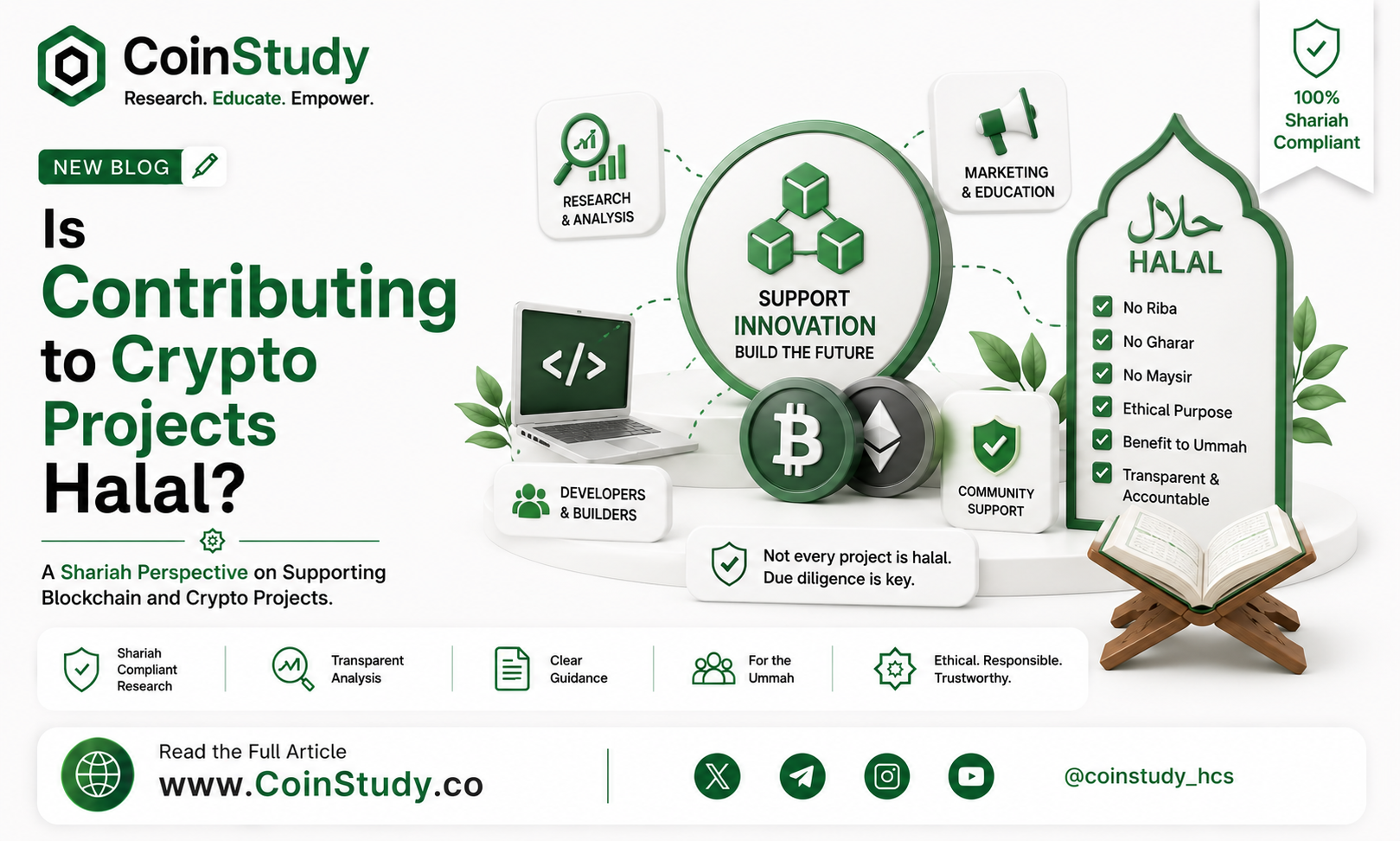
Is Contributing to Crypto Projects Halal?
Most discussions of halal crypto focus on one question. Is this token permissible to buy?
That is an important question and CoinStudy has dedicated hundreds of analyses to answering it. But it is not the only question that matters for Muslim investors navigating the Web3 space.
A growing number of Muslims are participating in the crypto ecosystem not as token buyers but as community contributors. They join Discord servers, create educational content, participate in governance forums, translate documentation, help moderate communities, and engage in the kinds of consistent volunteer activity that crypto projects rely on to build awareness and adoption. Many of these contributors do so hoping to qualify for future airdrops, earn contributor roles, or simply contribute to what they believe are genuinely beneficial projects.
For these contributors, the compliance question is different and more nuanced than for investors. A Muslim investor asking whether to buy a token is asking about what they receive and whether its value is derived from permissible activity. A Muslim contributor asking whether to create content about a project is asking about what they do and whether their own activity is permissible.
These are related but genuinely distinct questions that can have different answers. CoinStudy recently referred a specific case of this kind to our Shariah Board chairman. His ruling provides important guidance that every Muslim Web3 contributor should understand.
The Question That Started This Analysis
A Muslim community member from Bihar, India, currently working in the UAE, sent CoinStudy a detailed and sincere question about his situation.
He had been contributing to a blockchain project's Discord server for several weeks, creating educational posts about the project's infrastructure, technical architecture, and modular design. He was deliberately and consistently avoiding any discussion or promotion of a prediction market application built on that infrastructure, specifically because he understood that prediction markets are problematic under Islamic finance principles.
He wanted to know whether his contribution, focused entirely on infrastructure education while avoiding the problematic application, was permissible.
CoinStudy researched the specific project and found that it explicitly showcases prediction markets as a flagship demonstration of its technology on its own platform and marketing materials. We communicated this finding and recommended scholarly consultation before continuing.
He applied the hadith of the Prophet Muhammad, peace be upon him, which states: "Leave that which makes you doubt for that which does not make you doubt." (Jami' at-Tirmidhi, 2518)
CoinStudy referred the complete details of his case to our Shariah Board chairman, who holds a PhD in Islamic finance and operates under AAOIFI standards. His ruling forms the scholarly foundation of this blog.
The Chairman's Ruling — Translated and Explained
Our Shariah Board chairman provided the following ruling in response to this specific case:
"Contribution to this project can continue. If any infrastructure supports both halal and haram activities, the ruling is determined by looking at the majority of the work being done. Based on the details provided by the questioner, continuing this work is acceptable. Regarding prediction markets, there are many types of commerce that are called speculative trade. That which has a positive probability and involves no deception can be conducted."
This ruling rests on a well-established principle in Islamic jurisprudence called the majority work principle, which states that when an activity involves both permissible and impermissible elements, the ruling on the activity follows the majority character of what is actually being done.
The questioner's specific situation qualified for this principle because his actual work, which consisted of educational posts about technical infrastructure and architecture, was majority permissible content. His deliberate and consistent avoidance of promoting the prediction market application meant his contribution was not majority impermissible activity.
This is a meaningful and practically important ruling for the entire category of Muslim Web3 contributors.
The Critical Distinction — Contributing vs Investing
Before applying the chairman's ruling broadly, it is essential to understand the precise distinction it establishes. This distinction has two separate dimensions that must not be conflated.
What you DO as a contributor is evaluated differently from what you OWN as an investor.
When CoinStudy evaluates a token for investment purposes, we evaluate what that token represents and whether its value is derived from permissible economic activity. A token whose buyback mechanism is funded by perpetual futures revenue fails our red-line screening regardless of what the individual token holder personally does. The holder benefits financially from the growth of a prohibited product whether they intend to or not. This is why CoinStudy classifies exchange tokens like BNB, CRO, and LEO as Haram.
When evaluating contribution activity, the analysis is different. A contributor is not receiving financial benefit from the growth of a prohibited product simply by being present in a community. They are performing specific identifiable work. That work can be evaluated on its own terms. If the specific work being done is majority permissible, the majority work principle applies.
This is not a contradiction between CoinStudy's investment analysis and the chairman's ruling on contribution. They answer different questions about different types of participation.
What Makes Contribution Activity Permissible
Based on the chairman's ruling and CoinStudy's framework, contribution to a crypto project is more clearly permissible when the following conditions are genuinely met.
The majority of your actual work involves permissible content and activity. If you are writing about technical architecture, explaining consensus mechanisms, helping new community members navigate documentation, translating educational content, or moderating general community discussions, your work is majority permissible regardless of what other applications exist somewhere in the broader ecosystem.
You are deliberately and consistently avoiding any promotion of haram-classified applications within the ecosystem. The questioner's case was specifically strengthened by his deliberate avoidance of the prediction market application. This is not a technicality. It is a genuine and meaningful choice that affects the compliance character of his overall contribution.
Your contribution does not involve actively recruiting users into haram-classified products. There is a meaningful difference between writing educational content about a blockchain's technical design and actively encouraging people to use a gambling or speculation product built on that blockchain. The former is permissible educational activity. The latter is facilitating haram activity regardless of the infrastructure context.
You are not being financially incentivized specifically to grow the adoption of prohibited products. If a project's contribution rewards are specifically tied to driving users into haram-classified products, the incentive structure itself creates a compliance concern even if your individual activities are otherwise permissible.
What Makes Contribution Activity More Problematic
The majority work principle is not a blanket permission for all contribution to any project regardless of what that contribution involves. Certain types of contribution activity raise genuine compliance concerns even when the underlying project has permissible infrastructure.
Directly promoting or creating content specifically about haram-classified applications within the ecosystem. If a contributor creates content specifically promoting a prediction market application, a perpetual futures trading platform, or an interest-bearing lending product, even within a broader permissible infrastructure ecosystem, that specific content is haram-adjacent regardless of the majority work principle. The principle applies to the overall character of the work, not as a license to engage in specific haram-promoting activities.
Being the primary marketing and growth driver for a project whose principal product is haram-classified. If the project you are contributing to is primarily known for and derives most of its value from a haram-classified product, and your contribution role is fundamentally about growing that project's overall adoption and reputation, the majority work principle provides less protection because the majority purpose of your contribution is serving the growth of a primarily haram product.
Receiving contribution rewards specifically structured around driving users into prohibited activity. Some projects structure their contributor programs specifically around metrics related to prohibited products. If your rewards depend on how many users you direct into a gambling protocol, a leveraged trading product, or an interest-bearing lending service, your incentive structure creates a compliance problem regardless of the educational framing of your individual posts.
Applying This to the Three Tiers of Infrastructure
CoinStudy's infrastructure neutrality framework identifies three tiers of infrastructure based on how directly a project promotes haram-classified use cases in its own strategic positioning. The majority work principle for contributors interacts with this framework in a way Muslim contributors should understand.
Tier One — Genuinely Neutral Infrastructure
Projects like Ethereum, Solana, or Cardano at the base protocol level are genuinely neutral infrastructure. They do not promote any specific use case as flagship or featured. Both permissible and impermissible applications exist in their ecosystems in genuinely organic proportions without the infrastructure provider directing users toward either.
Contributing to genuinely neutral infrastructure at this tier carries the least compliance concern. Educational content about Ethereum's consensus mechanism, Solana's parallel execution model, or Cardano's smart contract design is clearly permissible activity. The majority work principle applies comfortably and the underlying infrastructure does not itself point toward prohibited activity.
Tier Two — Infrastructure With Stated Strategic Targeting
Projects whose own published roadmaps or strategic vision explicitly identify haram-classified use cases as core growth targets, such as a data availability layer that targets perpetual futures exchanges in its published roadmap, sit in a more complex position for contributors.
Contributing to Tier Two infrastructure is more clearly permissible when the contributor's specific work focuses on aspects of the technology unrelated to the haram-targeted use cases. A contributor writing about the data availability mechanics and avoiding any mention of the perpetual futures targeting in the roadmap is in a more defensible position than one whose content specifically validates and promotes the haram-targeted use case as a selling point.
Tier Three — Infrastructure That Showcases Haram as Flagship
Projects whose own primary marketing materials feature a haram-classified application as a headline demonstration of the technology's value sit in the most complex position for contributors.
The chairman's ruling on the specific case described in this blog addresses exactly this situation. The ruling is that contribution focused on the permissible infrastructure aspects, with deliberate and consistent avoidance of promoting the flagship haram application, remains permissible under the majority work principle. The questioner's specific description of his work, focused on technical architecture and design while avoiding the prediction market application, satisfied the conditions of this principle in the chairman's assessment.
However Muslim contributors in this tier should be especially attentive to ensuring their actual work genuinely reflects this separation. If the haram-showcased use case is so central to the project that it becomes difficult to discuss the infrastructure without implicitly validating or promoting that use case, the separation becomes harder to maintain and the compliance picture becomes more uncertain.
The Practical Reality of Web3 Contribution
Understanding Islamic finance compliance in Web3 contribution requires acknowledging a practical reality that Muslim contributors face daily.
Almost every major blockchain ecosystem hosts both permissible and impermissible applications. A contributor cannot avoid this reality by simply refusing to engage with any project that has any impermissible application anywhere in its ecosystem. That approach would eliminate virtually every meaningful contribution opportunity in Web3.
The majority work principle provides a genuine and scholarly grounded path through this complexity. It does not ask contributors to pretend that prohibited applications do not exist in the ecosystems where they work. It asks them to ensure that their own actual work is majority permissible and that they are not actively promoting or facilitating the prohibited applications they know exist.
This is a practically achievable standard that allows Muslim contributors to participate meaningfully in the Web3 ecosystem while maintaining genuine Islamic compliance in their own activity.
At the same time, the principle is not infinitely elastic. A contributor who claims to be doing infrastructure education while spending most of their actual effort directing users toward gambling or speculation products would not satisfy the majority work principle regardless of how they frame their activity. The principle follows the genuine character of the work, not the label applied to it.
The Intention Dimension
Islamic ethics places significant weight on intention, called niyyah, in evaluating the permissibility of actions. The questioner's situation illustrated this beautifully. His intention was explicitly to contribute to genuinely permissible infrastructure education while avoiding anything that would promote the prediction market application he knew was present in the ecosystem.
This intentional separation, consistently maintained over weeks of contribution activity, was a meaningful factor in the chairman's assessment. Islamic jurisprudence generally evaluates activity in its complete context, including the actor's genuine intention and the actual substance of what they do.
A Muslim contributor who enters a project with the genuine intention of contributing to permissible educational and technical content, and who maintains that intention consistently in their actual work, is in a fundamentally different position from one who contributes primarily to grow their financial exposure to a project they hope will reward them through increased adoption of its haram-classified products.
Both contributors may be writing in the same Discord server. But what they are genuinely doing, and why, determines the compliance picture of their specific participation.
Guidance for Muslim Web3 Contributors
Based on the chairman's ruling and CoinStudy's framework, here is practical guidance for Muslim contributors navigating these questions in their own situations.
Before joining a project as a contributor, research what the project actually does and what its primary products are. Understand whether any haram-classified applications exist in the ecosystem and how prominently they are featured in the project's own marketing.
Assess whether you can genuinely maintain the separation the majority work principle requires. If the project's haram-classified application is so central to its identity that educational content about the project inevitably promotes that application, the separation you need to maintain may not be practically achievable.
Define clearly for yourself what your contribution will and will not include. The questioner's case was strengthened by his clear and consistent avoidance of promoting the specific application he knew was problematic. Vague intentions are not a substitute for genuine behavioral consistency.
If you have genuine doubt about a specific project, apply the hadith of Tirmidhi 2518 honestly. The Prophet Muhammad, peace be upon him, instructed us to leave that which causes doubt for that which does not. In the Web3 ecosystem with hundreds of active projects seeking contributors, there is rarely a shortage of opportunities in genuinely permissible territory. Doubt about a specific project is a signal worth taking seriously before committing significant time and effort.
Seek scholarly guidance for situations that remain genuinely uncertain after your own research. CoinStudy's Shariah Board is specifically constituted for Islamic finance and cryptocurrency questions. Scholars at islamqa.info provide detailed responses in multiple languages. For complex individual situations, personal scholarly consultation remains the most reliable path to genuine clarity.
Important Questions for Muslim Web3 Contributors
Before committing to a contribution role in any crypto project, ask yourself honestly.
What is the majority character of the specific work I will actually be doing? Am I able to genuinely and consistently maintain separation between my educational content and any haram-classified applications in the ecosystem? Is my contribution incentivized specifically around driving users toward prohibited products or around general community growth and education? Am I entering this contribution with a genuine intention to create permissible educational value, or primarily with the hope of financial reward from a project whose value is driven by haram-classified activity? Does this project cause me genuine doubt that the hadith of Tirmidhi 2518 would advise me to leave?
Final Verdict
Contributing to crypto projects is not a single compliance question with a single universal answer. Like most questions in Islamic finance that intersect with genuinely novel modern financial structures, it requires honest individual assessment of the specific situation.
The majority work principle, confirmed by CoinStudy's Shariah Board chairman in response to a specific case, establishes that contribution focused on genuinely permissible aspects of a project, with deliberate and consistent avoidance of promoting haram-classified applications within the ecosystem, remains permissible even when haram-classified applications exist somewhere in that ecosystem.
This ruling does not eliminate the need for individual assessment. It provides a framework for making that assessment honestly and consistently. Muslim Web3 contributors who apply this framework carefully, maintain genuine intentional consistency in what their actual work includes and avoids, and seek scholarly guidance when genuine doubt remains, can participate meaningfully in the Web3 ecosystem while maintaining Islamic compliance in their own contribution activity.
For Muslim contributors seeking practical guidance on specific projects, CoinStudy's halal airdrop section at coinstudy.co/halal-airdrops provides assessments of projects we have screened as Halal or Halal With Concerns, giving contributors a starting point for identifying opportunities that minimize the compliance complexity described in this blog.
Read detail analysis of following coins here:
Why Are Exchange Tokens Haram?
Halal Airdrop Opportunities
What Is Darurah in Islamic Finance?
Learn Halal Trading Strategies with CoinStudy's Partner
Disclaimer: This article is provided for educational and research purposes only. The scholarly ruling included is provided by CoinStudy's Shariah Board chairman in his capacity as an Islamic finance scholar. This article does not constitute a personal fatwa for any specific individual situation. Muslim contributors facing specific questions about their own situations are encouraged to seek personal guidance from a qualified Islamic scholar who knows their complete circumstances.