

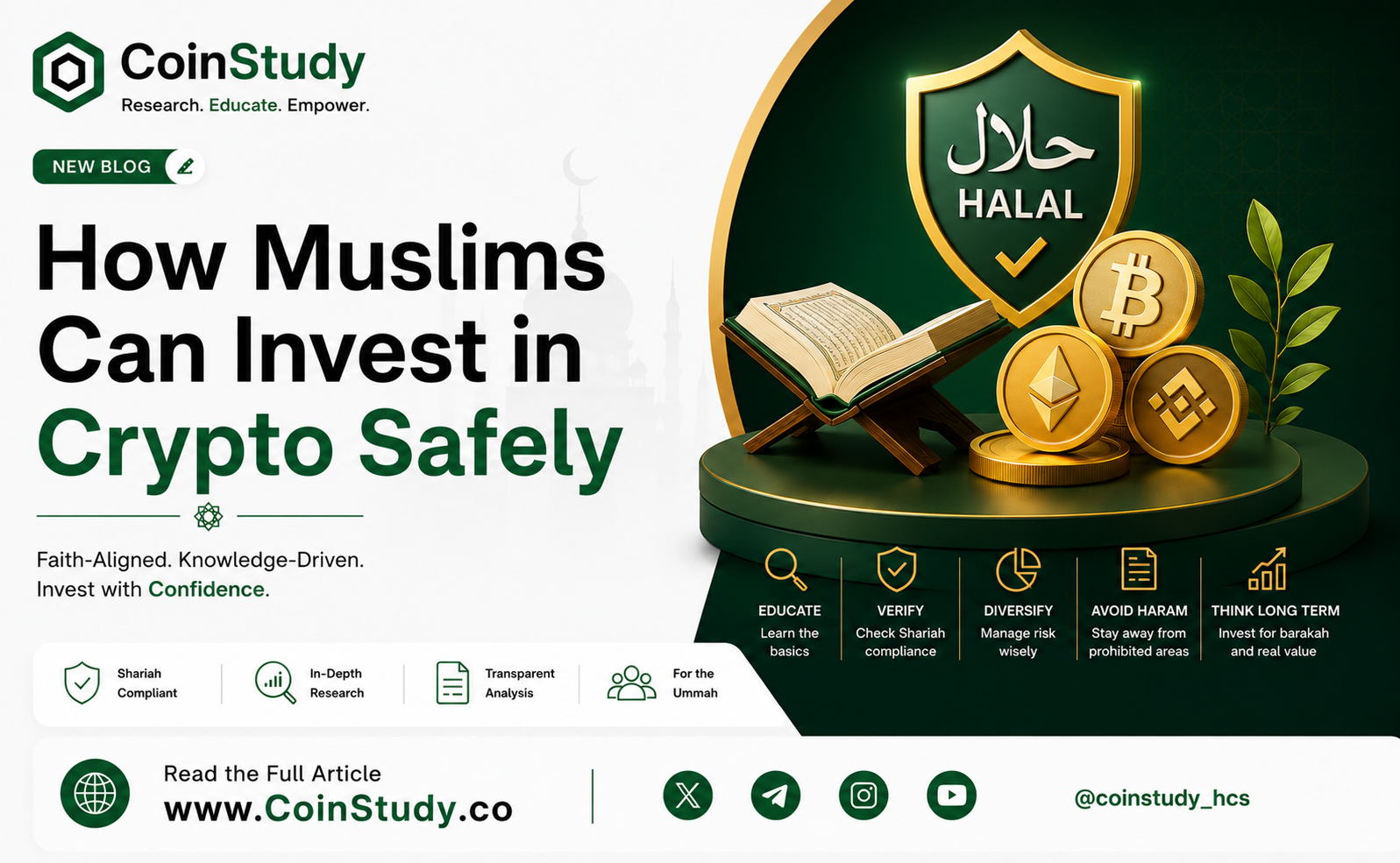
How Muslims Can Invest in Crypto Safely — A Complete Islamic Finance Guide for 2026
There are 1.8 billion Muslims in the world.
The global Islamic finance market is set to amount to $6.67 trillion by 2027. The halal cryptocurrency market is expanding at over 11% annually, reaching a projected $12.45 billion by 2028. The Muslim community represents one of the largest and fastest-growing demographics of potential cryptocurrency investors anywhere in the world. Traders UnionMEXC
And yet the guidance available to most Muslim investors who want to participate in this space remains inadequate, incomplete, or actively misleading. Generic lists of halal coins without methodology. Sweeping prohibitions without scholarly engagement with how specific protocols actually work. Influencer content that ignores Islamic finance principles entirely. Platforms that apply inconsistent criteria and give different answers to the same question depending on the day.
This is the gap CoinStudy was built to fill.
This guide provides a complete, honest, and practical answer to the question that millions of Muslim investors are asking: how do I invest in cryptocurrency in a way that is both financially sound and Islamically permissible? Not a theoretical framework disconnected from the realities of how crypto markets work. Not a blanket permission or prohibition that ignores the genuine complexity. A practical, methodology-backed, scholar-reviewed guide to navigating the crypto space with both financial wisdom and Islamic integrity.
Quick Verdict: Safe Halal Crypto Investing Is Possible With Discipline ✅
Muslim investors can participate in cryptocurrency markets safely and permissibly if they apply consistent Islamic finance principles to every decision they make, avoid specific prohibited activities that are clearly identifiable, and build on a foundation of genuine understanding rather than hype-driven decision making.
Clearly halal options include Bitcoin held long-term and cryptocurrencies with genuine utility and no built-in Riba at the protocol level. Clearly haram activities include lending protocols, leverage trading, meme coins, and interest-bearing stablecoins. Raseed Invest
The crypto market is not uniformly halal or uniformly haram. It contains both. Knowing the difference, with the rigor and scholarly backing that the decision deserves, is what CoinStudy provides.
Why This Question Matters More in 2026 Than Ever Before
By 2026, approximately 60% of countries with a majority-Muslim population have legalized cryptocurrency trading, either explicitly or via the absence of legal restriction. This means the practical question for most Muslim investors is no longer whether they can access crypto markets but whether they should and how.
The stakes of getting this wrong in either direction are real and specific.
Getting it wrong by avoiding all cryptocurrency means Muslim investors miss participation in one of the most significant wealth-creation technologies of the digital age, potentially leaving their communities economically disadvantaged relative to peers who engage with appropriate discernment.
Getting it wrong by engaging without Islamic finance guidance means Muslim investors expose themselves to Riba through interest-bearing products they do not understand, Maysir through speculative trading structures that function like gambling, and Gharar through investments with no economic foundation beyond hype cycles.
Both failures are costly. The solution is neither blanket prohibition nor uncritical participation. The solution is informed, principled, methodology-backed engagement.
The Two Types of Risk Every Muslim Crypto Investor Faces
Before understanding what to do, understanding what you are protecting against is essential. Crypto investing for Muslim investors involves two distinct categories of risk that must be managed simultaneously.
Financial Risk
Financial risk in crypto is real, measurable, and well-documented. Price volatility can move cryptocurrency values by double-digit percentages in hours. Project failure can reduce an investment to zero within months. Market crashes can eliminate significant portions of portfolio value across the entire asset class simultaneously. Scams and fraud cost the crypto industry billions of dollars annually.
Research indicates that 75 to 90% of traders face losses. This is not a fringe outcome. It is the majority experience for retail participants who engage without proper research, risk management discipline, and long-term perspective.
Religious Risk
Religious risk is the category that most investing guides for Muslim audiences fail to address with sufficient precision, and it is the category where CoinStudy's methodology provides the most distinctive value.
Religious risk means inadvertently earning Riba through interest-bearing products you did not recognize as interest-bearing. It means participating in speculative trading structures that function as Maysir even though they are packaged as investment products. It means holding assets whose entire value proposition depends on Gharar, specifically the continuation of speculative interest rather than genuine economic activity.
The fundamental insight for Muslim investors is that these two categories of risk are not separate problems requiring separate solutions. They are deeply connected. Islamically prohibited financial activities, precisely because they are built on Riba, Maysir, and Gharar, tend to be the same activities that expose investors to the highest financial risks. Avoiding what is Islamically prohibited and avoiding what is financially dangerous often point toward the same decisions.
A safe investment for a Muslim investor must be both financially sound and Islamically compliant. These goals reinforce each other rather than competing.
The CoinStudy HCS Framework — How We Assess Every Coin
CoinStudy's Halal Crypto Standard provides the methodological foundation for every recommendation in this guide. Understanding how it works helps Muslim investors apply its logic independently when evaluating new investments.
Layer 1 — Sharia Red Line Screening
The first question for any cryptocurrency is whether it fails any of five absolute prohibitions. Any single failure results in an automatic Haram classification regardless of how appealing the investment might appear on other dimensions.
The five red lines are Ecosystem Riba Exposure, meaning no interest-bearing lending or borrowing at the protocol level. Gambling and Betting, meaning no speculative wagering or prediction market mechanics. Haram Industry, meaning no connection to alcohol, gambling, tobacco, weapons of mass destruction, or other prohibited industries. Guaranteed Interest, meaning no predetermined percentage returns on locked capital from lending or similar mechanisms. Synthetic Interest Products, meaning no instruments that automatically generate interest-like returns from lending capital to borrowers.
If a coin fails any of these five checks the analysis stops immediately. No further research is needed. The asset is impermissible.
Layer 2 — HCS Scoring Across Seven Dimensions
Coins that pass all five red lines are then scored across seven weighted Islamic finance principles totaling 100 points. Financial Exposure Risk is weighted at 25 points and assesses the coin's indirect exposure to interest-bearing mechanisms even when it passes the direct red-line check. Gharar is weighted at 15 points and measures the level of uncertainty about the asset's fundamental nature and value. Maysir is weighted at 15 points and assesses whether the asset's market activity is primarily driven by genuine productive use or speculative trading. Underlying Business Activity is weighted at 15 points and evaluates whether the core economic purpose is permissible and productive. Utility and Real Use is weighted at 10 points and measures genuine adoption beyond speculative holding. Tokenomics Fairness is weighted at 10 points and assesses whether the token distribution was equitable. Transparency and Governance is weighted at 10 points and evaluates how open and accountable the protocol's development and management are.
The scoring bands are Halal at 80 to 100, Halal With Concerns at 60 to 79, Doubtful at 40 to 59, and Haram at 0 to 39. Every analysis is reviewed by our Shariah Board Chairman Dr. Usman Quddus, PhD in Islamic Studies and Finance, trained under AAOIFI standards.
The Complete Step-by-Step Guide to Safe Halal Crypto Investing
Step 1 — Understand Before You Invest
The most common and most costly mistake in cryptocurrency investing is participating before understanding what you are participating in. This is financially dangerous for every investor. For Muslim investors it carries the additional risk of inadvertently engaging in prohibited financial activity without realizing it.
Understanding does not require becoming a blockchain engineer. It requires understanding three things about any asset you consider. What does this project actually do? Who uses it and why? Does it involve any of the five red-line prohibited mechanisms?
CoinStudy's Islamic Finance Q&A at coinstudy.co/islamic-finance-qa is specifically designed to answer the most common questions Muslim investors have about specific coins and concepts. Our Shariah Board Chairman's direct rulings, published in both English and Urdu, provide specific scholarly guidance that goes beyond generic principles to address how particular blockchain mechanisms are assessed under Islamic jurisprudence.
Understanding Islamic finance principles specifically matters because crypto products are designed and marketed in ways that obscure their economic structure. A product called a "yield account" sounds like a savings product but is actually an interest-bearing lending arrangement. A product called "liquidity mining" sounds like a technical infrastructure service but may generate income from lending your assets to borrowers who pay interest. Knowing the three prohibited categories of Riba, Maysir, and Gharar helps you identify these structures regardless of what they are called.
Step 2 — Choose the Right Projects
The CoinStudy Halal library at coinstudy.co gives you a starting point of pre-screened, scholar-reviewed assessments for over 300 cryptocurrencies. But understanding how to evaluate projects yourself is equally important because new projects launch constantly and our library will always be growing toward comprehensive coverage.
Apply the Layer 1 red-line check as your first filter. For any project you are considering, ask whether it involves lending where depositors earn interest from borrowers. Ask whether it involves derivative products like futures, perpetual swaps, or options. Ask whether it involves prediction market or gambling mechanics. Ask whether it involves guaranteed percentage returns on locked capital. If yes to any of these, stop.
For projects that pass this filter, focus on three key quality indicators that align with both financial soundness and Islamic finance values. Genuine utility means the project solves a real problem for real users who need it, not just speculators who hope the price will rise. Transparent governance means the project's development, treasury management, and protocol changes are openly documented and accountable rather than controlled by anonymous insiders with misaligned incentives. Fair tokenomics means the initial token distribution was reasonably equitable without massive insider pre-allocation that creates structural advantage for early participants at the expense of retail buyers.
Step 3 — Start Small and Scale With Knowledge
Investing only what you can genuinely afford to lose is not just a conventional risk management rule. It is an Islamic finance principle. Capital that you cannot afford to lose creates desperate pressure for quick returns that leads to exactly the speculative and high-risk behavior that Islamic finance cautions against.
Starting small in cryptocurrency is especially important because understanding how a specific blockchain platform works in practice is different from understanding it in theory. Running a small position in a coin you have researched gives you genuine experience with how its price moves, how its ecosystem develops, and whether the use cases it claims are materializing in reality. This experiential knowledge is more valuable than any amount of reading when it comes to sizing a larger position later.
The prophetic guidance around not risking necessities in business ventures is directly applicable here. Crypto investment should come from genuinely discretionary capital, not from savings you need for essential living expenses, emergency reserves, or assets owed to others including Zakat obligations.
Step 4 — Avoid Every High-Risk Activity Completely
Some categories of crypto activity are Haram under Islamic finance with no ambiguity, no edge cases, and no exceptions. Understanding these categories clearly is as important as understanding what to invest in.
Margin and leverage trading involves borrowing capital at interest to amplify trading positions. The interest charged on borrowed capital is Riba. Leverage trading, margin trading, futures, and perpetual swaps involve borrowing with interest and excessive speculation. These activities combine Riba from the interest cost with Maysir from the speculative nature of leveraged positions. They are Haram and Muslim investors should avoid them entirely without exception. Raseed Invest
Futures and derivatives trading involves speculating on future prices of assets without necessarily owning the underlying asset. The combination of Gharar from uncertainty about future prices, Maysir from the speculative wagering structure, and often Riba from funding rates on perpetual contracts makes derivatives trading one of the clearest Haram categories in the crypto space.
Crypto lending as a depositor, where you deposit your cryptocurrency into a protocol and earn interest from borrowers who pay interest fees on outstanding loan balances, is Riba in its most direct form. Whether the platform is centralized like Nexo and Celsius or decentralized like Aave and Compound, the economic relationship is identical: capital deposited, interest charged to borrowers, interest earned by depositors. Our Shariah Board Chairman confirmed this directly: taking profit on a loan is Haram in Islamic jurisprudence.
Meme coins and hype-driven speculation involve market dynamics where early participants profit systematically from later participants' losses with no genuine economic value created in between. Approximately 97% of meme coins die or lose meaningful trading volume, with an average lifespan near one year. The documented failure rate and wealth transfer dynamics of meme coin markets place them firmly in the Maysir-problematic category for most Muslim investors.
Step 5 — Think Long-Term and Avoid Emotional Decisions
Long-term investing in genuinely halal cryptocurrencies is both financially superior and more aligned with Islamic investment principles than short-term speculative trading.
Financially, the evidence from conventional investing and from crypto markets specifically confirms that the majority of retail traders who attempt to time the market, chase price momentum, or react to news events underperform simple long-term holding strategies. The emotional decision-making that leads to buying at peaks of excitement and selling at peaks of fear destroys wealth consistently across market cycles.
From an Islamic perspective, the speculative mindset that characterizes short-term trading approaches is itself the Maysir concern that CoinStudy's methodology targets. When the primary motivation for any financial transaction is capturing price movement rather than participating in genuine productive economic activity, the financial behavior has drifted toward gambling regardless of how the transaction is legally classified.
Long-term holding of genuinely halal assets that you have researched and understand is the investment approach most consistent with Islamic commercial ethics around productive participation in economic activity and avoidance of speculative wealth transfer.
What Is Safe and Halal — Specific Asset Categories
Established Payment Cryptocurrencies
Bitcoin at 95 out of 100 Halal is the most straightforward option for Muslim investors seeking exposure to digital assets with the cleanest compliance profile. No staking mechanism, no DeFi ecosystem generating interest income, a fixed maximum supply, a fair Proof of Work launch with no insider pre-allocation, and fifteen years of operational history without a successful network-level exploit. The halal position holds that Bitcoin qualifies as valid property, functions as a medium of exchange accepted by merchants globally, and involves no built-in Riba in its base transactions. Traders Union
Kaspa at 90 out of 100 Halal offers technical innovation through BlockDAG architecture with a perfectly clean financial compliance profile. No staking yield, no DeFi ecosystem, a fair launch with no pre-mine, and pure Proof of Work payment focus.
Litecoin at 91 out of 100 Halal provides the most established Bitcoin fork with genuine payment utility across thirteen years of continuous operation and a simple design with no staking complexity.
Blockchain Infrastructure Platforms
Ethereum at 88 out of 100 Halal provides smart contract infrastructure with our Chairman's direct confirmation of permissibility. His ruling acknowledged that Ethereum provides equal economic rights to Muslim and non-Muslim society alike and that the direct causes of prohibition are absent at the protocol level. Muslim investors should note that DeFi applications built on Ethereum require individual assessment.
Solana at 87 out of 100 Halal provides high-performance blockchain infrastructure with the Chairman's confirmation that the currency does not contain interest or Gharar. The meme coin ecosystem on Solana requires avoidance while the infrastructure itself is permissible.
Cardano at 90 out of 100 Halal offers research-driven blockchain development with the strongest governance score in our infrastructure analysis series. Its focus on financial inclusion in Africa and developing nations aligns directly with Islamic values around serving underserved communities.
XDC Network at 90 out of 100 Halal provides enterprise trade finance blockchain infrastructure with $1.1 billion in tokenized assets and institutional partnerships including keynote presence alongside BlackRock and JPMorgan at the London RWA Summit.
Service-Based DePIN Infrastructure
Filecoin at 89 out of 100 Halal provides decentralized data storage where every FIL earned by a storage provider represents verified service delivery. No interest mechanism and one of the most clearly Ijarah-compatible economic models in our analysis series.
Render Network at 88 out of 100 Halal provides decentralized GPU computing where clients pay for genuine completed computational work and operators earn for providing that work. Service-based economic model with no interest structure.
Halal Airdrops
Airdrops of genuinely halal projects received through permissible activity are permissible income. CoinStudy's Halal Airdrops page at coinstudy.co/halal-airdrops provides a regularly updated list of pre-screened airdrop opportunities with specific guidance on which activities within each project are permissible and which to avoid.
The key principle is that the airdrop farming activity itself must be permissible. Completing free quests, community tasks, testnet participation, and social engagement for halal projects is permissible regardless of the airdrop motivation. Depositing capital into lending protocols, participating in prediction markets, or engaging in gambling-structured tournaments for airdrop rewards is not made permissible by the airdrop intention.
What to Avoid Completely — The Clear Haram List
Crypto lending platforms including Nexo, Celsius, Aave, Compound, Morpho, Maple Finance, JustLend, and Sky Protocol are all Haram because they generate Riba from lending capital to borrowers and distributing interest income to depositors and governance token holders.
Margin and leverage trading on any platform including perpetual futures, options, and leveraged tokens are Haram because they involve borrowing capital at interest rates, which is Riba, and wagering on speculative price movements, which is Maysir.
Exchange tokens of interest-based exchanges including BNB, OKB, KCS, BGB, GateToken, CRO, HTX, and LEO are Haram because their value is structurally tied to the growth of exchange ecosystems that generate significant revenue from prohibited products.
Prediction markets including Polymarket, Kalshi, Rain, Prophet Market, and Kaito's Attention Markets are Haram because they create financial arrangements where participants stake capital on uncertain future outcomes with winners collecting directly from losers.
T-Bill backed stablecoin yield products including USDT Earn, USDC Savings, and all similar yield-generating deposit products are Haram because they distribute interest income from Treasury securities to depositors. Note that our Chairman has confirmed using USDT as a medium of exchange for permissible transactions is conditionally permissible with caution.
Meme coins in the vast majority of cases are Doubtful to Haram because their market dynamics are driven by wealth transfer from uninformed late buyers to informed early holders with no productive economic activity occurring in between.
Zakat on Cryptocurrency
Crypto holdings above the nisab threshold, equivalent to 85 grams of gold or roughly $6,000 to $7,000 in 2026, are subject to Zakat. Raseed Invest
This applies to cryptocurrency held for one full lunar year at or above the nisab threshold. The Zakat obligation is 2.5% of the total market value of halal cryptocurrency holdings that have been held for the full Hawl period. This should be calculated at the current market value at the time Zakat is due rather than at the purchase price.
Muslim investors who earn cryptocurrency through airdrops, staking rewards that are assessed as permissible, or other income sources should also assess whether these earnings reach the nisab threshold and whether Zakat applies to them under their scholar's guidance.
Risk Management for Muslim Crypto Investors — Practical Guidance
Diversification Within the Halal Universe
Concentrating your entire crypto portfolio in one asset exposes you to project-specific risks that diversification can reduce without requiring any compromise on Islamic finance principles. CoinStudy's top 10 halal cryptocurrencies analysis at coinstudy.co/blog/top-10-halal-cryptocurrencies-in-2026 provides a researched starting point for building a diversified halal portfolio across different blockchain categories.
A practical halal portfolio structure might include a core position in Bitcoin as a digital store of value, exposure to one or two blockchain infrastructure platforms like Ethereum or Cardano, exposure to one or two service-based DePIN projects like Filecoin or Render, and selective participation in halal airdrops through permissible free activity. This structure provides genuine diversification across blockchain use cases while maintaining strong Islamic finance compliance throughout.
Using Secure Platforms
Choosing where to hold and trade your cryptocurrency is a practical risk management decision with significant financial implications. Hardware wallets including Ledger and Trezor provide the highest security for long-term holdings by keeping your private keys offline and away from exchange custody risk.
For trading, centralized exchanges that offer spot trading of halal assets can be used for the spot trading activity itself. Our Chairman's ruling on BNB established that individual spot trading profit is halal for the person even when the exchange itself hosts prohibited products, provided you strictly limit your activity to spot trading of halal assets and avoid all the exchange's prohibited products including earn programs, lending, margin, and futures.
Avoiding Emotional Decision Making
The two most common emotional decision-making failures in crypto investing are FOMO-driven buying at price peaks and panic selling at price troughs. Both reliably destroy wealth. Both are driven by the same underlying emotional response to price movement rather than rational assessment of whether the asset's underlying value proposition has changed.
The discipline required to avoid emotional decision-making in crypto is the same discipline that Islamic finance instills through its emphasis on avoiding speculative behavior. If your investment thesis is built on genuine understanding of what a project does and why it has long-term value, price volatility does not change the thesis. If your investment thesis is built on price momentum and social media excitement, any price decline rationally requires you to reassess whether the basis for the investment was sound.
The Honest Self-Assessment Before Every Investment
Before adding any new cryptocurrency to your portfolio, answer these questions with complete honesty.
Do I understand what this project actually does and who genuinely needs it? Have I checked it against the five HCS red lines and confirmed it passes all five? Is my reason for buying this based on genuine conviction in the project's utility and long-term value, or is it based on price momentum, influencer promotion, or fear of missing out? Can I afford to lose this investment entirely without it affecting my essential financial obligations, emergency savings, or Zakat obligations? Am I prepared to hold this for a minimum of one to two years rather than looking for a short-term price appreciation opportunity?
If you cannot answer all five questions affirmatively with genuine honesty, either do more research before investing or do not invest.
The Prophet Muhammad, peace be upon him, advised leaving that which makes you doubt for that which does not make you doubt. The crypto market contains many things that should make you doubt, and some things that a Muslim investor with proper research can engage with confidently. The discipline to know the difference is the foundation of safe halal crypto investing.
Common Mistakes Muslim Crypto Investors Make — And How to Avoid Them
Chasing quick profits through short-term trading is the most common path to financial loss and Maysir-adjacent behavior simultaneously. The combination of poor financial outcomes and compromised Islamic finance compliance makes this the mistake with the highest combined cost.
Ignoring halal status because a coin is popular or because people in your community are talking about it is how Muslim investors end up in Haram financial products without realizing it. BNB's popularity does not change its compliance classification. Aave's large TVL does not make lending at interest permissible. The correct research process requires checking the Islamic finance classification of every asset independently of its popularity.
Overtrading by making frequent buy and sell decisions based on price movements increases both financial risk and the Maysir risk of engaging in speculative rather than investment behavior. Long-term holding of genuinely halal assets is both more profitable on average and more aligned with Islamic investment principles.
Ignoring Zakat obligations on cryptocurrency is a financial and religious obligation issue. Muslims with crypto holdings above the nisab threshold held for a full lunar year are obligated to pay Zakat at 2.5% of the market value.
Relying on social media influencers rather than verified Islamic finance methodology for halal assessments is how Muslim investors get misled into both financially poor and Islamically impermissible investments. CoinStudy's methodology is transparent, documented, and reviewed by a named PhD Islamic finance scholar. The influencer's motivation to promote a coin they hold is structurally opposed to providing objective Islamic finance guidance.
How CoinStudy Helps
CoinStudy provides Muslim investors with specific, methodology-backed, scholar-reviewed guidance that addresses the complete question of safe halal crypto investing rather than only the Islamic finance compliance half or only the financial risk management half.
Our Halal Crypto Standard analysis library covers over 300 cryptocurrencies with full five-red-line screening and seven-dimension HCS scoring reviewed by Dr. Usman Quddus.
Our Islamic Finance Q&A provides direct answers to specific questions with the chairman's ruling incorporated where applicable.
Our Halal Airdrops page provides regularly updated guidance on permissible airdrop participation with specific compliance notes for each project.
Our Halal Staking page provides guidance on which staking mechanisms are assessed as permissible and which are not.
Our Halal Trading Signals page, launching shortly, will provide TA and FA-backed trading signals exclusively for halal-classified assets, with every signal identifying the coin's HCS score alongside the entry, take profit, and stop loss levels.
Our vision extends beyond cryptocurrency to become the world's largest halal investment research platform covering stocks, ETFs, REITs, Sukuk, mutual funds, and tokenized real-world assets. Every asset class will be assessed using the same rigorous methodology with the same scholarly oversight that currently covers crypto.
The mission is simple: to help Muslims make informed investment decisions with confidence by combining authentic Islamic finance principles, professional investment research, transparency, education, and technology.
Final Verdict
Muslims can invest in crypto safely. This is not a cautious hedge or a theoretical possibility. It is a practically achievable goal for any Muslim investor who combines Islamic finance principles with financial discipline and rigorous research methodology.
The path is specific. Choose from the halal-classified assets that pass all five HCS red lines and score above 80 on the seven-dimension HCS scoring. Avoid completely the clear haram categories of lending, leverage, futures, meme coin speculation, and interest-bearing stablecoins. Start with capital you can genuinely afford to lose. Think in years rather than weeks. Avoid emotional decision-making driven by price movements rather than fundamental value assessment. Pay Zakat on holdings above the nisab threshold. Consult a qualified Islamic scholar for personal guidance on specific situations your research does not clearly resolve.
Muslim crypto investors in 2026 possess unprecedented access to halal options, proving that faith and financial innovation can thrive together in the digital age. The challenge is no longer finding permissible options. The challenge is applying the discipline to engage with them correctly while avoiding the many impermissible options that surround them. Zipmex
Safe investing is not just about profit. It is about ethical and responsible participation in the digital economy in a way that serves your long-term financial wellbeing and your integrity as a Muslim investor.
Read detail analysis and concepts of following coins here:
Is DeFi Halal?
Is Bitcoin Halal?
Is Crypto Lending Halal?
Is Crypto Airdrop Halal?
Top 10 Halal Cryptocurrencies 2026
Disclaimer: This guide is provided for educational and research purposes only and does not constitute a formal fatwa or personal financial advice. This analysis is based on guidance from CoinStudy's HCS Shariah Board members. CoinStudy does not issue personal fatwas. Please consult a qualified Islamic scholar for individual guidance on your specific investment decisions.