

Understanding Gharar in Crypto, What Every Muslim Investor Must Know in 2026
Before you invest in any cryptocurrency, there is a question that matters more than price predictions, technical charts, or influencer endorsements.
Does this investment involve excessive uncertainty?
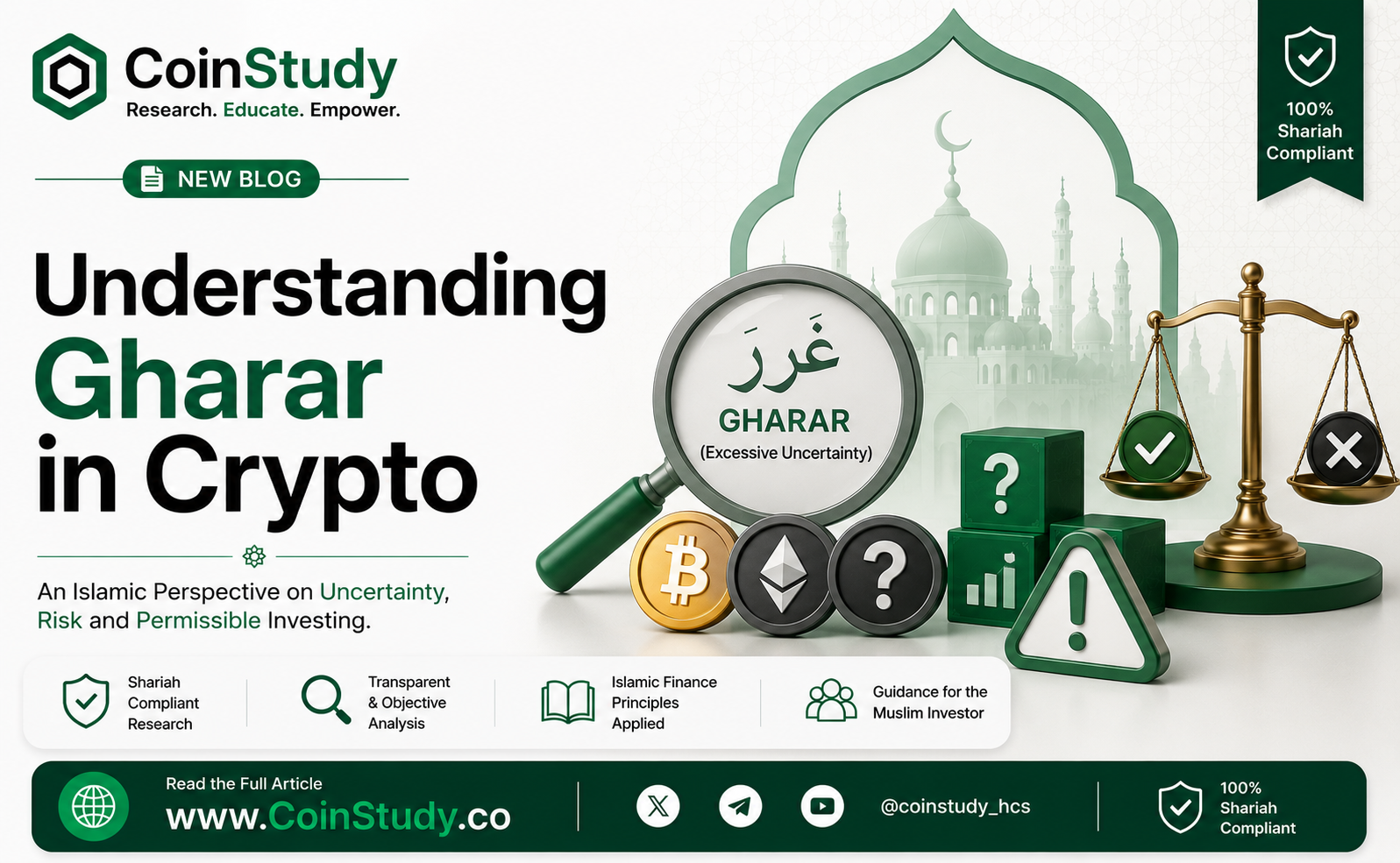
This question comes from one of the foundational principles of Islamic commercial law. Gharar, which translates approximately as uncertainty, ambiguity, or lack of clarity in a contract or transaction, is a concept that Islamic scholars have applied to commercial dealings for fourteen centuries. The Prophet specifically prohibited transactions characterized by Gharar. The Quran's prohibition on gambling is closely related because gambling is the most extreme form of financial uncertainty where one party's gain is another's loss through a mechanism of pure chance.
In 2026, as the global cryptocurrency market exceeds $3 trillion in total value and the number of digital assets reaches into the hundreds of thousands, the question of Gharar has never been more important or more complex for Muslim investors. Not because crypto is uniquely problematic compared to other investment categories, but because crypto contains an extraordinary diversity of projects ranging from those with almost no meaningful Gharar to those whose entire value proposition is built on manufactured uncertainty designed to benefit insiders at the expense of retail participants.
According to the Journal of Integrated Sciences March 2026 research on cryptocurrency and Islamic ethics, Gharar is used to describe the high degree of uncertainty which exists in all or part of a contractual agreement between parties, and this uncertainty creates issues with fairness, transparency, and predictability in contracts. According to research published in the Journal of Islamic Monetary Economics and Finance Volume 12 in 2026, cryptocurrencies' speculative volatility, absence of intrinsic value, and lack of transparency become major concerns under Shariah because Islamic law forbids gharar, maysir, and riba simultaneously.
CoinStudy has now analyzed over 100 cryptocurrency projects. The pattern across every analysis is consistent: Gharar is the most nuanced and the most frequently misunderstood of the three major Islamic finance prohibitions as applied to crypto. Riba is binary: either interest income is generated or it is not. Maysir is largely binary: either a gambling mechanism exists or it does not. Gharar operates on a spectrum and the scholar's task is to determine where on that spectrum a specific project falls.
This blog explains that spectrum precisely, gives Muslim investors the tools to assess Gharar in any crypto project independently, and shows how CoinStudy applies the Gharar principle across our analysis library.
Quick Verdict: Gharar Is Present in Crypto But Not Always Haram ⚠️
Gharar exists in cryptocurrency investments in various forms and degrees. This is not a reason for blanket avoidance. Islamic jurisprudence has always distinguished between the manageable uncertainty inherent in all commercial activity, which is permissible, and the excessive uncertainty that creates injustice, deception, or unfair advantage between parties, which is prohibited. The compliance question for any specific crypto project is not whether Gharar exists at all but whether the Gharar present is within the bounds that Islamic commercial ethics permits.
What Gharar Actually Means, The Classical Foundation
Gharar in its classical Arabic usage means danger, risk, or uncertainty. In Islamic commercial law it describes transactions where the outcome, the subject matter, or the terms are insufficiently defined to allow parties to make fully informed decisions about whether to enter the contract.
The classical scholars identified three specific conditions that must all be present for Gharar to make a transaction prohibited. The Gharar must be excessive rather than minor. It must be part of the contract's main subject matter rather than incidental. And it must cause one party an unjust disadvantage relative to the other.
These three conditions together explain why Islamic commercial law permits many activities that involve uncertainty while prohibiting others.
Buying agricultural produce before harvest involves uncertainty about the exact quantity and quality of the crop. But this Gharar is manageable: the parties understand roughly what they are trading, the uncertainty is within normal commercial bounds, and neither party is systematically advantaged by the uncertainty itself. The Salam contract, which permits forward purchase of agricultural commodities with full price payment upfront, is a classical example of how Islamic commercial law accommodates manageable uncertainty rather than prohibiting all forward transactions.
By contrast, the pre-Islamic practice of selling fish that have not yet been caught from the sea on an unspecified future date at an unspecified price creates Gharar that the Prophet specifically prohibited. The uncertainty is excessive, the subject matter is undefined, and the seller has a structural informational advantage over the buyer.
The distinction between these two cases is the entire Gharar analysis applied to any financial transaction including cryptocurrency.
The Five Forms of Gharar in Cryptocurrency - 2026 Analysis
Cryptocurrency markets in 2026 manifest Gharar in five specific forms that have become CoinStudy's analytical framework for the Gharar dimension of every HCS analysis.
Form 1 - Price Volatility Gharar
Price volatility is the most discussed form of Gharar in crypto and also the most frequently misapplied as a compliance argument.
Bitcoin has experienced price swings of over 80% in both directions within single calendar years. Most altcoins experience even more extreme volatility. This volatility creates genuine uncertainty for investors about the value of their holdings at any future point.
However classical Islamic scholars never required price certainty as a condition for permissible investment. All equity markets involve price risk. All commodity markets involve price volatility. A farmer who plants wheat faces crop price uncertainty. A merchant who buys goods to sell faces demand uncertainty. These are the normal risks of productive commercial activity that Islamic commercial ethics has always permitted.
The relevant Gharar question about price volatility is not whether prices fluctuate but whether the price formation mechanism is transparent and free from manipulation. A token whose price is manipulated through wash trading, coordinated pump-and-dump schemes, or information asymmetry where insiders know price-moving information that retail investors do not has Gharar from price manipulation that is specifically prohibited. A token whose price fluctuates based on genuine supply and demand in a transparent open market has the normal commercial price risk that Islamic commercial ethics permits.
CoinStudy's Gharar assessment distinguishes between these two forms of price uncertainty when scoring this dimension.
Form 2 - Project Uncertainty Gharar
Project uncertainty is the most compliance-determining form of Gharar for the majority of crypto investments. It encompasses four specific sub-categories.
Team anonymity creates Gharar because accountability requires knowing who is responsible for delivering on commitments. When a project's founders are anonymous, investors have no recourse if the team abandons the project, acts dishonestly, or fails to deliver on stated development promises. The Prophet's prohibition on transactions where the subject matter is uncertain applies directly: when you do not know who you are transacting with, you do not know whether the counterparty can fulfill their commitments.
CoinStudy's analysis of Ribbita by Virtuals at 38 out of 100 Haram scored 4 out of 15 on Gharar specifically because the stealth launch with no named team created total accountability uncertainty. CoinStudy's analysis of Dogwifhat at 29 out of 100 Haram scored 1 out of 15 on Gharar because the anonymous developer immediately exited all positions after launch, creating maximum accountability uncertainty. Contrast these with ENS at 91 out of 100 Halal which scores 13 out of 15 on Gharar because a named founder, publicly documented governance, and years of consistent development provide strong accountability anchors.
Unclear utility Gharar arises when a project's stated purpose is vague, aspirational, or unverifiable. When a token promises future utility that does not yet exist, the investment involves exactly the type of Gharar the Prophet identified in the fishing example: paying for something whose delivery is uncertain and whose quantity and quality are undefined. CoinStudy has consistently scored pure narrative tokens lower on Gharar than infrastructure tokens with demonstrated operational utility.
Roadmap uncertainty affects projects where development promises are not backed by verifiable progress. According to the Oxford Capital Markets Law Journal research, the use of cryptoassets as tokens to raise finance proves problematic when it involves future goods and services on the blockchain that do not exist at the time of the contract, exposing the transaction to Gharar. This concern applies directly to ICOs and token presales that promise future development without demonstrated capability to deliver.
Tokenomics uncertainty creates Gharar when the rules governing token supply, distribution, and value capture are unclear or subject to arbitrary change. When a project team can mint unlimited new tokens, change fee mechanisms without community approval, or alter reward structures unilaterally, investors face Gharar from the unknown future terms of their investment.
Form 3 - Smart Contract Risk Gharar
Smart contract risk is a form of Gharar specific to blockchain technology that has no classical Islamic jurisprudence precedent and requires fresh analytical engagement.
Smart contracts are programs that automatically execute financial transactions when specified conditions are met. They eliminate human intermediary discretion and execute automatically according to their code. This automation reduces Gharar in one dimension by removing human discretionary intervention from contract execution. But it introduces Gharar in another dimension through the risk of bugs, vulnerabilities, and unexpected behavior in the code.
According to Oxford University research, smart contract functionality creates a form of uncertainty that requires specific Islamic scholarly attention. A smart contract that contains an undetected vulnerability may behave in ways entirely different from what the parties understood when they entered the transaction. When users deposit funds into a DeFi protocol based on their understanding of how the smart contract works, and the smart contract contains a bug that causes those funds to behave differently than understood, the transaction involved Gharar that neither party could fully assess at the time.
CoinStudy addresses this form of Gharar through the Transparency and Governance dimension of the HCS score. Projects that have undergone comprehensive independent smart contract audits from reputable firms, that have published audit reports publicly, and that have demonstrated years of secure operation reduce the Gharar from smart contract risk through verifiable evidence. Projects with unaudited code or audit reports from unknown auditors have elevated smart contract Gharar.
Form 4 - Regulatory Uncertainty Gharar
Regulatory uncertainty is a form of Gharar that is partially external to any specific project but creates genuine uncertainty for investors about whether they can hold, use, and transact with assets they have purchased.
According to the Journal of Integrated Sciences 2026 research, countries like Pakistan demonstrate regulatory uncertainty where crypto was banned in 2018 but now indicates a possibility of reconsidering digital assets in light of remittances and financial inclusion. According to the same research, Bahrain is rapidly becoming one of the most forward-thinking regulators in the Muslim world with a regulatory sandbox for crypto.
For Muslim investors in markets with unclear or changing regulatory status, regulatory Gharar creates genuine uncertainty about the future permissibility and practical usability of crypto holdings. The SEC's classification framework updated March 2026, the GENIUS Act for stablecoins, and MiCA in Europe have all reduced regulatory Gharar for investors in their respective jurisdictions by creating clearer legal frameworks. In markets where regulation remains unclear or prohibitive, this form of Gharar remains elevated.
CoinStudy's Gharar assessment includes regulatory clarity as a component of the Transparency and Governance score. Assets with clear regulatory classification in major jurisdictions score higher than assets whose legal status remains contested.
Form 5 - Information Asymmetry Gharar
Information asymmetry Gharar is perhaps the most insidious form because it is designed rather than accidental.
When project insiders, early investors, or connected parties have access to material information about a project that ordinary investors do not have, the Gharar created is specifically prohibited because it creates an unjust advantage for one party over another. This is the structural unfairness that classical Gharar scholarship identified as the distinguishing feature of prohibited uncertainty: uncertainty that systematically benefits one party at the expense of another through information advantage.
In the crypto context, information asymmetry Gharar manifests through several specific mechanisms. Insider token allocations with short vesting periods allow project teams to sell tokens into markets where retail buyers do not know the extent of insider selling pressure. Undisclosed tokenomics changes that affect token value are announced only after insiders have repositioned. Wash trading creates false impressions of trading volume and liquidity that retail investors cannot distinguish from genuine activity.
CoinStudy's Tokenomics Fairness dimension specifically addresses information asymmetry by assessing whether insider allocations, vesting schedules, and distribution mechanisms create structural advantages for insiders over retail participants. High insider concentrations with short vesting periods that dump into retail markets create the information asymmetry Gharar that Islamic commercial law prohibits.
The Gharar Spectrum, From Permissible to Prohibited
Understanding Gharar requires understanding that it operates on a spectrum rather than as a binary condition. CoinStudy's HCS methodology operationalizes this spectrum in its Gharar scoring from 0 to 15.
Low Gharar - 12 to 15 out of 15:
Low Gharar projects have named teams with verifiable backgrounds and track records. They have published whitepapers with specific and verifiable technical claims. They have undergone multiple independent smart contract audits with published results. They have transparent tokenomics with clearly documented distribution. They have demonstrated operational utility at verifiable scale. They operate in jurisdictions with clear and favorable regulatory frameworks.
CoinStudy examples of low Gharar scores include ENS at 13 out of 15 Gharar, Band Protocol at 13 out of 15, and Bitcoin at 14 out of 15. These scores reflect the specific certainty anchors present in each project that allow investors to make informed decisions about what they are purchasing and from whom.
Moderate Gharar - 8 to 11 out of 15:
Moderate Gharar projects have some but not all of the low Gharar characteristics. They may have named teams but shorter track records. They may have genuine utility but in a newer and less proven category. They may have regulatory clarity in some jurisdictions but uncertainty in others. They may have audited smart contracts but with shorter operational histories than ideal.
CoinStudy classifies projects in this range as Halal With Concerns when other dimensions score sufficiently well. The moderate Gharar is acknowledged honestly in the analysis and reflected in the score. Muslim investors who engage with these projects should understand the specific uncertainty dimensions present and monitor for resolution over time.
High Gharar - 0 to 7 out of 15:
High Gharar projects have anonymous teams with no accountability mechanism. They have vague or nonexistent development documentation. They have no audited smart contracts or audits from unknown firms. They have opaque tokenomics with unclear insider positions. They have no demonstrated utility or verifiable operational activity. They may operate in regulatory gray areas or prohibited jurisdictions.
When High Gharar combines with low scores on other dimensions, the combined Layer 2 score falls into the Doubtful or Haram range even without specific red-line violations. CoinStudy's classifications of Ribbita by Virtuals at 38 out of 100, Dogwifhat at 29 out of 100, and Fartcoin at 28 out of 100 all reflect this pattern: no individual red-line violation but combined scores in the Haram range driven substantially by extreme Gharar.
The Critical Distinction, Gharar vs Maysir
Muslim investors frequently conflate Gharar and Maysir when evaluating crypto compliance. They are related but distinct concepts that require separate analysis.
Gharar is uncertainty about the known terms, parties, or outcomes of a transaction. A stealth-launched token with anonymous founders creates Gharar because you do not know who you are transacting with or whether the stated utility will materialize.
Maysir is intentional risk-taking designed to produce a zero-sum transfer of wealth between participants through a chance mechanism rather than through productive economic activity. Perpetual futures trading creates Maysir because you are betting on price direction and your gain comes directly from another trader's loss with no productive economic activity between you.
The distinction matters practically for two reasons.
First, some activities have high Gharar but low Maysir. An early-stage blockchain infrastructure project with genuine utility goals but incomplete documentation has high Gharar from the project uncertainty dimension but low Maysir because the economic model involves genuine service provision rather than zero-sum speculation. CoinStudy would assess this as Doubtful, acknowledging the Gharar concern while not triggering the Maysir red line.
Second, some activities have low Gharar but high Maysir. A well-documented and transparently operated perpetual futures platform like Hyperliquid has relatively low Gharar because the mechanism is clearly documented, the team is known, and the operations are transparent. But it has extreme Maysir because the mechanism is explicitly designed for leveraged zero-sum speculation. CoinStudy has assessed Hyperliquid as Haram primarily for Maysir rather than Gharar reasons.
Understanding this distinction allows Muslim investors to apply the right analytical framework to each compliance question rather than treating Gharar and Maysir as interchangeable concerns.
How AAOIFI Addresses Gharar in Financial Instruments
The Accounting and Auditing Organization for Islamic Financial Institutions provides additional scholarly framework for assessing Gharar in modern financial instruments that CoinStudy applies to crypto analysis.
AAOIFI Standard No. 21 on financial papers requires that financial instruments represent claims on genuinely defined assets or revenue streams. When a token represents a claim on a genuinely productive economic system with defined economic relationships, the Gharar from vague subject matter is reduced. When a token represents a claim on future utility that does not yet exist, the Gharar from undefined subject matter is elevated.
AAOIFI Standard No. 5 on guarantees requires that financial commitments be based on genuine and definable obligations by identifiable parties. Anonymous teams creating tokens with undefined obligations violate this standard directly because there is no identifiable party to hold accountable for the commitments the token represents.
AAOIFI Standard No. 12 on asset management requires that investment arrangements provide investors with sufficient information to make informed decisions. Information asymmetry that creates structural advantages for insiders over retail investors violates the AAOIFI principle that investors deserve transparency sufficient to make informed decisions.
According to the Oxford Capital Markets Law Journal research, the use of cryptoassets as tokens to raise finance has proved problematic because it involves future goods and services that do not exist at the time of the contract, which exposes the transaction to Gharar. This academic assessment from 2023 remains directly applicable to the majority of token launches in 2026 where future utility is promised but not yet demonstrated.
Real 2026 Examples, The Gharar Spectrum in CoinStudy's Library
The most practical way to understand how Gharar analysis works is through specific examples from CoinStudy's analysis library. These examples span the full spectrum from low to extreme Gharar.
ENS - 91 out of 100 Halal - Gharar 13 out of 15:
ENS has been operational since 2017 with a named founder, open-source code, multiple audits, and over 2 million registered .eth names confirming genuine adoption at documented scale. The subject matter of the investment is clearly defined: governance rights in a domain naming system that demonstrably works for real users. The team is identified and accountable. The utility is not promised but proven. This is about as low a Gharar profile as crypto provides.
Bitcoin Cash BCH - 91 out of 100 Halal - Gharar 12 out of 15:
A fork of Bitcoin with the same codebase, known development community, and clear stated purpose of enabling faster and cheaper everyday payments. The Gharar is low because the project's identity, purpose, and technical foundation are all well-documented and verifiable.
Starknet STRK - 79 out of 100 Halal With Concerns - Gharar 12 out of 15:
ZK-rollup infrastructure with StarkWare's institutional backing provides strong certainty anchors. The monthly token unlock schedule through March 2027 and the centralized sequencer pending decentralization are specific and documented uncertainties that reduce the score from the highest range without reaching high Gharar.
Trust Wallet Token TWT - 72 out of 100 Halal With Concerns - Gharar 12 out of 15:
The wallet's genuine utility and Binance's institutional backing provide certainty. The Layer 3 yield mechanism documentation gaps and the Ondo Finance integration timeline create specific documented uncertainties that reflect moderate Gharar.
Kaia KAIA - 68 out of 100 Halal With Concerns - Gharar 12 out of 15:
KakaoTalk and LINE's genuine distribution provides strong certainty for genuine adoption. The savings account yield mechanism not being specifically documented and the native stablecoin reserve structures pending disclosure create specific uncertainties.
Ribbita by Virtuals TIBBIR - 38 out of 100 Haram - Gharar 4 out of 15:
Stealth launch with no confirmed team, no whitepaper, no confirmed utility, no confirmed tokenomics, and an unconfirmed institutional association narrative providing the entire value proposition. This is the Gharar of a transaction where you do not know who you are transacting with, what you are purchasing, or whether any of the stated value propositions have substance. The score of 4 reflects only the public blockchain's on-chain transparency as the sole certainty anchor.
Dogwifhat WIF - 29 out of 100 Haram - Gharar 2 out of 15:
No named team, no whitepaper, no roadmap, the developer immediately exited, and the $700,000 Sphere Wif Hat community campaign was abandoned without delivering the promised outcome or providing refunds. The abandonment of the community campaign is a documented concrete example of what maximum accountability absence means for financial participants.
Fartcoin FARTCOIN - 28 out of 100 Haram - Gharar 1 out of 15:
Anonymous AI-suggested concept, anonymous human developer, immediate developer exit, no documentation, no development activity in nearly two years of operation. The Gharar is so total that the only certainty anchor is Solana's blockchain infrastructure.
How to Assess Gharar in Any Project Before You Invest
Muslim investors who want to independently assess Gharar before investing can apply CoinStudy's framework through six specific questions.
The first question is who is responsible for this project. Can you identify named individuals with verifiable backgrounds who are accountable for the project's development and governance? If the team is anonymous or the founders have immediately exited, maximum Gharar applies on this dimension.
The second question is what specifically does this project do and for whom. Can you describe in plain language what service the project provides, who pays for it, how they pay, and what they receive in return? Vague answers to this question indicate elevated Gharar from unclear subject matter.
The third question is whether the stated utility is operational or promised. Is there verifiable evidence that real users are using this project for its stated purpose? Impressions, transaction volume, and demonstrated adoption can be verified on-chain. Promised future utility cannot be verified and creates elevated Gharar.
The fourth question is whether the smart contract code has been independently audited. Has the code been reviewed by a reputable independent security firm? Has the audit report been published? Has the project demonstrated secure operation for sufficient time to validate the audit findings?
The fifth question is what the token distribution looks like. Do insiders, team members, and venture investors hold large concentrations of tokens with short vesting periods that create dump pressure into retail markets? Does the distribution structure create information asymmetry Gharar that disadvantages retail investors?
The sixth question is how regulatory clarity stands in your jurisdiction. Is the token's legal status clear in your country? Does your country's framework provide investor protections relevant to this type of digital asset? Regulatory Gharar is partly beyond a project's control but is part of the complete investment uncertainty assessment.
The Maqasid al-Shariah Dimension of Gharar
The prohibition on Gharar in Islamic commercial law is not arbitrary. It serves the five goals of Islamic law, the Maqasid al-Shariah, which scholars have identified as the preservation of religion, life, lineage, intellect, and wealth.
According to the Journal of Integrated Sciences 2026 research, the speculative use of cryptocurrencies goes against the five goals of Islamic law, particularly the protection of wealth known as Hifz al-Mal. The excessive Gharar in highly speculative crypto projects creates conditions where wealth is destroyed rather than protected, where the strong exploit the less informed, and where the productive economic activity that Islamic economics values is replaced by zero-sum transfers of existing wealth.
The wealth preservation goal of Maqasid al-Shariah explains why Islamic commercial law does not simply prohibit all uncertainty. Prohibiting all uncertainty would make commercial activity impossible. The goal is to protect wealth from the specific type of excessive uncertainty that enables exploitation, deception, and unjust enrichment at the expense of less-informed participants.
When CoinStudy scores a token's Gharar, it is ultimately asking a Maqasid al-Shariah question: does the uncertainty present in this project create conditions where wealth is likely to be destroyed through exploitation of the less informed, or does it represent the manageable commercial uncertainty that accompanies all genuine productive economic activity?
Gharar in 2026, What Has Changed and What Has Not
The forms of Gharar present in crypto markets in 2026 are the same forms that existed in 2021. What has changed is the sophistication with which they are packaged and the variety of contexts in which they appear.
The maturation of the regulatory environment has reduced regulatory Gharar in major markets. The SEC's March 2026 digital asset classification framework, the GENIUS Act for stablecoins, and MiCA in Europe have all provided clearer legal frameworks that reduce the regulatory uncertainty dimension for assets in their scope.
The maturation of the smart contract audit industry has reduced smart contract Gharar for projects that engage reputable auditors and publish their results. The growth of on-chain analytics has reduced information asymmetry Gharar by making token flows, insider selling, and wash trading more detectable.
What has not changed is the fundamental human tendency to launch projects with deliberately obscured information designed to attract investment before the limitations of the project become apparent. The stealth launches, the anonymous teams, the vague roadmaps, and the promised future utility that never materializes are as present in 2026 as they were in 2017. The technology for packaging them has improved. The underlying Gharar has not.
Practical Guidance for Muslim Investors
The practical guidance for Muslim investors navigating Gharar in crypto is specific and actionable.
Check CoinStudy's HCS score before investing. The Gharar dimension is explicitly scored in every analysis and the reasoning is documented in the analysis text. A project scoring below 10 out of 15 on Gharar has specific and documented uncertainty concerns that you should understand before investing.
Apply the six-question framework above to any project not yet in CoinStudy's library. The questions address the same dimensions that CoinStudy's analysts assess. Projects that produce clear, specific, and verifiable answers to all six questions have low Gharar. Projects that produce vague, unverifiable, or non-existent answers have high Gharar.
Distinguish between Gharar that resolves over time and Gharar that is structural. An early-stage infrastructure project with genuine utility goals and a named team has Gharar from the novelty of its category that may resolve as the project demonstrates adoption. An anonymous team with no whitepaper and no utility has structural Gharar that cannot resolve without fundamental changes to the project's identity.
Avoid investments where you cannot explain to a knowledgeable third party exactly what you are buying. If the investment thesis depends on narrative, sentiment, and the hope that others will pay more in the future, you are describing the speculative wealth transfer mechanism that creates both Gharar and Maysir simultaneously.
Consult a qualified Islamic scholar when facing genuinely novel compliance questions. The Gharar dimension of crypto compliance is the dimension most frequently requiring individual scholarly assessment because it depends on specific project characteristics that change over time and that affect individuals differently based on their knowledge, risk tolerance, and financial circumstances.
Final Verdict
Gharar is present in cryptocurrency investments in various forms and degrees. This is the honest assessment that every Muslim investor deserves to hear rather than a blanket assurance that crypto is halal or a blanket condemnation that it is haram.
The Islamic commercial law framework provides a sophisticated and precise tool for navigating this reality. Manageable Gharar from normal commercial uncertainty is acceptable and has been accepted by Islamic scholars across fourteen centuries of jurisprudence. Excessive Gharar that creates unjust advantage for one party over another through opacity, anonymous accountability, undefined subject matter, or deliberate information asymmetry is prohibited.
The difference between a Bitcoin that our Chairman has confirmed as permissible and a Fartcoin that scores 28 out of 100 Haram is precisely this difference. Both involve price uncertainty. The Gharar that separates them is the difference between a well-documented, transparently governed, demonstrated-utility monetary infrastructure and an anonymous, undocumented, explicitly purposeless humor token.
Muslim investors who understand the Gharar principle at this level of precision have a powerful analytical tool that does not require them to choose between blind acceptance and blanket avoidance. It requires them to ask the right questions, verify the answers independently, and invest in projects where the uncertainty present is the manageable uncertainty of genuine productive economic activity rather than the excessive uncertainty of opacity and exploitation.
Read detailed analysis and concepts here:
Is DeFi Halal?
Is ENS Halal?
Is USDT Halal?
Is Bitcoin Halal?
Is Fartcoin Halal?
Is Crypto Trading Halal?
Are Meme Coins Halal?
Real Risks of Haram Crypto
Disclaimer: This blog is provided for educational and research purposes only based on guidance from CoinStudy's HCS Shariah Board including Chairman Dr. Usman Quddus, PhD in Islamic Studies and Finance. The Gharar assessment framework described is the analytical approach CoinStudy applies in its HCS methodology. Individual project assessments require individual analysis. CoinStudy does not issue personal fatwas or financial advice. Please consult a qualified Islamic scholar for individual guidance.