

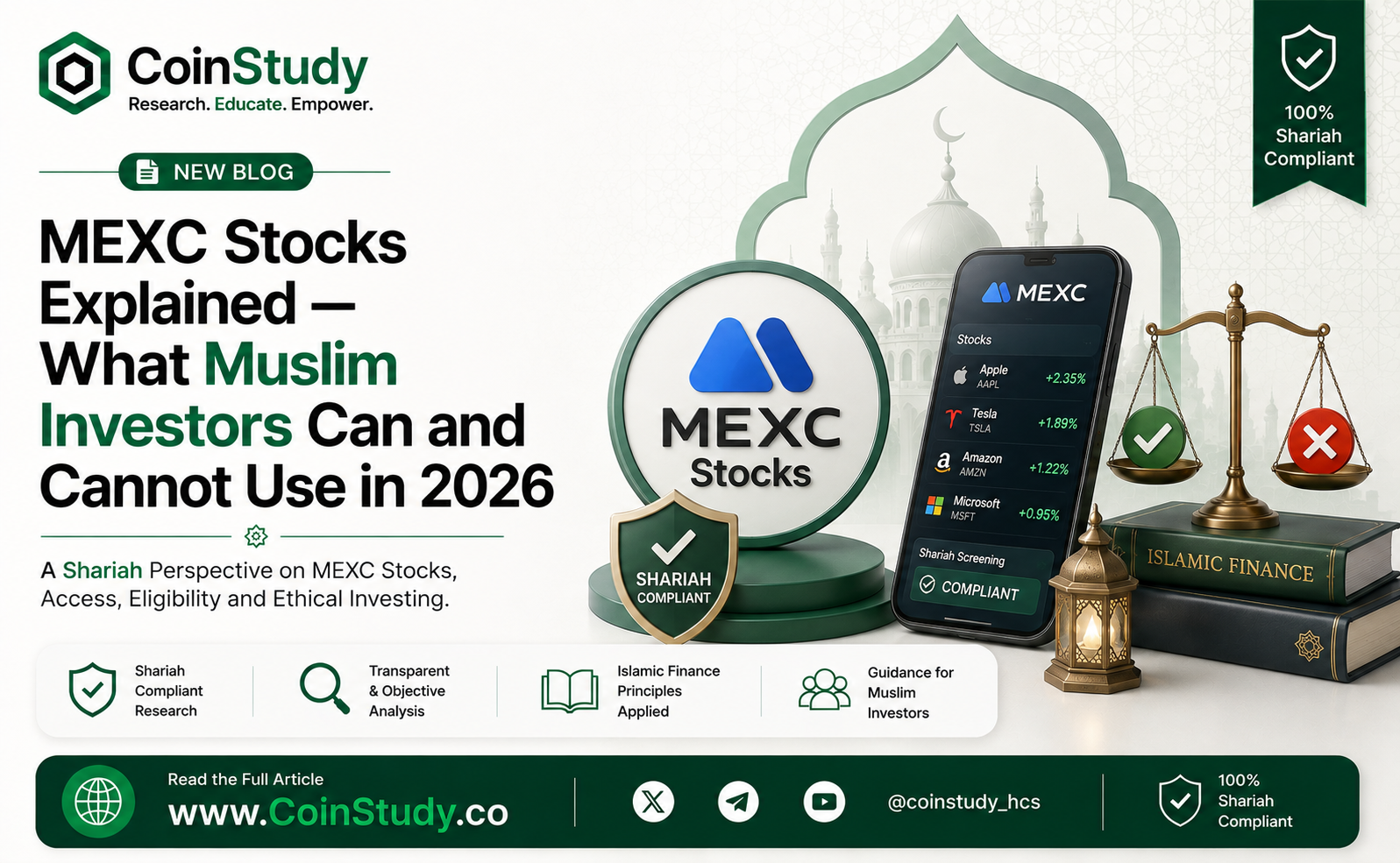
MEXC Stocks Explained — What Muslim Investors Can and Cannot Use in 2026
June 1, 2026 marked a turning point for crypto investors who also follow stock markets.
On that single day, multiple major cryptocurrency exchanges announced equity products simultaneously, not by coincidence, but as the direct result of the SEC's innovation exemption published in May 2026, which created a compliant pathway for crypto-native platforms to offer on-chain equity access without full broker-dealer registration. MEXC was among the first to respond with the launch of Real Stocks, adding genuine share ownership to a platform that already offered Stock Futures, Tokenized Stocks, and Pre-IPO products.
For the 2 billion Muslims globally who want to participate in global equity markets, MEXC's four stock product categories raise genuinely important and distinct Islamic finance questions. The answers are not the same for each product. Two of the four product categories are clearly compatible with halal investing when the right individual stocks are chosen. One is definitively prohibited. One requires specific individual assessment depending on the product structure selected.
This blog provides a complete, product-by-product Islamic finance analysis of every MEXC stock offering so Muslim investors can make informed decisions about which products they can use, which they must avoid, and exactly why the distinction matters.
The Four Products — What They Are and How They Differ
Before the Islamic finance analysis, every Muslim investor needs to understand what each product actually is. The four MEXC stock products are structurally different instruments with different ownership rights, different risk profiles, and different compliance profiles.
Real Stocks provides genuine ownership of real shares in actual companies. When you buy Apple through MEXC Real Stocks, you own real Apple shares held in custody by MEXC's partnered licensed broker. You receive applicable dividends or distributions. You have the beneficial ownership rights of a shareholder, not a derivative position or a token claim. According to the official MEXC product documentation, eligible users can buy and hold real shares across 7,000 plus stocks and ETFs, with participation starting from 5 USDT and weekly and monthly recurring investments supported.
Stock Futures are derivative contracts, not share ownership. When you trade Stock Futures on MEXC, you are opening a leveraged speculative position that tracks the price of an underlying stock without owning that stock. You can go long or short. You can use leverage up to 200x on selected contracts as of August 2026. You pay funding fees. Your position can be liquidated. As of August 2026, MEXC offers 300 plus Stock-related instruments including individual stocks, ETFs, and indices with USDT settlement across markets including the US, South Korea, Hong Kong, and Japan.
Tokenized Stocks are blockchain tokens that represent claims on underlying shares held by custodians. According to the official documentation, selected Ondo Tokenized Stocks are backed by corresponding securities held through regulated custodial brokers. MEXC added Ondo tokenized stock trading pairs to its spot markets starting March 2026, covering TSLAX, NVDAX, AAPLX, and others. The combined tokenized stock market reached a record $1.2 billion in late 2025. Tokenized Stocks do not provide direct ownership or voting rights in the underlying company.
Pre-IPO products come in two distinct forms that must not be confused. Pre-IPO Launchpad allows participation in or trading of market expectations around a company's pre-listing valuation through USDT-based products. Pre-IPO Futures are a separate derivative product with a different risk structure from Launchpad. According to official documentation, Pre-IPO products do not provide direct ownership of company shares, do not guarantee a listing, an allocation, or a return.
These four products serve different purposes, carry different risks, and most importantly for Muslim investors, have entirely different Islamic finance compliance profiles. Grouping them together as stock products would obscure the compliance distinctions that matter most.
Product 1 — RealStocks: Conditionally Permissible ✅⚠️
RealStocks is the most straightforwardly permissible of the four product categories for Muslim investors, and it is the product where CoinStudy's existing ruling from Chairman Dr. Usman Quddus directly applies.
When a Muslim investor buys shares in a company through RealStocks, they acquire genuine equity ownership in that company's productive economic activity. This is the same commercial relationship that Islamic jurisprudence has recognized as permissible for centuries: investing in a business enterprise, sharing in its profits and losses, and earning returns from the business's genuine productive economic activity rather than from interest charged on a loan.
The Chairman's ruling is direct and clear: business with halal company stocks is permissible. Owning equity in a halal company through RealStocks is the same commercial relationship as owning equity in any other form. The blockchain and USDT access mechanism do not change the underlying commercial nature of the transaction.
The Halal Stock Screening Requirement:
The key requirement for permissibility is that the specific company whose shares you are purchasing must pass AAOIFI Standard No. 21 screening for halal company equity. Not every company in MEXC's 7,000 plus stock universe is halal. The four screening tests that CoinStudy applies under AAOIFI Standard 21 are:
Debt must be below 30% of total market capitalization. When a company's debt exceeds this threshold the interest burden it carries is too significant for the investment to be considered genuinely free of Riba exposure.
Haram revenue must be below 5% of total revenue. Companies that derive more than 5% of their income from alcohol, gambling, conventional banking interest, tobacco, weapons manufacturing, or other prohibited industries fail this screen.
Interest income must be below 30% of total revenue. Companies that earn significant portions of their income from lending money at interest fail this screen regardless of their primary business activity.
Accounts receivable must be below 45% of total assets. This test addresses the concern about companies that are primarily financial intermediaries rather than genuine producers of goods and services.
Companies that CoinStudy has individually screened and confirmed as halal-classified include Apple, Amazon, NVIDIA, and Google. CoinStudy's complete equity screening analysis is available in our dedicated stock screening section.
Companies that fail halal screening include major conventional banks such as JPMorgan Chase, Bank of America, and Goldman Sachs, whose primary business is interest-based financial intermediation. Alcohol companies, gambling companies, tobacco companies, and defense contractors whose primary business is weapons manufacturing also fail halal screening.
The zero-fee structure for eligible RealStocks products removes the concern about paying excessive fees that might constitute unjust financial extraction. The 5 USDT minimum entry and recurring investment options enable genuinely fractional participation that makes halal equity investing accessible to Muslim investors who could not previously afford full shares in high-priced stocks.
The Dividend Question:
RealStocks provides applicable dividends or distributions to eligible holders. Dividends from halal companies represent a share of genuine business profits and are permissible income under Islamic commercial law. Dividends are specifically different from interest: they are a share of what the company actually earned from productive economic activity rather than a predetermined percentage return on a loan. Receiving dividends from a halal company through RealStocks is permissible.
Practical Guidance:
Use RealStocks for long-term ownership of individually halal-screened company stocks. Verify each company's halal status through CoinStudy's stock screening section or an AAOIFI-compliant screening service before purchasing. Avoid buying index ETFs through RealStocks unless the specific ETF has been comprehensively screened for its constituent companies, since index ETFs bundle many companies including conventional banks and other companies that fail halal screening. The dividend income from halal companies is permissible. Do not use leverage with RealStocks for any purpose.
Product 2 — Stock Futures: Definitively Haram ❌
Stock Futures on MEXC are definitively Haram under CoinStudy's Halal Crypto Standard and under the broader Islamic finance principles that CoinStudy's Chairman Dr. Usman Quddus has ruled upon across multiple analyses.
The ruling is direct and applies consistently to every stock futures product regardless of the underlying stock's own halal status. A futures contract on Apple stock is prohibited even though Apple stock itself is halal-classified. The prohibition is on the futures contract mechanism, not on the underlying company.
Why Stock Futures Are Haram:
Stock Futures are leveraged derivative contracts that allow traders to speculate on the price movement of underlying stocks without owning those stocks. The Islamic finance analysis identifies three independent compliance failures.
The first failure is leverage as a mechanism for speculative magnification. Stock Futures support leverage up to 200x on selected contracts as of August 2026. At 200x leverage, a 0.5% adverse price movement eliminates the entire position. This is not genuine investment in a company's productive economic activity. It is speculative wagering on short-term price movements with borrowed capital. The Chairman has consistently ruled across multiple analyses including Hyperliquid, EdgeX, Injective, and Raydium that leveraged speculative positions resembling gambling are prohibited under the Maysir principle regardless of the underlying asset.
The second failure is the funding fee mechanism. Futures positions that are held overnight accrue funding fees, which are periodic payments between long and short position holders based on the difference between the futures price and the spot price. These funding fees constitute guaranteed periodic transfers on outstanding leveraged positions that resemble interest on borrowed capital. They are assessed as Riba al-Nasiah-adjacent regardless of whether they are labeled as interest, funding fees, or financing costs.
The third failure is the short selling mechanism. Stock Futures allow traders to go short, profiting when a company's stock price falls. Short selling in futures contexts involves borrowing assets that the seller does not own and selling them with the obligation to return them later. Classical Islamic commercial law requires that a seller own the asset being sold at the time of sale. Selling something you do not own is specifically prohibited under the principle of la tabi' ma laysa 'indak, do not sell what you do not have.
The 200x Leverage Context:
The 200x leverage specifically available on selected MEXC Stock Futures contracts is among the highest leverage ratios in any financial product anywhere in the world. The Chairman's specific ruling on leverage in the prop firm forex challenge analysis was unambiguous: leverage transforms technical trading into speculative trading resembling Maysir, and an open justification for it cannot be given. At 200x leverage this prohibition applies with absolute certainty.
Practical Guidance:
Do not use MEXC Stock Futures under any circumstances. No modification of trading strategy, no selection of halal underlying companies, no swap-free account, and no position management approach makes Stock Futures permissible. The leverage mechanism, the funding fee structure, and the short selling mechanism each independently trigger a Haram classification. All three triggering simultaneously makes this the clearest prohibition in the entire MEXC stock product analysis.
Product 3 — Tokenized Stocks: Conditionally Permissible With Careful Screening ✅⚠️
Tokenized Stocks occupy a similar compliance position to RealStocks: the specific company underlying each token determines whether that specific product is permissible or prohibited. The Chairman's ruling that business with halal company stocks is permissible applies to tokenized versions of those stocks when the token represents a genuine claim on the underlying share held by a regulated custodian.
What Tokenized Stocks Actually Are:
MEXC offers 200 plus Tokenized Stock products through its spot market with USDT settlement. According to the official product documentation, selected Ondo Tokenized Stocks are backed by corresponding securities held through regulated custodial brokers. The token represents a claim on a real share held in institutional custody rather than being an algorithmic synthetic position with no real underlying asset.
According to available research, Ondo Finance received regulatory approval to distribute tokenized US stocks and ETFs across the European Economic Area and has generated over $11 billion in cumulative trading volume with more than $550 million in total value locked. The institutional infrastructure behind the Ondo products provides genuine asset backing verification.
The Critical Distinction From Synthetic Products:
Tokenized Stocks backed by genuine underlying shares held by regulated custodians are fundamentally different from synthetic stock derivatives that track price without real asset backing. The compliance of tokenized stocks depends critically on this distinction. MEXC's Ondo-backed products represent genuine claims on real shares in institutional custody, which is different from a purely algorithmic synthetic position.
This matters for Islamic finance because genuine ownership of a claim on a real underlying asset is assessed differently from a derivative position that merely tracks price. A tokenized share representing a genuine claim on a real Apple share held by a custodian is closer to genuine equity ownership than to a speculative derivative. Tokenized Stocks do not provide direct ownership or voting rights, but they do provide genuine economic exposure to the underlying company through custodian-held real shares.
The Individual Company Screening Requirement:
The same AAOIFI Standard 21 screening requirement that applies to RealStocks applies equally to Tokenized Stocks. Buying AAPLX on MEXC is conditionally permissible if Apple passes halal screening. Buying SPCXX representing the S&P 500 index is not permissible because the index bundles hundreds of companies including conventional banks and other companies that fail halal screening, and the index cannot be comprehensively screened for AAOIFI compliance.
According to available research on tokenized equities, the infrastructure is better than the crypto average and disclosure is genuinely strong, but the platform tokenizes compliant and non-compliant equities side by side with no screening layer. The screening burden sits entirely with the investor. This is the honest summary: the products that represent halal companies are conditionally permissible, and the products that represent haram companies are prohibited regardless of the tokenization mechanism.
Products to Specifically Avoid:
SGOVx and any tokenized ETF representing US Treasury bills or bond portfolios are definitively Haram regardless of the sophisticated token engineering around them. The underlying asset is an interest-bearing government bond. Tokenizing it does not change what it is. The same ruling that makes USDT Haram for T-Bill backed reserves makes any tokenized T-Bill product Haram.
Products representing conventional banking companies, alcohol companies, or other companies that fail AAOIFI screening are Haram regardless of the tokenized format.
Extended Trading Hours:
Selected Tokenized Stock products provide access outside regular US market hours. The extended trading hours through blockchain infrastructure are a feature of the tokenization mechanism rather than a compliance concern. Buying a halal company's tokenized stock outside regular market hours is the same compliance position as buying it during regular hours.
Practical Guidance:
Use MEXC Tokenized Stocks only for individually halal-screened company tokens. Apply the same AAOIFI Standard 21 four-screen test to each specific company before purchasing. Avoid all index tokenized products unless they have been comprehensively screened for every constituent company. Avoid all T-Bill and bond ETF tokenized products. Hold tokenized stocks as genuine equity exposure rather than as speculative trading instruments.
Product 4 — Pre-IPO Products: Split Assessment ⚠️❌
Pre-IPO products at MEXC come in two structurally different forms that the official documentation specifically instructs users to distinguish. The compliance assessment is different for each.
Pre-IPO Launchpad — Doubtful ⚠️
Pre-IPO Launchpad allows participation in pre-listing opportunities through USDT-based products. The specific compliance questions for Pre-IPO Launchpad depend on the exact product structure. If the Launchpad provides genuine rights to future shares in a company that will eventually list publicly, and the company itself is halal-classified, the structure resembles a forward contract for equity ownership that requires specific scholarly analysis.
Classical Islamic commercial law addresses forward contracts for permissible goods. The Salam contract, which is a recognized permissible forward contract in Islamic jurisprudence, requires that the good being sold be deliverable at a specified future date, the price be paid in full upfront, and the quantity and quality of the good be specified at the time of contract. If Pre-IPO Launchpad products meet these requirements, a specific scholarly ruling on the specific product could potentially find permissibility for halal company pre-IPO participation.
However the official documentation states that Pre-IPO products do not provide direct ownership of company shares, do not guarantee a listing, an allocation, or a return. This disclosure of uncertain delivery, uncertain allocation, and no guarantee of the fundamental promised outcome creates Gharar concerns that make these products at minimum Doubtful under CoinStudy's framework. Without a specific formal ruling from our Chairman on the specific Launchpad product structure, Muslim investors should treat Pre-IPO Launchpad as Doubtful and exercise maximum caution.
Pre-IPO Futures — Definitively Haram ❌
Pre-IPO Futures are a separate derivative product from Launchpad with a different risk structure. The word Futures in the product name describes exactly what this product is: a derivatives contract on pre-listing company valuations. The same analysis that makes Stock Futures Haram applies here with additional Gharar concerns specific to pre-listing companies.
Pre-IPO Futures combine the prohibited mechanics of derivatives trading, leverage, short selling, and funding fees, with extreme Gharar about the underlying valuation of a private company that has not yet listed. The uncertainty about whether the company will list at all, at what valuation, at what timeline, and whether the derivative contract's pricing reflects genuine fundamental value creates multiple simultaneous compliance failures.
The Chairman's ruling that leveraged derivative trading resembles Maysir applies to Pre-IPO Futures with the same force as to Stock Futures. The additional Gharar layer from pre-listing uncertainty makes this product more problematic rather than less.
Practical Guidance:
Treat Pre-IPO Launchpad as Doubtful and seek a specific scholarly ruling before any participation. Never use Pre-IPO Futures under any circumstances. The derivative structure, leverage mechanism, and extreme pre-listing Gharar combine to make this a clearly prohibited product.
The Complete Compliance Summary
Every Muslim investor using MEXC's stock products needs a clear and practical guide to what they can and cannot do. Here is the complete framework:
Permissible activities on MEXC stocks:
Buying and holding individual halal-screened company shares through RealStocks is permissible when each company passes AAOIFI Standard 21 four-screen test. Receiving dividends from halal company RealStocks is permissible income from genuine business profits. Buying individually halal-screened Tokenized Stocks through the spot market is conditionally permissible. Using USDT for genuine equity purchase through RealStocks or Tokenized Stocks is permissible under the Chairman's conditional permissibility framework for T-Bill backed stablecoins used as mediums of exchange for permissible transactions.
Prohibited activities on MEXC stocks:
Using Stock Futures in any form regardless of the underlying company's halal status. Using leverage for any stock-related trading purpose. Short selling stocks through any product mechanism. Using Pre-IPO Futures for any speculative or hedging purpose. Buying index ETFs through any product without comprehensive constituent screening. Buying Tokenized T-Bill products such as SGOVx or any bond ETF token. Buying any stock of a company that fails AAOIFI Standard 21 screening regardless of the product format.
Activities requiring individual assessment and caution:
Pre-IPO Launchpad participation requires specific product structure review and ideally a formal scholarly ruling before any participation. Using the recurring investment feature for halal company RealStocks requires verifying that the recurring purchase mechanism does not involve any interest-bearing credit or margin component.
The Critical Infrastructure vs Product Distinction
One clarification is essential for Muslim investors who might assume that because MEXC is a cryptocurrency exchange its stock products are somehow assessed differently from conventional brokerage products.
CoinStudy's compliance framework assesses the economic substance of a financial product rather than the platform delivering it. A Stock Futures contract with 200x leverage is assessed identically whether it is offered by MEXC, Binance, a conventional broker, or any other platform. The leverage, funding fee, and short selling mechanisms are prohibited regardless of the platform delivering them.
Conversely, genuine equity ownership in a halal company through RealStocks is permissible regardless of whether the delivery mechanism is a conventional broker, a crypto exchange, or any other regulated platform. The genuine ownership of the halal company's productive economic activity is what makes it permissible, and that genuine ownership exists regardless of the delivery mechanism.
The platform is neutral infrastructure. The product determines the compliance. This is the same principle CoinStudy applies consistently across every blockchain analysis.
Using Different Products for Different Purposes — The Permissible Strategy
For Muslim investors who want to use MEXC's permissible stock products strategically, the two permissible products serve different purposes.
RealStocks serves the genuine long-term ownership purpose. When a Muslim investor believes in a company's long-term productive potential and wants genuine ownership with dividend rights and real share ownership, RealStocks provides this at accessible minimum entry of 5 USDT with recurring investment options. This is the closest digital equivalent to opening a conventional brokerage account, but with USDT access and no mandatory currency conversion process.
Tokenized Stocks serve the blockchain-native equity access purpose. When a Muslim investor wants exposure to a halal company's equity through USDT on the spot market with blockchain-native settlement and extended trading hours, Tokenized Stocks of halal companies provide this access with the fractional participation that tokenization enables.
Neither product serves speculative short-term trading purposes in an Islamic finance-compliant way. The absence of a permissible speculative trading product is not a gap to fill by using Stock Futures. It is a reflection of the Islamic commercial ethics principle that productive investment in genuine business enterprises is encouraged while speculative wealth transfer through leveraged derivatives is prohibited.
MEXC vs Traditional Brokerage — The Halal Investor Comparison
Muslim investors in markets like Nigeria, Pakistan, Indonesia, and Bangladesh often face significant practical barriers to conventional brokerage access for US stocks. Currency conversion requirements, minimum account sizes, geographic restrictions, and complex account opening processes have historically excluded many Muslim investors from halal global equity investing.
MEXC's RealStocks and Tokenized Stocks reduce several of these barriers while maintaining genuine equity ownership rights. The 5 USDT minimum for RealStocks is accessible to a far wider range of Muslim investors than the minimum requirements of most conventional brokerages. The USDT access mechanism eliminates the currency conversion barrier for investors already holding USDT from other crypto activities.
However Muslim investors who already hold USDT should remember that USDT itself is Haram-classified for its T-Bill backed reserve structure. Using USDT as a medium of exchange to purchase a halal company's stock falls under the Chairman's conditional permissibility for T-Bill backed stablecoins used as mediums of exchange for permissible transactions rather than as yield-bearing instruments. The purchase of the halal stock is the permissible transaction and USDT is the settlement medium.
The zero-fee structure for eligible RealStocks products is a practical advantage for Muslim investors who want to build halal equity positions through regular small purchases. Eliminating transaction fees removes a commercial friction that does not add genuine economic value to the transaction.
Building a Halal Portfolio on MEXC — The Practical Framework
A Muslim investor who wants to use MEXC's permissible stock products practically needs a clear decision framework.
The first step is halal company identification. Before using any MEXC stock product, identify the specific companies you want to invest in and verify their halal status through CoinStudy's stock screening section or an AAOIFI Standard 21 compliant screening service. This list becomes your personal halal investment universe on MEXC.
The second step is product selection. Use RealStocks for companies where you want genuine share ownership with dividend rights and long-term holding. Use Tokenized Stocks for the same companies when the blockchain-native settlement and extended hours features suit your needs better. Never use Stock Futures or Pre-IPO Futures for any purpose.
The third step is position management. Manage your positions in halal company stocks as genuine long-term equity investments rather than short-term trading instruments. The Islamic commercial ethics emphasis on genuine business investment over speculation applies equally to MEXC RealStocks as to any other equity investment.
The fourth step is dividend purification if needed. If any dividend received from a halal company contains a minor portion derived from incidental impermissible activity below the 5% threshold, classical scholars recommend purifying that proportion through charity. The specific purification amount depends on the company's disclosed impermissible income percentage.
Final Verdict — The Complete Ruling by Product
RealStocks: Conditionally Permissible for individually halal-screened companies. The genuine equity ownership structure, dividend rights, and no-leverage design make this the most straightforwardly permissible MEXC stock product for Muslim investors. Apply AAOIFI Standard 21 screening to every company before purchasing.
Stock Futures: Definitively Haram regardless of the underlying company's halal status. Leverage up to 200x, funding fees resembling Riba, and short selling violating the la tabi' principle combine to make this product prohibited under three independent Islamic commercial law grounds.
Tokenized Stocks: Conditionally Permissible for individually halal-screened company tokens backed by genuine underlying shares in regulated custody. Apply the same AAOIFI Standard 21 screening as RealStocks. Avoid all index tokens, T-Bill tokens, and bond ETF tokens.
Pre-IPO Launchpad: Doubtful, approaching impermissible given the Gharar from uncertain delivery, allocation, and listing outcome. Seek a specific formal scholarly ruling before any participation.
Pre-IPO Futures: Definitively Haram as leveraged derivatives on pre-listing company valuations combining multiple prohibited mechanisms with extreme Gharar.
Read detail analysis and concepts here:
Is Bitcoin Halal?
Is Raydium Halal?
Is USDT Halal?
Is RWA Crypto Halal?
Is USDC Halal?
Are Tokenized Stocks Halal?
Is Crypto Trading Halal?
Is Crypto Staking Halal?
Disclaimer: This blog is provided for educational and research purposes only based on guidance from CoinStudy's HCS Shariah Board including Chairman Dr. Usman Quddus, PhD in Islamic Studies and Finance. The compliance of specific stocks requires individual AAOIFI Standard 21 screening. MEXC product features, fee structures, and availability are subject to change and jurisdiction-specific restrictions. CoinStudy does not issue personal fatwas or financial advice. Please consult a qualified Islamic scholar for individual guidance.