

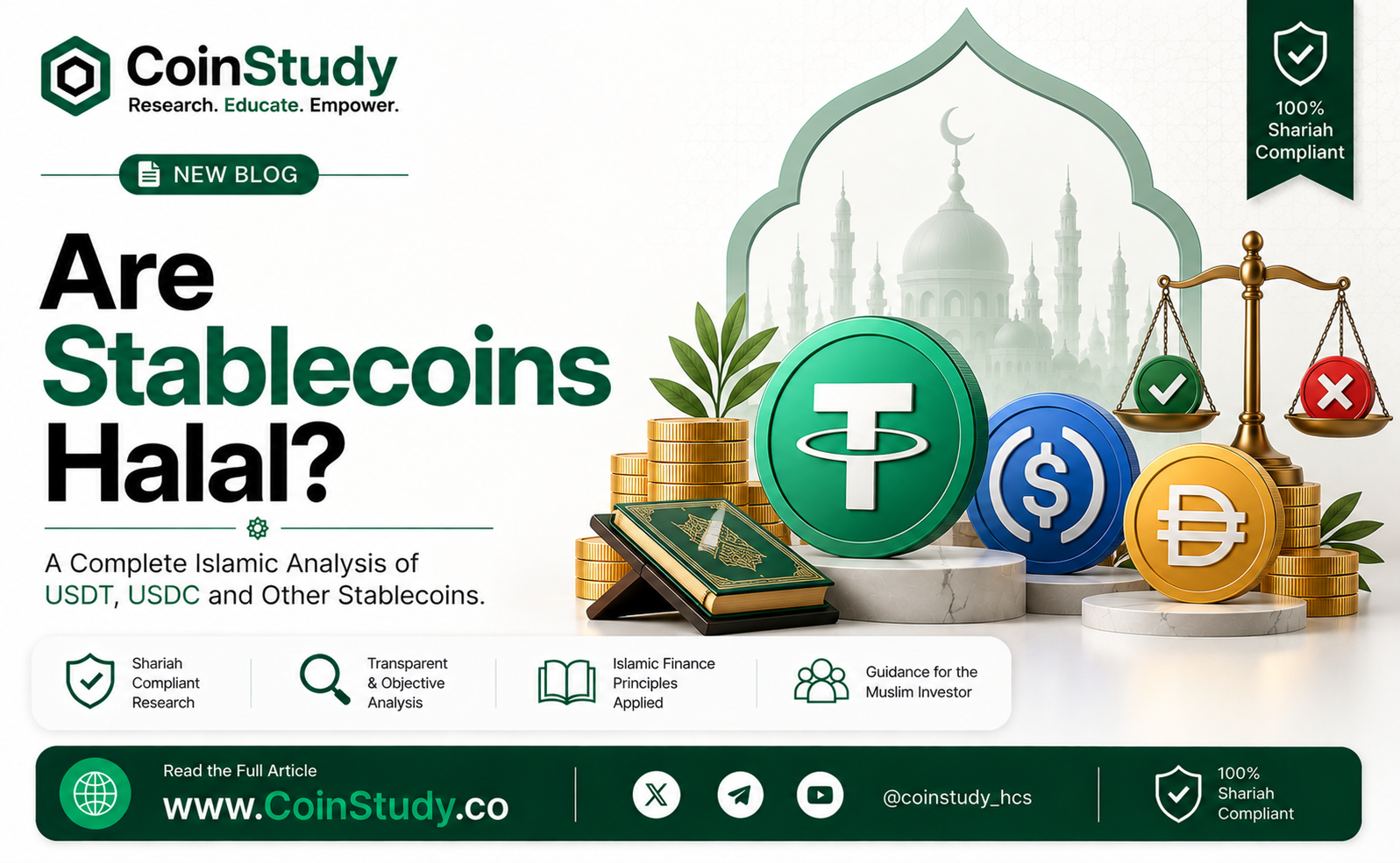
Are Stablecoins Halal? A Complete Islamic Finance Guide for Muslim Investors in 2026
The question sounds simple. A stablecoin is pegged to the dollar. It does not go up or down like Bitcoin. It just sits at $1. What could possibly be the problem?
The answer, once you understand how stablecoins actually work, is more complex than either their proponents or their critics typically acknowledge. Some stablecoins raise serious Riba concerns because of how their reserves are invested. Others function as payment instruments with no prohibited element at the mechanism level. Still others are backed by entirely different structures, some involving crypto collateral, some involving algorithmic mechanisms, and some blending multiple approaches in ways that require entirely different Islamic finance analyses.
This blog is CoinStudy's complete guide to the stablecoin question in 2026. We work through the main stablecoin types, explain the specific Islamic finance questions each one raises, and provide practical guidance for Muslim investors navigating this landscape.
Why the Stablecoin Question Matters in 2026
Stablecoins are no longer niche instruments. As of October 2026, the total stablecoin market is estimated at approximately $306 billion according to DefiLlama stablecoin market data, a figure that changes with market conditions and should be taken as an order-of-magnitude indicator rather than a precise fixed number. USDC has approximately $73 billion in circulation per CoinMarketCap research. USDT has approximately $184 billion in circulation according to available market data. DAI, PYUSD, USDS, and dozens of others collectively represent hundreds of billions of dollars in on-chain dollar liquidity.
Every Muslim investor who interacts with crypto will encounter stablecoins. They are used as the settlement currency on exchanges. They are the primary instrument in DeFi lending and liquidity protocols. They are a default medium for cross-border remittances on-chain. They are how people hold value between volatile positions without fully exiting crypto markets. They are how businesses receive and pay on-chain.
The question of whether stablecoins are halal is therefore not an academic exercise. It is a practical question that Muslim investors face every day, and the answer depends on which stablecoin, how it works, and what the individual investor is doing with it.
The Islamic Finance Framework for Evaluating Stablecoins
Before examining specific types, it helps to establish the analytical framework Islamic scholars and researchers apply to stablecoins.
The first question is always about the underlying structure: what is actually backing this token's value, and does that backing involve prohibited elements? For fiat-backed stablecoins, this means asking what the reserves are invested in, because the token's stability depends on those reserves. For crypto-backed stablecoins, it means asking how the collateral functions and whether yield is generated in prohibited ways. For algorithmic stablecoins, it means understanding the mechanism that maintains the peg and whether that mechanism contains prohibited elements.
The second question is about the legal and economic character of the token itself. Is the token a debt claim on an issuer? Is it a property right? Is it analogous to digital cash? The answer matters because Islamic commercial law treats debt claims, property ownership, and cash differently. A token that represents a debt claim on an interest-earning institution raises different questions from a token that represents fractional ownership of a commodity.
The third question is about the specific use the investor is making of the stablecoin. Holding a stablecoin in a portfolio is analytically different from using it to transfer a payment for halal goods. Depositing a stablecoin into a DeFi lending protocol to earn yield is analytically different from holding it in a wallet as idle digital cash. The same stablecoin in different contexts can raise different compliance questions.
CoinStudy's HCS methodology evaluates stablecoins primarily through the Ecosystem Riba Exposure red-line check, which asks whether the token's native economic architecture is built on an interest-bearing reserve or revenue model. This is the most important single check because it is the most commonly triggered concern in the stablecoin space.
Type One: Fiat-Backed Stablecoins
Fiat-backed stablecoins are the most common type and the ones most Muslim investors encounter first. USDC and USDT are the dominant examples. The basic premise is straightforward: for every stablecoin token in circulation, the issuer holds reserve assets designed to support the tokens in circulation at par value. USDC is issued by Circle Internet Financial, LLC and its affiliate Circle Internet Financial Europe SAS, subsidiaries of Circle Internet Group, Inc. Many holders access USDC through exchanges or intermediaries rather than through direct redemption: direct redemption through Circle is subject to Circle Mint eligibility and account requirements rather than being universally available to all token holders.
The Islamic finance concern with fiat-backed stablecoins is not the concept of a peg, nor the existence of a digital dollar, nor the fact that the token exists on a blockchain. The concern is what the issuing company does with the dollars it holds in reserve.
In 2026, major fiat-backed stablecoin issuers hold their reserves primarily in US Treasury bills, Treasury repurchase agreements, and similar short-term government instruments. These are interest-bearing instruments by design. The documented fact, per Circle's official Q2 2026 financial highlights, is that Circle reported approximately $668 million in reserve income in Q2 2026, representing approximately 95% of its $701 million in total revenue and reserve income, with $73.3 billion in USDC circulation at quarter-end. This is Circle-specific evidence. CoinStudy applies issuer-specific evidence rather than assuming identical reserve compositions across all fiat-backed stablecoins, because each issuer must be examined on its own documented figures.
For USDC, Deloitte-attested reserve data as of August 31, 2026 shows approximately 67.6% in Treasury repurchase agreements, approximately 18.0% in US Treasury securities, and approximately 14.4% in cash and settlement adjustments, representing approximately 85.6% of the total reserve in interest-linked instruments. For the specific reserve composition evidence supporting CoinStudy's USDT classification, readers should consult CoinStudy's dedicated USDT analysis. The two issuers have different reserve compositions and transparency levels and must be assessed on their own documented figures separately.
CoinStudy's methodological rule is that material interest-linked reserve exposure of this kind triggers the Ecosystem Riba Exposure red line. CoinStudy's framework-based conclusion is that both USDC and USDT are classified as Haram under HCS on this basis, each based on their own documented reserve evidence.
It is important to understand what this classification does and does not mean. It represents CoinStudy's framework-based conclusion applying its structural-exposure rule rather than an undisputed legal or scholarly determination. The question of whether a token holder's indirect relationship with an interest-earning reserve constitutes prohibited participation is genuinely contested within Islamic finance scholarship. Scholars who take the permissibility position argue that since stablecoin holders receive no interest themselves, the Riba concern belongs to the issuer's business model rather than to the holder's transaction. CoinStudy's methodology takes the structural-exposure position. Muslim investors should seek individual scholarly guidance.
The GENIUS Act: What It Does and Does Not Require
The Guiding and Establishing National Innovation for US Stablecoins Act, known as the GENIUS Act, was enacted in July 2025 with an expected effective date of January 18, 2027, or earlier if specified final regulations trigger it sooner.
The Act establishes a federal regulatory framework for payment stablecoin issuers and specifies eligible reserve assets. These include cash, demand deposits at insured banks, and short-maturity US Treasury securities and qualifying overnight repurchase agreements. Critically, the Act does not require every reserve dollar to earn interest. Cash and demand deposits, which may earn little or no interest depending on the account structure, are also eligible reserve assets under the Act.
CoinStudy's concern with regulated fiat-backed stablecoins therefore arises from the actual documented reserve choices that major issuers make, not from a claim that the law forces interest-bearing reserves on every issuer. Circle's disclosed reserve data, showing approximately 85.6% of the USDC reserve in interest-linked instruments as of August 31, 2026, reflects Circle's management approach rather than a legal inevitability imposed by the GENIUS Act alone.
This distinction matters for Muslim investors evaluating future stablecoins that may seek GENIUS Act compliance. A GENIUS Act-compliant stablecoin that held most of its reserves in non-interest-bearing demand deposits would have a different compliance profile under CoinStudy's HCS methodology than one holding most of its reserves in Treasury bills and repos. The Act establishes a list of permitted reserve types; which ones a specific issuer uses is a management decision that requires issuer-specific analysis.
Type Two: Crypto-Backed Stablecoins
Crypto-backed stablecoins take a fundamentally different approach. Instead of holding fiat currency or government bonds in reserve, these stablecoins require users to lock up cryptocurrency as collateral that typically exceeds the value of the stablecoins issued, maintaining the peg through over-collateralization. DAI, issued by the MakerDAO protocol, is the most established and widely known example.
The Islamic finance analysis of crypto-backed stablecoins is genuinely different from the analysis of fiat-backed ones, and the specific findings depend heavily on each individual protocol's design. DAI in particular is a multi-collateral stablecoin whose collateral mix includes crypto assets and real-world assets alongside its overcollateralized vault mechanism. Its specific borrowing fees and yield mechanisms must be examined independently rather than treated as a simple example of pure crypto collateral backing.
The general mechanism of a crypto-backed stablecoin works as follows. A user deposits cryptocurrency into a smart contract vault. The protocol allows them to borrow a stablecoin up to a certain percentage of their deposited collateral's value. If the collateral falls below the required ratio, the protocol liquidates enough of it to maintain the system's stability. Understanding whether this structure involves prohibited elements requires examining three specific questions for each protocol: does the borrowing arrangement involve a fee or rate that functions economically as interest on the borrowed funds? Does any savings or yield mechanism pay returns to stablecoin holders in a way that functions as interest? And does the collateral itself consist of assets whose backing or yield generation involves prohibited elements?
In MakerDAO's various iterations, stability fees charged to vault users have functioned economically like interest on borrowed DAI. The Maker protocol has also introduced savings rates and other yield mechanisms that create more explicit interest-like structures for certain participants. These specific mechanisms require case-by-case scholarly analysis rather than a blanket ruling on crypto-backed stablecoins as a category.
The general principle CoinStudy applies is that a crypto-backed stablecoin mechanism that charges borrowers a fee economically equivalent to interest on borrowed funds raises the same Riba concern as conventional borrowing at interest, regardless of whether the documentation calls it a stability fee or a borrowing rate. Crypto-backed stablecoins that avoid yield-generating mechanics for either borrowers or holders are more likely to pass the Riba analysis. Muslim investors considering any specific crypto-backed stablecoin should examine that protocol's specific mechanisms rather than assuming that the absence of fiat reserve backing resolves the compliance question.
Type Three: Algorithmic and Hybrid Stablecoins
Algorithmic stablecoins attempt to maintain their peg through supply-and-demand mechanisms, tokenomics, and in some cases partial backing, rather than through full reserve backing. The collapse of TerraUSD in 2022 remains the most widely documented illustration of the risks inherent in certain designs within this category.
From an Islamic finance perspective, algorithmic stablecoins require mechanism-specific analysis across multiple dimensions. The peg maintenance mechanism itself can involve minting and burning of related tokens in ways that create economic exposure for holders that is difficult to characterize clearly under classical frameworks. The governance mechanisms determining monetary policy may involve conflicts of interest or information asymmetries. The stability of the peg, which in certain designs depends on continued market confidence and algorithm behavior rather than hard asset backing, creates forward-looking uncertainty that the HCS Gharar dimension specifically addresses.
Some scholars and analysts have raised concerns about algorithmic stablecoins whose stability depends on continuous new participant demand, noting structural features worth examining from an Islamic finance perspective. CoinStudy treats this as a concern requiring case-specific justification and individual scholarly assessment rather than a universal categorical conclusion, because different algorithmic stablecoin designs have meaningfully different structural characteristics.
CoinStudy's approach to algorithmic stablecoins is to evaluate each one individually based on its specific mechanism. Some hybrid stablecoins with substantial hard backing and limited algorithmic components may pass elements of the structural analysis. Pure algorithmic stablecoins with minimal or no hard backing typically raise concerns across multiple HCS dimensions simultaneously and warrant particular caution.
Type Four: Commodity-Backed Stablecoins
Commodity-backed stablecoins are pegged to physical commodities, most commonly gold, and hold actual commodity reserves to back the tokens in circulation. Paxos Gold (PAXG) and Tether Gold (XAUt) are among the primary examples.
Gold-backed stablecoins may be more compatible with classical Islamic property frameworks when the relevant conditions are met. Gold has been recognized as Mal Mutaqawwim by Islamic scholars across centuries and juristic traditions, and a token representing genuine ownership of gold held in an audited vault is conceptually related to a warehouse receipt, a form of property claim with longstanding recognition in Islamic commercial practice.
However, Muslim investors must be aware that gold transactions carry specific requirements under Islamic commercial law that go beyond simple asset backing. Under AAOIFI Shariah Standard No. 57 and the classical juristic tradition concerning gold as a ribawi commodity subject to the rules of sarf, gold must be exchanged spot with valid possession, whether actual or constructive, at the time of the transaction. As the World Gold Council's Shariah gold guidance notes, constructive possession is recognised where a buyer holds genuinely allocated ownership, which may take the form of individual ownership or joint ownership through an undivided beneficial interest in a trust, alongside spot settlement and the practical ability to take delivery or sell the gold.
For a gold-backed stablecoin to satisfy these requirements, several conditions must be examined. Does the token represent genuinely allocated ownership, whether through individual allocation or an undivided beneficial interest in a trust holding identifiable gold, rather than an unallocated claim against a pooled reserve? Is valid constructive possession established in a manner that satisfies the sarf requirement? Do the custodial and storage arrangements avoid interest-bearing financing that would contaminate the reserve? And does any redemption process avoid creating a deferred exchange that violates the spot settlement requirement?
The gold backing addresses the interest-bearing reserve composition concern that makes dollar-backed stablecoins problematic under CoinStudy's HCS methodology, but it does not automatically satisfy the sarf and possession requirements that classical Islamic commercial law imposes on gold transactions. Muslim investors considering gold-backed stablecoins should seek specific scholarly guidance on whether a product's structure satisfies these requirements before treating it as automatically permissible.
Earning Yield on Stablecoins: A Separate and Important Analysis
Whatever analysis applies to holding a stablecoin, one additional question arises frequently: what about earning returns on a stablecoin through Earn programs, savings products, or DeFi protocols?
The first and most important principle is that a return is not automatically Riba merely because a stablecoin is involved. What matters is the underlying contract and its economic substance. A genuine profit-sharing arrangement where returns arise from actual permissible business activity, structured through a Mudarabah or Musharakah contract, is not Riba even if a stablecoin is the instrument used. The prohibited element is not a return itself but the specific structure of a guaranteed return on a loan.
Where stablecoin Earn arrangements function as loans of stablecoins at predetermined interest rates, whether called savings rates, APY, rewards, or any other label, the arrangement is prohibited under Islamic commercial law as Riba regardless of the label. The economic substance of a guaranteed return on deposited principal in a lending relationship constitutes the prohibited element, not merely the fact that a stablecoin is involved or that the arrangement is digital rather than conventional.
Muslim investors evaluating any yield-generating stablecoin arrangement should examine the actual contract structure rather than relying on the platform's marketing language. The question to ask is whether the arrangement is economically equivalent to a loan at interest, or whether it reflects genuine participation in permissible profit-generating economic activity through an Islamic contract structure. Most stablecoin Earn programs offered by centralized exchanges and DeFi lending protocols function economically as the former rather than the latter.
The Transactional Use Question: A Different Framework
CoinStudy's Chairman, Dr. Usman Quddus, PhD in Islamic Studies & Finance, has ruled separately on the question of using USDT as a medium of exchange in permissible commercial transactions. This ruling, issued in connection with CoinStudy's USDT analysis, holds that using USDT as a medium of exchange in permissible commercial transactions is permissible with conditions, as a distinct finding from the HCS token classification at the portfolio-holding level. This ruling was issued specifically in the context of USDT and should not be assumed to extend automatically to other stablecoins, each of which requires its own individual scholarly assessment.
This reflects an important and long-standing distinction in Islamic finance scholarship between holding or investing in an instrument and using it as a medium of exchange in a specific permissible transaction. Muslim investors who need to use stablecoins for genuine payment purposes, such as cross-border remittances, paying for services, or receiving payment from clients, should seek individual scholarly guidance about their specific situation and the specific stablecoin they are using, rather than assuming that any particular ruling automatically settles the transactional use question across all stablecoins and all contexts.
Why the Classification Matters
Some Muslim investors ask whether the stablecoin question really matters practically for short-term holdings or payment use. CoinStudy's view is that the compliance question merits careful attention for several reasons.
The structural character of what you are holding does not change based on how long you intend to hold it: an interest-bearing instrument held for one day is as interest-bearing as one held for a year. More practically, the stablecoin ecosystem is rapidly evolving in ways that amplify the concern. As more DeFi protocols build native yield on stablecoin deposits, as more exchange platforms offer default Earn programs, and as more financial products use stablecoins as collateral in interest-generating structures, the chain between holding a stablecoin and participating in Riba-adjacent structures becomes shorter and more direct.
Muslim investors who are intentional about Shariah compliance benefit from understanding the stablecoin landscape accurately in order to make genuinely informed decisions. The goal of this guide is to provide that understanding clearly and honestly.
CoinStudy's Practical Framework for Stablecoin Decisions
Based on the analysis above, CoinStudy offers the following practical framework for Muslim investors evaluating any stablecoin.
The first question to ask is: what backs this stablecoin's value, and does that backing involve interest-bearing instruments as a matter of the issuer's documented reserve management choices? If yes, the stablecoin triggers the Ecosystem Riba Exposure concern under CoinStudy's HCS methodology regardless of whether you personally receive any interest income.
The second question is: does the stablecoin's mechanism involve any borrowing relationship, stability fee, savings rate, or yield structure that functions economically as interest for either borrowers or holders? If yes, this creates an additional and independent Riba concern beyond any reserve composition question.
The third question is: does the stablecoin have genuine hard backing in assets recognized as Mal Mutaqawwim under Islamic law, or does its stability depend on algorithmic mechanisms, market confidence, or tokenomics that may not constitute genuine underlying asset value? If the backing is not robustly documented hard assets, Gharar concerns arise alongside any Riba analysis.
The fourth question is: what specifically are you planning to do with this stablecoin? Holding it as a portfolio asset, depositing it to earn returns, using it to make a specific payment for halal goods, and using it as collateral in DeFi protocols are different activities that may have different compliance assessments even for the same underlying stablecoin.
The fifth question is: have you consulted or do you plan to consult a qualified Islamic scholar for individual guidance? CoinStudy's analysis provides a research framework and methodology-based classification. It does not replace individual scholarly guidance, particularly for complex situations or material financial decisions.
What Genuinely Halal Digital Stable Value Might Look Like
Muslim investors frequently ask whether any fully Shariah-compliant alternative to conventional fiat-backed stablecoins exists or could exist. This is a genuinely important question for the future of Islamic digital finance.
A fully Shariah-compliant stable digital payment instrument would need to meet several conditions. Its backing would need to consist of genuine hard assets recognized under Islamic law as Mal Mutaqawwim, potentially gold or other eligible commodities with proper sarf and possession conditions satisfied, or alternatively pooled Murabaha or Ijarah receivables structured through genuine Islamic finance contracts. Its reserve management would need to avoid interest-generating placements. Its operational model would need to generate revenue through permissible means such as service fees rather than through interest on reserves. And its legal structure would need to give holders a clear and recognized property right consistent with Islamic property principles.
Several projects have attempted to build instruments meeting some of these conditions, and the Islamic finance industry has significant institutional interest in developing genuinely compliant stable value instruments. CoinStudy monitors this space and will provide specific analyses as credible instruments emerge. The existence of a genuine need does not automatically validate any particular project claiming to fill it, and Muslim investors should apply the same rigorous mechanism-based analysis to Islamic stablecoin claims as to any other project.
The Honest Bottom Line
Stablecoins are not uniformly halal or uniformly haram. The answer depends on the specific type, the specific mechanism, the specific reserve structure, and what you are doing with it.
Fiat-backed stablecoins like USDC and USDT raise material Riba concerns under CoinStudy's HCS methodology because their documented reserve compositions are substantially invested in interest-bearing instruments, triggering the Ecosystem Riba Exposure red line. CoinStudy classifies both as Haram at the HCS token classification level based on issuer-specific reserve evidence, while acknowledging that this is a genuinely contested question in Islamic finance scholarship and that CoinStudy's classification is a framework-based conclusion rather than a universal fatwa. For the specific reserve evidence behind each classification, see CoinStudy's dedicated USDC analysis and USDT analysis.
Crypto-backed stablecoins raise mechanism-specific questions that depend on whether the borrowing, stability fee, and yield arrangements in each specific protocol involve Riba. Multi-collateral protocols like DAI require especially careful individual analysis given the complexity of their collateral mix and fee structures.
Algorithmic stablecoins require individual mechanism-based analysis. Certain designs raise concerns across multiple HCS dimensions simultaneously, while others with substantial hard backing may present different risk profiles.
Commodity-backed stablecoins, particularly gold-backed ones where the relevant sarf, possession, and allocated ownership conditions are met, may be more compatible with the Islamic finance framework than fiat-backed alternatives. Specific product analysis and scholarly guidance remain essential before treating any specific token as automatically permissible.
Yield-earning arrangements on stablecoins that function economically as interest on deposited principal are prohibited regardless of the stablecoin type, though genuinely profit-sharing arrangements through Islamic contract structures require their own individual assessment.
Transactional use of stablecoins is a separate scholarly question from portfolio holding. CoinStudy's Chairman has issued a documented ruling specifically on using USDT as a medium of exchange in permissible commercial transactions. Each other stablecoin requires its own individual assessment and Muslim investors should seek individual scholarly guidance for their specific situation and stablecoin.
If you are a Muslim investor using stablecoins in your day-to-day crypto activity and have never thought carefully about these questions, this guide is your starting point. The stablecoin market is large, growing, and increasingly integrated into every corner of the crypto ecosystem. Getting the compliance analysis right is an act of diligence and an expression of taqwa.
Read detailed analysis and concepts here:
Understanding Gharar in Crypto
Disclaimer: This blog post is provided for educational and research purposes only. It does not constitute a personal fatwa or individual financial or legal advice. The classifications and analysis presented reflect CoinStudy's HCS methodology and are not universal scholarly rulings. The Chairman's ruling on transactional use was issued specifically in the context of USDT and should not be assumed to apply to other stablecoins without individual assessment. Always consult a qualified Islamic scholar for personal guidance on your specific situation.