

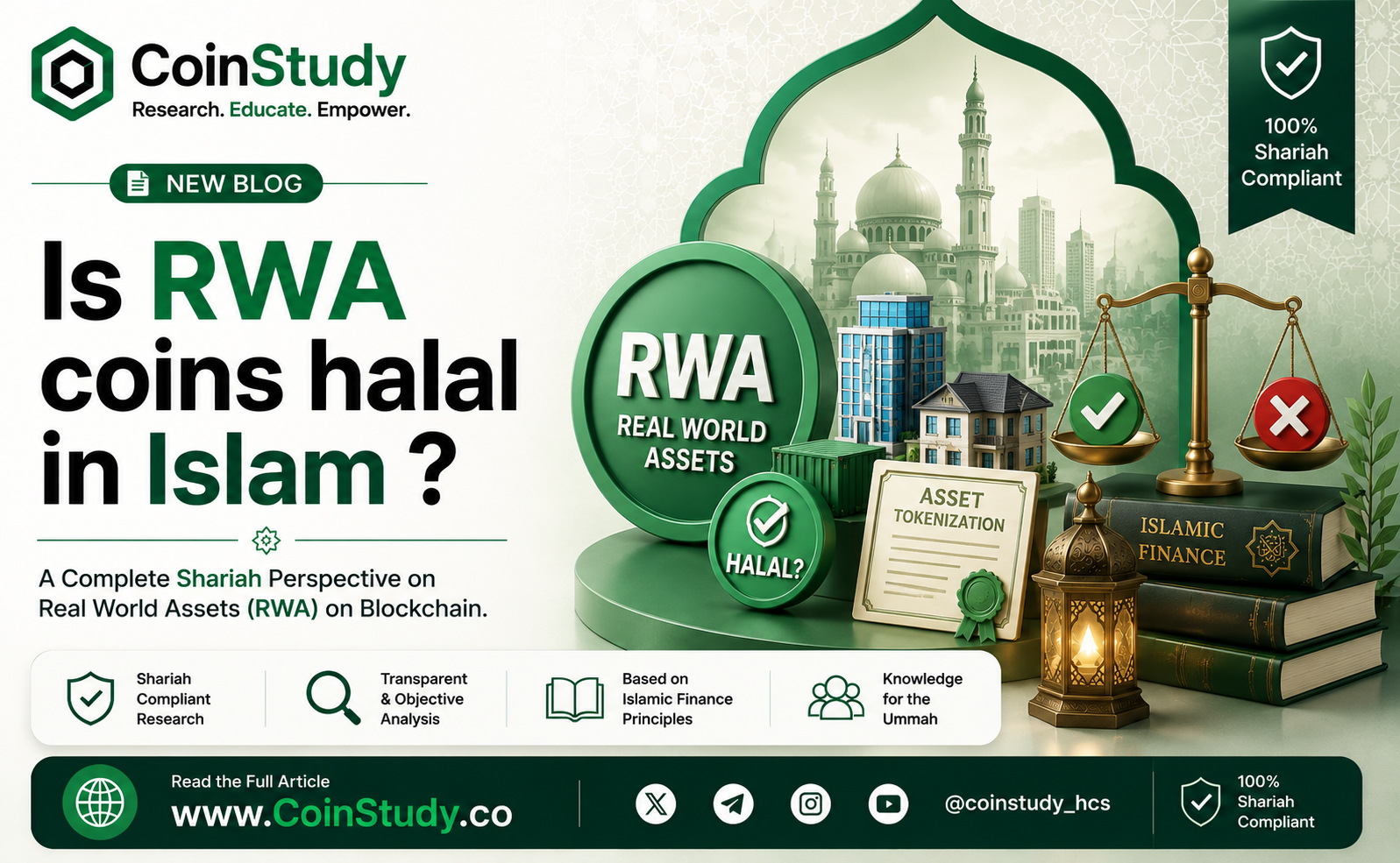
Is RWA Crypto Halal? A Complete Islamic Finance Guide for 2026
The most consequential shift happening in financial markets right now is not happening in a trading room, a central bank, or a stock exchange. It is happening on blockchain networks where some of the world's largest financial institutions are converting traditional assets into digital tokens that can be transferred, held, and traded around the clock without intermediaries.
The real-world asset crypto market holds $37.89 billion in distributed asset value as of August 6, 2026, up from $4.1 billion in January 2025, a roughly 9x expansion in 19 months. The sector has seen approximately 66% growth in 2026 alone, fueled by tokenized treasuries, private credit, and institutional demand. CoinPaprikaFinextra
BlackRock, the world's largest asset manager with over $10 trillion in assets under management, has described tokenization as a major evolution in capital markets infrastructure. Franklin Templeton, JPMorgan, Goldman Sachs, and BNY Mellon have all launched tokenized financial products on public blockchains. The shift from pilot programs to production-scale tokenization accelerated in 2026, led by the largest asset managers in traditional finance. MetaMask
For the 2 billion Muslims globally who want to participate in this transformation while maintaining Islamic finance compliance, Real World Asset crypto presents the most nuanced and important compliance question of the year. The answer is not a single yes or no. It is a precise and actionable framework that identifies which RWA products are permissible, which are prohibited, and which require individual scholarly assessment.
This blog provides that framework with comprehensive coverage of every major RWA category, the most significant 2026 institutional and regulatory developments, and the specific guidance from CoinStudy's Shariah Board Chairman Dr. Usman Quddus for Muslim investors navigating this rapidly evolving space.
Quick Verdict: RWA Crypto Depends Entirely on the Underlying Asset and Structure ⚠️
RWA crypto is not inherently halal or haram. The same blockchain technology and tokenization infrastructure can represent a permissible gold-backed commodity token or a definitively prohibited US Treasury bond token. The technology is neutral. The underlying asset and the financial structure determine the ruling. CoinStudy has analyzed multiple specific RWA products and found examples across all four HCS classification categories. Every Muslim investor must evaluate the specific RWA product rather than the RWA category before participating.
What Is RWA Crypto? The 2026 Definition
Real World Asset crypto refers to the process of tokenizing real-world assets on a blockchain, converting ownership rights in physical or financial assets into digital tokens that can be held, traded, and transferred on-chain. The result is a digital representation of a real-world asset that provides some or all of the economic rights associated with the underlying asset through a blockchain-based ownership record.
Tokenized real-world assets are traditional financial instruments like stocks, treasuries, commodities, and bonds represented digitally on a blockchain network. The RWA market in 2026 spans six major categories. These categories include tokenized government securities primarily US Treasury bills and bonds, private credit and corporate lending instruments, tokenized equities including individual stocks and index funds, commodity-backed tokens primarily gold and silver, real estate tokenization, and institutional fund products. MetaMask
The scale of institutional engagement with RWA tokenization in 2026 is unprecedented. BlackRock's USD Institutional Digital Liquidity Fund BUIDL, a tokenized Treasury-backed money market fund launched in March 2024, reached over $2.5 billion in total asset value by May 25, 2026. In February 2026, BUIDL also became tradeable on Uniswap through UniswapX, marking a notable step toward institutional DeFi integration. MetaMaskCryptic
Franklin Templeton's BENJI fund was the first SEC-registered tokenized mutual fund on a public blockchain and has since expanded across multiple chains. Ondo Finance has become one of the most referenced names in institutional RWA conversations because of its role in bringing Treasury exposure on-chain. JPMorgan, Goldman Sachs, and BNY Mellon have all launched tokenized money market products or related blockchain-based financial infrastructure. Cryptic
The 2026 regulatory framework has also significantly advanced. According to CoinStudy's analysis of the SEC and CFTC joint interpretive guidance issued in March 2026, tokenized equities received a specific classification framework, and Nasdaq's approval of tokenized equities set parameters for the broader market. The tokenized stock holder base grew 117% in a single month following these regulatory developments. CoinPaprika
Why RWA Crypto Matters for Muslim Investors Specifically
RWA tokenization addresses several genuine economic barriers that Muslim investors in developing economies face when trying to participate in global asset markets.
The accessibility barrier is real and significant. A Muslim investor in Lagos, Karachi, or Jakarta who wants to invest in gold cannot easily access the London or New York gold markets. The minimum investment sizes, currency conversion costs, custody fees, and regulatory barriers make direct ownership of physical gold economically inaccessible for most investors. A tokenized gold product that allows fractional ownership of real gold in increments of $10 removes this barrier entirely.
The same principle applies to equity ownership, real estate investment, and participation in the sukuk bond market. Tokenization converts assets that previously required significant capital and geographic proximity into blockchain-native instruments accessible from any smartphone with a self-custodial wallet.
RWAs add portfolio ballast and attract longer-term capital, offering stability, yield, and accessibility in an evolving market. For Muslim investors specifically, this combination of genuine asset backing and accessibility represents the kind of productive commerce that Islamic finance has always encouraged rather than the speculative dynamics that dominate much of the crypto market. KuCoin
The Islamic finance opportunity in RWA is not limited to existing Western financial products being tokenized. Genuine Islamic financial instruments including sukuk bonds, Musharakah equity partnerships, and Ijarah asset rental arrangements can themselves be tokenized, creating blockchain-native halal financial products that serve Muslim communities globally. According to available research, SUKUKChain is developing tokenized Islamic bonds using NFT-like certificates for transparent ownership tracking, representing the most genuinely exciting application of RWA technology from an Islamic finance perspective.
The Islamic Finance Framework for RWA Assessment
CoinStudy applies the full two-layer Halal Crypto Standard to every RWA product. Understanding how this framework applies specifically to RWA products helps Muslim investors evaluate new products independently.
The five Layer 1 red lines apply with particular force in the RWA category because the underlying assets in RWA products directly determine which red lines are triggered.
The Ecosystem Riba Exposure red line asks whether the underlying asset generates interest income. This is the single most important red line for RWA products because the most common and most widely traded RWA products in 2026 are US Treasury bills and bonds. US Treasuries dominate the RWA market at 45% share with over $8.7 billion in on-chain distributed value. US Treasury bills are interest-bearing government bonds. Every tokenized Treasury product in the market generates interest income for the issuer and in many cases distributes that interest to token holders. This is Riba regardless of the sophisticated financial engineering and institutional credibility of the issuer. KuCoin
The Guaranteed Interest red line asks whether the token provides predetermined percentage returns on deployed capital. When a tokenized Treasury product pays token holders a yield of 4% to 5% annually from T-Bill interest income, this predetermined percentage return on deployed capital is Guaranteed Interest regardless of the blockchain technology delivering it.
The Synthetic Interest Products red line applies to RWA products that create digital instruments capturing the yield stream of interest-bearing assets. Pendle Yield Tokens built on xStocks, yield tokenization products built on T-Bill backed stablecoins, and any DeFi product that extracts and tokenizes the interest income from underlying RWA assets creates a Synthetic Interest Product regardless of the blockchain infrastructure.
The Haram Industry red line applies to RWA products whose underlying assets serve prohibited industries, including alcohol, conventional banking interest income distribution, gambling operations, and weapons manufacturing.
The Gambling and Betting red line applies to RWA-adjacent prediction market products that use real-world event outcomes as the basis for financial wagering, even when those products are marketed as RWA or information markets.
The Six RWA Categories — Each Assessed Precisely
Category 1 — Tokenized Government Bonds and Treasuries: Definitively Haram ❌
This is the largest RWA category by market value and the most directly prohibited under Islamic finance principles. US Treasuries represent 45% of the tokenized RWA market at over $8.7 billion in distributed on-chain value. KuCoin
The compliance assessment is direct and unambiguous. US Treasury bills are interest-bearing government bonds. Owning a tokenized T-Bill product means holding a digital representation of an interest-bearing instrument. The interest income generated by the T-Bill flows to the token holder either directly as yield distribution or indirectly as appreciation in the token's value. This interest income is Riba regardless of the blockchain packaging.
This assessment applies equally to every specific product in this category. BlackRock's BUIDL is a tokenized Treasury-backed money market fund distributing T-Bill interest income to holders. Ondo Finance's OUSG is a tokenized short-term US Treasury product. Franklin Templeton's BENJI is a tokenized money market fund backed by US government securities. Every one of these products fails CoinStudy's Ecosystem Riba Exposure and Guaranteed Interest red lines for the same fundamental reason: they distribute interest income from T-Bills to token holders.
CoinStudy has separately analyzed and classified as Haram the following specific T-Bill backed products: USDT, USDC, AUSD by Agora Finance, TrueUSD, USAT, RLUSD, and every other T-Bill backed stablecoin and RWA product in our analysis library. The consistency of this classification across all T-Bill backed products reflects a consistent principle rather than a case-by-case determination. The principle is simple: T-Bills are interest-bearing. Products backed by T-Bills inherit that interest-bearing character. Interest income distributed to investors is Riba.
Muslim investors must specifically avoid: BUIDL by BlackRock, BENJI by Franklin Templeton, OUSG by Ondo Finance, BUIDL-equivalent products from JPMorgan, Goldman Sachs, and BNY Mellon, SGOVx and any tokenized Treasury ETF on xStocks or Arcus, and any tokenized bond product whether government or corporate that distributes interest income.
Category 2 — Commodity-Backed Tokens (Gold and Silver): Generally Permissible ✅
Commodity-backed tokens representing direct ownership of physical precious metals stored in audited vaults are among the most clearly permissible RWA products available in 2026.
Islamic jurisprudence has consistently recognized gold and silver as genuine stores of value and permitted their purchase, sale, and holding. The scholars' consensus on this is longstanding and unambiguous. When a blockchain token represents actual physical gold stored in a regulated vault with verifiable proof of reserve, buying that token is functionally equivalent to buying gold with modern settlement infrastructure.
The compliance conditions for commodity-backed tokens are specific. The underlying commodity must itself be halal, which eliminates alcohol, pork products, and other prohibited commodities but includes gold, silver, oil, natural gas, wheat, and other permissible commodities. The backing must be genuine with verifiable proof of physical asset custody rather than fractional reserve or synthetic exposure. The smart contract must not embed any interest-bearing yield mechanism that generates returns from lending the commodity. The trading must be spot-based because the Prophet specifically prohibited forward contracts on gold and silver without immediate hand-to-hand exchange.
The spot trading requirement for gold and silver deserves specific attention. Islamic jurisprudence has a specific rule for gold and silver transactions that requires immediate exchange of counter-value. Forward contracts, futures, and deferred delivery arrangements for gold and silver are generally not permitted under the classical position of all four major Sunni madhabs. Muslim investors who buy tokenized gold for immediate settlement in their self-custodial wallet are within the permissible framework. Muslim investors who buy tokenized gold futures or forward contracts are in the prohibited category regardless of the tokenization wrapper.
Specific products in this category that CoinStudy has assessed include PAXG by Paxos, which represents one troy ounce of physical gold on the London Bullion Market Association's vaults. XAUT by Tether, which represents ownership of gold in Swiss vaults. Both pass CoinStudy's red-line screening when used for spot purchase and genuine holding rather than for leveraged speculation.
Category 3 — Tokenized Equities (Individual Stocks): Conditionally Permissible ✅⚠️
Tokenized equities representing genuine ownership exposure to individual company stocks are conditionally permissible when the underlying company passes CoinStudy's AAOIFI-based stock screening methodology.
Our Shariah Board Chairman Dr. Usman Quddus issued a direct and historic ruling on this category: business with xStocks of halal companies is permissible. This ruling establishes the foundational principle for all tokenized equity products: the compliance of the underlying company determines the compliance of the token.
The tokenized stock holder base grew 117% in a single month following the SEC and CFTC joint framework announcement in March 2026. According to CoinStudy's analysis of xStocks, the platform has facilitated over $250 million in tokenized stock volume accounting for more than 90% of such volume on Solana as of August 2025. The Chairman's ruling enables Muslim investors to participate in this growing market for specifically halal-classified company tokens. CoinPaprika
The individual company screening requires four AAOIFI Standard No. 21 financial ratio tests. The debt ratio must be below 30% of total market capitalization. Haram revenue must be below 5% of total revenue. Interest income must be below 30% of total revenue. Accounts receivable must be below 45% of total assets. CoinStudy has conducted these screens for multiple companies whose tokens are available on xStocks and Arcus, confirming halal classification for Apple, Amazon, NVIDIA, and Google among others.
The compliance concerns for tokenized equities are specific and important. Index fund tokens like SPYx representing the S&P 500 or QQQx representing the Nasdaq-100 bundle hundreds of companies of which many have not passed AAOIFI screening. These index tokens cannot receive halal classification without comprehensive screening of every constituent company. SGOVx representing US Treasury bill ETFs is definitively Haram as it provides direct investment exposure to interest-bearing government bonds. And deploying tokenized equities into DeFi lending protocols as collateral for interest-bearing loans creates Riba exposure even when the underlying stock is halal-classified.
Category 4 — Private Credit and Corporate Bonds: Definitively Haram ❌
Private credit and corporate bond tokenization represents the fastest-growing RWA subcategory and the most consistently prohibited from an Islamic finance perspective.
Private credit runs near 53% of tokenized RWA deployment in smart contracts, while tokenized bonds sit at 5.6%. These products generate returns through interest income from corporate borrowers who pay interest on outstanding loan balances. The lender, which in the tokenized context is the token holder, earns predetermined interest income from the borrower. This is Riba in its most direct commercial form regardless of whether it occurs in a bank branch or on a blockchain. CoinPaprika
Maple Finance's tokenized lending products, Centrifuge's credit facility tokens, and Goldfinch's emerging market lending tokens all operate on this interest-charging loan model. None of these products are permissible under CoinStudy's framework regardless of the geographic diversity of their borrowers or the social impact narratives around their lending programs. A halal purpose does not make an interest-bearing loan structure permissible.
The Islamic alternative to interest-based private credit is Mudarabah, where the capital provider receives a share of the profits from the productive activity the capital funds rather than predetermined interest on the outstanding balance. If a private credit RWA product were structured as a genuine Mudarabah where returns depend on the actual economic performance of the funded business, CoinStudy would assess it differently. No major private credit RWA product currently on the market is structured as Mudarabah. They are all structured as interest-bearing loans.
Category 5 — Real Estate Tokenization: Halal With Conditions ✅⚠️
Tokenized real estate represents one of the most genuinely exciting RWA categories from an Islamic finance perspective because rental income from legitimate property is clearly permissible economic activity in classical Islamic commercial law.
When a tokenized real estate product provides fractional ownership of a real property with rental income distributed proportionally to token holders as genuine rental revenue rather than interest income, the economic relationship is straightforwardly permissible. Property owners earn rental income from tenants. The Quran and prophetic tradition both recognize this as legitimate trade. Tokenizing this relationship to enable fractional ownership by global investors does not change its economic character.
The compliance conditions are specific. The underlying property must not be used for prohibited purposes including alcohol sales, conventional banking operations, or other prohibited businesses. The income distribution must be from genuine rental revenue rather than from interest-bearing financial instruments held by the fund. The ownership rights must be genuine and legally enforceable rather than synthetic exposure through derivatives. The smart contract must not embed interest-bearing mechanisms for leveraging the property or generating additional yield beyond the rental income.
The 2026 RWA real estate landscape includes products from Lofty AI, RealT, and other tokenization platforms that allow fractional ownership of residential and commercial properties with rental income distribution. Muslim investors should verify the specific property usage, the income distribution mechanism, and the legal structure of each product before participating.
Category 6 — Tokenized Institutional Funds: Requires Individual Assessment ⚠️
The institutional fund category encompasses products like BlackRock's BUIDL, Franklin Templeton's BENJI, and various private equity and hedge fund tokenization products. This category requires the most careful individual assessment because institutional funds bundle multiple asset types and multiple income sources into a single product.
A tokenized fund investing in T-Bills is Haram as definitively as buying the T-Bills directly. A tokenized fund investing in Sharia-compliant equities and distributing equity profits is closer to permissible as definitively as the equities themselves. A mixed fund investing in both T-Bills and equities for income distribution requires assessment of what proportion of income comes from each source and whether the specific fund structure resembles a permissible Mudarabah.
Muslim investors considering institutional RWA fund products must understand what the fund invests in, how income is generated, and whether any component of the income stream comes from interest-bearing instruments before making any participation decision.
The Islamic RWA Alternative — Sukuk and Blockchain Native Halal Products
The most important development for Muslim investors in the RWA space is not the tokenization of existing conventional financial products. It is the emergence of blockchain-native products specifically designed to meet Islamic finance standards.
Sukuk are Islamic bonds structured around genuine asset ownership and revenue sharing rather than interest payments. A sukuk holder owns a proportional share of a defined tangible asset and earns income from that asset's genuine economic activity rather than from interest charged on a loan. The absence of interest is structural and definitional rather than cosmetic.
Tokenizing sukuk creates fractional ownership of genuinely halal fixed-income-adjacent instruments that were previously accessible only to institutional investors with minimum investment requirements of hundreds of thousands of dollars. A tokenized sukuk accessible in $100 increments through a self-custodial blockchain wallet brings the Islamic finance principle of Rahn-adjacent asset-backed income to ordinary Muslim investors globally.
According to available research, SUKUKChain is developing exactly this: tokenized Islamic bonds using blockchain-based certificates for transparent ownership tracking. The vision of tokenized sukuk representing the gold standard of what halal RWA can be: genuine asset ownership, genuine revenue sharing from productive economic activity, complete absence of interest income, and blockchain-native accessibility for the global Muslim investor community.
CoinStudy's Specific RWA Rulings — 2026 Summary
CoinStudy has analyzed multiple specific RWA products in 2026. The classification pattern is consistent and important for Muslim investors to understand.
Every T-Bill backed product has received Haram classification. USDT, USDC, AUSD, TrueUSD, USAT, RLUSD, BlackRock BUIDL by extension, Franklin Templeton BENJI by extension, Ondo Finance OUSG by extension, and SGOVx on xStocks. All Haram for the same reason: T-Bills are interest-bearing and products backed by them distribute Riba to holders.
Tokenized equities of halal companies have received conditional permissibility under the Chairman's ruling. Apple, NVIDIA, Amazon, and Google as individual company tokens on xStocks are permissible when held on spot markets without DeFi leverage. Index fund tokens like SPY and QQQ are not cleared because they bundle unscreened companies.
Commodity-backed gold tokens PAXG and XAUT pass the red-line screening for spot holding of permissible commodities. The spot trading requirement from Islamic jurisprudence on gold applies specifically to immediate settlement.
Physical real estate income tokens from legitimate property with rental income distribution require individual property assessment. The category is generally permissible in principle. Individual products require verification of property use, income source, and legal structure.
The 2026 Regulatory Developments and Their Islamic Finance Significance
The March 2026 SEC and CFTC joint interpretive framework classifying different types of digital assets into specific regulatory categories including digital collectibles, digital commodities, digital tools, stablecoins, and digital securities represents the most significant regulatory development for RWA products.
For Muslim investors, this regulatory development has two specific significances. First, it confirms that regulators are beginning to distinguish different types of blockchain assets rather than treating all cryptocurrencies as a single undifferentiated category. This regulatory sophistication creates the infrastructure for genuinely halal RWA products to receive appropriate regulatory treatment rather than being lumped with prohibited products.
Second, the regulatory framework's focus on consumer protection, transparency, and genuine asset backing moves RWA markets toward the characteristics that Islamic finance values: clear ownership rights, genuine economic backing, transparent income sources, and enforceable legal claims. Regulatory progress and Islamic finance compliance progress are moving in the same direction for RWA products even though they are driven by different motivations.
Practical Guide for Muslim Investors Evaluating RWA Products
The following checklist provides the specific questions Muslim investors should answer before participating in any RWA product.
The first question is what specific asset underlies this token. Gold, silver, and permissible commodities pass the initial screen. Individual halal-classified company stocks pass with Chairman's ruling confirmed. T-Bills, government bonds, corporate bonds, and private credit loans trigger the Haram classification. Real estate passes in principle with individual property verification required.
The second question is how is income generated. Rental income from property, profit sharing from genuine business activity, and price appreciation of permissible commodities are closer to permissible. Interest income from lending, T-Bill coupon payments, and bond coupon distributions are Riba.
The third question is whether predetermined percentage returns are promised. Fixed APY from interest-bearing instruments is the Guaranteed Interest red line. Variable returns from genuine economic activity of the underlying asset are more permissible.
The fourth question is whether the token is being deployed into any DeFi protocol. Depositing a halal-classified xStock into Kamino Finance for yield is Riba regardless of the xStock's own compliance. The DeFi activity determines a separate compliance assessment from the underlying token's classification.
The fifth question is whether the ownership is genuine and legally enforceable. Synthetic exposure through derivatives without genuine underlying ownership creates Gharar concerns that reduce compliance scores and in some cases trigger the Synthetic Interest Products red line.
The sixth question is whether this specific product has been assessed by CoinStudy. Checking our analysis library before participating saves the individual assessment work and provides the benefit of our Shariah Board Chairman's formal rulings on specific mechanisms.
Final Verdict
RWA crypto is not halal or haram as a category. It is one of the fastest-growing sectors in the blockchain ecosystem and one of the most practically important for Muslim investors specifically because it provides blockchain-native access to asset classes that have historically been geographically and financially inaccessible to ordinary Muslim investors in developing economies.
With the tokenized RWA market reaching $19 to $36 billion in early 2026 following 300 plus percent recent growth and $37.89 billion in distributed asset value as of August 2026, the category is too large and too practically important for Muslim investors to ignore based on categorical caution about all RWA products. KuCoinCoinPaprika
The Islamic finance framework provides precise and actionable guidance. Tokenized T-Bills and bonds are Haram regardless of the institutional credibility of the issuer. Tokenized equities of halal companies are conditionally permissible as confirmed by Chairman Dr. Usman Quddus's direct ruling. Commodity-backed gold tokens for spot holding are generally permissible. Tokenized real estate with rental income is generally permissible with individual verification. Private credit and corporate bonds are Haram. Tokenized sukuk and Islamic finance-native products represent the genuinely exciting frontier of halal RWA.
Muslim investors who apply the six-question checklist above to every RWA product before participating will avoid the prohibited 45% of the market dominated by T-Bills and access the genuinely permissible opportunities in commodities, halal equities, and the emerging Islamic finance-native tokenization sector.
Read detail analysis and concepts here:
Is xStocks Halal?
Is USDT Halal?
Are Tokenized Stocks Halal?
Is NFT Halal?
Is Crypto Lending Halal?
Disclaimer: This blog is provided for educational and research purposes only based on guidance from CoinStudy's HCS Shariah Board members including Chairman Dr. Usman Quddus, PhD in Islamic Studies and Finance. Individual RWA products require individual assessment. The classification of tokenized T-Bills as Haram reflects the structural Riba concern in interest-bearing instruments and applies consistently to all products whose returns derive from T-Bill interest income regardless of the issuer's institutional credibility. CoinStudy does not issue personal fatwas or financial advice. Please consult a qualified Islamic scholar for individual guidance on specific RWA products.