


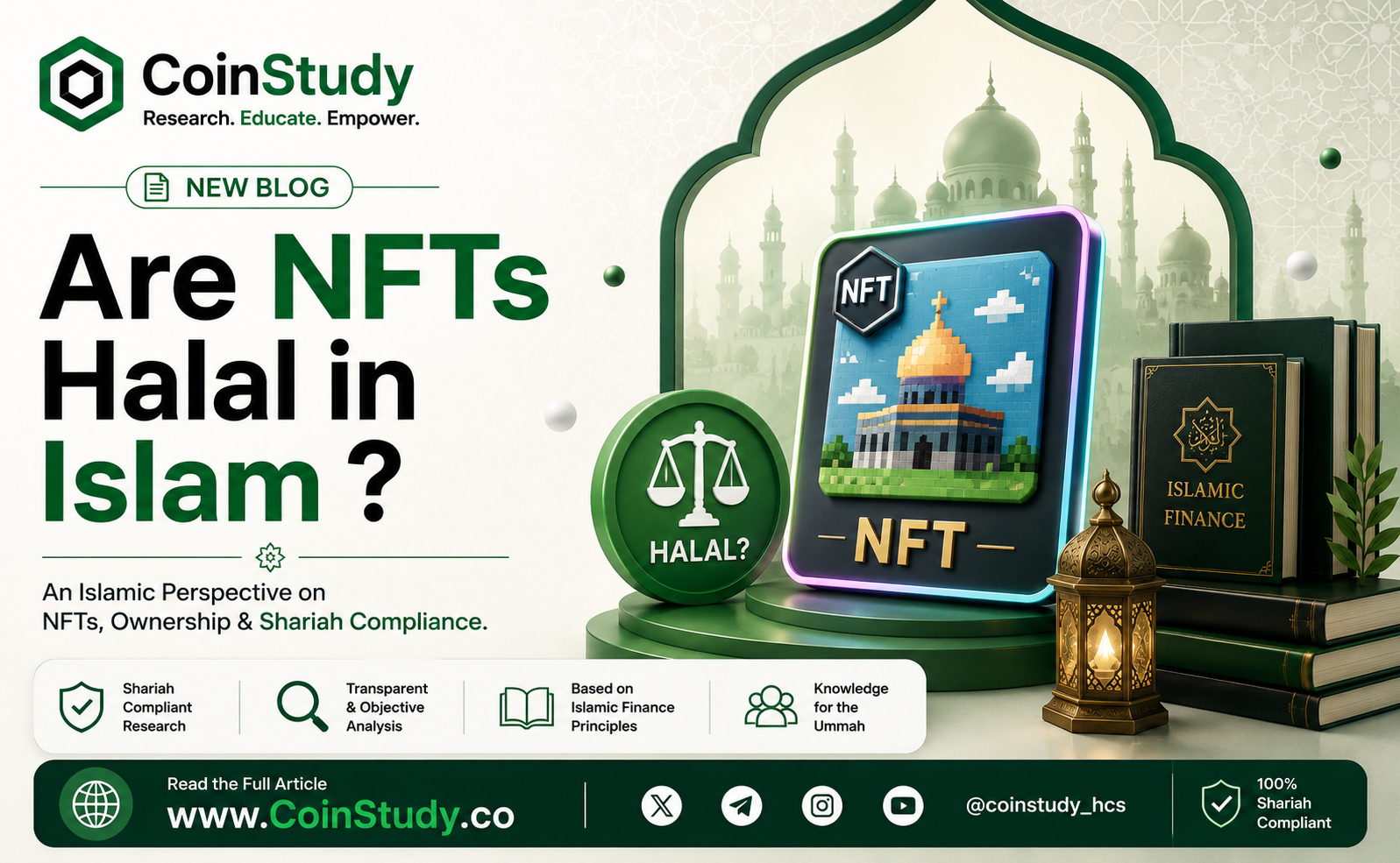
Is NFT Halal or Haram? A Complete Islamic Finance Guide for 2026
In March 2021, a digital collage titled Everydays: The First 5000 Days by an artist known as Beeple sold at Christie's auction house for $69 million. The buyer received nothing physical. No canvas. No print. No sculpture. They received an NFT, a Non-Fungible Token, which recorded on the Ethereum blockchain that a specific digital file was associated with their wallet address.
The world's financial media could not decide whether to report this as a revolutionary milestone in digital ownership or an extraordinary example of speculative excess. The answer, as CoinStudy's analysis confirms, is that it was probably both simultaneously, and the distinction between those two characterizations is precisely what determines whether NFT activity is permissible or prohibited under Islamic finance principles.
According to Traders Union research, the global NFT market was valued at $25.3 billion in 2024 with over 10.8 million NFT sales recorded across major blockchains including Ethereum, Solana, and Polygon, and experts project the market to surpass $31 billion by 2026. According to MetaMask research, on March 17, 2026, the SEC and CFTC issued a joint binding interpretation classifying NFTs specifically as digital collectibles in a five-category framework alongside digital commodities, digital tools, stablecoins, and digital securities, marking the first coordinated federal regulatory classification of NFT assets.
For the 2 billion Muslim investors globally, these developments raise the same question that has been asked since NFTs entered mainstream consciousness: are they halal?
The honest and complete answer is that NFTs are not halal or haram as a category. They are a technology. The permissibility depends entirely on what specific NFT you are discussing, what it represents, how it was created, what economic purpose it serves, and what activity you are engaging in with it. A tokenized Quran manuscript NFT and a gambling platform membership NFT both exist on the same Ethereum blockchain and both use the same ERC-721 token standard. One is permissible. The other is not. The technology is neutral. The specific application determines the ruling.
CoinStudy has analyzed dozens of NFT-integrated projects and applied the full Halal Crypto Standard to the category. Here is the complete picture.
Quick Verdict: NFTs Depend Entirely on Use Case ⚠️
NFTs are not inherently halal or haram. Their permissibility depends on the content of the underlying asset, the economic purpose they serve, the level of speculation involved in their market, and whether any prohibited financial mechanisms are embedded in their design. CoinStudy has identified five specific NFT categories with distinct compliance profiles ranging from clearly permissible to definitively Haram. Every Muslim investor must evaluate the specific NFT rather than the category before participating.
What Is an NFT? The 2026 Definition
Non-Fungible Tokens are unique digital assets stored on a blockchain that prove ownership of a specific item. Unlike cryptocurrencies such as Bitcoin or Ethereum which are fungible and interchangeable, each NFT is unique and cannot be replaced by an identical unit. NFT stands for Non-Fungible Token, where non-fungible means unique and irreplaceable.
In 2026, NFTs are significantly more diverse in their applications than in the 2021 to 2022 era when they were primarily associated with digital art and profile picture collections. According to Cryptorbix research, three technical developments have accelerated NFTs' transition from art speculation to genuine utility: account abstraction and token-bound accounts through ERC-6551 implementations that make NFTs active agents capable of holding assets and executing transactions, Layer-2 and ZK-rollup scalability making frequent NFT updates affordable, and the combination of decentralized identifiers and verifiable credentials providing a portable on-chain identity layer.
NFTs in 2026 represent digital artwork, gaming items, music rights, sports collectibles, event tickets, loyalty program memberships, professional credentials, real estate ownership records, Islamic bond certificates, intellectual property rights, and supply chain provenance records. The range of applications is genuinely broad and each application has a different compliance profile.
How NFTs Work — The Technical Foundation
NFTs are created through a process called minting. A smart contract on a blockchain assigns a unique identifier to a specific digital file or record, linking the file to a wallet address that represents ownership. The ownership record is stored permanently and transparently on the blockchain, meaning any party can verify who owns any NFT at any time.
When an NFT is sold, the blockchain records the transfer of ownership from the seller's wallet to the buyer's wallet. The smart contract can include programmed rules such as royalty payments that automatically transfer a percentage of every future sale to the original creator without requiring any third-party enforcement.
The underlying asset that an NFT represents can be anything: a digital image stored on IPFS, a music file, a virtual game item, a smart contract right to a physical asset, a legal claim on real estate, or a membership credential. The NFT itself is just the ownership record. The compliance assessment requires evaluating what that ownership record represents.
The Islamic Finance Framework Applied to NFTs
Islamic finance evaluates financial products through three primary prohibitions and a general requirement for genuine economic value. Understanding how each applies to NFTs specifically is essential for Muslim investors.
Riba — Interest: NFTs themselves do not inherently involve interest. An NFT is a digital ownership certificate and ownership certificates do not pay interest. However the 2026 NFT ecosystem has developed financial products layered on top of NFTs that do create Riba concerns. According to Cryptorbix research, NFT-native yield where an NFT accrues staking rewards or fee shares over time is now common in 2026 protocols, and protocols support NFT-backed lending where an NFT is used as collateral and the underlying yield from the NFT helps repay loans. When an NFT generates predetermined yield from interest-based mechanisms or is used as collateral in interest-bearing lending, the Riba concern is triggered at the application layer rather than the NFT layer.
Gharar — Excessive Uncertainty: NFTs can involve significant Gharar concerns depending on their specific design. An NFT whose underlying digital file is stored on a centralized server that could be taken down creates Gharar about whether the ownership is real and persistent. An NFT whose value is entirely dependent on the continued popularity of a specific artist or project creates Gharar about what economic value the ownership actually represents. An NFT that promises future utility from a project that does not yet have operational products creates Gharar about whether those promises will be fulfilled. The degree of Gharar varies enormously across different NFT types.
Maysir — Gambling: The NFT market has historically exhibited strong gambling-like characteristics in certain segments. According to Traders Union research, many NFT transactions involved price manipulation and quick resale often within 24 hours closely mimicking gambling behavior. When an NFT is purchased primarily because the buyer hopes another buyer will pay a higher price shortly afterward with no underlying economic value creation between transactions, the market dynamic resembles the zero-sum wealth transfer that Islamic finance identifies as Maysir. This concern applies specifically to purely speculative NFT trading rather than to all NFT activity.
Genuine Economic Value: Islamic commercial ethics requires that financial transactions involve genuine value exchange. Buying and selling genuine goods and services for fair prices is the economic model Islam encourages. NFTs that represent genuine ownership of something with genuine economic utility create genuine value exchange. NFTs that represent nothing of genuine economic value beyond the expectation that someone else will pay more later create a value-free market dynamic that is problematic under Islamic commercial principles.
The Five NFT Categories — Each Assessed Precisely
Category 1 — Real-World Asset NFTs: Generally Permissible ✅
The most clearly permissible NFT category in 2026 is real-world asset tokenization where NFTs represent genuine ownership claims on physical assets or legal rights with real economic value.
Real estate ownership records, tokenized property deeds, fractional ownership certificates for commercial buildings, supply chain provenance records for commodities, intellectual property rights certificates, and professional credentials all represent genuine ownership of something real and economically valuable. When an NFT records the ownership of a halal-classified real-world asset with clear legal backing, transparent ownership rights, and genuine economic utility, the compliance profile is generally positive.
According to BarristerNG research, under Islamic finance, token holders should have genuine ownership of the underlying asset proportion, not just speculative derivatives, with examples including real estate sukuk tokens, halal commodity tokens, shares in Sharia-compliant businesses, and infrastructure project tokens.
According to Halal Times research, SUKUKChain is developing tokenized Islamic bonds using NFT-like certificates for transparent ownership tracking, representing exactly the kind of genuinely halal application of NFT technology that Islamic finance scholars have indicated is permissible in principle.
The specific compliance of any real-world asset NFT depends on three factors. The underlying asset must be halal-classified, meaning no alcohol, no conventional interest-bearing bonds, no prohibited industry assets. The ownership rights must be legally clear and enforceable rather than ambiguous. The smart contract must not embed any interest-based yield mechanism or guaranteed return structure.
Category 2 — Utility NFTs for Permissible Services: Halal With Conditions ✅⚠️
Utility NFTs that provide genuine access to permissible services, products, or experiences represent the second most clearly permissible category when specific conditions are met.
Event access NFTs that function as digital tickets for concerts, conferences, or sports events are ownership records for a genuine service. Gaming item NFTs that represent actual in-game assets with genuine gameplay utility are ownership records for digital property within a permissible game. Loyalty program NFTs that provide genuine discounts or access to permissible goods and services are ownership records for contractual commercial rights. Professional credential NFTs that record educational or professional qualifications are ownership records for verified achievement.
The compliance conditions for utility NFTs are specific. The service or product being accessed must itself be permissible under Islamic law. A concert ticket NFT for a concert featuring prohibited content is Haram not because it is an NFT but because the event it grants access to is prohibited. A gaming item NFT for a game that includes gambling mechanics is Haram not because of the NFT structure but because of the game's prohibited mechanism.
The utility must be genuine and not contingent on third-party continued operation without legal backing. An NFT that promises future access to a platform that does not yet exist creates Gharar. An NFT with clear, immediate, legally backed utility creates less Gharar.
CoinStudy's analysis of Valhalla NFT creatures for Floki's MMORPG illustrates this principle. The Vera NFT creatures in Valhalla have genuine gameplay utility in skill-based competition that does not involve gambling mechanics, making the NFT ownership itself closer to permissible. However the Floki staking mechanism that uses these NFTs in predetermined yield structures creates additional compliance concerns layered on top of the NFT's base permissibility.
Category 3 — Digital Art and Collectible NFTs: Doubtful ⚠️
Digital art NFTs and collectible NFTs represent the category with the most genuine scholarly uncertainty and the most honest need for individual case assessment.
The fundamental Islamic finance question about digital art NFTs is whether digital ownership of a unique representation of artwork constitutes genuine economic value exchange or purely speculative wealth transfer. This question does not have a single answer that applies to all digital art NFTs.
Islamic jurisprudence has consistently permitted the purchase and sale of art that does not depict prohibited subjects. Classical Islamic commercial law recognizes the value of craftsmanship, creative work, and aesthetic beauty as genuine goods that can be bought and sold for fair prices. On this basis, purchasing a digital artwork NFT from a genuine artist for a price that reflects your appreciation of the creative work, with the intention of either displaying or reselling it, is closer to permissible commerce than to prohibited speculation.
The Maysir concern arises specifically when NFT purchasing is driven not by appreciation of the creative work but by the expectation that prices will rise quickly and provide short-term profit. The same physical painting purchased as investment speculation versus purchased for genuine aesthetic appreciation raises different considerations, and the same principle applies to digital art NFTs.
The Gharar concern arises from the subjectivity of value and the absence of any objective measure of what a digital art NFT is worth. When an NFT sells for $69 million based purely on social narrative and celebrity endorsement rather than any objective measure of economic value, the uncertainty about fair value is extreme. This does not make all digital art NFTs Gharar-problematic, but it means Muslim investors should honestly assess whether a price they are paying reflects genuine value or purely speculative narrative.
CoinStudy classifies digital art and collectible NFTs as Doubtful by default, with individual assessment potentially moving specific NFTs toward permissible when genuine artistic value is clearly established and speculative intent is genuinely absent.
Category 4 — Purely Speculative NFT Trading: Haram ❌
Purely speculative NFT trading where tokens are purchased with no intention of using their utility, no appreciation of their creative value, and no purpose beyond selling to a higher buyer, is Haram under Islamic finance principles regardless of what the NFT represents.
This is not a classification of the NFT itself. It is a classification of the specific activity. The same NFT that is permissible to hold as a genuine collectible is impermissible to flip within hours for speculative profit with no genuine economic purpose beyond extracting value from other market participants.
According to Traders Union research, many NFT transactions involving price manipulation and quick resale within 24 hours closely mimic gambling behavior. When the primary market dynamic is wash trading, artificial scarcity creation, coordinated pumping of prices followed by selling to retail buyers, and celebrity-driven FOMO without underlying economic substance, the market structure is identical to what Islamic finance identifies as Maysir regardless of the NFT technology wrapping it.
The practical guidance for Muslim investors is the honesty test: would you still purchase this NFT if you believed the price would remain exactly where it is and not increase? If the answer is yes because you genuinely value the art, the utility, or the real-world asset it represents, the purchase is closer to permissible. If the answer is no because your only motivation is price appreciation, the purchase is speculative Maysir regardless of how it is framed.
Category 5 — NFTs with Haram Content or Mechanisms: Haram ❌
NFTs that represent, enable, or derive value from prohibited activities are Haram regardless of their technical structure.
Gambling platform NFTs that represent membership in or access to gambling services are Haram because they provide ownership rights to prohibited economic activity. Adult content NFTs are Haram because the underlying content is prohibited. NFTs whose smart contracts embed interest-bearing yield mechanisms that pay predetermined returns to holders are Haram because the financial mechanism triggered constitutes Riba. NFTs used as collateral in interest-bearing lending protocols where the loan carries interest charges are Haram because the borrowing arrangement is Riba.
The 2026 development of NFT-native yield and NFT-backed lending deserves specific attention because it creates prohibited financial products from NFTs that might individually be permissible. According to Cryptorbix research, NFT-native yield where an NFT accrues staking rewards or fee shares over time is common in 2026, and protocols support NFT-backed lending where an NFT is used as collateral and the underlying yield from the NFT helps repay loans. When a halal-content NFT is placed in a protocol that generates interest income from it, the NFT holder is earning Riba from a Riba-generating mechanism regardless of the NFT's own content.
The 2026 Regulatory Development — What It Means for Muslim Investors
The March 17, 2026 joint SEC and CFTC interpretation specifically classifying NFTs as digital collectibles in the first coordinated federal regulatory framework for crypto assets is a significant development for Muslim investors evaluating NFT compliance.
The regulatory classification of NFTs as digital collectibles rather than securities or investment contracts reflects the regulatory view that NFTs are primarily ownership records for unique digital items rather than investment products promising financial returns. This regulatory characterization is broadly consistent with Islamic finance's most permissible NFT use cases: genuine ownership of genuine unique items for genuine economic or aesthetic purposes.
When regulators require NFTs to be treated as collectibles with genuine ownership backing rather than as investment contracts promising returns, the regulatory framework moves NFT markets toward the kind of genuine value exchange that Islamic finance values and away from the pure speculative financial product design that creates the most significant compliance concerns.
The regulatory development does not resolve the Islamic finance assessment of any specific NFT. But it confirms that the direction of regulatory thought about what NFTs should be is aligned with the Islamic finance characterization of what they can permissibly be.
The Growing Halal NFT Ecosystem
The Muslim world's engagement with NFT technology is not limited to individual Muslim investors evaluating the permissibility of existing NFT markets. Islamic finance institutions and developers are actively building NFT infrastructure specifically designed for Sharia-compliant use cases.
According to Halal Times research, SUKUKChain is developing tokenized Islamic bonds using NFT-like certificates for transparent ownership tracking, applying the NFT's core innovation of blockchain-verified unique ownership records to the traditional Islamic finance instrument of sukuk.
The tokenized sukuk use case is one of the most genuinely promising applications of NFT technology from an Islamic finance perspective. Traditional sukuk, which are Islamic bonds structured around genuine asset ownership and revenue sharing rather than interest payments, have historically been expensive and inaccessible to ordinary Muslim investors due to high minimum investment requirements. Tokenizing sukuk as NFTs allows fractional ownership of sukuk positions, enables global trading of Islamic bond certificates without geographical restrictions, and provides the transparent on-chain ownership verification that sukuk investors require.
This specific application of NFT technology to Islamic finance infrastructure demonstrates that the technology itself is genuinely compatible with Islamic finance principles when applied to permissible underlying instruments and structures.
Chairman's Ruling Framework Applied to NFTs
CoinStudy's Shariah Board Chairman Dr. Usman Quddus has issued rulings on several related questions that establish the framework for NFT assessment under Islamic jurisprudence.
His ruling confirming that business with xStocks of halal companies is permissible establishes the principle that tokenized ownership of halal underlying assets is permissible when the ownership is genuine and the asset itself is halal-classified. This principle applies directly to RWA-backed NFTs representing halal real-world assets.
His ruling on prediction markets including Rain and Pieverse established that any financial mechanism structured around uncertain outcomes where participants stake capital and winners take from losers is Maysir regardless of the technology wrapping it. This principle applies to NFT markets where wash trading and coordinated speculative pumping create gambling-like wealth transfer dynamics.
His ruling on service-based compensation through genuine economic activity being permissible applies to NFT royalty structures where creators earn a percentage of future sales as compensation for their creative work, confirming that royalty-based NFT income for permissible creative work is permissible service income.
His ruling that predetermined interest returns on deployed capital are Riba regardless of the denomination of the reward applies to NFT-native yield products, confirming that an NFT that accrues predetermined interest-like returns from financial mechanisms is Haram regardless of the NFT content.
CoinStudy HCS Screening Results — By NFT Category
Real-World Asset NFTs (Halal Underlying Asset)
Ecosystem Riba Exposure — ✅ Passed when no yield mechanism exists. ❌ Failed if NFT includes interest-bearing yield.
Gambling and Betting — ✅ Passed.
Haram Industry — ✅ Passed when underlying asset is halal-classified.
Guaranteed Interest — ✅ Passed if no predetermined return mechanism. ❌ Failed if NFT accrues interest-style yield.
Synthetic Interest Products — ✅ Passed for simple ownership records.
Overall: Halal to Halal With Concerns depending on yield mechanics.
Utility NFTs for Permissible Services
All five red lines passed when the service accessed is permissible and no interest mechanism exists. Overall: Halal With Conditions.
Digital Art and Collectible NFTs
No red-line violations at the protocol level. Maysir and Gharar concerns assessed in Layer 2. Overall: Doubtful — requires individual assessment.
Purely Speculative NFT Trading
Gambling and Betting red line triggered by market dynamics. Overall: Haram.
NFTs with Prohibited Content or Interest Mechanisms
Multiple red-line failures depending on specific mechanism. Overall: Haram.
Practical Guidance for Muslim Investors in 2026
Before purchasing any NFT, Muslim investors should answer six specific questions honestly.
The first question is what does this NFT actually represent? A genuine ownership claim on a real-world asset, a digital artwork from a real artist, a gaming item with genuine gameplay utility, or nothing more than a JPEG file with no utility or real-world backing? The more genuine and clearly defined the ownership claim, the more favorable the compliance profile.
The second question is what is my honest reason for purchasing? Genuine appreciation of creative value or utility, or the expectation that someone else will pay more later? Honest self-assessment of this question is the most important single factor in determining whether your specific NFT activity is permissible or constitutes Maysir.
The third question is does the NFT's smart contract generate any yield? If the NFT produces returns from interest-bearing mechanisms, lending income, or predetermined percentage returns on the ownership position, these yield mechanisms require individual assessment against the Guaranteed Interest and Synthetic Interest Products red lines.
The fourth question is does this NFT grant access to anything prohibited? Gaming NFTs for games with gambling mechanics, entertainment NFTs for prohibited content, and platform membership NFTs for prohibited services all fail the Haram Industry check regardless of the NFT technology itself.
The fifth question is how clear are the ownership rights? Can you verify on-chain that the file exists permanently rather than on a centralized server, that the legal claim the NFT represents is enforceable, and that the project has disclosed its plans, team, and governance transparently?
The sixth question is what happens to this NFT if the project team disappears? If the answer is that all the NFT's utility evaporates because it depends entirely on continued company operation, the Gharar concern is significant. If the answer is that on-chain ownership remains permanently verifiable and the underlying real-world asset or creative work continues to exist, the Gharar profile is more manageable.
Final Verdict
NFTs are not halal or haram as a category. They are a technology for recording unique ownership on a blockchain, and the permissibility of that technology depends entirely on what ownership is being recorded and how it is used.
Real-world asset NFTs representing genuine halal assets with clear legal ownership rights are generally permissible under Islamic finance principles consistent with the Chairman's ruling on tokenized halal assets. Utility NFTs providing genuine access to permissible services are permissible when the service itself is permissible and no interest mechanism is embedded. Tokenized sukuk and Islamic bond certificates represent the most genuinely promising halal application of NFT technology.
Digital art NFTs are Doubtful by default requiring individual honest assessment of whether the purchase involves genuine appreciation of creative value or purely speculative Maysir activity. Purely speculative NFT trading driven by flip-for-profit motivation with no genuine economic purpose is Haram under the Maysir principle regardless of what the NFT represents. NFTs with prohibited content, interest-bearing yield mechanisms, or gambling-platform access rights are Haram regardless of their technical structure.
The 2026 development of NFT-native yield and NFT-backed lending creates new compliance layers that require Muslim investors to assess not only what an NFT represents but what financial mechanisms it has been integrated into. A halal-content NFT deployed into an interest-bearing protocol becomes entangled with Riba at the application layer even if it passes the content assessment cleanly.
CoinStudy's analysis of individual NFT-integrated projects provides the specific project-by-project assessments that the general framework above enables. Muslim investors who want to know whether a specific NFT project is permissible should check CoinStudy's analysis library for individual project assessments.
Read detail analysis and concepts here:
Is Floki Halal?
Is xStocks Halal?
Is Crypto Staking Halal?
Are Meme Coins Halal?
Are Tokenized Stocks Halal?
Disclaimer: This blog is provided for educational and research purposes only based on guidance from CoinStudy's HCS Shariah Board members including Chairman Dr. Usman Quddus, PhD in Islamic Studies and Finance. CoinStudy does not issue personal fatwas or financial advice. Individual NFT projects require individual assessment. Please consult a qualified Islamic scholar for personal guidance on specific NFT transactions.