

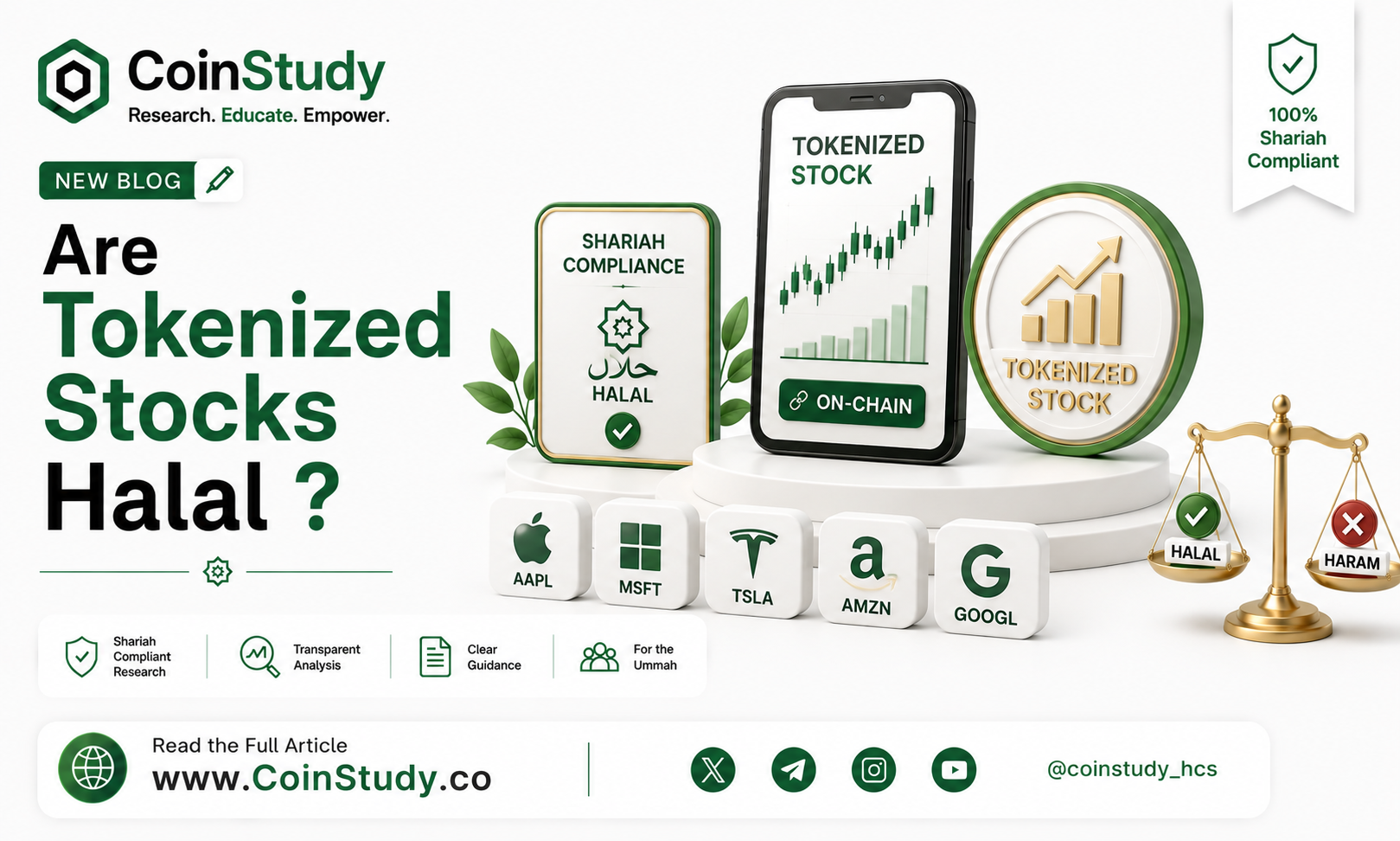
Are Tokenized Stocks Halal?
A new financial category has grown from nearly nothing to over a billion dollars in market value in just over a year.
Tokenized stocks, often called xStocks, let crypto users buy blockchain-based tokens that track the price of real companies like Apple, Tesla, and Nvidia. No brokerage account. No regional restrictions. No waiting for market hours. Just connect a wallet and trade Wall Street exposure around the clock.
The growth has been extraordinary. The tokenized stocks market crossed $20 million in value with fewer than 1,500 users in December 2024. By March 2026 it had surpassed $1 billion in aggregate market value with more than 185,000 holders. Monthly on-chain transfer volume reached over $2 billion.
For Muslim investors, this growth raises an urgent and practical question. Is this halal? We examined the structure of tokenized stocks through CoinStudy's HCS methodology. Here is the complete picture.
What Are Tokenized Stocks?
Tokenized stocks are blockchain-based digital tokens designed to represent economic exposure to shares of real, publicly traded companies.
The largest provider in this space is xStocks, a platform developed through a partnership between Kraken and Backed Finance. When you buy an xStock token like AAPLx for Apple or TSLAx for Tesla, the issuer holds the equivalent real shares in custody through a regulated entity. The token you hold is backed 1:1 by those underlying shares.
These tokens trade on centralized exchanges including Kraken, Bybit, Gate.io, and KuCoin, and on decentralized platforms including Jupiter and Raydium on Solana. They move across blockchains using infrastructure like Chainlink's CCIP protocol, meaning the same tokenized Apple exposure can exist and move between multiple blockchain networks.
By early 2026, xStocks alone had processed over $25 billion in total transaction volume with more than 80,000 unique on-chain holders.
How Tokenized Stocks Actually Work
Understanding the mechanism is essential before any Islamic finance assessment can be made.
When a tokenized stock platform issues a token like AAPLx, the issuing entity purchases the actual Apple shares and holds them in custody through a licensed and regulated custodian. The blockchain token is then minted as a digital representation of that custodial claim.
When you buy AAPLx, you are not buying Apple stock directly from Nasdaq. You are buying a token that represents a claim on Apple shares held by a third party custodian on your behalf. The token's price tracks Apple's real share price because it is backed by the real asset and redeemable for cash value tied to that asset.
This is structurally similar to how American Depositary Receipts work in traditional finance, where international investors hold a certificate representing foreign shares held in custody rather than holding the foreign shares directly.
A critical detail that affects the Islamic finance assessment is that xStocks tokens do not carry voting rights or direct dividend payments. Instead, dividends are automatically reinvested into the token's value rather than distributed as cash to holders.
The Islamic Finance Question — Genuine Equity or Synthetic Price Tracker?
This is the central question that determines the compliance assessment, and it requires careful and honest examination.
Islamic finance has well-established principles for evaluating equity ownership. A Muslim can own shares in a permissible business, participate in its genuine economic activity, and share in its profits and losses as a part owner. This is fundamentally different from holding a synthetic instrument that merely tracks a price without conferring genuine ownership rights.
The question for tokenized stocks is which category they fall into.
The Case for Genuine Ownership
The strongest argument for permissibility rests on the 1:1 custodial backing. When you hold a tokenized stock backed by real shares held in regulated custody, you have a documented economic claim on actual equity in a real company. The underlying asset exists. The custodian is regulated. The relationship is analogous to holding shares through any brokerage intermediary, where you also do not hold a physical share certificate but have a documented claim through a custodial chain.
If the underlying company conducts permissible business activities, and if the custodial relationship constitutes genuine economic ownership rather than a synthetic side bet on price movement, the structural case for permissibility has real merit.
The Case for Concern
The absence of voting rights and direct dividend payments is a meaningful concern. Classical Islamic finance scholarship on equity investment generally emphasizes that genuine ownership includes participation rights, not merely economic price exposure. A token that gives you price movement without ownership participation raises a legitimate question about whether you are holding equity or holding a synthetic instrument that behaves like equity without being equity.
The custodial layer also introduces counterparty risk and Gharar considerations. Your claim depends entirely on the custodian's solvency, regulatory compliance, and ability to maintain the 1:1 backing. If the custodian fails or the backing becomes impaired, your token's value is affected regardless of how the underlying company performs.
Additionally, the practical reality of supply constraints matters. During periods of extremely high demand, such as major IPO events, some platforms have struggled to actually acquire enough underlying shares to maintain genuine 1:1 backing, leading to canceled offerings and refunds on some platforms. This raises questions about whether the backing claim is always fully honored in practice.
Why This Differs From Perpetual Futures and Synthetic Derivatives
It is worth being direct about a critical distinction that protects Muslim investors from confusing two very different products.
Some platforms offer synthetic derivatives products using stock tickers and names, including pre-IPO perpetual futures contracts with leverage, where no actual underlying shares are ever purchased and the pricing is generated entirely through a synthetic index derived from the contract's own trading activity.
This is fundamentally different from genuinely 1:1 backed tokenized equity. A leveraged perpetual contract tracking a stock's price involves funding rate mechanisms, leverage financing fees, and zero-sum speculative dynamics between long and short position holders. These products fail CoinStudy's Sharia screening decisively, triggering multiple red lines including Ecosystem Riba Exposure, Gambling and Betting, Guaranteed Interest, and Synthetic Interest Products.
Genuinely 1:1 backed tokenized stocks with real custodial backing do not share this structure. There is no leverage. There is no funding rate. There is no zero-sum derivatives mechanism. The distinction between these two product categories is significant for Muslim investors and should never be confused.
The DeFi Integration Concern
A development that deserves direct attention is the growing use of tokenized stocks as collateral within DeFi protocols.
Some platforms now allow users to lock tokenized stock holdings as collateral to mint stablecoins or to stake them for yield. One example involves locking tokenized S&P 500 exposure to earn additional percentage-based yield on top of the underlying index exposure.
This creates the same compliance concern that CoinStudy has identified across our DeFi analysis series. Even if the underlying tokenized stock itself were determined permissible, using it as collateral for interest-bearing lending products or staking it for guaranteed yield introduces a separate and direct Riba concern through the DeFi mechanism layered on top.
Muslim investors should evaluate the base tokenized stock holding and any DeFi yield mechanism built around it as two separate questions. A potentially permissible underlying asset does not make a yield-generating DeFi wrapper around it permissible.
The Underlying Business Activity Still Matters
Even setting aside the structural ownership question, Muslim investors must remember a foundational Islamic finance principle that applies regardless of how an asset is held.
A share in a company is only potentially permissible if the underlying business itself is conducting permissible activity. This applies identically whether you hold the share directly through a conventional brokerage or through a tokenized representation.
A tokenized stock tracking a conventional bank, an alcohol producer, a gambling company, or another company whose primary business involves prohibited activity does not become permissible simply because it is held on a blockchain. The blockchain wrapper does not launder the underlying business activity.
This means evaluating tokenized stocks requires two separate layers of analysis. First, is the structural mechanism of tokenization itself permissible, which depends on genuine custodial backing and ownership characteristics. Second, is the specific underlying company's business activity permissible under standard Islamic equity screening principles that exclude companies primarily engaged in interest-based finance, alcohol, gambling, and other prohibited industries.
CoinStudy's Preliminary Position
This is a genuinely emerging area of Islamic finance that does not yet have the kind of settled scholarly consensus that exists for more established questions like conventional equity screening.
CoinStudy's Shariah Board views 1:1 backed tokenized stocks with genuine regulated custodial backing as occupying a grey area that requires individual scholarly guidance rather than a blanket classification in either direction.
The structural backing by real shares held in regulated custody is a meaningful and genuine distinction from synthetic price-tracking derivatives, and this distinction should not be minimized. At the same time, the absence of voting rights, the absence of direct dividend distribution, and the dependency on custodial intermediaries mean tokenized stocks are not straightforwardly equivalent to direct equity ownership.
Tokenized derivatives products including leveraged perpetual futures using stock names and tickers are clearly Haram under CoinStudy's methodology, with no ambiguity in that assessment.
For genuinely 1:1 backed tokenized equity products, CoinStudy recommends that Muslim investors consult a qualified Islamic scholar before participating, and pay close attention to three specific factors when evaluating any individual tokenized stock product. Whether the underlying company's business activity passes standard Islamic equity screening. Whether the custodial backing is genuinely verified and regulated rather than merely claimed. Whether any DeFi yield or lending mechanism is layered on top of the holding.
Important Questions for Muslim Investors
Before participating in any tokenized stock product, ask yourself honestly.
Is the token genuinely backed 1:1 by real shares held in regulated custody, or is it a synthetic derivative using a stock's name and ticker? Does the underlying company's business activity pass standard Islamic equity screening principles? Am I comfortable holding an asset without voting rights or direct dividend participation? Is the platform using this holding as collateral for any interest-bearing DeFi product? Have I consulted a qualified Islamic scholar about this specific and genuinely emerging area of Islamic finance?
Final Verdict
Tokenized stocks occupy a genuine grey area in Islamic finance that requires careful individual analysis rather than a single blanket ruling.
Genuinely 1:1 backed tokenized equity products with regulated custodial backing have a meaningful structural case for permissibility, rooted in the real underlying asset and the genuine economic claim the token represents. However the absence of ownership participation rights, the dependency on custodial intermediaries, and the requirement that the underlying business itself be permissible all create real considerations that prevent a simple and confident halal classification.
Synthetic derivatives products using stock names, including leveraged perpetual futures contracts with no genuine underlying share backing, are clearly Haram under CoinStudy's HCS methodology with no ambiguity.
This is an actively evolving area of Islamic finance scholarship. CoinStudy will continue monitoring developments in tokenized equity structures and will update our guidance as the underlying products, custodial frameworks, and scholarly consensus continue to mature throughout 2026 and beyond.
Shariah Board Chairman's Opinion
CoinStudy's Shariah Board Chairman, Dr. Usman Quddus, who holds a PhD in Islamic Studies & Finance under AAOIFI standards, reviewed the question of xStocks and tokenized equities specifically and provided the following ruling:
"Business with xStocks of halal companies is permissible. Liquidity provision is permissible if it is given for the purpose of partnership and trade and it is known that your liquidity will be used in a permissible place. Standard DeFi lending of xStocks is not permissible since taking profit on a loan is Haram in Islamic jurisprudence. However if lending is structured as a genuine Musharakah partnership agreement rather than a simple loan, the profit becomes permissible. Referral commission is not impermissible in itself. Its permissibility depends on the product. If commission is taken on a halal product it is halal, and if taken on a haram product it is haram. Creating fake referrals using fake IDs and fraudulent methods is Haram due to deception."
Based on this ruling, CoinStudy's position on tokenized equities of halal companies is as follows. Buying and holding xStocks of companies that pass standard Islamic equity screening is permissible. Providing liquidity in halal pairs such as AAPLx paired with SOL is permissible. Standard DeFi lending of xStocks is Haram. Referral activity directed toward halal participation is permissible while referral activity directed toward lending or other haram activities is Haram. Fake referrals are Haram due to deception.
Muslim investors should note that the underlying company's business activity must independently pass standard Islamic equity screening before any xStock of that company is considered permissible. A tokenized stock representing a bank, a company primarily engaged in interest-based finance, or a company exceeding acceptable debt ratios under AAOIFI standards does not become permissible through tokenization. The blockchain wrapper is neutral. The underlying business is not.
Read detail analysis of following topics here:
Is Buying SpaceX Stock Through Kraken Halal?
Is Perpetual Trading Halal?
Is Crypto Staking Halal?
Learn Halal Crypto Trading Strategies with CoinStudy's Partner
Disclaimer: This article is provided for educational and research purposes only. CoinStudy does not provide personal financial or religious rulings. This is a genuinely emerging area of Islamic finance scholarship. Investors should consult qualified Islamic scholars for individual guidance specific to their circumstances.