


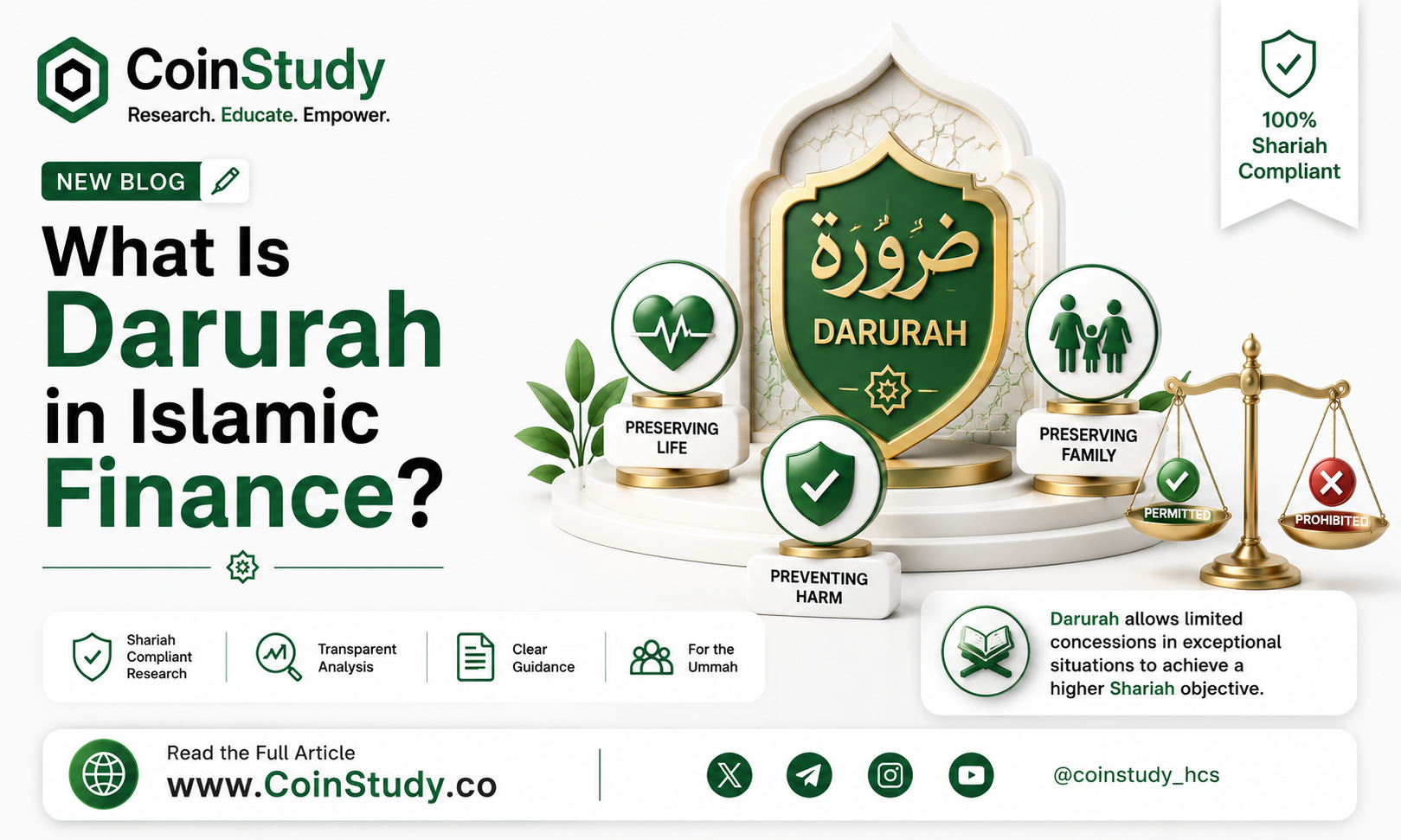
What Is Darurah in Islamic Finance?
Every Muslim who takes their faith seriously eventually faces a version of this question.
Not as a theoretical puzzle for a classroom. As a real situation, with real stakes, where the answer actually matters for how they live and what they decide.
A family member needs urgent surgery. The bills are beyond what any halal source can cover. Zakat funds are exhausted. Family and friends have given everything they can. Islamic charities have no more capacity. Interest-free loan options do not exist in this specific place at this specific time. The hospital requires payment. The life is at risk.
Is there any Islamic ruling that addresses this situation honestly, without either dismissing the severity of Riba or abandoning a person in genuine crisis?
The answer is yes. And it has been established in Islamic law for over fourteen centuries.
The Principle of Darurah — What It Actually Means
Darurah comes from the Arabic root meaning severe necessity or dire compulsion. It is not a modern invention or a contemporary rationalization. It is one of the most ancient, most rigorously discussed, and most firmly established principles in classical Islamic jurisprudence, recognized across all four major Sunni schools of thought.
The principle can be stated simply. When a person faces genuine compulsion that threatens one of the fundamental objectives Islamic law exists to protect, the prohibition that would otherwise apply is lifted to the minimum extent necessary to remove that compulsion.
This is not a loophole. It is not a clever workaround. It is a direct expression of Islam's core understanding that the law was given to serve humanity, not to destroy it.
The Quranic Foundation
The Prophet Muhammad, peace be upon him, did not invent the principle of necessity. It is established directly in the Quran, in multiple places, in language that could not be more clear.
Allah says in Surah Al-Baqarah: "He has only forbidden to you dead animals, blood, the flesh of swine, and that which has been dedicated to other than Allah. But whoever is forced by necessity, neither desiring nor transgressing, there is no sin upon him. Indeed, Allah is Forgiving and Merciful." (2:173)
The same principle appears in Surah Al-An'am: "But whoever is forced by necessity, neither desiring nor transgressing, indeed, your Lord is Forgiving and Merciful." (6:145)
And in Surah Al-Ma'idah: "Whoever is forced by severe hunger with no inclination to sin, then indeed, Allah is Forgiving and Merciful." (5:3)
The pattern across these verses is identical and deliberate. A genuine prohibition is stated. An exception for genuine necessity is immediately established. Allah's mercy and forgiveness are explicitly invoked.
The Prophet Muhammad, peace be upon him, reinforced this principle through hadith as well. He said: "Harm shall not be inflicted or reciprocated." This foundational hadith, authenticated in Ibn Majah and Al-Muwatta, established that Islamic law does not exist to cause additional harm to a person who is already suffering genuine compulsion.
From these evidences and others, Islamic scholars across all centuries and all major schools derived the formal legal maxim: Al-darurat tubih al-mahzurat. Necessities render permissible that which is otherwise prohibited.
What Exactly Qualifies as Darurah?
This is the most practically important question, and it requires a precise answer rather than a vague one.
Darurah in Islamic law is not simply hardship, inconvenience, or financial difficulty. It is a specific legal category defined by Islamic scholars with specific conditions that must genuinely be met before the principle applies.
The classical scholarly definition of Darurah is a state of genuine compulsion in which there is a real threat to the preservation of one or more of the five Maqasid al-Shariah, the foundational objectives that Islamic law exists to protect and preserve.
These five objectives are the preservation of life, the preservation of intellect and reason, the preservation of lineage and family, the preservation of wealth, and the preservation of religion.
A genuine life-threatening medical emergency directly threatens the first and most important of these objectives, which is the preservation of life itself. This is why Islamic scholars of all major schools consistently place genuine medical emergencies among the clearest and most recognized examples of situations where the conditions of Darurah can be met.
The Six Scholarly Answers — From Our Shariah Board Chairman
CoinStudy's Shariah Board chairman, who holds a PhD in Islamic Studies & finance and operates under AAOIFI standards, provided direct scholarly responses to the six specific questions this topic requires addressing. His responses are presented here in full.
On the definition of Darurah:
Darurah is a state of compulsion in which there is a genuine threat to the preservation of life, wealth, religion, intellect, or lineage. These are the Maqasid al-Shariah, the objectives of Islamic law. To the extent that genuine compulsion is established in any of these categories, prohibited matters become permissible to that same degree.
On who determines whether Darurah has been reached:
The person who faces the necessity is the one who determines to what extent they are genuinely compelled. This is an important and often misunderstood point. Islamic law does not require a person in genuine crisis to wait for external certification of their necessity before the principle applies. The individual, knowing their own circumstances honestly, makes this determination themselves, with the understanding that they are accountable to Allah for the honesty of that assessment.
On whether medical emergencies qualify:
Medical and emergency situations relate to the preservation of life and wealth, therefore they fall within the subject matter of Darurah. A life-threatening medical situation is not merely analogous to necessity. It is one of the most direct and clearest examples of what the principle was designed to address.
On what becomes permissible and to what extent:
Whatever is prohibited becomes permissible to the degree that the necessity actually requires, and not beyond it. This condition of proportionality is essential. Darurah does not open a blanket permission for everything prohibited. It permits specifically and only what is required to resolve the specific compulsion that exists.
On scholarly consensus:
This is a Quranic ruling and Islamic scholars are in unanimous consensus on it. The principle of Darurah is not a minority opinion, a disputed ruling, or a modern liberal interpretation. It is among the most firmly established principles in all of Islamic jurisprudence, agreed upon across all four major Sunni schools and recognized by Islamic scholars across fourteen centuries of scholarly tradition.
On the Muslim's position within human society:
A Muslim is also a member of human society, and it is therefore necessary for them to remove genuine compulsion to the extent that necessity demands. This is a profound and important point. Islam does not expect its followers to be superhuman, to suffer preventable death rather than use a prohibited means of last resort when no permissible means genuinely remains available. The mercy embedded in Islamic law is real, and it applies to real human beings in real human situations.
The Four Conditions That Must Be Genuinely Present
Understanding that Darurah exists is only the beginning. Understanding the specific conditions that must be genuinely present before it applies is equally important, because the principle is not unlimited and its application requires honest self-examination.
Classical Islamic scholars, drawing on the Quranic formulation of "neither desiring nor transgressing," have consistently identified four conditions.
First, the threat must be real, current, and genuine. Theoretical future risk or speculative harm does not activate the principle. The danger must be actually present and actually threatening one of the five objectives at the time the decision is made.
Second, all genuinely available halal alternatives must have been exhausted. This condition requires real effort, not perfunctory looking. If an interest-free loan is realistically available but was not seriously pursued, the condition is not met. If zakat funds exist but were not applied for, the condition is not met. The exhaustion of alternatives must be genuine and documented in the person's honest knowledge of their own situation.
Third, the prohibited action must be limited to the minimum extent necessary. Darurah permits exactly what is required to remove the specific compulsion that exists. It does not permit more. If a specific amount of an interest-bearing loan is needed for a specific medical procedure, the permission extends to that amount for that purpose. Borrowing more than is necessary, or using the permission for additional purposes beyond the necessity, falls outside the scope of what Darurah authorizes.
Fourth, the person must have no intention of transgressing or exploiting the permission. The Quranic formulation is explicit: "neither desiring nor transgressing." A person who uses a genuine emergency as a pretext to access something they wanted access to regardless is not operating within Darurah. The honest internal intention matters.
The Question of Who Makes This Determination
One of the most practically significant points in our chairman's response deserves particular attention, because it differs from what Muslim investors often assume.
The person who faces the necessity is the one who determines to what extent they are genuinely compelled.
This does not mean the determination is arbitrary or unchecked. It means that Islamic law places the honest assessment of genuine necessity on the person who is actually experiencing the compulsion, not on an external authority who must certify their suffering before any action is permitted.
This makes sense when understood correctly. No external scholar, however qualified, can fully know the internal reality of another person's situation with the completeness that the person themselves knows it. The person knows what alternatives they genuinely tried and found unavailable. The person knows the real severity of the threat they face. The person knows whether their own internal intention is genuinely to resolve a genuine necessity or to rationalize access to something desired.
Islamic law places this determination on the individual's honest conscience and their accountability directly before Allah, not on a bureaucratic certification process. This is both practically sensible and theologically coherent with Islam's understanding of individual moral responsibility before the Creator.
What is recommended, though not formally required for the principle to apply, is seeking scholarly guidance wherever it is genuinely available and accessible. A qualified scholar can help a person honestly examine whether the conditions are genuinely met, identify halal alternatives that may not have been considered, and ensure that the proportionality condition is properly understood. This guidance is genuinely valuable even when it is not legally required for the principle to operate.
How Darurah Applies to Financial Riba in a Medical Emergency
The specific scenario that prompted this discussion deserves direct address. Can Darurah apply to an interest-based loan taken for a genuine, life-threatening medical emergency when all halal alternatives have truly been exhausted?
The scholarly consensus, as confirmed by our chairman, is yes. The conditions of the principle, when genuinely met, extend to this situation.
The life-threatening medical emergency is a direct threat to life, the highest of the five objectives Islamic law protects. The exhaustion of all halal alternatives, family support, friends, zakat, sadaqah, charitable organizations, and interest-free lending options, satisfies the condition of genuine necessity without available permissible remedy. The limitation to borrowing only what is needed for the medical treatment satisfies the proportionality condition. The honest motivation of preserving life rather than seeking financial advantage satisfies the "neither desiring nor transgressing" condition.
When all of these conditions are genuinely present, and only when they are genuinely present, the prohibition of Riba is suspended to the specific extent required to resolve the specific necessity. This is not permanent permission. It is a bounded, temporary, proportional suspension of a prohibition for the purpose of removing genuine compulsion.
What Happens After the Necessity Is Resolved
One aspect of Darurah that is sometimes overlooked in discussions of the principle is what follows after the compulsion is removed.
The permission that Darurah grants is bounded in time and scope by the necessity itself. Once the necessity no longer exists, because the medical emergency is resolved, the patient recovers, or other means become available to repay the interest-bearing obligation, the person returns to full compliance with the original prohibition.
If an interest-bearing loan was taken under Darurah for a medical emergency, the obligation is to repay it as quickly as possible, to avoid allowing it to compound or grow beyond what was originally necessary, and to return to full Riba avoidance in all financial dealings as soon as circumstances permit. Some scholars also recommend accompanying the return to compliance with sincere repentance and increased charitable giving, both as acknowledgment of having used a prohibited means even under necessity and as gratitude to Allah for the mercy that the principle of Darurah represents.
A Note on Darurah and Its Boundaries
It would be incomplete to discuss Darurah without also being honest about where it does not apply, because the principle has boundaries that matter.
Darurah does not apply to desires, preferences, or conveniences. It does not apply to financial situations that are genuinely difficult but not genuinely life-threatening. It does not apply when halal alternatives have not been seriously and genuinely exhausted. It does not apply beyond the minimum required to remove the specific compulsion.
Islamic scholars across all centuries have consistently warned against expanding the principle of necessity beyond its genuine scope, because doing so would effectively dissolve the very prohibitions the principle is meant to respect. Darurah is mercy within the law, not dissolution of the law.
The honest Muslim who finds themselves needing to invoke this principle should approach it with genuine humility, honest self-examination, and the full recognition that they are accountable before Allah for the truthfulness of their assessment of their own necessity.
Guidance for Muslim Investors in Difficult Financial Situations
While this blog's immediate context is a medical emergency, the principle of Darurah has broader application to financial situations that Muslim investors may face. Understanding it correctly protects against both excessive rigidity that ignores genuine mercy and excessive latitude that expands the principle beyond its legitimate scope.
Before concluding that a financial situation has reached the level of Darurah, genuinely and seriously exhaust every available halal alternative. Document your efforts honestly in your own knowledge, since you are accountable for this honestly before Allah. Seek the guidance of a qualified Islamic scholar wherever accessible, not because external certification is required but because genuine scholarly guidance helps ensure the conditions are honestly met. If the principle genuinely applies, use it proportionally, exactly what is needed and nothing more. Return to full compliance as soon as circumstances permit.
Final Verdict
Darurah is one of Islamic law's most profound expressions of mercy within principle. It exists not because the prohibitions are arbitrary or negotiable, but because the law was given to serve human wellbeing, and serving human wellbeing sometimes requires a bounded, honest, and proportional acknowledgment that genuine compulsion exists.
A life-threatening medical emergency, with all halal alternatives genuinely exhausted, falls within the recognized scope of Darurah in the view of Islamic scholars across all major schools, as affirmed by our Shariah Board chairman. The prohibition of Riba is suspended to the minimum extent necessary to preserve the life that Islamic law itself exists to protect.
This is not a convenient permission for financial ease. It is a carefully bounded mercy for genuine human crisis. The difference between the two lies entirely in the honest conscience of the person invoking it and their accountability before Allah.
May Allah grant every Muslim in genuine need the clarity to assess their situation honestly, the resources to avoid necessity entirely wherever possible, and the mercy that Islamic law itself guarantees when genuine necessity genuinely exists.
Read detail analysis of following coins here:
Is USDT Halal?
Is Forex Trading Halal?
Learn how CoinStudy scores every coin
Learn Halal Trading Strategies with CoinStudy's Partner
Disclaimer: This article is provided for educational and research purposes only. The scholarly responses included are provided by CoinStudy's Shariah Board chairman in his capacity as an Islamic finance scholar. This article is not a personal fatwa for any specific individual situation. Muslim investors facing real financial emergencies are encouraged to seek personal guidance from a qualified Islamic scholar who knows their full circumstances.