


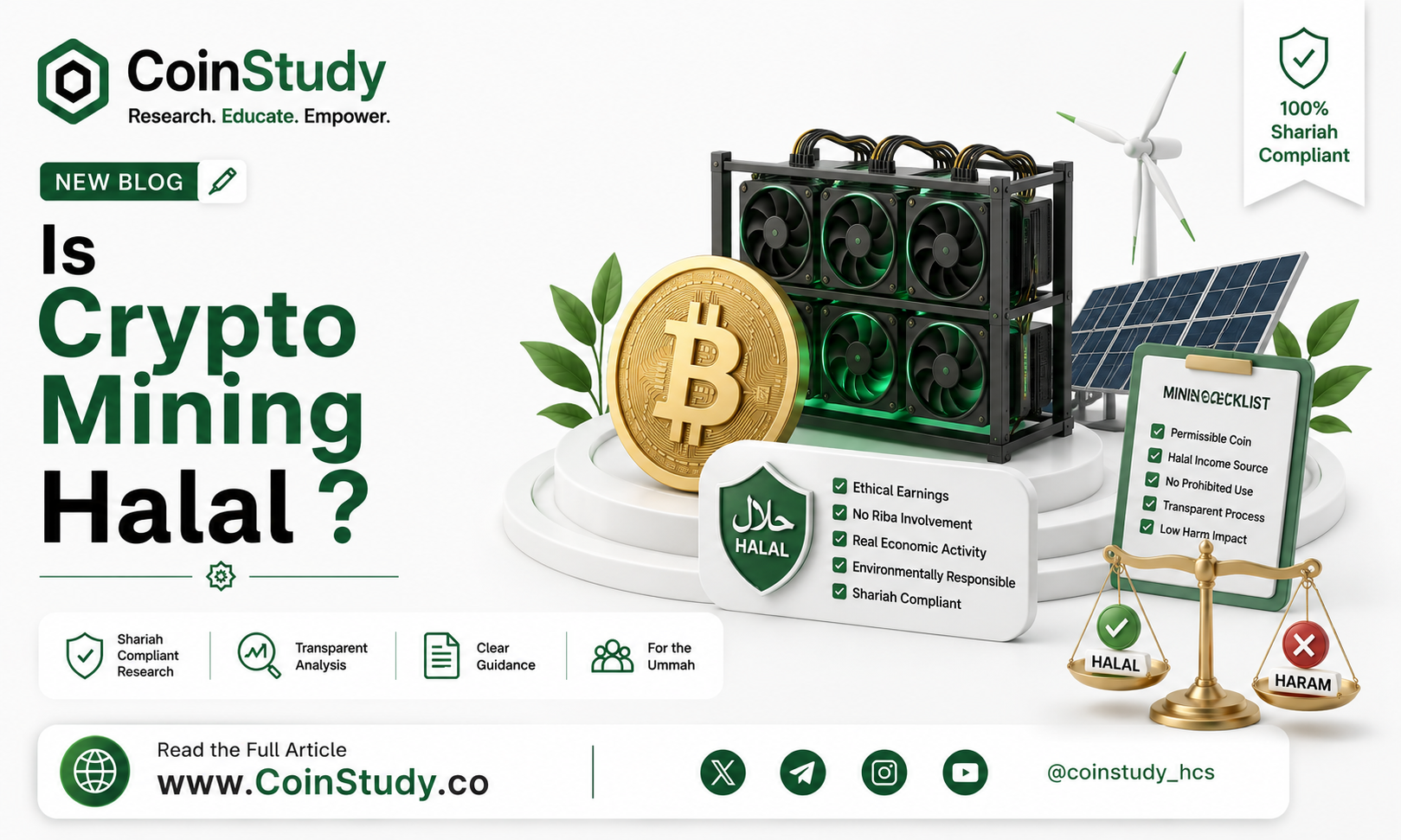
Is Crypto Mining Halal?
Every Bitcoin in existence started the same way.
Before it could be bought, sold, or held, it had to be mined. Somewhere in the world, a machine solved a cryptographic puzzle, earned the right to add a new block to the blockchain, and received newly created Bitcoin as a reward. This process has run continuously since 2009, consuming enormous amounts of electricity and computing power in the process.
For Muslim investors, particularly those considering mining as a business activity rather than simply buying crypto on an exchange, the question deserves a complete and dedicated answer. We examined crypto mining through Islamic finance principles the same way CoinStudy evaluates every financial activity. Here is the complete picture.
Quick Verdict: Crypto Mining Is Generally Halal With Conditions ✅
Crypto mining does not inherently involve Riba or operate as a gambling system. It is primarily a process of providing computational work, securing a network, and earning rewards for genuine participation.
Under the CoinStudy Halal Crypto Standard, Layer 1 screening passes cleanly and Layer 2 analysis is generally positive, with specific operational considerations that responsible Muslim miners should understand and apply.
What Is Crypto Mining?
Crypto mining is the process of validating blockchain transactions, securing the network, and adding new blocks to the blockchain. Miners use powerful computers to solve complex mathematical problems, and in return they receive block rewards in the form of newly created coins plus transaction fees paid by network users.
This is fundamentally a service. Miners are not lending money. They are not charging interest. They are deploying computational resources, electricity, and hardware to perform the genuine economic function of validating and securing a transaction network. In exchange for this service, they receive compensation.
How Crypto Mining Works
Mining is most commonly associated with Proof of Work systems like Bitcoin. In a Proof of Work network, miners compete to solve cryptographic puzzles. The first to solve it earns the right to add the next block to the blockchain, and rewards are distributed for successful validation.
Mining requires specialized hardware, significant electricity consumption, and genuine technical expertise. This combination of deployed capital, consumed resources, and applied expertise is what makes mining a resource-based productive activity rather than a passive financial arrangement.
Mining also serves a critical functional purpose beyond individual miner compensation. It ensures network security, transaction validation, and decentralization. Without mining, Proof of Work blockchain networks would not function at all.
The Ijarah Framework — Why Mining Has a Strong Permissibility Foundation
This is the central concept that most discussions of crypto mining skip entirely, and it deserves to be the foundation of this analysis.
Islamic finance has a well-established contract structure called Ijarah, which governs payment for services or the use of an asset. When a person performs genuine labor, deploys genuine resources, or provides a genuine service, and receives compensation for that service, this falls under Ijarah principles and is permissible.
Crypto mining maps onto this framework directly. A miner deploys real capital in the form of mining hardware. They consume real electricity. They perform a genuine computational service that secures the network and validates transactions. The reward they receive is compensation for this service, similar in structure to how Sharia-compliant cloud computing, manufacturing, or technical service providers earn compensation for deploying their resources and expertise.
This is structurally and meaningfully different from Riba. In a Riba arrangement, capital is lent and a predetermined return is demanded regardless of whether any productive activity occurs. In mining, the reward is earned through the deployment of real computational work and is never guaranteed. A miner who deploys equipment and electricity may earn nothing in a given period if their hardware fails to solve a block before competitors do.
This distinction, between earning through deployed productive effort versus earning through guaranteed return on lent capital, is precisely the line that separates permissible commerce from Riba in Islamic finance.
Islamic Principles Relevant to Mining
Riba — Interest
Mining does not involve lending money or earning interest. This removes the primary and most serious concern that disqualifies most other crypto financial products in CoinStudy's analysis series.
Gharar — Uncertainty
Mining outcomes are genuinely uncertain. A miner invests in hardware and electricity with no guarantee of earning any specific reward in any specific timeframe. Mining difficulty adjusts automatically based on total network computing power, meaning rewards become harder to earn as more miners compete.
This raises a legitimate Gharar question. However Islamic finance distinguishes between excessive and prohibited uncertainty in the terms of a contract itself, and normal commercial risk inherent in any productive business activity.
A farmer who plants crops does not know with certainty what their harvest will yield, yet farming is unquestionably permissible. A merchant who imports goods does not know with certainty what price they will sell for, yet trade is foundational to Islamic commerce. Mining's uncertainty is of this same character. It is business risk inherent in deploying capital toward a productive activity with variable but genuine outcomes, not the kind of fundamental contractual ambiguity that Gharar specifically prohibits.
The mining reward mechanism itself is also transparent and publicly verifiable. The rules governing block rewards, difficulty adjustment, and halving schedules are published, predictable, and identical for every participant. This transparency further reduces the Gharar concern compared to genuinely opaque or manipulable arrangements.
Maysir — Speculation
Mining is not inherently speculative. It is based on effort, deployed resources, and genuine contribution to network security and transaction validation, not on chance or betting against other participants. The reward structure compensates productive work, not prediction of uncertain future outcomes.
CoinStudy HCS Analysis
Layer 1 — Sharia Red Line Screening
Mining is checked against the same five red lines applied to every coin and activity in CoinStudy's methodology.
Ecosystem Riba Exposure — ✅ Passed. Mining does not involve interest-based lending. Compensation comes from genuine computational service under the Ijarah framework.
Gambling and Betting — ✅ Passed. Mining is not a gambling system. Rewards are earned through verifiable computational work, not chance-based wagering.
Haram Industry — ✅ Passed. Mining as an activity is not linked to any prohibited industry.
Guaranteed Interest — ✅ Passed. Mining does not guarantee fixed returns. Rewards depend entirely on successfully solving blocks, which is never certain.
Synthetic Interest Products — ✅ Passed. No synthetic interest instruments exist in the basic mining reward structure.
No red line violations were found. Mining as an activity is eligible for Layer 2 consideration.
Layer 2 — Illustrative Assessment
Since mining is an activity rather than a single tradeable coin, Layer 2 is presented as a qualitative assessment rather than a numeric score.
Riba Exposure is low, since mining involves no direct interest-based mechanism.
Gharar is low to moderate, reflecting reward variability tied to mining difficulty and market price fluctuation, which is normal business uncertainty rather than excessive contractual ambiguity.
Maysir is low, since rewards stem from computational effort and network participation, not speculation against other participants.
Underlying Business Activity is strong, since mining performs the genuinely essential function of securing and validating a blockchain network.
Utility is high, given mining's direct and indispensable role in maintaining decentralization and transaction processing for Proof of Work networks.
Tokenomics considerations are strong when block reward schedules are transparent, publicly known in advance, and applied identically to every participant, as is the case with Bitcoin's published halving schedule.
Transparency is high, since most mining systems operate on openly published, rule-based, and decentralized protocols where every participant can verify the rules governing reward distribution.
What Determines Permissibility — The Underlying Coin Matters
This is the single most important qualifying principle in this entire analysis, and it deserves direct emphasis.
Mining itself, as an activity, is permissible under the Ijarah framework described above. But mining a specific coin is only permissible if that coin's underlying structure passes Islamic finance screening on its own merits.
This means mining Bitcoin, which CoinStudy classifies as Halal due to its clean payment-focused structure with no built-in interest mechanisms, would be permissible from the underlying asset perspective, subject to the energy and environmental considerations discussed below. Mining a coin that CoinStudy classifies as Haram, due to debt-based creation mechanisms, gambling features, or interest-generating ecosystem connections, would not become permissible simply because the mining process itself uses a permissible Ijarah structure.
The service of mining is neutral. What you are mining is not automatically neutral. Both questions must be answered, and a positive answer to one does not resolve the other.
Proof of Work Mining vs Proof of Stake Validation
It is worth clarifying a distinction that often creates confusion among Muslim investors researching this topic.
Traditional mining, as described throughout this blog, applies specifically to Proof of Work networks like Bitcoin, where miners deploy computational hardware to solve cryptographic puzzles. Many newer blockchains, including Ethereum since 2022, use Proof of Stake instead, where validators lock up existing tokens rather than deploying computing power to secure the network.
These are genuinely different mechanisms requiring separate analysis. CoinStudy has addressed Proof of Stake validation and staking extensively in our dedicated staking content, where the core question revolves around whether rewards come from genuine block production and network security participation versus disguised lending arrangements. Proof of Work mining, by contrast, centers on the Ijarah-based computational service framework discussed in this blog. Muslim investors should not conflate the two when researching permissibility, as the underlying mechanisms and the specific concerns each raises are distinct.
The Energy and Environmental Dimension — An Honest Addition
Most discussions of crypto mining's Islamic permissibility focus exclusively on the financial structure. This misses an important dimension that genuinely matters in Islamic ethics.
Islam places significant emphasis on the principle of avoiding wasteful consumption and unnecessary harm, captured in concepts like Israf, which refers to extravagance and waste, and the broader Islamic principle of environmental stewardship, or Khalifah, which describes humanity's responsibility as custodians of the earth's resources.
Proof of Work mining, particularly Bitcoin mining, consumes substantial amounts of electricity globally. This is not a Sharia compliance red line in the same category as Riba or Maysir, but it is a genuine ethical consideration that conscientious Muslim investors evaluating mining as a personal business activity should weigh seriously.
This consideration becomes more favorable when mining operations specifically use renewable or otherwise underutilized energy sources, such as stranded natural gas, excess hydroelectric capacity, or genuinely renewable solar and wind installations built for mining purposes. A miner who deliberately structures their operation around responsible and sustainable energy sourcing is engaging in a more ethically considered form of the same underlying permissible activity than one who indiscriminately consumes whatever energy is cheapest regardless of source or environmental impact.
This is not a factor that changes the core Sharia compliance classification of mining as an activity, but it is a factor that responsible Muslim miners should genuinely consider as part of broader Islamic ethical conduct.
Mining Pools — An Additional Structural Question
Most individual miners today do not mine alone. They join mining pools, where many participants combine their computational power and split rewards proportionally based on contributed work.
This structure is generally consistent with Ijarah principles as well, provided the reward-sharing mechanism genuinely reflects each participant's actual contributed computational work rather than involving fixed guaranteed payouts disconnected from actual mining performance. A pool that pays participants proportionally based on verified work submitted is sharing genuine service compensation. A pool that promises fixed guaranteed daily payouts regardless of actual network conditions and difficulty would shift closer to a different and more concerning financial structure resembling guaranteed return products, which raises the same concerns CoinStudy identifies across guaranteed-yield platforms throughout our analysis series.
Muslim miners considering joining a pool should understand specifically how that pool's payout structure works before participating, applying the same due diligence CoinStudy recommends for any platform offering crypto-related rewards.
Cloud Mining — A Separate and More Concerning Category
A distinct product worth addressing separately is cloud mining, where a company sells contracts promising customers a share of mining output without those customers owning or operating any actual hardware themselves.
This category deserves significantly more caution than genuine mining. Many cloud mining arrangements have historically functioned closer to investment contracts promising fixed or guaranteed returns rather than genuine service-for-compensation arrangements, and the crypto industry has a well-documented history of fraudulent cloud mining schemes that never operated real mining hardware at all, simply paying early participants from new customer deposits in a pattern resembling Ponzi structures.
Muslim investors should apply far greater scrutiny to cloud mining contracts than to operating genuine personally controlled or verifiably operated mining hardware, specifically verifying that real hardware exists, that returns are genuinely variable based on actual mining performance rather than guaranteed, and that the operating company has verifiable transparency about its actual mining operations.
The Scholarly Consensus
Research into named scholarly positions on this question reveals a meaningfully consistent picture among scholars who have addressed crypto mining specifically.
Scholars including Mufti Muhammad Abu-Bakar and Mufti Faraz Adam, who have published detailed analysis on cryptocurrency from an Islamic finance perspective, generally view mining as permissible specifically because it constitutes genuine value-creating computational work rather than an interest-based arrangement, classifying the activity under the Ijarah framework for service compensation discussed throughout this blog.
This represents a meaningfully different and more settled scholarly position than exists for some other crypto activities CoinStudy has examined, such as forex trading or certain DeFi yield products, where genuine and significant scholarly disagreement persists. Mining's classification under Ijarah principles for service-based compensation is comparatively well-established among scholars who have specifically addressed it, though the qualification that the underlying mined asset itself must independently pass Sharia screening remains essential and non-negotiable.
Key Considerations for Muslim Miners
Mining is generally permissible when conducted ethically and within legal regulatory frameworks applicable to the miner's jurisdiction.
Energy consumption and environmental impact should be considered responsibly as part of broader Islamic ethical conduct, even though this does not alter the core Sharia compliance classification.
Market volatility and operational costs, including hardware depreciation, electricity price fluctuation, and changing mining difficulty, may significantly affect actual profitability and should be factored into any decision to engage in mining as a business activity.
Important Questions for Muslim Investors Considering Mining
Before engaging in crypto mining as a business activity, ask yourself honestly.
Does the coin I intend to mine independently pass Islamic finance screening, such as CoinStudy's HCS methodology? Am I deploying genuine hardware and resources, or am I purchasing a cloud mining contract whose underlying operations I cannot verify? If using a mining pool, does the payout structure genuinely reflect proportional contributed work rather than fixed guaranteed returns? Have I considered the energy sourcing of my mining operation from a broader Islamic ethical perspective around responsible resource use? Am I treating mining as a genuine productive business activity, or am I drawn to it primarily by speculative expectations about coin price appreciation?
Final Verdict
Crypto mining, as an activity, has a genuinely strong foundation for permissibility under Islamic finance principles, structured appropriately under the Ijarah framework as compensation for genuine computational service rather than interest on lent capital. This represents a relatively settled scholarly position compared to many other questions in Islamic crypto finance.
Based on the CoinStudy Halal Crypto Standard methodology, crypto mining is generally considered halal, as it involves providing real work, earning rewards for genuine contribution, and contains no inherent Riba or gambling structure at Layer 1.
However this permissibility is conditional, not unconditional. The coin being mined must independently pass Sharia compliance screening. Mining pool structures must distribute rewards based on genuine contributed work. Cloud mining contracts require significantly elevated scrutiny given documented fraud risks in that specific category. And responsible Muslim miners should give genuine consideration to the energy and environmental dimensions of their mining operations as part of broader Islamic ethical conduct, even though this consideration does not itself alter the core Sharia compliance classification.
Mining Bitcoin, which CoinStudy classifies as Halal, through genuine hardware with a transparent and proportional reward structure, represents one of the more clearly defensible forms of crypto-related economic activity available to Muslim investors today. Muslim participants should ensure ethical practices throughout and avoid involvement in impermissible activities such as fraudulent cloud mining schemes or pools offering disguised guaranteed returns.
Read detail analysis of following topics here:
Is Bitcoin Halal?
Is Crypto Staking Halal?
Is Crypto Trading Halal?
Learn Halal Trading Strategies with CoinStudy's Partner
Disclaimer: This article is provided for educational and research purposes only and does not constitute a formal fatwa. This analysis is based on guidance from CoinStudy's HCS Shariah Board members. CoinStudy does not issue personal fatwas or financial advice. Please consult a qualified Islamic scholar for individual guidance specific to your mining operation and circumstances.