

Why Sharia Screening Matters in Crypto
Every day, millions of Muslim investors face the same silent dilemma.
The crypto market is growing. Opportunities are everywhere. Friends are investing. Social media is full of success stories. And somewhere in the background, a quiet but important question remains unanswered.
Is this halal?
That question is not paranoia. It is not overly cautious. It is the natural and correct instinct of a Muslim investor who understands that how you earn matters as much as how much you earn. And without a systematic, principled answer to that question, Muslim investors are left choosing between two uncomfortable options. Invest without knowing and risk earning from something prohibited. Or avoid crypto entirely and potentially miss genuine permissible opportunities.
Sharia screening exists to solve this problem. CoinStudy's Halal Crypto Standard exists to make that solution systematic, transparent, and accessible to every Muslim investor in the world.
This blog explains why Sharia screening is essential in crypto, what it looks like in practice, and what happens when it is absent.
The Crypto Market Is Not Simple
Most people think of cryptocurrency as buying Bitcoin and watching the price go up or down.
The reality is far more complex. The crypto market today includes:
Decentralized finance protocols where users can lend, borrow, and earn yields on deposited assets. Stablecoin systems where tokens maintain fixed values through reserve mechanisms backed by government bonds or algorithmic financial engineering. Derivatives markets where traders open leveraged positions on cryptocurrency price movements without owning the underlying assets. NFT and gaming ecosystems where digital assets are bought, sold, and traded with varying degrees of speculative activity. Yield farming platforms where capital is deployed across multiple protocols to maximize returns through automated strategies. Perpetual futures markets where traders pay ongoing funding rates between long and short positions.
Each of these categories introduces completely different Islamic finance considerations. A project that passes every compliance test in one category may fail immediately in another. The complexity of the crypto market means that the question "is this halal" cannot be answered with a single general rule. It requires systematic evaluation of each specific financial structure.
What Happens Without Sharia Screening
This is the honest and uncomfortable question that every Muslim investor needs to consider.
Without proper Sharia screening, Muslim investors may unknowingly engage in financial activities that are prohibited under Islamic law. Not because they are dishonest or careless. But because the prohibited elements are often invisible to someone who does not know what to look for.
The Riba Problem
A Muslim investor discovers a platform offering 15% APY on deposited USDT. The marketing calls it "staking rewards." The interface looks clean and professional. Nothing obviously flags it as problematic.
But underneath the surface, the platform is lending deposited assets to borrowers who pay interest charges. The 15% APY is funded by that interest income. The Muslim investor is earning Riba without knowing it because the financial structure is described in technology language rather than in the financial terms that would immediately trigger recognition.
CoinStudy's analysis series has identified this pattern across dozens of platforms. The terminology changes. The structure does not. Yield programs, earn accounts, lending vaults, and savings products all use different names for the same economic relationship, which is deposited capital generating guaranteed percentage returns through interest-based mechanisms.
The Maysir Problem
A Muslim investor buys a meme coin because their social media feed is full of people making extraordinary returns. The community is enthusiastic. The price is moving. The FOMO is real.
What is actually happening is a wealth transfer mechanism where early holders profit from the capital of late buyers. No economic value is created. No genuine utility is provided. The entire market dynamic is driven by social media momentum and speculation rather than fundamental economic activity. This is the financial structure Islamic finance identifies as Maysir, which is gambling-like activity where one participant's gain comes directly from another's loss.
Without Sharia screening, there is no systematic way to identify this dynamic before investing. CoinStudy's analysis of meme coins in our series has consistently revealed that the speculative dynamics are structural features of these tokens, not incidental risks.
The Gharar Problem
A Muslim investor discovers a promising new project with an impressive whitepaper, a large community, and a compelling vision. The team is anonymous. The tokenomics are complex. The revenue model is unclear.
Gharar is the Islamic finance prohibition on excessive uncertainty in financial contracts. It does not prohibit all uncertainty, since every investment involves some uncertainty. It prohibits financial arrangements where the fundamental nature of what is being transacted is genuinely unclear or unknowable.
Anonymous teams mean no accountability. Complex tokenomics with unclear distributions mean no transparency about who benefits and when. Vague revenue models mean no sustainable economic foundation for the token's value. These are not investment risks. They are structural Gharar concerns that Islamic finance specifically addresses.
The Haram Ecosystem Problem
This is perhaps the most subtle concern and the one most often overlooked even by Muslim investors who are actively trying to invest halal.
A Muslim investor holds an exchange token because the exchange is widely used and the token provides trading fee discounts. The token itself has no lending mechanism. It pays no guaranteed returns. It has no direct gambling feature.
But the exchange it belongs to generates enormous revenue from interest-bearing earn programs, lending products with advertised APY rates, and perpetual futures markets with leverage financing fees. The token's value grows when these products grow. Holding the token means benefiting financially from the growth of prohibited financial activity even without personally using any of those products.
Without Sharia screening that evaluates ecosystem-level exposure, this indirect compliance concern is completely invisible. CoinStudy's analysis series has identified this pattern across eight consecutive exchange tokens, all classified as Haram for this reason.
Why Conventional Analysis Falls Short
The crypto market has no shortage of research tools, price analysis platforms, and investment research.
CoinMarketCap provides market data. DeFiLlama tracks Total Value Locked. Messari produces detailed research reports. Token Terminal analyzes protocol revenue. These are all genuinely useful tools for conventional investment research.
None of them ask the Islamic finance questions that matter to Muslim investors.
A project can show strong price performance, growing Total Value Locked, and excellent fundamental metrics while simultaneously having interest-bearing financial structures embedded in its core mechanism. The conventional research tools will rate it positively. The Sharia screening will classify it as Haram.
This is not a flaw in conventional research tools. They were not built to answer Islamic finance questions. But it does mean that Muslim investors who rely only on conventional research are missing an entire dimension of analysis that is critical to their investment decisions.
CoinStudy exists specifically to fill this gap. Not to replace conventional financial analysis but to add the Islamic finance dimension that conventional tools were never designed to provide.
What Sharia Screening Actually Is
Sharia screening is the systematic process of evaluating whether a financial instrument, investment, or activity complies with Islamic law and aligns with Islamic economic principles.
In traditional Islamic finance, Sharia screening was developed for conventional equity investments. Scholars and institutions developed frameworks to evaluate whether companies were involved in prohibited industries, whether their revenue came substantially from interest-based activities, and whether their debt structures created excessive leverage.
Applying Sharia screening to cryptocurrency requires extending and adapting these frameworks to address the specific financial structures that exist in the crypto market. Token economics are different from company equity. DeFi protocol mechanics are different from corporate lending. Perpetual futures are different from conventional derivatives.
CoinStudy's Halal Crypto Standard was built from the ground up to address crypto-specific compliance questions using Islamic finance principles as the analytical framework.
The CoinStudy HCS Methodology — How It Works
CoinStudy's Halal Crypto Standard uses a two-layer screening process that evaluates every cryptocurrency systematically.
Layer 1 — Sharia Red Line Screening
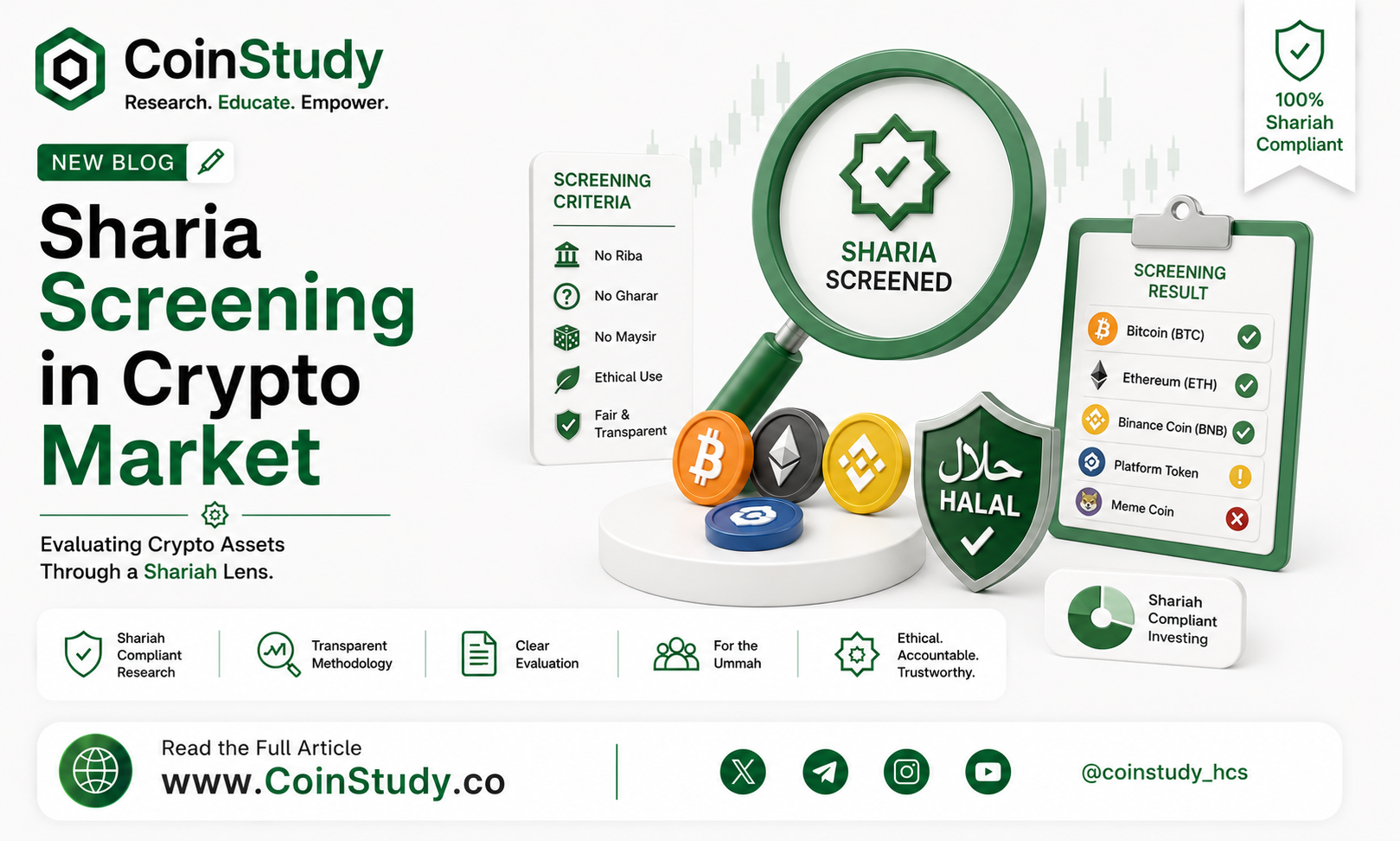
Layer 1 is a binary gateway. Every cryptocurrency must pass five absolute prohibitions before it is eligible for further evaluation. A single failure results in automatic Haram classification regardless of any other characteristics of the project.
The five red lines are:
Ecosystem Riba Exposure asks whether the token or the ecosystem it powers has a structural connection to interest-generating mechanisms, whether directly through the token itself or indirectly through the ecosystem whose growth drives the token's value. USDT fails this because its Treasury bill reserves generate interest income. BNB fails this because the Binance ecosystem's lending and earn products generate interest revenue that drives BNB's value.
Gambling and Betting asks whether the protocol facilitates or is built around gambling-like financial activity. Hyperliquid fails this because its entire business model is perpetual futures trading where traders bet on price movements. Polymarket fails this because its entire purpose is financial speculation on uncertain future event outcomes.
Haram Industry asks whether the project is directly involved in prohibited industries including alcohol, tobacco, conventional banking, gambling operations, or prohibited content.
Guaranteed Interest asks whether the protocol promises fixed predetermined percentage returns on deposited capital. Aerodrome Finance fails this because the veAERO vote-lock mechanism offers explicit ongoing fee distributions on locked capital positions constituting guaranteed percentage-based returns.
Synthetic Interest Products asks whether the token functions economically as an interest-bearing instrument even if not formally structured as a loan or savings product. Curve Finance's Savings crvUSD fails this because it distributes ongoing yield from the protocol's interest-generating activities to holders.
Layer 2 — The HCS Score
Projects that pass Layer 1 are scored across seven dimensions on a 100-point scale.
Financial Exposure Risk measures the degree of indirect financial exposure to interest-based products within the broader ecosystem on a spectrum from zero to 25 points.
Gharar and Uncertainty measures clarity in contracts and the absence of excessive uncertainty from zero to 15 points.
Maysir and Speculation measures the absence of gambling-like mechanics or high-speculation design from zero to 15 points.
Underlying Business Activity measures whether the nature of the project's core business is genuinely permissible from zero to 15 points.
Utility and Real Use measures genuine utility and real economic value from zero to 10 points.
Tokenomics Fairness measures fair distribution, absence of exploitation, and sustainable tokenomics from zero to 10 points.
Transparency and Governance measures open-source development, audit history, and clear governance structures from zero to 10 points.
The total score determines the classification. A score of 80 to 100 is classified as Halal. A score of 60 to 79 is classified as Halal With Concerns. A score of 40 to 59 is classified as Doubtful. A score below 40 or any Layer 1 failure is classified as Haram.
Real Examples — Why These Classifications Matter
The most important way to understand why Sharia screening matters is to see its outcomes applied to real assets that Muslim investors actually hold and consider.
Bitcoin: 95/100 Halal
Bitcoin is a pure payment and store of value network. No lending. No yield. No interest mechanisms. Fixed supply of 21 million coins providing genuine scarcity. Over 15 years of operational history. Sharia screening confirms what many Muslim investors already intuitively believe. Bitcoin is one of the most clearly halal assets in the crypto market.
USDT: Haram
USDT is used by virtually every crypto trader in the world. It appears to simply be a dollar that moves quickly. But its Treasury bill reserves generate interest income that funds the stability mechanism. Three red lines fail. Sharia screening reveals a structural Riba problem that is invisible without systematic analysis.
BNB: Haram
BNB provides trading fee discounts on the world's largest exchange. It appears to be a simple utility token. But Binance's lending products, earn programs, and perpetual futures markets generate enormous revenue and BNB's value grows when these products grow. Ecosystem Riba Exposure makes BNB non-compliant despite the token itself having no direct interest mechanism.
Hyperliquid: Haram
Hyperliquid is technically one of the most impressive decentralized exchanges ever built. Genuine innovation. Real adoption. Strong performance. But its entire business model is perpetual futures trading. The decentralization does not change what is being traded. Three red lines fail immediately.
Akash Network: 88/100 Halal
Akash is a decentralized cloud computing marketplace where buyers pay for compute services and providers earn for genuine work performed. Service-based economics with no interest mechanisms. Real utility for AI model training and deployment. Sharia screening confirms a strong halal classification that Muslim investors can rely on.
These five examples illustrate why the same systematic framework applied consistently produces dramatically different outcomes across projects that might all appear superficially similar as "crypto investments."
The Four Benefits of Systematic Sharia Screening
Benefit 1 — Protecting Investors From Invisible Risks
The most significant risks in Islamic finance terms are often invisible to investors without specialized knowledge. Interest-bearing reserve structures, ecosystem Riba exposure, and synthetic interest products are not labeled as such in crypto marketing materials. Systematic screening makes these invisible risks visible before investment decisions are made.
Benefit 2 — Building Genuine Confidence
There is a meaningful difference between hoping your investment is halal and knowing it has been systematically evaluated against Islamic finance principles by a Shariah Board-reviewed methodology. CoinStudy's analyses give Muslim investors the confidence to invest based on knowledge rather than assumption.
Benefit 3 — Encouraging Ethical Innovation
When halal-classified projects receive more investment from the Muslim investor community and haram-classified projects receive less, market forces begin to reward ethical project design. Systematic Sharia screening creates economic incentives for crypto projects to build permissible financial structures. This is how Islamic finance principles shape markets rather than simply reacting to them.
Benefit 4 — Reducing Broader Financial Risk
The overlap between Islamic finance principles and sound financial risk management is not coincidental. Excessive leverage, opaque financial structures, concentrated ownership, and guaranteed returns that are economically unsustainable all fail Islamic finance screening for principled reasons. The same Terra Classic ecosystem whose algorithmic stablecoin mechanism made it haram under Islamic finance also collapsed catastrophically in May 2022. The same perpetual futures platforms whose leverage financing fees trigger Islamic finance red lines are also where retail investors lose enormous amounts of capital through liquidations. Islamic finance principles and prudent risk management frequently point in the same direction.
The Responsibility That Remains With Muslim Investors
Sharia screening is a tool. Like any tool, its value depends on how it is used.
CoinStudy's analyses identify whether a project's financial structure is permissible. They cannot control how Muslim investors engage with permissible projects. A halal-classified asset can still be traded in haram ways. Bitcoin is halal as a payment network and store of value. Bitcoin traded with 100x leverage on a perpetual futures platform is not halal regardless of Bitcoin's own classification.
The screening tells you whether the asset is permissible. Your behavior, your intent, and your strategy determine whether your participation in that asset is permissible.
Several responsibilities remain with Muslim investors even when investing in halal-classified assets.
Verify the specific platform you use. A halal-rated coin on a haram-classified exchange is a different compliance picture than the same coin on a permissible platform.
Avoid excessive speculation on halal-classified assets. The Maysir prohibition is about behavior as well as structure. Trading halal coins in a gambling-like manner, chasing hype, and treating investments as pure speculation creates compliance concerns regardless of the underlying asset's classification.
Keep position sizing proportionate to genuine conviction. Investing more than you can afford to lose in pursuit of speculative gains is behavior that conflicts with Islamic principles of moderation and avoiding harm even when the asset itself is halal.
Consult a qualified Islamic scholar for personal rulings. CoinStudy's analyses provide systematic structural evaluations. Personal usage decisions in complex scenarios, particularly in areas of genuine scholarly disagreement like stablecoin medium of exchange usage, require individual scholarly guidance that CoinStudy cannot and does not replace.
CoinStudy's Mission — Making Halal Crypto Accessible
CoinStudy was built with a specific and focused mission. To make systematic, scholarly-reviewed, honest halal crypto research accessible to every Muslim investor in the world regardless of their location, their wealth, or their prior knowledge of Islamic finance.
Over 130 coins analyzed. Every major stablecoin. Every major exchange token. The most important DeFi protocols. Infrastructure blockchains. Payment networks. AI tokens. DePIN projects. Privacy coins. Meme coins.
Every analysis uses the same methodology. Every verdict is explained with the same transparency. Every scholarly disagreement is acknowledged honestly. Every update, when the evidence warrants it, is published transparently.
The vision is to become the global standard for halal crypto research. Not the only voice on these questions, since Islamic finance scholarship involves genuine debate among qualified scholars. But a systematic, consistent, transparent, and honest voice that Muslim investors can rely on as a starting point for their research and decision-making.
Final Verdict
Sharia screening matters in cryptocurrency because the crypto market is genuinely complex, the prohibited elements are often invisible without specialized analysis, and the stakes for Muslim investors who unknowingly engage in prohibited financial activity are real.
The CoinStudy Halal Crypto Standard provides a systematic, two-layer framework that evaluates every cryptocurrency against Islamic finance principles consistently and transparently. Layer 1 filters out direct red-line violations. Layer 2 scores the quality of permissible projects across seven dimensions. The combined result gives Muslim investors a principled basis for investment decisions that neither conventional financial research nor general Islamic advice alone can provide.
For Muslim investors who want to participate in the crypto market responsibly, the question is not whether Sharia screening matters. The question is which systematic and transparent screening methodology to trust. CoinStudy exists to earn that trust through honest research, transparent methodology, genuine scholarly engagement, and the discipline to say haram when the evidence demands it regardless of how popular or profitable a project may be.
Read detail analysis of following coins here:
Is USDT Halal?
Is Bitcoin Halal?
Why Are Exchange Tokens Haram?
Disclaimer: This article is provided for educational and research purposes only. CoinStudy does not provide personal financial or religious rulings. Investors should consult qualified Islamic scholars for individual guidance.