

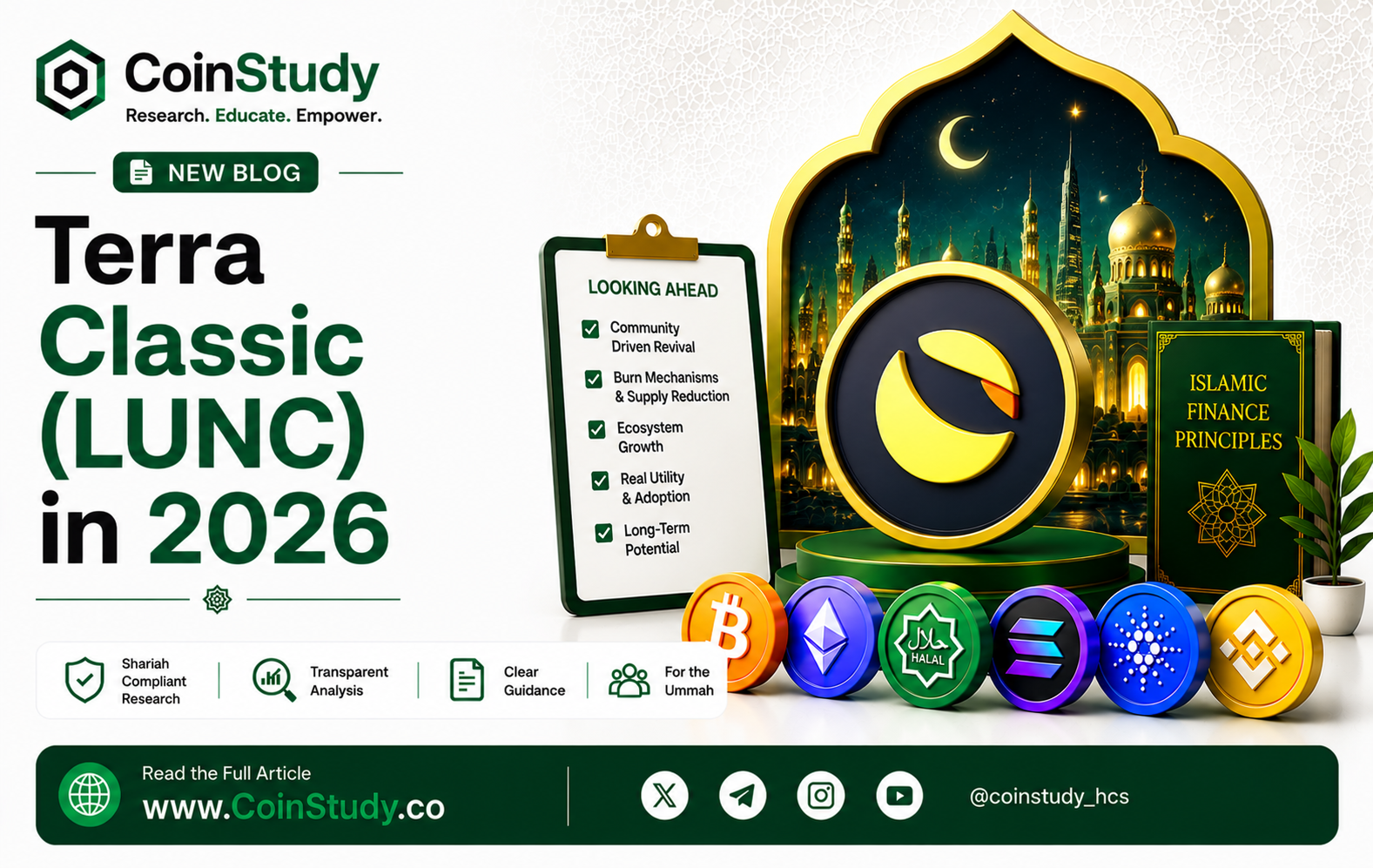
Terra Classic in 2026 — CoinStudy's Fresh Review and What Actually Changed
In a recent email exchange, a respected member of our community asked CoinStudy a question that deserved a serious answer.
Alhassan Bah, Founder of Nufaa Technologies, a Sharia compliant fintech platform based in The Gambia, challenged our Terra Classic classification respectfully and thoroughly. He pointed out that recognized Shariah scholars including Sharlife Sdn Bhd and Sheikh Azam have assessed the current Terra Classic network and reached different conclusions from ours. He asked four specific questions. What criteria led to the classification? Is it based on historical events or current functionality? Have recent scholarly assessments been considered? And would CoinStudy be willing to conduct a fresh review?
We committed publicly to conducting that fresh review within thirty days. This blog fulfills that commitment.
Here is what we found.
The Questions We Asked in Our Fresh Review
Our approach to the fresh review was straightforward. We set aside our previous analysis entirely and asked four clean questions about Terra Classic as it exists today.
Is the USTC algorithmic stablecoin mechanism still active on the chain? Is the community's primary stated goal still to re-peg USTC to one dollar? What drives LUNC's price in current market conditions? And does the current network, evaluated on its present structure rather than its history, pass CoinStudy's HCS Layer 1 red-line screening?
The answers to these questions determine the outcome.
What Terra Classic Actually Looks Like in June 2026
Before the analysis, Muslim investors deserve an honest picture of what Terra Classic is today.
Terra Classic is a community-governed Proof of Stake blockchain running on Cosmos SDK with Tendermint consensus. After the departure of Terraform Labs following the 2022 collapse, the chain became fully community-run. All protocol changes, from bug fixes to major upgrades, are decided through decentralized governance where validators and delegators vote on proposals. The v4.0.1 network upgrade was approved by governance in May 2026, demonstrating that active development continues.
A burn tax of 0.5% is applied to all transactions on the network, permanently reducing the total supply. Over 448 billion LUNC have been burned to date. The top ten validators control over 55% of bonded stake, creating meaningful governance concentration.
The USTC algorithmic stablecoin mechanism remains active on the chain. The community's stated primary strategic goal in 2026 continues to be re-pegging USTC to one dollar. The Market Module 2.0 reactivation, one of the chain's stated development priorities, is specifically designed to improve token issuance control in support of this re-pegging goal.
LUNC's price action is driven primarily by retail sentiment around burn events and news about USTC re-pegging progress rather than measured economic utility adoption metrics.
The Scholarly Positions We Considered
Alhassan's letter raised several scholarly assessments that deserved genuine consideration in our review.
Sharlife Sdn Bhd concluded that Terra Classic remains Sharia-compliant after reviewing its governance model, utility, staking mechanism, and burn processes. Their analysis specifically concluded that neither the community burn mechanism nor third-party activities alter the token's Shariah status.
Sheikh Azam and other contemporary Islamic finance researchers have assessed LUNC based on its current functionality rather than historical events, reaching a position that Terra Classic now operates as a community-governed Proof of Stake blockchain where staking rewards arise from network validation rather than Riba-based activities.
We have read and considered these assessments carefully. We respect the scholarly effort behind them and the conclusions they reach are not without basis. The disagreement between our assessment and theirs comes down to one specific methodological question, which is whether a token can be evaluated separately from the active algorithmic mechanism that defines its ecosystem's primary value proposition.
Where Our Assessment Agrees With the Scholarly Challenges
Before explaining our conclusion, intellectual honesty requires stating clearly where the challengers are right.
The burn mechanism does not constitute gambling or a prohibited transaction. Token burns reduce supply through a transparent and predictable mechanism. This is not a compliance concern under our methodology. The challengers are correct on this point.
Native Proof of Stake staking rewards from network validation are generally permissible under Islamic finance principles, as we analyzed in detail in our crypto staking blog. If Terra Classic were purely a Proof of Stake blockchain, the staking reward mechanism would likely pass our screening. The challengers are correct that staking rewards from block production are not inherently Riba.
The historical collapse of 2022 is not the basis for our classification. We evaluate the current structure. The challengers are correct that historical events should not determine present-day rulings if the structure has genuinely changed.
The Specific Issue Our Review Identified
Here is the honest answer to Alhassan's most important question. Our classification is not based on Terra Classic's history. It is based on one specific structural feature of the chain as it currently exists, which is the USTC algorithmic stablecoin mechanism.
The USTC mechanism works as follows. When demand for USTC rises, LUNC tokens are burned to mint USTC, expanding the stablecoin supply. When USTC demand falls, USTC is burned and LUNC is minted, contracting the stablecoin supply. The mechanism uses LUNC as the reserve asset and adjustment mechanism for an algorithmic synthetic dollar.
This mechanism is active on the Terra Classic chain today. It is not a historical relic of the 2022 collapse. It is an operational feature of the current network.
The compliance concerns with this mechanism are specific and genuine. The USTC instrument functions as a synthetic financial product whose value is maintained through algorithmic financial engineering rather than genuine asset backing. When users participate in the USTC mechanism, they are entering a financial arrangement whose characteristics resemble those of synthetic interest-bearing instruments.
More significantly for the compliance assessment, the entire ecosystem's value proposition in 2026 is explicitly tied to the success of this mechanism. The community's stated primary goal is re-pegging USTC to one dollar. The development roadmap is oriented around making this mechanism work at scale. LUNC's market value reflects the market's assessment of whether this re-pegging will succeed.
This is not the same as evaluating LUNC purely as a Proof of Stake governance and utility token. A token whose fundamental value proposition depends on the success of an active algorithmic stablecoin re-pegging project inherits the compliance concerns of that mechanism.
The Methodological Difference Explained
Here is where our methodology differs from Sharlife's assessment and it is worth explaining clearly because it is a genuine methodological choice, not a factual disagreement.
Sharlife's assessment appears to evaluate the LUNC token in isolation, specifically focusing on its role as a governance and network utility token, and concludes that the token itself has permissible characteristics.
CoinStudy's methodology evaluates a token within its full ecosystem context. A token cannot be fully separated from the primary value proposition of the ecosystem it operates within. If that ecosystem's value proposition is primarily tied to an active algorithmic mechanism with compliance concerns, the token that drives that mechanism inherits those concerns.
Under Sharlife's approach, you could argue that a governance token for a lending protocol is permissible because the token itself does not charge interest. Under CoinStudy's approach, a governance token for a lending protocol has indirect Riba exposure because its value grows when the lending protocol grows, and the lending protocol's growth comes from interest-bearing activity.
Neither approach is inherently wrong. They represent different methodological choices about how to draw the boundary of evaluation. Muslim investors deserve to understand this difference rather than simply being told that one assessment is right and another is wrong.
The Fresh HCS Classification
Following our thorough review of Terra Classic's current structure, our classification is unchanged.
Terra Classic (LUNC) fails two Sharia red lines under CoinStudy's HCS methodology.
Riba Exposure is failed because the USTC algorithmic mechanism remains active and the ecosystem's primary value proposition is tied to its functioning. This mechanism creates synthetic financial instrument characteristics that trigger this red line.
Synthetic Interest Products is failed because the USTC instrument functions as a synthetic interest-like product maintained through algorithmic financial engineering rather than genuine asset backing.
The classification remains Haram with two red-line violations.
We acknowledge that this conclusion differs from the assessments of Sharlife and Sheikh Azam. We respect their scholarly work and acknowledge that their methodological approach produces a different but defensible conclusion. The difference is not about facts. It is about how broadly to draw the boundary of what a token's compliance assessment should include.
What Would Change Our Assessment
We want to be direct and honest with Alhassan and with anyone else who is genuinely concerned about this classification.
Our assessment would change if one of two things happened.
First, if the USTC algorithmic stablecoin mechanism were formally decommissioned from the Terra Classic chain, removing the primary compliance concern from the ecosystem. A Terra Classic that operated purely as a community-governed Proof of Stake blockchain without an active algorithmic stablecoin mechanism would be evaluated very differently under our methodology.
Second, if the community formally shifted its primary stated goal away from USTC re-pegging toward other forms of permissible utility, and if this shift were reflected in actual development activity and ecosystem direction rather than just stated intentions.
If either of these conditions is met, we will conduct another fresh review and publish the updated result transparently.
A Message to Alhassan Bah and Nufaa Technologies
We want to acknowledge directly the spirit in which this inquiry was raised. Alhassan's letter was thorough, respectful, and genuinely motivated by a desire to help Muslim investors access accurate information. That spirit reflects the best of what Islamic finance scholarship is supposed to be.
We honor the commitment we made to conduct a fresh review and we hope this blog demonstrates that we took that commitment seriously. We investigated the current structure of Terra Classic thoroughly, considered the scholarly positions he raised carefully, and published our findings transparently.
Our conclusion is different from the scholars he cited. But the difference is one of methodology, not one of care or seriousness. We hope this explanation of our reasoning is useful to Alhassan, to the Nufaa Technologies community, and to every Muslim investor who wants to understand not just what CoinStudy concludes but why.
For Muslim Investors Currently Holding LUNC
This is the practical question that matters most.
CoinStudy's classification reflects our methodology's evaluation of the structural compliance of the Terra Classic ecosystem. Other scholars have reached different conclusions using different methodological approaches. This is a genuine area of scholarly disagreement.
If you hold LUNC, you should consult a qualified Islamic scholar for personal guidance, presenting both CoinStudy's structural concerns and Sharlife's assessment, and receive a personal ruling based on your specific circumstances.
CoinStudy answers the structural compliance question as we understand it through our methodology. The personal usage and investment question requires qualified personal scholarly guidance that CoinStudy cannot and does not replace.
Final Position
Terra Classic (LUNC) remains classified as Haram / Non-Compliant under the CoinStudy Halal Crypto Standard following our fresh June 2026 review.
Two Sharia red lines are triggered by the active USTC algorithmic mechanism whose operation and success remain central to the Terra Classic ecosystem's value proposition.
This classification is based on the current structure of the chain, not on its history. It acknowledges genuine scholarly disagreement. It explains the specific methodological choice that leads to a different conclusion from other assessments. And it commits to ongoing review if the structural conditions change.
That is the honest, transparent, and principled approach that CoinStudy owes to every member of the Muslim investor community who takes the time to engage with us as seriously as Alhassan Bah did.
Read detail analysis of following coins here:
Is Crypto Staking Halal?
Is Cosmos Halal?
Is Terra Classic Halal?
Disclaimer: This article is provided for educational and research purposes only. CoinStudy does not provide personal financial or religious rulings. Investors should consult qualified Islamic scholars for individual guidance.