

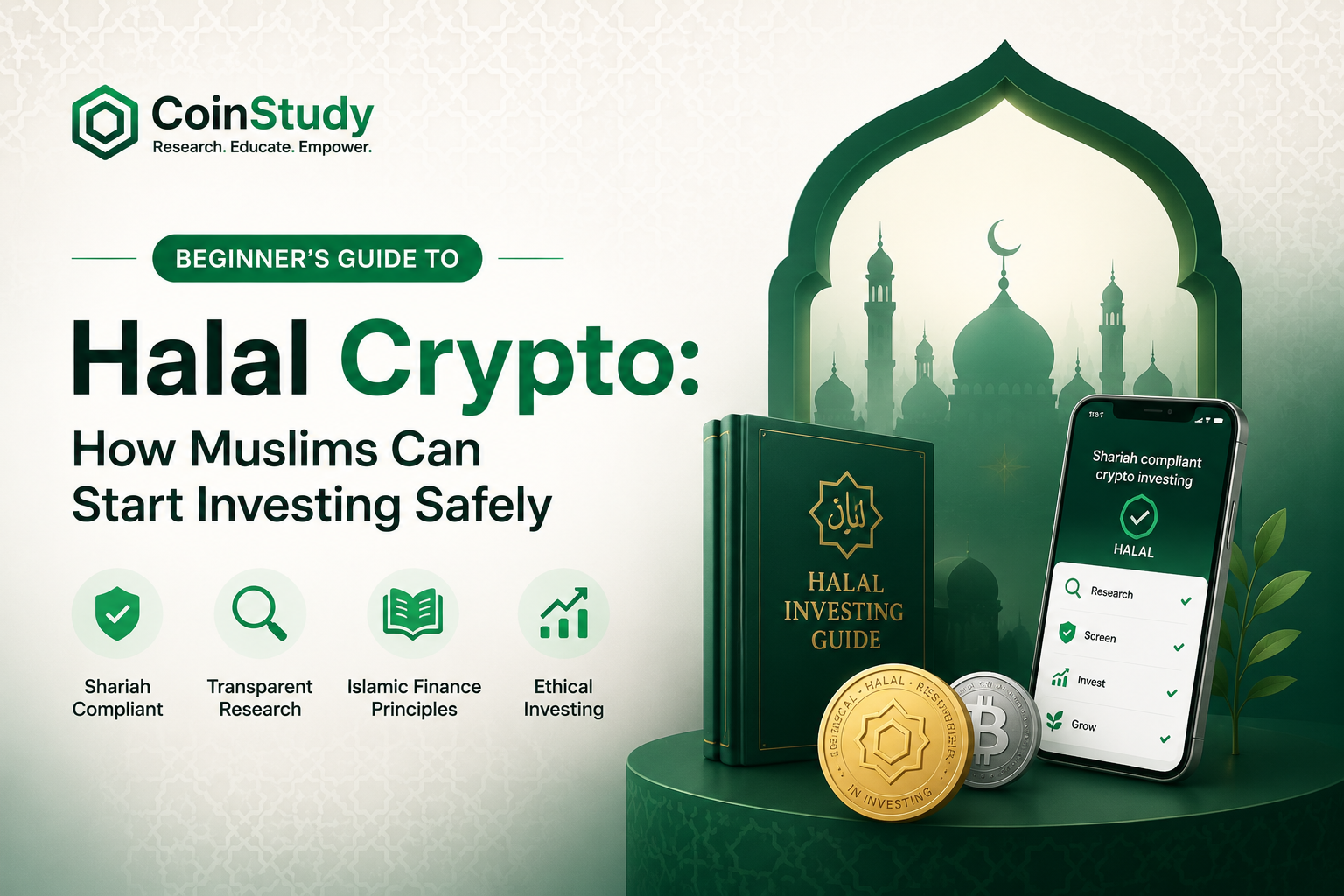
Beginner's Guide to Halal Crypto — A Simple Islamic Introduction to Cryptocurrency
Cryptocurrency is everywhere right now. Your colleagues are talking about it. Your family members are asking about it. And somewhere in the back of your mind, you're wondering whether any of it is actually permissible for a Muslim.
The honest answer is that it depends. Not every cryptocurrency is the same. Not every way of using crypto is the same. And the difference between what's halal and what isn't in this space is more specific and more important than most beginner guides will tell you.
This guide breaks it down clearly using the CoinStudy Halal Crypto Standard (HCS) methodology so you know exactly what to look for before you invest a single dirham, rupee, naira, or dollar.
Is Cryptocurrency Halal or Haram?
Cryptocurrency is not automatically halal. It's also not automatically haram.
The permissibility of any specific cryptocurrency depends on three things, which are what the project does, how you use it, and whether it involves any of the core prohibited elements in Islamic finance.
Here is the general framework:
Spot investing in legitimate projects with real utility is generally halal. Interest-bearing crypto products are generally haram. Leverage and futures trading are generally haram. Highly speculative meme tokens are likely doubtful or haram.
Understanding why requires knowing three fundamental concepts from Islamic finance.
Three Islamic Concepts Every Muslim Crypto Investor Must Know
Riba — Interest Is Prohibited
Riba means earning money through interest-based lending or borrowing. In crypto, this shows up as lending platforms that pay you guaranteed percentage returns for depositing assets, borrowing crypto with financing fees attached, and leveraged trading that charges you interest for the capital you're borrowing.
If a crypto platform offers you 8% APY for depositing your assets, that's interest. It doesn't matter that it's called a "yield" or a "reward" or an "APY." The financial relationship is the same, and Riba is prohibited regardless of what label is used.
Gharar — Excessive Uncertainty Is Problematic
Gharar refers to excessive uncertainty or ambiguity in financial transactions. Islam encourages transparent, understandable financial arrangements, which are contracts and investments where you genuinely understand what you're entering into and why.
In crypto, Gharar concerns arise around projects with unclear purposes, hidden risks, anonymous teams with no accountability, and investments you genuinely can't explain to yourself or anyone else. If you can't describe what a project does and why it has value, that uncertainty itself is a concern.
Maysir — Gambling-Like Speculation Is Prohibited
Maysir refers to gambling-like behavior, which is financial activity where outcomes depend on chance rather than genuine economic value creation. In crypto, this shows up as betting on short-term price movements, buying meme tokens based purely on social media hype, and trading strategies based on predicting what other speculators will do rather than genuine analysis of value.
The line between investing and gambling in crypto isn't always obvious, but the test is your honest motivation. Are you acquiring an asset because you believe it creates genuine long-term value? Or are you buying something hoping someone else will pay more for it later?
How CoinStudy Evaluates Crypto Projects
CoinStudy uses a two-layer framework to evaluate whether any cryptocurrency meets Islamic finance standards.
Layer 1 — Red Line Screening
The first step identifies automatic disqualifiers. Does the project involve interest-based lending or borrowing? Does it include gambling mechanisms? Is it connected to haram industries? Does it offer guaranteed percentage returns on deposited capital?
If any of these apply, the project fails immediately and is classified as Haram regardless of anything else. You don't need to research further.
Layer 2 — HCS Scoring
If the project passes Layer 1, it's evaluated across seven Shariah principles covering financial exposure risk, uncertainty, speculation, underlying business activity, genuine utility, tokenomics fairness, and governance transparency. The resulting score determines the final classification.
Projects scoring 80 to 100 are classified as Halal. Projects scoring 60 to 79 are Halal With Concerns. Projects scoring 40 to 59 are Doubtful. Projects scoring below 40 are Haram.
Halal Ways to Start in Crypto
If you're a Muslim beginner genuinely trying to participate in crypto responsibly, here are the approaches that align most clearly with Islamic principles.
Buy and hold quality projects. The simplest and generally safest approach. Identify legitimate blockchain projects with real utility, established ecosystems, and transparent development. Hold them long-term. This approach minimizes speculation and maximizes your connection to genuine underlying value.
Use crypto for actual payments. Many cryptocurrencies were built specifically for payments, including Bitcoin, Litecoin, Stellar, and Dash. Using them to send money, receive remittances, or pay for goods and services is using them for their intended halal purpose.
Participate in network validation carefully. Some blockchain networks allow users to secure the network through staking and earn rewards for that work. The compliance of this depends on the specific structure. Some staking arrangements are permissible, others resemble interest income. CoinStudy's individual coin analyses address this for each specific project.
Join airdrops after research. Some blockchain projects distribute free tokens to community members. If the project itself is halal-rated and you understand what you're receiving, participating in an airdrop can be permissible. Research first, because not every airdrop is connected to a permissible project.
What Beginners Should Avoid
Several categories of crypto activity raise serious Islamic finance concerns that beginners should understand clearly before they encounter them.
Crypto lending platforms. Platforms that pay you ongoing percentage returns for depositing assets are offering interest income. This applies whether it's called APY, yield, rewards, or returns. If you deposit capital and receive a guaranteed percentage back over time, that's Riba.
Dollar-Pegged Stablecoins.
Dollar-pegged stablecoins like USDT, USDC, and PYUSD have a structural Riba concern. Their reserves are backed by interest-bearing instruments like Treasury bills and bank deposits. CoinStudy classifies them as Haram based on this structural concern.
However our Shariah Board acknowledges that some contemporary Islamic finance scholars hold a different view, which is that using these stablecoins purely as a medium of exchange is permissible, since the prohibited act of holding Riba-generating reserves belongs to the issuer, not the user. This is a genuine area of scholarly disagreement, not settled consensus.
Muslim investors should consult a qualified Islamic scholar for personal guidance on their specific stablecoin usage.
Margin and leverage trading. These activities involve borrowing funds to amplify your trading position, paying financing fees on that borrowed capital, and taking on risk that multiplies both potential gains and losses. The financing fees are interest. The amplified risk creates excessive Gharar. Both concerns make leveraged trading problematic.
Futures and perpetual trading. These derivative products allow you to bet on where an asset's price will go without owning the underlying asset. Profits come from correctly predicting market movements rather than from owning productive assets. This closely resembles gambling-like speculation under Islamic finance principles.
Meme coin hype. Projects driven primarily by social media attention, celebrity endorsements, and viral marketing rather than genuine utility. If you can't explain what a project does and why it creates genuine long-term value, you're speculating, not investing.
A Simple Halal Crypto Checklist
Before investing in any cryptocurrency, ask yourself these five questions honestly:
Does this project involve any interest-based mechanisms, including lending, borrowing, or guaranteed percentage returns? Is my investment based primarily on speculation about what other people will do, or on genuine belief in the project's utility? Does this project provide real value to real users, or does it exist primarily for trading? Do I genuinely understand what I'm investing in well enough to explain it to someone else? Would I be comfortable explaining this investment decision to a qualified Islamic scholar?
If you can answer these honestly and comfortably, you're approaching crypto the right way.
Common Beginner Mistakes
Following social media hype. The projects that get the most attention on Twitter and TikTok are often the most speculative. The projects worth investing in rarely trend on social media. They build quietly and steadily. Research independently before any investment.
Wanting to get rich quickly. This mindset leads directly to the most speculative and most prohibited crypto activities, including meme coins, leverage trading, and momentum chasing. Successful, halal crypto investing is patient investing.
Ignoring project fundamentals. Focus on what a project actually does, who builds it, how transparent the development is, and whether it has real adoption. These factors matter far more than short-term price movements.
Separating financial decisions from Islamic principles. Your religious values and your investment decisions shouldn't exist in separate compartments. Every investment you make is a choice about what you're supporting and how you're participating in the economy.
The Best Strategy for Muslim Beginners
Learn before you invest. Start with well-established halal-rated projects with long track records and clear utility. Bitcoin, Litecoin, Cardano, and Stellar are examples that consistently score highly in CoinStudy's analysis. Avoid leverage and speculation entirely. Build your knowledge gradually alongside your portfolio.
Cryptocurrency can be a legitimate part of a Muslim investor's financial strategy. It requires the same careful, principled approach that Islamic finance brings to every other financial decision.
How CoinStudy Can Help
CoinStudy exists to make halal crypto research accessible, clear, and actionable for Muslim investors. Every project on the platform is evaluated using the HCS methodology, with transparent scoring, honest analysis, and guidance grounded in Islamic finance principles.
Whether you're evaluating your first crypto investment or building a portfolio, CoinStudy's research is designed to give you the information you need to make decisions you're genuinely comfortable with.
Final Verdict
Cryptocurrency can be halal when approached with knowledge, patience, and genuine commitment to Islamic finance principles.
For beginners, the path is clear. Avoid Riba in all its forms. Minimize speculation. Focus on projects with genuine utility that you actually understand. Invest with a long-term mindset rather than short-term price chasing.
The crypto market will always have noise, hype, and temptation. The Muslim investor's advantage is a framework for cutting through all of it and asking the right questions.
Read detail analysis of following coins here:
Is Bitcoin Halal?
Why USDT is Haram if Fiat isn't?
Is Perpetual Trading Halal?
Disclaimer: This article is provided for educational and research purposes only. CoinStudy does not provide personal financial or religious rulings. Investors should consult qualified Islamic scholars for individual guidance.