

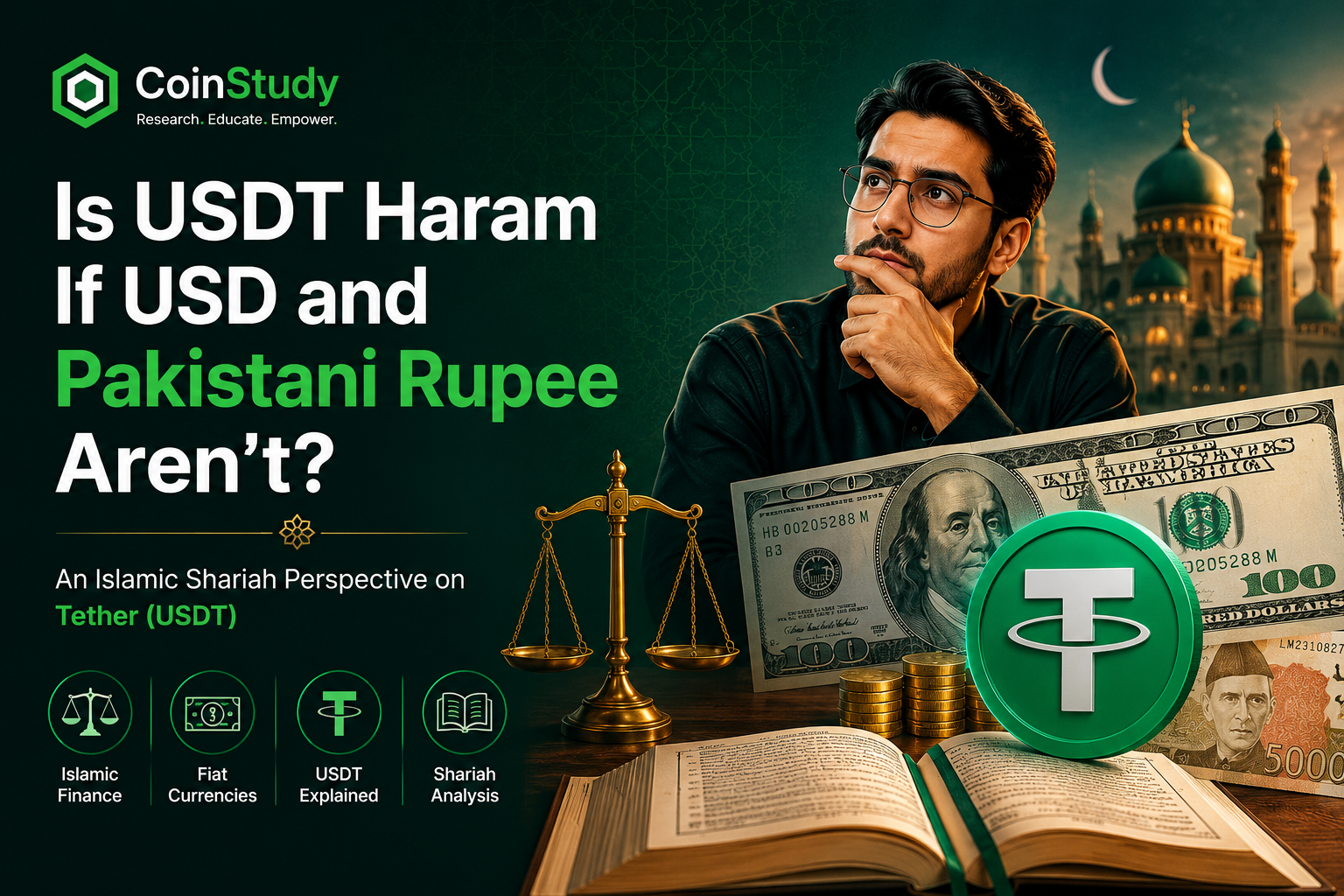
Is USDT Haram If USD and Pakistani Rupee Aren't? The Answer Muslims Need
This question comes up constantly in our community.
Someone reads CoinStudy's analysis classifying USDT as Haram. They push back. "But we use dollars every day. Pakistani rupees are backed by the same banking system. If USDT is haram, why aren't our regular currencies haram too?"
It's a fair question. It deserves a serious answer, not a dismissal.
This blog addresses that question directly, honestly, and completely. By the end, you'll understand exactly why the comparison doesn't hold and why USDT remains Haram under the CoinStudy HCS methodology regardless of how fiat currencies are structured.
First — The Question Is Actually Asking Something Important
Before explaining why the comparison doesn't work, it's worth acknowledging what's right about the question.
Modern fiat currencies, including the US Dollar, the Pakistani Rupee, and the Euro, exist within financial systems that are deeply connected to interest-based banking. Central banks hold foreign exchange reserves. Commercial banks operate on fractional reserve models involving interest. Government monetary policy is implemented through interest rate mechanisms.
Islamic economists have acknowledged this reality for decades. The relationship between Muslim communities and interest-based fiat monetary systems is a genuine and complex topic in Islamic finance scholarship.
So the person asking this question isn't wrong to notice a connection between fiat monetary systems and interest-based finance. They're wrong about what that connection means for the USDT comparison and wrong about what follows from it.
How Fiat Currency Actually Works — The Critical Distinction
The most important misunderstanding in this comparison is about what "backed by" means for fiat currencies versus what it means for USDT.
The Pakistani Rupee is not backed by interest-bearing instruments the way USDT is backed by Treasury bills.
Modern fiat currencies are not redeemable for any specific reserve asset. You cannot walk into the State Bank of Pakistan with 1,000 rupees and receive 1,000 rupees worth of government securities. The rupee's value comes from legal tender status, the economic output of Pakistan, government authority, and public trust in the monetary system. Not from a pool of financial instruments that rupee holders have a direct claim on.
The US Dollar works the same way. You cannot take $100 to the Federal Reserve and receive $100 worth of Treasury bills. The dollar's value is backed by the full faith and credit of the United States government and the productive output of the US economy, not by a specific reserve pool you can redeem against.
USDT is structurally different in the most fundamental way.
Every USDT token is explicitly backed by a specific pool of reserve assets, including US Treasury bills, bank deposits, money market instruments, and cash equivalents, that Tether holds on behalf of token holders. This is not a vague economic connection. It's a direct, documented, legally structured redemption claim. Hold USDT and you have a claim on those reserves. Those reserves generate interest income. That interest funds the infrastructure that makes USDT stable.
The rupee holder has no claim on any interest-bearing reserve pool. The USDT holder does.
That single structural difference is the foundation of the different rulings.
A Simple Test That Clarifies Everything
Here's the clearest way to understand the difference.
If you hold Pakistani rupees and the State Bank of Pakistan earns interest on its foreign reserves, does that interest income flow to you in any direct way? No. You hold a medium of exchange. You have no claim on those reserves. The interest generated by the State Bank's assets has no direct relationship to your rupee holdings.
If Tether holds US Treasury bills backing your USDT and those Treasury bills earn 5% annual interest, does that interest income flow to you? Not directly as a payment. But the interest generated by those assets funds the entire reserve management infrastructure that makes your USDT redeemable at $1. Without that interest income, the reserve structure couldn't be maintained, the peg couldn't be guaranteed, and the redemption promise couldn't be honored.
Your USDT stability guarantee is funded by Riba-generating assets. Your Pakistani rupee is not.
The relationship between the rupee holder and any interest-based activity in the banking system is distant, indirect, and structural. The relationship between the USDT holder and the Treasury bill interest income is immediate, direct, and explicitly documented in Tether's own reserve disclosures.
Where the Comparison Has Genuine Validity — Being Honest
Intellectual honesty requires acknowledging where this objection has real force.
Central banks do hold interest-generating foreign exchange reserves. The broader monetary system that gives fiat currencies their value does involve interest-based banking infrastructure. If you trace the economic connections far enough, fiat currency systems and interest-based finance are deeply intertwined.
Islamic scholars have addressed this reality through several important principles.
Necessity (Darurah). Muslims living in any country cannot function economically without using the local currency. You need rupees to buy food, pay rent, and conduct everyday commerce. The inability to opt out of the fiat currency system creates a genuine necessity. Nobody is forced to hold USDT. Holding USDT is a deliberate financial choice, not an unavoidable economic reality. The necessity argument that justifies fiat currency use does not extend to USDT.
Degree of connection to prohibited activity. Islamic jurisprudence recognizes that proximity to prohibited activity matters in rulings. Using rupees to buy groceries is many steps removed from whatever interest-based activity exists in the monetary system underlying the rupee. Holding USDT is one direct step from the Treasury bills generating interest income. Your token is literally backed by and redeemable against those instruments. The distance between your action and the prohibited activity is completely different.
Function and intent. Rupees function as a medium of exchange and unit of account for genuine economic transactions in the real economy. USDT functions primarily as a financial instrument designed to provide dollar-denominated stability on blockchain networks. The functional purpose differs even where underlying economic connections have some similarities.
Even If We Accept Fiat Has Problems — It Doesn't Help USDT
This is perhaps the most important point in the entire analysis.
Even if we accepted that fiat currencies have real Islamic finance complications, and serious Islamic economists do acknowledge this, the correct response is not "therefore USDT is also fine."
Islamic finance has never operated on the principle that two wrongs make a right.
If the rupee has problems rooted in its connections to interest-based monetary systems, the correct Islamic response is to seek better alternatives such as commodity-backed currencies, gold-backed assets, and equity-based exchange systems, and to advocate for Islamic monetary reform. The correct response is not to add more interest-backed instruments to the pile and declare them permissible by analogy.
The person who argues "fiat currencies are backed by interest-bearing systems so USDT should also be permissible" is essentially arguing that because an existing problem is unavoidable, we should stop caring about adding new avoidable problems. That reasoning doesn't hold in any area of Islamic jurisprudence and it doesn't hold here.
Why Twelve Stablecoins in a Row Reached the Same Conclusion
CoinStudy has analyzed twelve major dollar-pegged stablecoins. Every single one received a Haram classification.
USDT. USDC. DAI. PYUSD. USDG. RLUSD. USDD. United Stablecoin. TrueUSD. GHO. USD0. USD1.
Twelve different issuers. Twelve different blockchains. Twelve different branding strategies. Same structural problem every time, which is interest-bearing reserves backing a tokenized dollar claim.
This consistency isn't methodological rigidity. It's the inevitable result of applying a principled framework consistently to a category of products that share the same fundamental structure.
All twelve stablecoins failed for the same reason the thirteenth and fourteenth will fail, because you cannot back a dollar-pegged token with interest-generating assets and have it pass Islamic finance screening. The structure is the problem. The issuer's name doesn't change the structure.
What Would Actually Make a Stablecoin Halal?
This is the more constructive question and CoinStudy takes it seriously.
The stablecoin problem in Islamic crypto finance is not unsolvable. It requires building reserve structures on genuinely halal assets rather than finding ways to rationalize interest-bearing reserves.
Physical commodity backing is the most proven model. PAX Gold (PAXG) and Tether Gold (XAUT) back their tokens with physical gold. Gold generates no interest. Both received Halal classifications in CoinStudy's analysis. The model works and it demonstrates that the stablecoin compliance problem is structural, not technological.
Sharia-compliant asset backing, consisting of halal-compliant productive assets, equity in halal businesses, physical commodities, or real estate generating halal rental income, represents a theoretically sound approach that hasn't yet been implemented at meaningful scale.
The path to a genuinely halal stable-value digital asset runs through genuinely halal reserve assets. Not through analogies to fiat currencies or necessity arguments about how inconvenient it is to avoid interest-backed stablecoins.
The One-Line Answer for When Someone Asks This Question
If someone raises this comparison and you need a simple, direct response:
"Rupees and dollars are media of exchange backed by national economic authority, not direct claims on interest-bearing reserve pools. USDT explicitly represents a claim on reserves that generate interest income. The structures are fundamentally different. And even if fiat currencies had the same problem, two wrongs don't make a right in Islamic finance."
Final Verdict
USDT is Haram under the CoinStudy HCS methodology and the comparison to fiat currencies doesn't change that.
Fiat currencies are not direct claims on interest-bearing reserve pools. USDT is. That structural difference determines the ruling. The additional principles of necessity, proximity to prohibited activity, and functional purpose all reinforce the same conclusion.
The person asking this question deserves a serious answer, not a dismissal and not a rationalization. The serious answer is that the comparison identifies a real complexity in Islamic monetary economics, acknowledges it honestly, and still concludes that USDT's direct structural dependence on interest-bearing reserves makes it Haram in a way that fiat currency use is not.
The search for genuinely halal stable value in crypto is real and important. It leads toward commodity-backed tokens and halal-compliant reserve structures, not toward analogies designed to make interest-backed instruments seem permissible.
An Important Scholarly Note
CoinStudy's structural analysis reaches the Haram conclusion based on the reserve mechanism and that structural finding remains valid. However our Shariah Board wants Muslim investors to have the complete picture.
A respected body of contemporary Islamic finance scholarship holds a different view on the usage question. Some scholars argue that using USDT and dollar-pegged stablecoins generally, purely as a medium of exchange, is permissible. Their reasoning draws on a well-established principle in Islamic jurisprudence. The sin of a prohibited act belongs to the actor who performs it, not to every person who subsequently uses the resulting product.
Under this view, Tether commits the prohibited act by holding Riba-generating Treasury bills and bank deposits. That sin belongs to Tether. The Muslim who uses USDT for payments or trading is not holding Treasury bills, not earning interest, and not performing the prohibited act themselves. The usage is neutral. The structure is prohibited. These are two separate questions with potentially different answers.
This position is further supported by the fact that ordinary users never directly interact with the underlying Treasury instruments at all, receiving only dollar value upon redemption with zero contact with the interest-bearing assets themselves.
CoinStudy's Shariah Board acknowledges this scholarly disagreement openly and honestly. The structural Haram classification reflects our methodology's evaluation of the asset's financial architecture. Whether your personal usage of USDT as a medium of exchange is permissible is a question that requires guidance from a qualified Islamic scholar who knows your specific circumstances.
If you use USDT purely for trading and payments, not for yield, not for staking, not for earning, consult a qualified scholar for your personal ruling.
Read detail analysis for following coins here:
Is USDT Halal or Haram?
Is PAX Gold Halal?
Is Tether Gold Halal?
Is USDC Halal or Haram?
Disclaimer: This article is provided for educational and research purposes only. CoinStudy does not provide personal financial or religious rulings. Investors should consult qualified Islamic scholars for individual guidance.